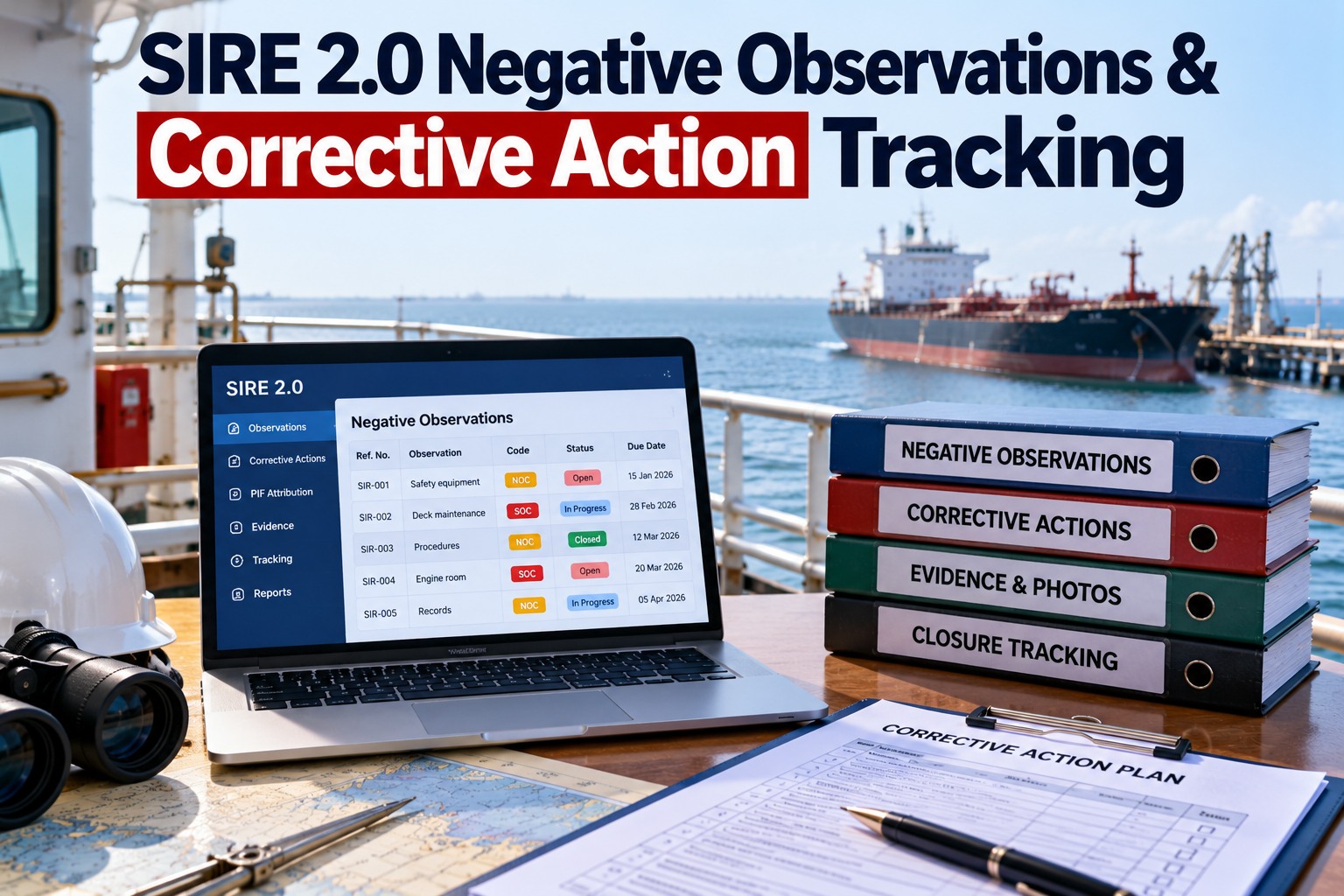
A SIRE 2.0 negative observation does not end at the closing meeting. Each one is coded, published to the SIRE database and read by charterers for the next 12 months, and the next inspector may look at the same area again. This guide covers how observations are coded with SOC, NOC and PIF, how to use the 14-day comment window, and how to track corrective action with evidence until it is closed. Book a demo to see observation tracking in action.
SIRE 2.0 negative observations: close the loop before the next vet
Every observation follows the same path. The work is making sure each one reaches the end.
Anatomy of a SIRE 2.0 negative observation: SOC, NOC and PIF
SIRE 2.0 questions are answered with up to three response tools: hardware, process and human. A negative response is recorded in the negative observation module with a subject of concern (SOC) and a nature of concern (NOC). A negative human response also carries at least one performance influencing factor (PIF). The example below is illustrative.
Officer of the watch could not describe the steps for isolating equipment before maintenance under the permit to work.
Why the coding matters
Coded findings can be compared and searched across a ship’s history and across fleets. Charterers and your own office can see patterns, such as the same NOC appearing again on another ship.
One defect, several observations
Anglo-Eastern reports that a single issue has produced up to six observations across hardware, process and human tools. Track each observation separately, even when one fix covers several.
PIF attribution: aim corrective action at the real cause
The PIF tells you why the crew response fell short, so it should decide what kind of corrective action you take. SIRE 2.0 uses nine PIFs. The corrective action focus shown for each is a suggested starting point, not OCIMF guidance.
Shares of PIF attributions from the INTERTANKO SIRE 2.0 benchmarking statistics for 2025 (7,241 inspections), as reported by Maritime Trainer, which also gives human factors as 37% of negative observations. Some sources list ergonomics and human-machine interface separately.
The 14-day window: operator comments on each observation
OCIMF gives the operator 14 days from when the report is processed to add initial comments. If none are added, the report publishes automatically without them. Later comments can be added at any time while the report is available. For a wider view of reducing findings, see our guide to reducing SIRE 2.0 negative observations.
Suggested split of the 14 days is illustrative. Factual errors in a draft report are handled separately through the report validation process.
Use all 14 days, not the last one
Turn each observation into a task with an owner, a due date and an evidence slot the day the report arrives.
Remediation evidence: what closes an observation
A closed task without proof is an open question at the next vet. Evidence should be dated, specific to the finding and easy to find. Our guide to SIRE 2.0 photo evidence covers photo practice in detail.
- “Crew reminded” with no record
- Undated photo of the area
- Generic circular to the fleet
- Task closed by the person who raised it
- Timestamped before and after photos
- Signed training or drill record with names
- Revised procedure with version and date
- Close-out checked by the office or a superintendent
Corrective action tracking: fields for every observation
Keep one record per observation, linked to the report. These fields cover what charterers, auditors and the next inspector may ask.
| Field | What to record | Why |
|---|---|---|
| Reference | Report, question number and observation text | Links the action to the published finding |
| Coding | Response tool, SOC, NOC, PIF | Lets you spot repeats across the fleet |
| Immediate action | What was done on board, with date | Shows the risk was controlled |
| Root cause | Analysis such as 5-Why, tied to the PIF | Stops the same finding returning |
| Corrective action | Measurable action, owner, due date | Clear responsibility |
| Preventive action | SMS, PMS or training change, fleet-wide if relevant | Protects sister ships |
| Evidence | Timestamped files attached to the record | Proof at the next vet |
| Verification | Who checked closure, and when | Independent close-out |
Closing the 12-month observation loop
OCIMF keeps a report active on the SIRE database for 12 months, during which charterers can read the observations and your comments. OCIMF does not set inspection frequency; each charterer applies its own criteria, and many look for a recent inspection. Plan closure well inside the window.
Milestones are illustrative targets, not OCIMF requirements.
Watch for repeats
Kaiko Systems fleet data, cited in our reduction guide, found about one in four observations had already been raised on the same ship. A repeat finding suggests the earlier corrective action did not hold.
Manage open defects properly
Anglo-Eastern notes that OCIMF has stated defects handled under a proper defect management process should not lead to negative observations. Keep a current open defect list ready to present.
Share across the fleet
A NOC on one ship is a check for every sister ship. Our fleet-wide SIRE 2.0 readiness guide covers this.
SIRE 2.0 remediation checklist
Run this for every published report.
How Marine Inspection tracks SIRE 2.0 corrective actions
Marine Inspection turns each observation into a tracked task with coding, an owner, a due date and attached evidence, and moves it through review to verified closure. The board below is illustrative.
Open 2
In action 2
Evidence review 1
Verified 2
SIRE 2.0 negative observation FAQs
What are SOC and NOC in SIRE 2.0?
Subject of concern and nature of concern. Inspectors use them to code a negative response in the negative observation module: what the concern is about and what was wrong.
What is PIF attribution?
For a negative human response, the inspector links at least one of nine performance influencing factors that explains why the task fell short, such as custom and practice.
How long do operators have to comment?
OCIMF gives 14 days from when the report is processed for initial comments. After that the report publishes automatically, and later comments can still be added.
How long do observations stay visible?
A report stays active on the SIRE database for 12 months, so its observations and your comments can be read by charterers during that time.
What counts as good remediation evidence?
Dated, specific proof: timestamped before and after photos, signed training records, revised procedures with version dates, and an independent close-out check.
Can Marine Inspection track observations across a fleet?
Yes. Start a free trial to log observations, assign actions and attach evidence per ship.
Close every observation with proof
Code it, own it, fix the cause and attach the evidence, so the next inspector finds the loop already closed.