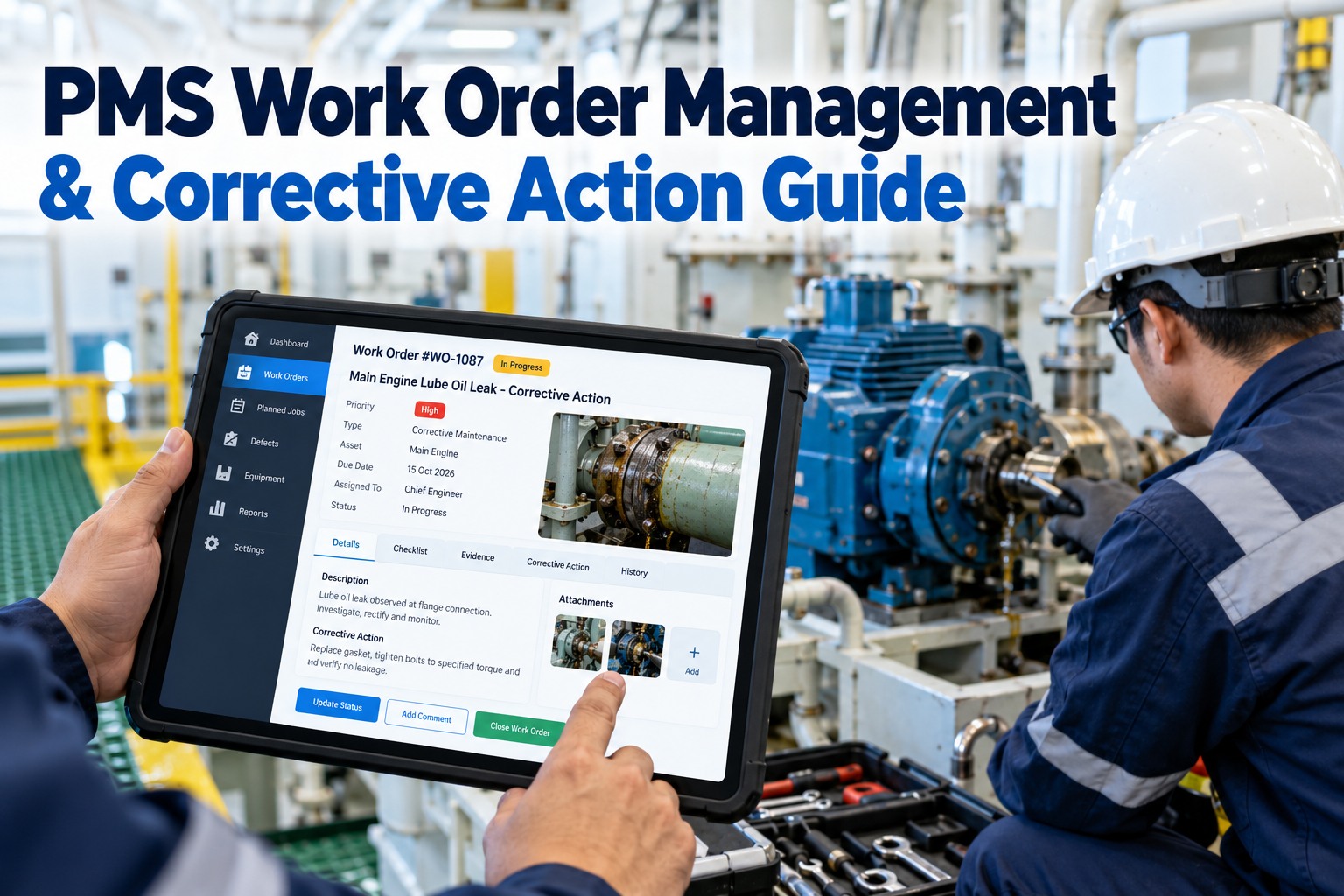
A defect only matters to a ship until it becomes a work order. After that, it matters to the Chief Engineer, the superintendent and eventually the inspector, and each of them wants to know the same three things: who owns it, what was done, and how anyone knows it worked. This guide covers how to raise, assign, track and close PMS work orders and how to link corrective actions to the inspection findings that triggered them. For the wider process of logging defects across a fleet, see our marine defect tracking software guide.
The Defect Lifecycle: What the ISM Code and the IACS Guide Expect
Where defects come from and why each source needs a linked work order
The IACS guide to managing maintenance under the ISM Code says problems may be discovered during routine technical inspections or maintenance, or after a breakdown or accident. External records, such as class, statutory, port State control and vetting records, add findings from outside. Whatever the source, each defect needs a work order that can be tracked to closure. The grouping below is our reading of that guide.
The six-step corrective action loop and why verification is the step people skip
IACS describes the corrective action process as identify the problem, establish the cause, propose solutions, evaluate them, implement the chosen one, and evaluate effectiveness. If the action is not effective, it returns to the loop. The guide states plainly that taking corrective action is not enough, and that effectiveness must be verified. Many ships stop at step five, which is why verification gets its own gate in the templates below. For how this fits a wider planned maintenance system, see our {L2}.
Raising and Assigning a Work Order: The Fields That Make It Closable
What a complete work order should capture at the moment the defect is found
A work order raised in a hurry usually fails at closure, because nobody wrote down what was wrong or why. ISM clause 10.2 asks for the possible cause to be reported where known, and the critical equipment list under 10.3 tells you which orders need faster escalation. The template below adds the fields that make the order closable: owner, deadline, proof and a verifier.
| Field | What goes in it | Why it matters | Source status |
|---|---|---|---|
| Equipment and defect | Equipment tag, location and a clear description | Lets the right person find and fix it | Our suggestion |
| Possible cause | Cause at raising, if known | ISM 10.2 asks for the possible cause, if known | IACS Rec. 74 |
| Critical flag | Marks equipment on the ISM 10.3 list | Routes the job to faster escalation | IACS Rec. 74 |
| Owner and deadline | A named person and a date | Without both, a job drifts | Our suggestion |
| Completion proof | Photo, reading or report | Shows the work was done | Our suggestion |
| Effectiveness check | Who verified, when and how | Corrective action must be verified | IACS Rec. 74 |
| Linked finding | Audit, class, PSC or vetting reference | Closes the loop with the source | Our suggestion |
Tracking Orders Through to Closure With a Verification Gate
A status path that stops jobs being closed before anyone checks them
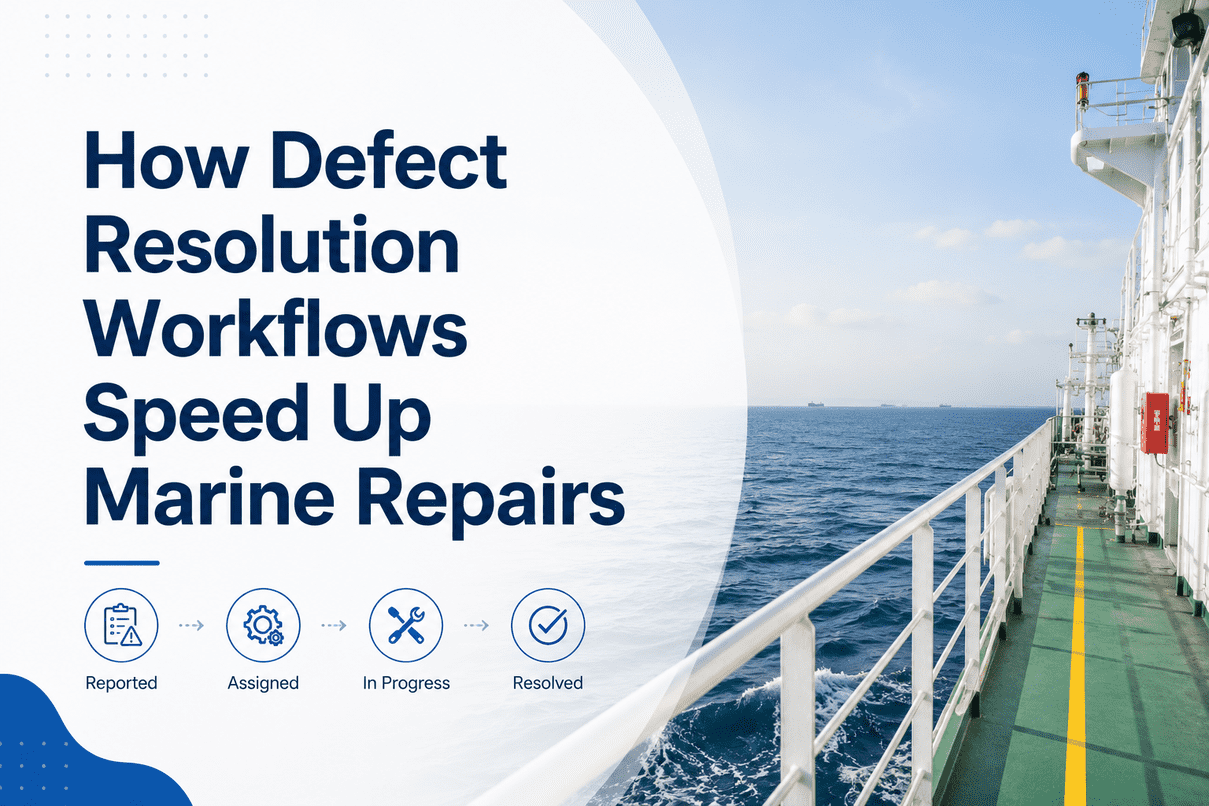
Most PMS tools have statuses like open, in progress and closed. The path below adds one: awaiting verification. A second person checks the work before closure, which matches the IACS point that effectiveness must be verified. If the check fails, the order returns with the reason recorded. The status names are ours and should be adapted to your system.
How to judge the strength of the evidence on a closed job
Closing a job with no note proves nothing, and a text note is only a claim. A dated photo is better, a photo with a reading or test result better still, and for critical equipment a second person's check is the strongest. The bars below are our own illustration of that ladder.
Why a repeat defect should trigger a fleet check and a change to the plan
The IACS guide says lessons should be checked for relevance across the fleet, and that analysing maintenance records can justify changing inspection or maintenance intervals and reveal recurring problems. For a Chief Engineer, that means tagging orders by equipment type and cause so that the same fault on two ships is visible to the superintendent. When a defect repeats, ask whether the interval, the spare or the procedure needs to change, and record the decision in the order.
Linking Corrective Actions to Inspection Findings From Audits, Class, PSC and Vetting
Why every external finding needs a work order with its own reference
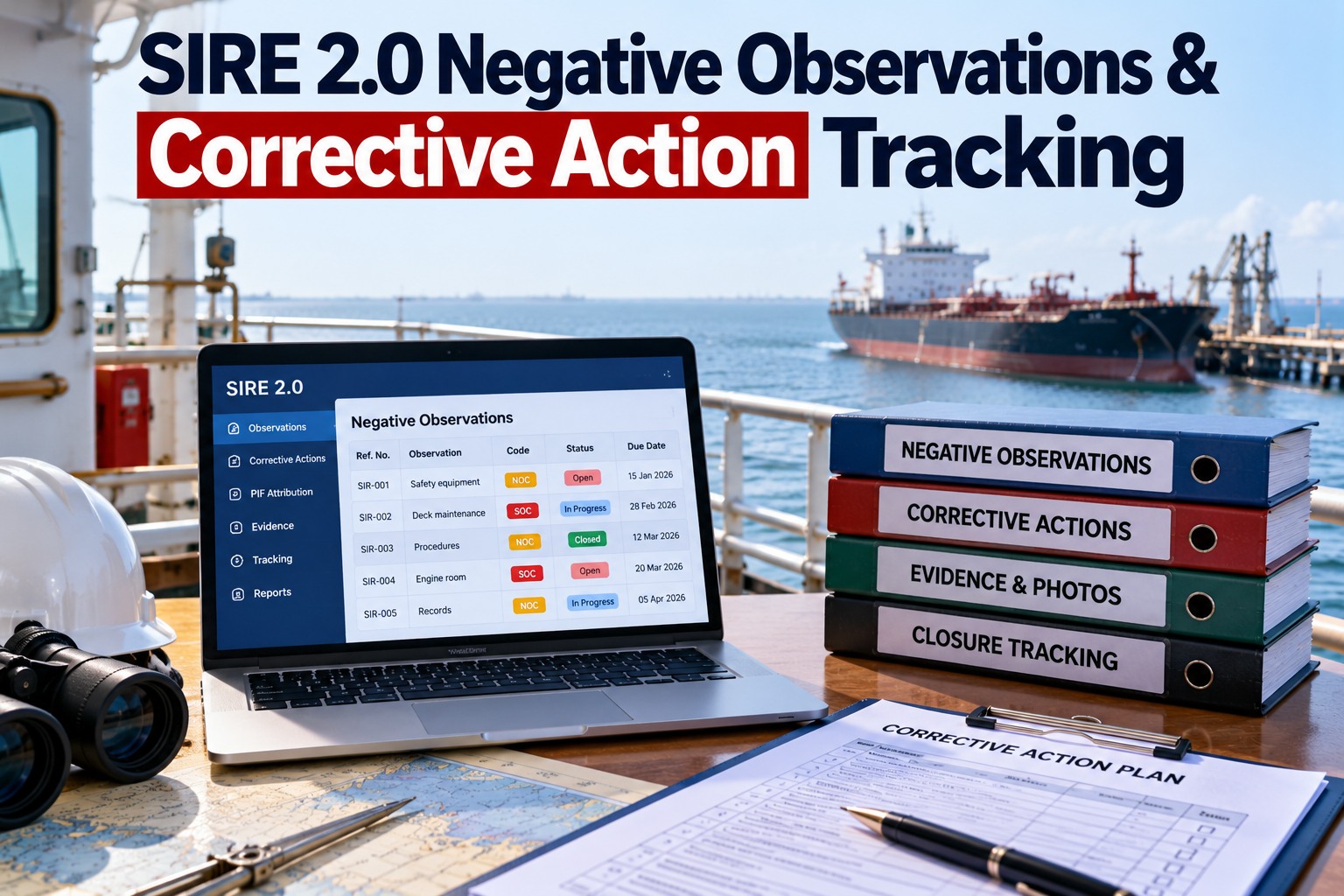
The SEE-Berufsgenossenschaft ISM circular on reports and analyses of non-conformities says the aim is that internal investigations and analyses lead to appropriate corrective and preventive actions, and that a missing report to the administration can cause port State control difficulties even when corrective action was taken. A finding that lives only in an inspection report is easy to lose. Give each one a work order that carries the finding's reference and a closure that points back to it.
| Finding source | Work order action | Evidence at closure | Checkpoint type |
|---|---|---|---|
| Internal inspection or audit | One order per finding, with the audit item referenced | Photo and the verifier's note | Visual |
| Class survey or condition of class | Order referencing the class item and due date | Surveyor-accepted report or certificate | Record |
| Port State control deficiency | Order marked urgent, with the authority's reference | Rectification record and photos | Record |
| Vetting inspection observation | Order with cause, correction and prevention | Root cause analysis and photos | Record |
| Breakdown or incident | Order plus cause analysis and a fleet check | Test run results after repair | Test |
| Overdue planned job | Order with reason and new date, approved | Completion proof or approved deferral | Record |
What a vetting close-out submission looks like in one example
RightShip's help page for its close-out process gives operators 15 days from receipt of the findings, with extensions only in limited cases. It asks for a detailed root cause analysis, an explanation of cause, correction and prevention, and supporting evidence such as photographs. Independent superintendents review each submission. Other vetting schemes and class have their own rules, so use this as an example of the pattern, not a universal standard.
The Work Order Closure Checklist for the Chief Engineer
A checklist with a checkpoint type on each item before an order is marked closed
Before closing any order, especially one on critical equipment, run through the table. It covers the description, cause, ownership, the repair, a test, evidence and verification. Adapt it to your PMS and company procedures.
| Item | What to check | Checkpoint type |
|---|---|---|
| Defect description | Clear enough that someone else could find and fix it | Record |
| Cause recorded | Possible cause at raising and the confirmed cause at closure | Record |
| Critical equipment | Flag checked and standby arrangements considered | Record |
| Owner and date | Named owner and a deadline, with any extension approved and explained | Record |
| Repair done | Work done as described and equipment in a fit state | Visual |
| Function tested | Equipment run or tested after repair, result recorded | Test |
| Evidence attached | Dated photos, readings or reports attached | Record |
| Verification | A second person confirmed the fix worked, and the order links to its source finding | Record |
Mistakes That Leave Defects Closed on Paper but Open on the Ship
Six habits that undermine corrective action
Systems That Keep Work Orders, Evidence and Findings Together
How a dated photo repository, task ownership and deadlines support closure and audit
Work orders get weak when the proof lives in a camera roll and the finding lives in a PDF. Marine Inspection supports a dated photo repository, observations turned into tasks with owners, deadlines and evidence, and certificate and equipment tracking. A dated photo of a repaired pump attached to the task, the task linked to the inspection observation, and an owner and deadline on each give the Chief Engineer and the superintendent one record to open. It does not replace your own procedures or the verification steps in them.