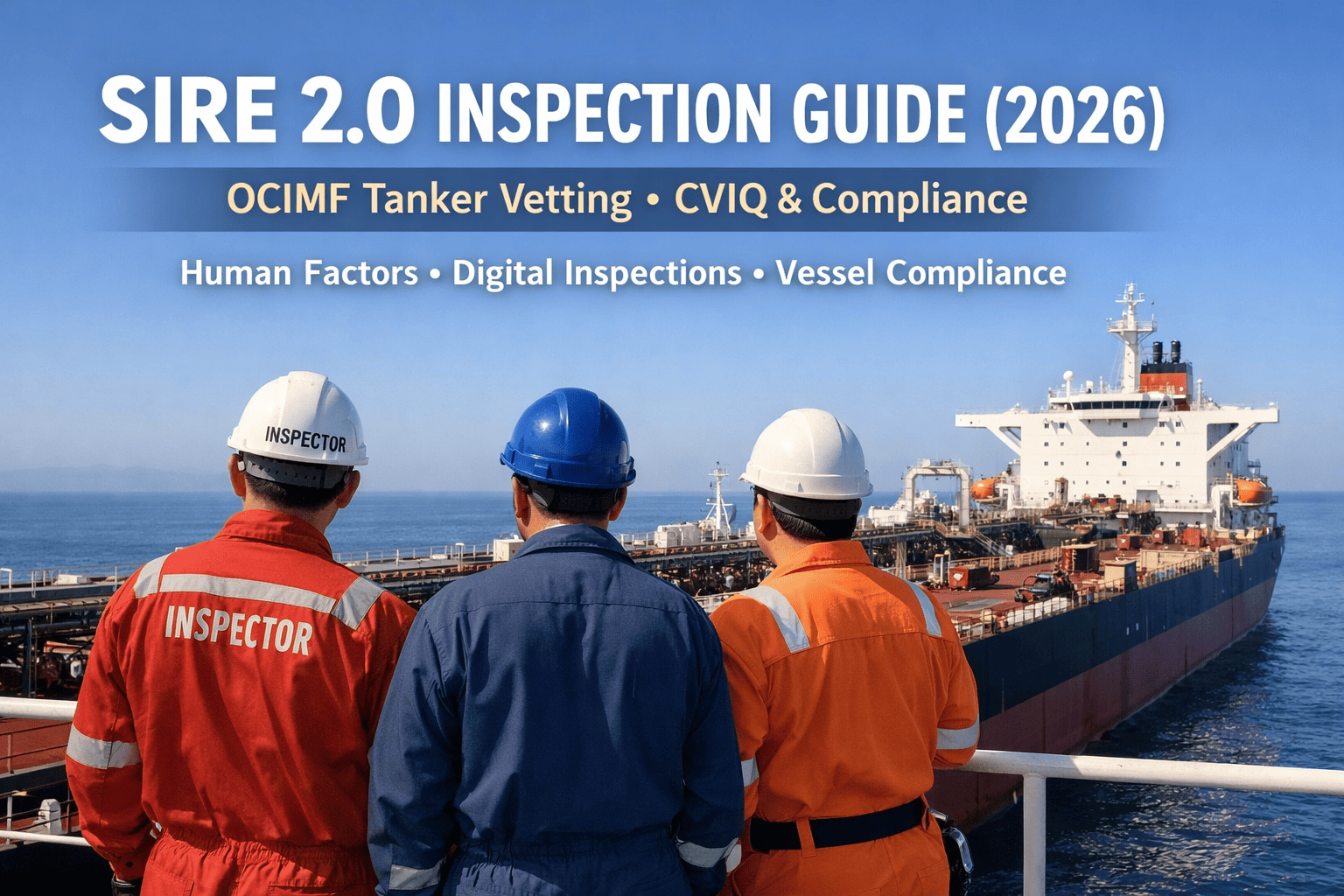
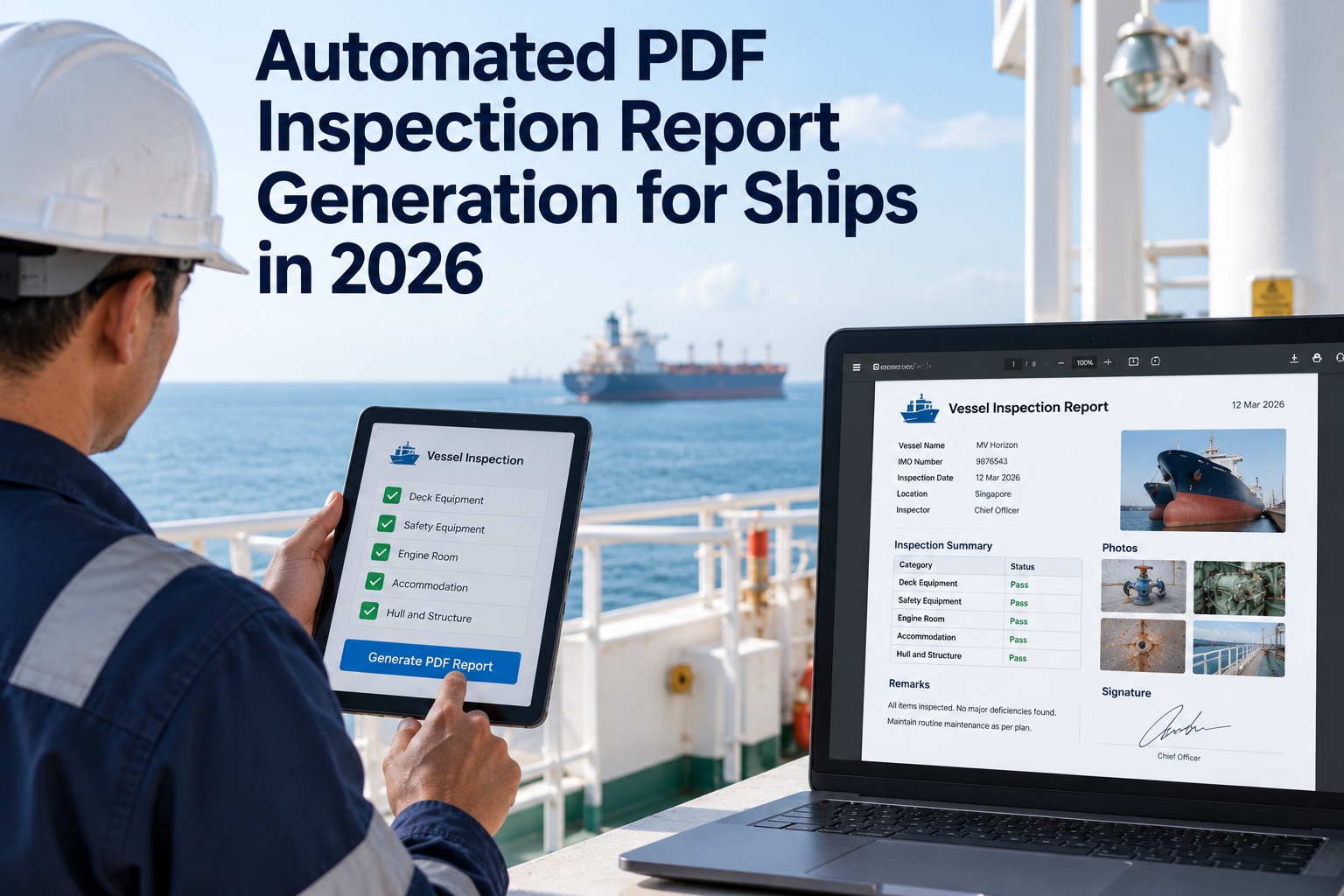
SIRE 2.0 has permanently replaced VIQ7 as OCIMF's tanker vetting standard since September 2, 2024. The shift is fundamental: inspections are now algorithm-driven, digitally recorded, and evaluate crew competency alongside hardware and procedures. With approximately 100 tailored questions per inspection drawn from a comprehensive question library, no two SIRE 2.0 inspections are identical — and every tanker crew must be prepared for the full scope of the programme. Tanker operators ready to digitize their SIRE 2.0 preparation can sign up for Marine Inspection's vessel compliance platform to integrate questionnaire readiness, photo evidence management, and corrective action tracking into one auditable system.
SIRE 2.0 Inspection Guide: Key Numbers Every Operator Should Know
24,000+
SIRE 2.0 Inspections
Completed since the September 2024 launch globally
~100
CVIQ Questions per Inspection
Algorithmically tailored from the full question library
9 PIFs
Human Factor Assessments
Performance Influencing Factors evaluated per observation
12 Months
Report Validity Period
Reports remain active in the OCIMF database
What Changed: VIQ7 vs SIRE 2.0 — The Complete Comparison
Understanding the differences between VIQ7 and SIRE 2.0 is the first step toward compliant operations. The transition isn't a minor update — it's a complete overhaul of how tanker inspections are conducted, recorded, and evaluated. Where VIQ7 relied on standardized questions with binary answers, SIRE 2.0 uses a risk-based, algorithmically-generated questionnaire that assesses every aspect across Hardware, Procedures, and Human Factors. Book a demo to see how Marine Inspection maps your fleet to SIRE 2.0 requirements.
VIQ7 vs SIRE 2.0: Side-by-Side Comparison
Aspect
VIQ7 (Legacy)
SIRE 2.0 (Current)
Questionnaire
Standardized ~300 questions, same for all vessels
Risk-based CVIQ, ~100 questions tailored per vessel via algorithm
Question Types
Single standardized set applied universally
Core + Rotational 1 & 2 + Campaign + Conditional questions
Response Format
Binary Yes/No answers only
Graded: Exceeds / As Expected / Largely / Not as Expected
Human Element
Limited crew assessment during inspections
9 PIFs evaluating crew competency, safety culture, fatigue
Recording
Paper-based inspection forms, manual submission
Digital tablet with GPS, real-time reporting, photo evidence
Photo Evidence
Not mandatory in the inspection process
Standardized Photo Repository, updated every 6 months
Assessment Focus
Number of observations recorded
Quality of safety culture across Hardware, Procedures, Human
Predictability
Same questions every time — preparation by repetition
Unpredictable rotation — must be ready for the full library
The CVIQ Explained: 4 Question Types That Drive Every Inspection
The Compiled Vessel Inspection Questionnaire (CVIQ) is the backbone of SIRE 2.0. Unlike VIQ7's fixed questionnaire, each CVIQ is algorithmically generated based on your vessel type, operational history, PIQ declarations, and which rotational questions have already been assigned. The algorithm ensures no two consecutive inspections are identical — making preparation across the full question library essential. Schedule a demo to see how Marine Inspection tracks CVIQ question coverage across your fleet.
Safety-critical questions included in every CVIQ where applicable to the vessel type. These cover risks that may lead to catastrophic or severe incidents — from cargo operations and navigation to fire safety and pollution prevention. Core questions form the foundation of every inspection.
≈ 50% of every inspection
Non-core questions rotated across inspections via algorithm to ensure complete coverage over time. Rotational 1 questions appear approximately every 3rd–4th inspection. Rotational 2 questions appear roughly every 6th inspection. The algorithm tracks assignment history per vessel, making consecutive inspections unpredictable.
2 tiers — randomized allocation
Time-limited focus areas activated by OCIMF in response to specific incident trends, emerging safety concerns, or industry-wide issues. A campaign question is an existing rotational question elevated to mandatory status for every inspection during the campaign period — similar to PSC concentrated inspection campaigns.
Industry-driven, time-limited focus
Triggered by vessel-specific data — including vessel type, operator history, or PIQ declarations. For example, declaring a superintendent inspection or specialist audit may generate verification questions. Declaring specific equipment or operational capabilities triggers relevant conditional assessments.
Vessel-specific triggers from PIQ data
The 9 Performance Influencing Factors (PIFs): SIRE 2.0's Human Element
The most transformative change in SIRE 2.0 is the structured evaluation of human performance through nine Performance Influencing Factors. Whenever a SIRE 2.0 inspector records a rating of "Exceeds Expectations" or "Not as Expected," they must tag the relevant PIFs — making crew competency a documented, data-driven component of every inspection report. Inspectors evaluate "work as done" versus "work as imagined" — watching how crew actually perform tasks rather than just checking whether a procedure manual exists.
The 9 Performance Influencing Factors (PIFs) in SIRE 2.0
1
Safety Criticality Recognition — Does the crew understand the safety significance of the task or its associated steps?
2
Custom & Practice — Are documented procedures actually followed, or has the crew developed informal workarounds and shortcuts?
3
Procedure Quality — Are procedures accessible, helpful, understood, and accurate for the task being performed?
4
Team Dynamics — Quality of communication, coordination, and collaboration between crew members during operations.
5
Fatigue & Workload — Evidence of excessive working hours, inadequate rest periods, or unsustainable operational workload.
6
Workplace Environment — Ergonomics including signage, tools, workspace layout, noise levels, lighting, and temperature conditions.
7
Competency & Training — Adequacy of formal training and whether demonstrated skill matches the requirements of the role.
8
Learning Opportunity — Can crew learn and practice through drills, feedback loops, and structured development opportunities?
9
Human-Machine Interface — Is equipment designed for safe, intuitive human operation with clear controls and displays?
SIRE 2.0 Grading System: How Observations Are Recorded
SIRE 2.0 replaces VIQ7's binary Yes/No format with a four-level grading scale applied across three dimensions — Hardware, Procedures, and Human Factors. Understanding how each grade impacts your vessel's report is critical: a single "Not as Expected" rating generates a negative observation with codified Subject of Concern (SOC) and Nature of Concern (NOC) linked to at least one PIF. Conversely, "Exceeds Expectations" is the only path to a "best practice" notation — increasingly what charterers look for when comparing vessels.
✦ Exceeds Expectations
Best Practice Recognition
The only way to receive a "best practice" rating in SIRE 2.0. Indicates the vessel's performance goes beyond standard requirements — demonstrating proactive safety management, exceptional crew competency, or equipment standards above industry norms. Requires PIF tagging to document what made performance exceptional.
✓ As Expected
Standard Compliance Met
The task meets established requirements across hardware condition, procedural compliance, and crew competency. This is the baseline target for every question — indicating the vessel operates at the standard the industry expects. No additional PIF tagging or observations generated.
≈ Largely as Expected
Room for Improvement
While no formal negative finding is recorded, this rating signals that performance fell slightly short of expectations. It implies areas for improvement and may prompt further questions from charterer vetting teams reviewing the report. Repeated "Largely" ratings across a report create a pattern vetters notice.
✗ Not as Expected
Negative Observation Generated
Triggers a formal negative observation with codified SOC, NOC, free-text detail, and mandatory PIF linkage. This rating directly impacts your vessel's vetting profile. Every NOC must be linked to at least one Performance Influencing Factor — making the human element a documented part of every deficiency.
SIRE 2.0 Inspection Preparation Checklist
Preparation is the difference between an inspection that validates your operations and one that generates costly negative observations. This checklist covers the end-to-end process from inspection request through post-inspection corrective actions — structured around the three phases every SIRE 2.0 inspection follows. Sign up to digitize your entire inspection preparation workflow.
Phase 1: Pre-Inspection Readiness
Update HVPQ and PIQ data — Pre-populated vessel data must be current. Your PIQ declarations directly influence which conditional questions the algorithm selects. Declare superintendent inspections and specialist audits only if complete, verified, and aligned with TMSA3 requirements.
Update Photo Repository (every 6 months) — Standardized photos of all safety-critical equipment, cargo areas, accommodation, and engine spaces with clear, dated images. The inspector will corroborate uploaded photos with the vessel's actual condition on inspection day.
Review all previous negative observations — SIRE 2.0 re-verifies past findings. Document every corrective action with timestamped evidence, completion photos, and responsible officer records. Unresolved observations from prior inspections will be flagged.
Prepare crew for PIF-based interviews — Every crew member should articulate their roles in emergency procedures, demonstrate familiarity with the SMS, and explain safety-critical task steps in their own words — not recite memorized responses. Inspectors test "work as done" versus "work as imagined."
Review rotational question coverage — Track which rotational categories have been covered in previous inspections and focus crew preparation on areas not yet addressed. The algorithm ensures uncovered categories will appear in future inspections.
Phase 2: During the Inspection (~8 Hours Onboard)
Inspector uses tablet-based CVIQ — Real-time digital recording with GPS verification and automatic time logging. Each question assessed across Hardware, Procedures, and Human Factors. Photos taken as corroborative evidence throughout the inspection.
Crew interviews and live demonstrations — Inspectors assess competency in real time across navigation, cargo operations, mooring, and emergency procedures. Make available the crew who normally perform each task — inspectors want to talk to the people who do the job daily.
Graded observations recorded with PIF tagging — Responses range from "Exceeds" to "Not as Expected." Negative observations include codified SOC, NOC, PIF linkage, and free-text details — providing far more granular data than VIQ7's binary format.
Phase 3: Post-Inspection Actions
Review draft report for inspector errors — The submitting company QA checks the draft before publication. Operators may comment on findings before the final report is published to the OCIMF database.
Convert negative observations to tracked corrective actions — Each finding should generate a maintenance task with deadline, responsible person, completion photo evidence, and full audit trail. The report remains active in the OCIMF database for 12 months — the next inspector will verify remediation.
Cascade lessons across the fleet — Findings from each inspection should inform fleet-wide preparation. Track which rotational questions have appeared, identify emerging patterns in negative observations, and prepare crews for uncovered categories in upcoming inspections.
Expert Analysis: Why Digital Preparation Is No Longer Optional
SIRE 2.0 has created three operational challenges that manual processes simply cannot solve at fleet scale. First, questionnaire unpredictability: because every CVIQ is algorithmically unique, operators need a system that tracks which question categories each vessel has covered across inspections and identifies preparation gaps before the inspector finds them. Spreadsheets and email chains cannot deliver this level of cross-vessel intelligence.
Second, photo evidence management: maintaining a current Photo Repository across a fleet of tankers requires systematic image collection, dating, and organization every six months. One missed update on one vessel means non-compliance on inspection day — and manual tracking across 10, 20, or 50 vessels is where preparation breaks down.
Third, corrective action accountability: when a negative observation is recorded, it stays in the OCIMF database for 12 months. The next inspector will verify whether you documented the fix with timestamped evidence — not just stated intentions. A digital audit trail is the only reliable way to prove remediation is complete. Marine Inspection's platform is purpose-built to connect all three workflows — schedule a walkthrough to see how CVIQ tracking, photo management, and corrective actions integrate across your fleet.
Conclusion
SIRE 2.0 represents the most significant change to tanker commercial inspection since OCIMF launched the original SIRE programme in 1993. The shift from standardized checklists to risk-based, algorithmically-generated inspections with graded responses and mandatory human element assessment means operators can no longer rely on last-minute preparation and memorized answers. The operators succeeding in 2026 are those treating SIRE 2.0 preparation as a continuous digital workflow — with photo repositories maintained every six months, crew competency documented through regular drills, rotational question coverage tracked across inspections, and negative observations converted to auditable corrective actions immediately. Marine Inspection delivers the platform that connects every element of SIRE 2.0 preparation into one system — sign up today to digitize your tanker fleet's inspection readiness.
Digitize Your SIRE 2.0 Inspection Workflow
From CVIQ question tracking to post-inspection corrective actions, Marine Inspection connects every stage of the SIRE 2.0 process — photo evidence, maintenance tasks, crew competency tracking, and certificate management — into one platform built for tanker operators.
Frequently Asked Questions
What is SIRE 2.0 and when did it replace VIQ7?
SIRE 2.0 is OCIMF's next-generation Ship Inspection Report Programme for tankers. It permanently replaced VIQ7 on September 2, 2024, and is now the sole inspection framework available for tanker operators. The programme uses an algorithm-generated Compiled Vessel Inspection Questionnaire (CVIQ) of approximately 100 questions tailored to each vessel's risk profile, replaces binary Yes/No answers with a four-level grading system (Exceeds / As Expected / Largely / Not as Expected), and evaluates every question across three dimensions — Hardware, Procedures, and Human Factors.
What are the four SIRE 2.0 question types in the CVIQ?
SIRE 2.0 uses four question categories. Core questions (approximately 50% of each inspection) cover safety-critical areas and appear in every CVIQ. Rotational questions are non-core questions rotated across inspections — Rotational 1 appears every 3rd–4th inspection, Rotational 2 approximately every 6th. Campaign questions are time-limited focus areas elevated by OCIMF in response to specific incident trends. Conditional questions are triggered by vessel type, operator history, or PIQ declarations. The algorithm tracks question assignment history per vessel, ensuring consecutive inspections cover different areas.
What are Performance Influencing Factors (PIFs)?
PIFs are nine standardized human factors that inspectors use to assess why crew performance exceeded or fell below expectations. They cover: (1) safety criticality recognition, (2) custom and practice, (3) procedure quality, (4) team dynamics, (5) fatigue and workload, (6) workplace environment, (7) competency and training, (8) learning opportunity, and (9) human-machine interface. Every non-standard observation — whether positive or negative — must be linked to at least one PIF, making human performance a documented, data-driven component of every SIRE 2.0 report.
How long is a SIRE 2.0 inspection and how long is the report valid?
The onboard portion of a SIRE 2.0 inspection is fixed at approximately 8 hours. Prior to boarding, the inspector conducts a document review checking certificates and PIQ information. Reports remain valid for 12 months from the publication date and are maintained in the OCIMF database for 2 years. Many major charterers require a recent SIRE report — typically within 6 months — before considering a vessel for charter.
How should tanker crews prepare for SIRE 2.0 inspections?
Crews should focus on three areas. First, maintain a current Photo Repository updated every 6 months with clear, dated images of all safety-critical equipment. Second, prepare for PIF-based interviews — inspectors assess whether crew can articulate procedures in their own words and demonstrate tasks in real time, not recite memorized responses. Third, maintain continuous documentation of drills, training, and maintenance actions, as SIRE 2.0 inspectors verify operational evidence rather than just certificates. The key difference from VIQ7: inspectors assess "work as done" by watching actual task performance, not just "work as imagined" from procedure manuals.
How does vessel inspection software help with SIRE 2.0 compliance?
Digital inspection platforms like Marine Inspection address three core SIRE 2.0 challenges. First, questionnaire unpredictability: the software tracks which question categories each vessel has covered across inspections, identifying preparation gaps before inspectors find them. Second, photo evidence management: maintaining a current Photo Repository across a fleet requires systematic image collection, dating, and organization that manual processes cannot sustain at scale. Third, corrective action tracking: converting negative observations into maintenance tasks with deadlines, responsible persons, completion evidence, and audit trails — so the next inspection verifies documented remediation, not just stated intentions.