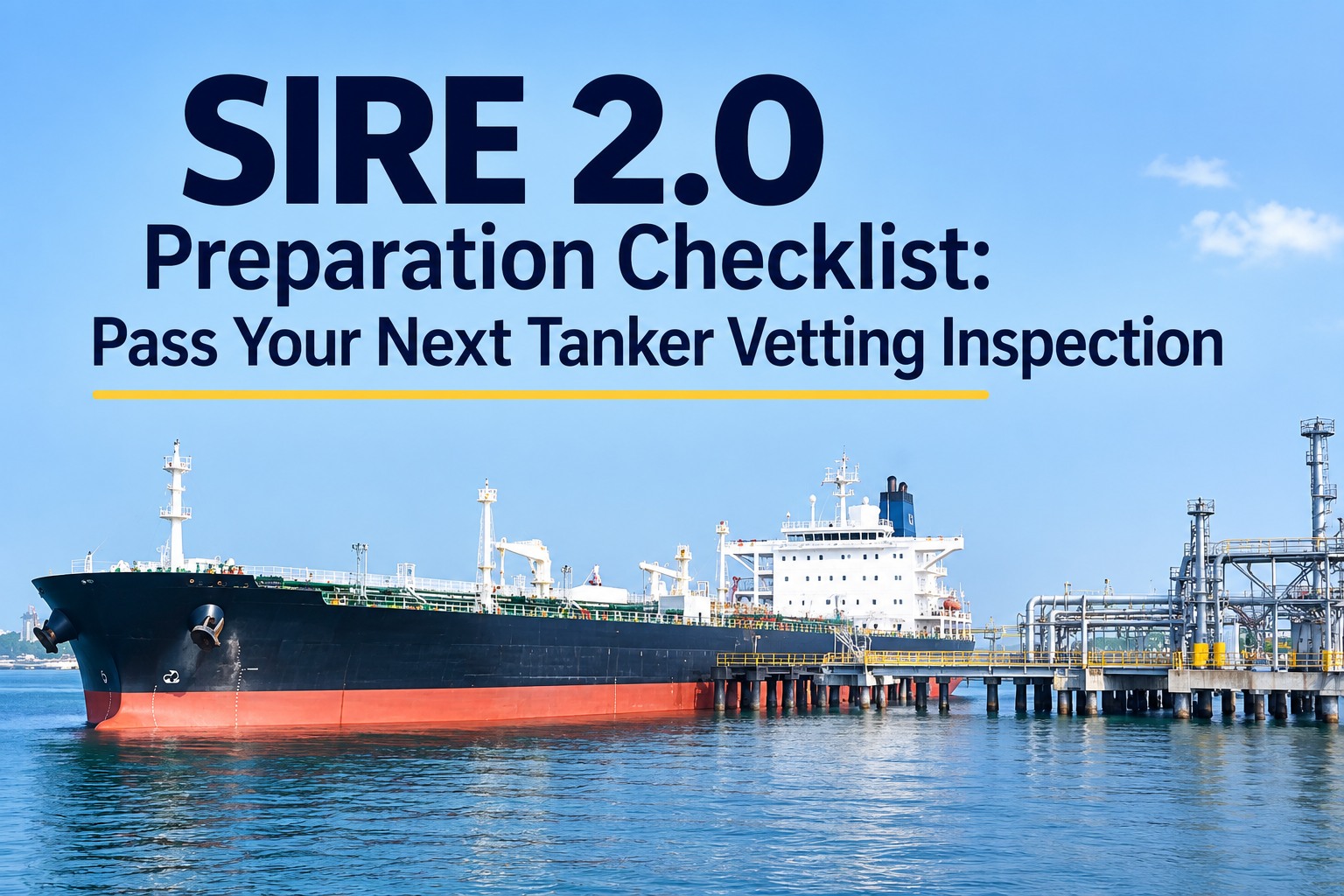
A Singapore-flagged VLCC learned that SIRE 2.0 inspections reward preparation, not luck. After implementing systematic vetting readiness protocols, their inspection observation count dropped from 47 to 9 over three consecutive SIRE inspections—a 81% reduction that directly improved their vetting score and charter opportunities. The transformation wasn't about major capital investments; it was operational discipline. Digital checklists ensured every SIRE-critical area maintained inspection-ready status daily, not just during the 72 hours before inspector arrival. When oil majors reject vessels with 30+ observations and premium charters require vetting scores above 90%,SIRE preparation becomes the difference between profitable employment and watching competitors secure the cargo.
The SIRE Vetting Reality
Why SIRE performance determines tanker commercial success
8,500+
annual inspections
SIRE inspections conducted globally on tankers, gas carriers, and offshore vessels
30+
rejection threshold
Observations that typically result in charter rejection by oil majors
$450K
revenue impact
Estimated annual revenue loss per vessel from poor SIRE performance
95%
charterer access
Percentage of major oil companies requiring clean SIRE reports
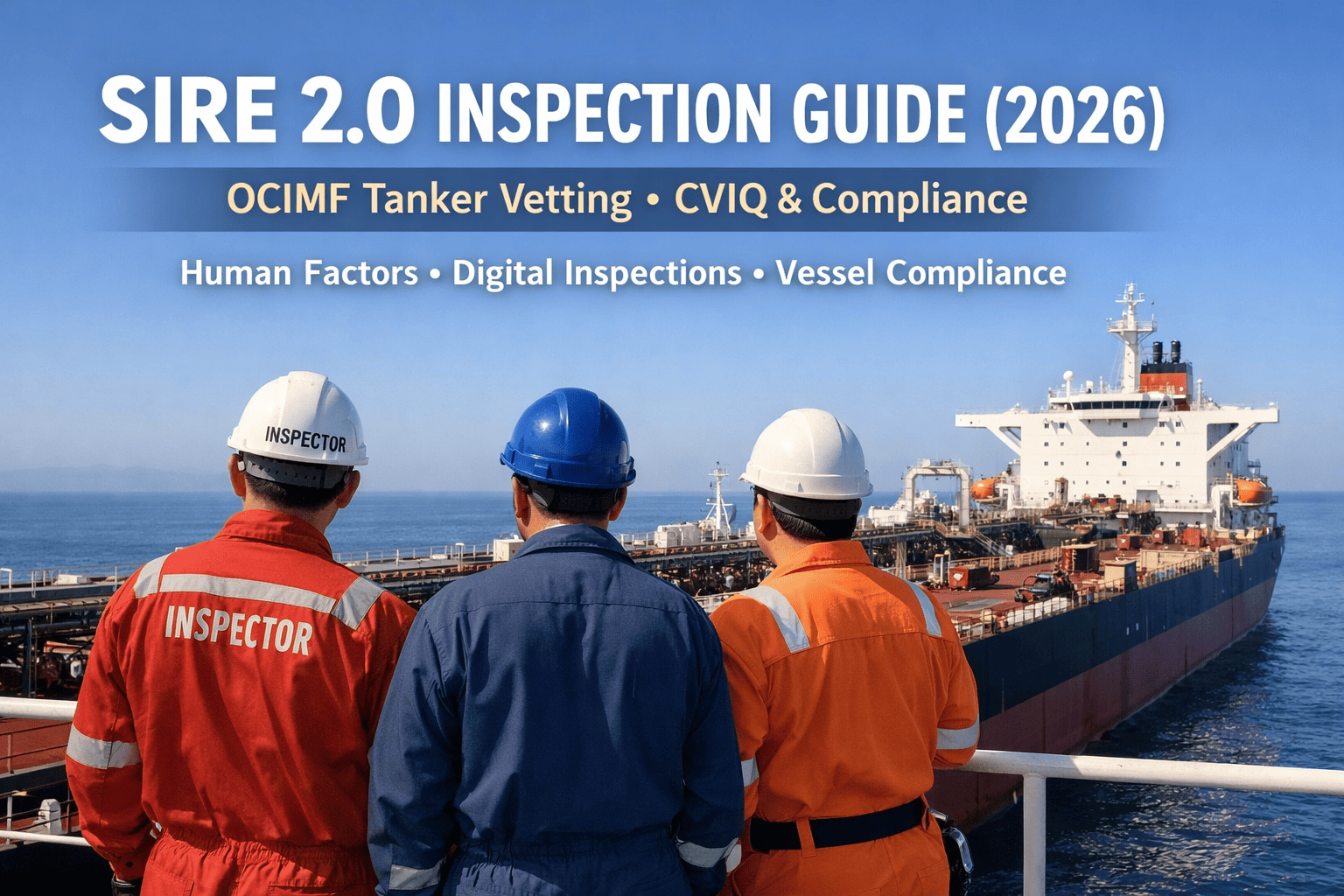
SIRE (Ship Inspection Report Programme) is OCIMF's vessel vetting system used by oil majors, chemical companies, and LNG operators to evaluate tanker and gas carrier safety standards before chartering. Unlike port state control inspections that verify regulatory compliance, SIRE inspections assess operational practices, safety culture, and vessel condition against industry best practices. SIRE 2.0, implemented in September 2023, introduced risk-based questioning, consistent global standards, and enhanced digital reporting that fundamentally changed inspection dynamics.
Understanding SIRE 2.0 Framework
SIRE 2.0 represents the most significant overhaul of tanker vetting in 30 years. The new system replaces yes/no checklists with risk-based assessment requiring inspectors to evaluate vessel operations holistically. Understanding the framework is essential for effective preparation.
SIRE 2.0 Core Changes from SIRE VIQ7
Risk-Based Questioning
Inspectors follow risk-based question paths rather than fixed checklists. Vessel's answers and conditions determine which questions are asked. Poor answers trigger deeper investigation into related areas. This means preparation must cover why practices exist, not just that they exist.
Chapter-Based Structure
Inspection organized into 12 chapters covering General Particulars, Navigation & Bridge, Cargo & Ballast, Mooring, Safety Management, Pollution Prevention, Crew Management, Maintenance, and Environmental. Each chapter contains 15-40 questions with multiple sub-questions based on vessel operations.
Observation Categories
Observations classified as Immediate (critical safety issue requiring immediate action), Within 30 Days (significant finding requiring correction before next charter), or Within 3 Months (operational improvement needed). Immediate observations effectively blacklist vessels from premium charters.
Continuous Assessment
SIRE 2.0 emphasizes ongoing vessel performance tracking. Charterers analyze observation trends across multiple inspections. Vessels showing improvement (declining observation counts) gain favor; those with increasing observations face commercial consequences regardless of absolute numbers.
The shift to risk-based assessment means crew must understand systems deeply, not just demonstrate surface compliance. Inspectors ask "why do you do it this way?" and "what happens if this fails?" Traditional rote memorization of procedures won't satisfy SIRE 2.0 requirements. Operators seeking to improve SIRE outcomes should implement digital training systems that document crew competency verification and equipment familiarity beyond basic safety drills.
Critical SIRE Inspection Areas
While SIRE 2.0 covers 12 chapters comprehensively, certain areas consistently generate the highest observation counts. Focusing preparation efforts on these high-risk areas delivers maximum observation reduction per effort invested.
1
Cargo & Ballast Operations
22% of observations
Common Observations:
Cargo system procedures not followed consistently
Ullage/sounding equipment poorly maintained
Inert gas system deficiencies
Ballast water treatment system documentation gaps
Tank cleaning procedures not documented
Preparation Focus:
Verify all cargo officers can explain complete cargo handling sequence from shore connection to discharge completion. Test cargo system alarms weekly; maintain calibration certificates for all gauging equipment. Ensure inert gas system maintains oxygen below 8% consistently with logged readings. Document every tank cleaning operation photographically showing before/after conditions.
2
Safety Management System
18% of observations
Common Observations:
Risk assessments generic rather than job-specific
Permit-to-work system not properly implemented
Near-miss reporting culture lacking
Management review of safety KPIs incomplete
Audit findings not closed with root cause analysis
Preparation Focus:
Review last 10 risk assessments; ensure they reference actual vessel conditions and specific hazards, not generic templates. Verify permit-to-work includes isolation verification and gas-free certification where required. Establish monthly near-miss reporting targets; track reporting rates as safety culture indicator. Close all audit findings with documented evidence before SIRE inspection.
3
Navigation & Bridge Procedures
15% of observations
Common Observations:
Passage planning incomplete or not followed
ECDIS/chart corrections not current
Bridge equipment alarms not tested regularly
Lookout posting during pilotage inadequate
Communication procedures during cargo ops unclear
Preparation Focus:
Ensure passage plans include speed calculations, abort positions, parallel indexing, and UKC monitoring for upcoming voyages. Update ECDIS weekly; maintain chart correction logs showing all T&P notices applied. Test all bridge alarms monthly with logged results. Clarify bridge/CCR communication protocols during cargo operations; conduct drills verifying procedures work practically.
4
Maintenance & Condition
14% of observations
Common Observations:
Planned maintenance system not effectively implemented
Critical spares insufficient or expired
Corrosion in tanks/void spaces not monitored
Emergency equipment testing overdue
Vessel general cleanliness below standards
Preparation Focus:
Print PMS overdue report; complete all overdue items or document deferral justification. Verify critical spares match OCIMF/ISGOTT recommendations; replace expired items (gaskets, fire suits, immersion suits). Inspect all cargo tanks, ballast tanks, void spaces within 30 days of SIRE; photograph condition. Test all emergency systems (EEBD, SCBA, portable gas detectors) monthly with certificates available.
Reduce SIRE Observations by 60%+
Implement systematic vetting preparation protocols that maintain SIRE-ready status continuously, not just pre-inspection. Digital tracking eliminates observation-causing oversights.
48-Hour SIRE Preparation Protocol
SIRE inspections typically provide 48-96 hours notice via OCIMF scheduling system. This protocol focuses on verification and final checks, not creating compliance. Vessels should maintain SIRE-ready status continuously; the 48-hour protocol confirms readiness rather than achieving it.
SIRE 2.0 Pre-Inspection Readiness Protocol
48 Hours Before
Documentation & Systems Review
☐
Review previous SIRE reports (last 3 inspections); verify all observations closed with evidence
☐
Confirm cargo system fully operational: pumps, valves, gauging, inert gas, tank cleaning
☐
Verify all SMS documentation current: risk assessments, drills, training matrix, audit closures
☐
Test emergency systems: EEBD, SCBA, portable gas detectors, fire suits; document results
☐
Update TMSA status report; ensure KPI data current for past 12 months
24 Hours Before
Physical Inspection & Crew Brief
☐
Walk entire vessel as inspector: note housekeeping issues, safety deficiencies, labeling gaps
☐
Inspect cargo manifold, deck pipelines, tank vents; ensure no leaks, proper labeling, clear access
☐
Review engine room: bilges dry, no oil leaks, fire dampers functional, escape routes clear
☐
Brief all officers on SIRE process: inspector rights, questioning style, answer guidelines
☐
Conduct mock SIRE questions: verify officers can explain systems, procedures, and safety rationale
Day of Inspection
Final Verification & Inspector Support
☐
Prepare ship's office: certificates accessible, SMS manuals available, computer/projector ready
☐
Assign escort officer knowledgeable about vessel systems; brief on inspection support role
☐
Ensure crew aware inspection underway; maintain normal professional operations throughout
☐
Provide inspector PPE, vessel familiarization briefing, emergency contact information
☐
Track observations during inspection; begin immediate corrective action for quick wins
Multi-vessel operators benefit significantly from centralized SIRE preparation tracking. Fleet managers can monitor readiness across all tankers, identify systemic issues appearing on multiple vessels, and share best practices from high-performing ships. Companies managing 5+ tankers should schedule a consultation to see how fleet-wide vetting management reduces average observation counts by 40-60% across entire fleets.
Most Common SIRE 2.0 Observations
Analysis of 2,000+ SIRE 2.0 reports reveals consistent patterns. The top observations are preventable through systematic operational discipline rather than capital investment.
1
Permit-to-Work Implementation Gaps
Finding: Permits issued without proper risk assessment; isolation verification incomplete; gas-free certificates missing or expired; permit close-out not documented.
Quick Fix: Implement permit checklist requiring risk assessment attachment, isolation tag verification, gas test results, and supervisor sign-off before work authorization. Conduct weekly permit-to-work audits reviewing all issued permits for completeness.
2
Cargo System Maintenance Documentation
Finding: Cargo pump maintenance records incomplete; valve condition monitoring not systematic; tank cleaning machine testing overdue; gauging equipment calibration expired.
Quick Fix: Create cargo system preventive maintenance schedule with specific intervals for pumps (quarterly inspection), valves (annual overhaul rotation), tank cleaning machines (monthly operation test), and gauging equipment (annual calibration). Document all maintenance photographically.
3
Emergency Equipment Testing Frequency
Finding: EEBD not tested monthly; SCBA annual maintenance overdue; portable gas detectors not bump-tested before use; fire suits condition not verified.
Quick Fix: Establish monthly emergency equipment test day: EEBD duration test (min 10 minutes), SCBA pressure check, gas detector bump test against known gas, fire suit visual inspection. Maintain test log with individual equipment serial numbers and results.
4
Near-Miss Reporting Culture
Finding: Near-miss reporting rates suspiciously low (suggesting underreporting); investigation depth insufficient; corrective actions not tracked to completion; trend analysis absent.
Quick Fix: Set monthly near-miss reporting targets (minimum 3-5 per vessel); recognize reporting in safety meetings; simplify reporting process through mobile apps; track corrective action completion rates; conduct quarterly trend analysis identifying systemic issues.
5
Passage Planning Detail & Execution
Finding: Passage plans lack abort points; parallel indexing not marked; UKC calculations missing; wheel-over positions not calculated; plan not updated for actual conditions encountered.
Quick Fix: Use standardized passage plan template requiring: way points with course/distance, abort positions for all critical areas, parallel indexing tracks, UKC calculations for shallow areas, wheel-over positions for course changes, weather routing consideration. Master reviews and signs all plans before departure.
SIRE vs PSC: Understanding the Difference
Many operators confuse SIRE vetting with port state control inspections. While both examine vessels, their purposes, standards, and consequences differ significantly. Understanding these differences optimizes preparation strategies.
SIRE Vetting vs Port State Control
Aspect
SIRE Inspection
PSC Inspection
Authority
Industry body (OCIMF) on behalf of oil majors
Government maritime authorities
Standard
Industry best practices (exceeds regulations)
Regulatory compliance (IMO conventions)
Frequency
Every 6-12 months per vessel
Risk-based (5-36 months depending on profile)
Duration
8-12 hours comprehensive examination
2-8 hours targeted inspection
Consequence
Charter rejection (commercial impact)
Detention (regulatory enforcement)
Focus
Operational practices and safety culture
Certificate validity and equipment function
Key Insight: Vessels can pass PSC but fail SIRE. SIRE evaluates whether crew knows WHY procedures exist; PSC verifies procedures exist. SIRE preparation requires deeper operational understanding.
Master SIRE 2.0 Preparation
Stop scrambling before inspections. Maintain continuous vetting readiness with digital systems that track every SIRE-critical area automatically.
Frequently Asked Questions
What is SIRE 2.0 and how does it differ from SIRE VIQ7?
SIRE 2.0, implemented September 2023, replaced SIRE VIQ7 with risk-based questioning instead of yes/no checklists. Inspectors now follow question paths determined by vessel answers and conditions, meaning poor responses trigger deeper investigation. The system includes 12 chapters with adaptive questioning, observation categories (Immediate, Within 30 Days, Within 3 Months), and enhanced digital reporting. SIRE 2.0 requires crews to explain WHY procedures exist and WHAT happens if systems fail, not just demonstrate that procedures exist.
How many observations result in charter rejection?
Most oil majors reject vessels with 30+ observations, though standards vary by charterer and cargo type. Any "Immediate" category observation effectively blacklists vessels from premium charters until corrected and verified. More important than absolute observation count is the trend: vessels showing declining observations over successive inspections gain commercial advantage; those with increasing observation counts face rejection regardless of total numbers. High-value cargoes and sensitive trades (chemicals, LNG) apply stricter thresholds, sometimes rejecting vessels with 20+ observations.
How long does a SIRE inspection typically take?
SIRE inspections average 8-12 hours including opening meeting, documentation review, vessel tour, operational demonstrations, crew interviews, and closing meeting. Tankers with complex configurations (chemical carriers, multi-grade capability) face longer inspections (10-14 hours). Well-prepared vessels with organized documentation and knowledgeable crew complete inspections faster; unprepared vessels face extended questioning and additional verification. Unlike PSC inspections that can be shortened, SIRE 2.0 requires inspectors to complete all applicable questions—preparation affects observation count, not inspection duration.
Can vessels appeal SIRE observations?
Vessels can request observation clarification or correction through OCIMF's dispute resolution process, but appeals rarely succeed unless observation contains factual errors. SIRE observations reflect inspector's professional judgment based on witnessed conditions—disputing "vessel cleanliness below standards" is difficult when photographic evidence exists. More effective approach: accept observations, implement immediate corrective actions, document improvements thoroughly, and demonstrate lower observation counts on subsequent inspections. Some operators successfully negotiate observation categorization (changing "Within 30 Days" to "Within 3 Months") if they can demonstrate immediate corrective action initiated during inspection.
What's the most effective way to prepare crew for SIRE 2.0?
Effective SIRE 2.0 preparation focuses on understanding over memorization. Conduct mock SIRE sessions where officers explain systems to each other: "Why do we inert cargo tanks?" "What happens if inert gas oxygen exceeds 8%?" "How do you verify tank cleaning machine coverage?" Officers must demonstrate practical knowledge, not recite SMS procedures. Use previous SIRE reports to identify weak areas; assign officers to research those topics and brief crew. Implement monthly "system walkthroughs" where different officers explain operational sequences to the master. Document crew competency verification beyond basic STCW requirements. Most importantly, maintain continuous operational discipline—SIRE preparation should verify readiness, not create it in 48 hours.