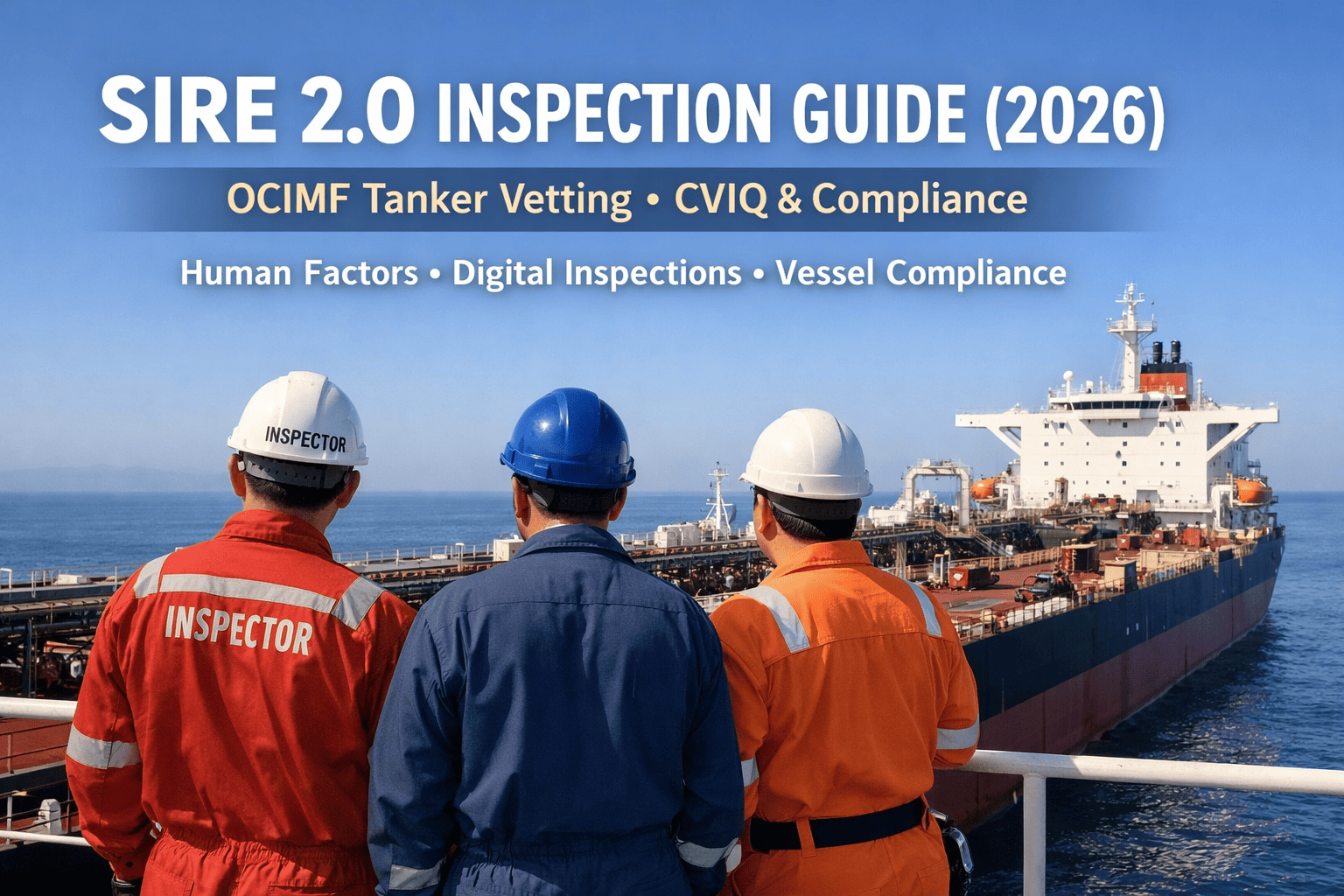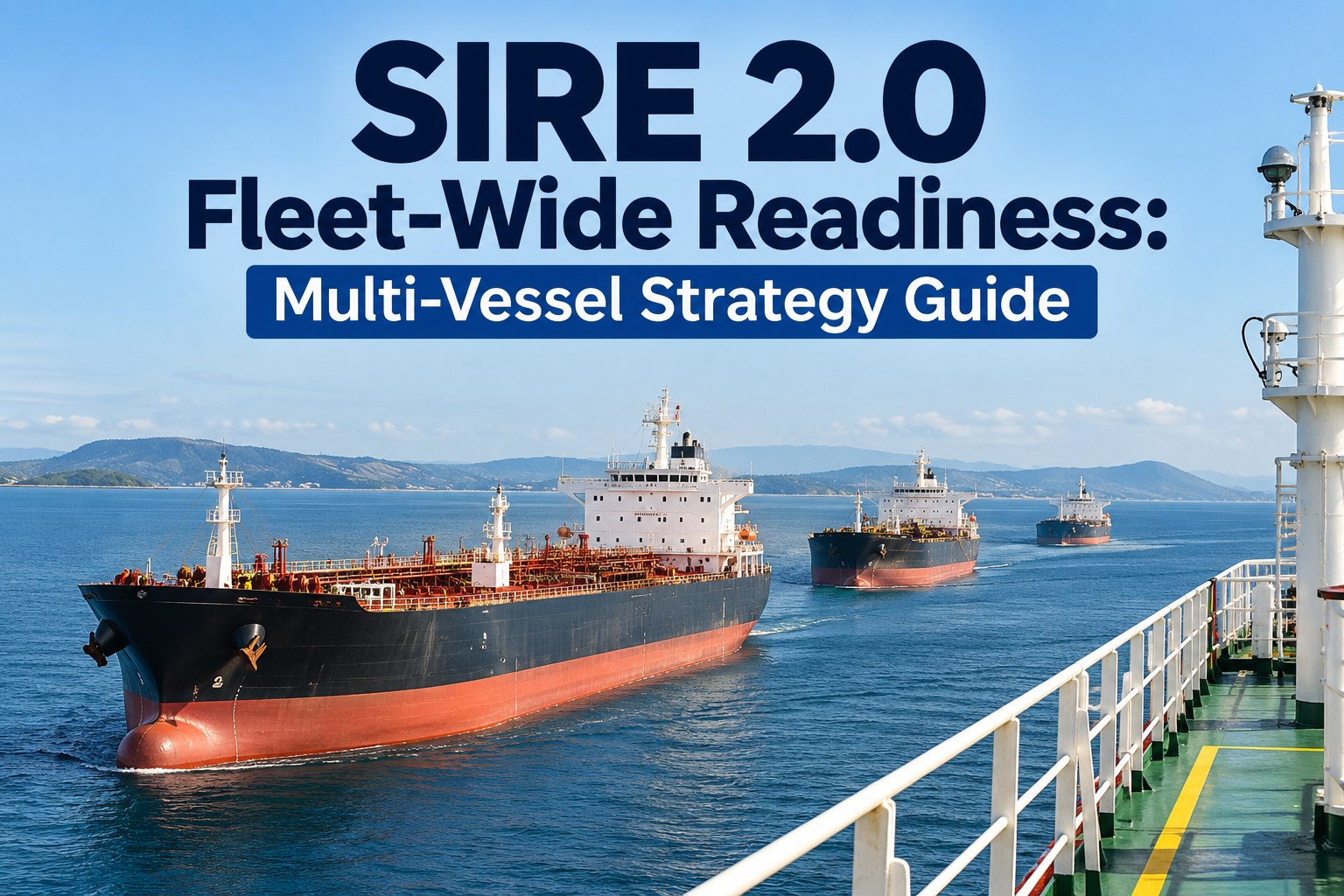
SIRE 2.0 fleet-wide readiness means every tanker in your fleet is ready for a vetting inspection on any given day, not just the ship with an inspection booked next week. For a QHSE Manager, that shift matters because SIRE 2.0 builds each questionnaire algorithmically, so no two inspections are the same and last-minute preparation rarely covers the right ground. This guide sets out a multi-vessel strategy: standardised procedures, cross-vessel observation trends, a 90-day rollout plan and the systems that hold it together. Start a free trial of Marine Inspection to run it from one place.
- SIRE 2.0 questionnaires are generated per inspection, so readiness has to be continuous and fleet-wide, not ship-by-ship cramming.
- Industry average negative observations fell from 6.33 in late 2024 to 5.24 in 2025, and human factor is 37% of them.
- Repeat findings are the cheapest to fix: about 1 in 4 observations had been raised on the same vessel before.
- Standardise procedures, photo evidence and action tracking across every vessel, then trend observations across the fleet.
- Start self-inspection about four weeks ahead, cover at least 80% of the questions and close findings with evidence.
What Fleet-Wide SIRE 2.0 Readiness Means
The OCIMF Ship Inspection Report Programme (SIRE 2.0) is the inspection regime that charterers, oil majors and terminals use to judge tanker quality. Reports stay on the OCIMF index for 12 months and in the database for two years, so every inspection is a public-facing record for your fleet, not a private event.
Vessel-level readiness asks whether one ship can pass one inspection. Fleet-level readiness asks whether your company can produce the same quality on every ship, every time, without heroic effort. The second question is the one charterers are really asking when they look at a run of reports across your vessels.
What changes under SIRE 2.0 for a fleet
- Algorithmic questionnaires. The questions are compiled per inspection from core, rotational, campaign and conditional sets, so you cannot rehearse a fixed list.
- Three observation types. One question can produce observations on hardware, process and human factors. Anglo-Eastern reports up to six observations from a single issue.
- Heavier preparation. World Ports Organization commentary notes that preparation time has doubled for some operators and that guidance grew from about 179 pages for VIQ 7 to nearly 1,300 pages.
- Year-round activity. Evidence, photos and records must stay current, not be assembled the week before.
Why Single-Vessel Preparation Fails at Fleet Scale
Preparing one ship at a time creates three problems. First, the work is repeated on every ship with no shared learning. Second, knowledge sits with the people on board and leaves with them at crew change. Third, nobody can see patterns, because each inspection is treated as its own story.
Idwal Marine notes that 10 to 15 observations on one inspection would once have been considered severe, yet are increasingly common under SIRE 2.0. Industry data also shows how concentrated the problems are. Kaiko Systems analysed 1,300 SIRE 2.0 reports from 25 tanker fleets and found that 10 of about 300 questions accounted for 40% of all observations, and that one in four observations had already been raised on the same vessel.
A fleet approach turns those patterns into leverage. If ten questions cause most of the findings, a fleet team can fix them once and roll the fix to every ship. If a quarter of findings are repeats, a closed-loop action process pays back quickly. See how Marine Inspection shows repeat findings across vessels.
The Benchmark Numbers to Manage Against
You cannot manage a fleet against numbers you do not track. The table below gives the public benchmarks that matter most. Compare your own fleet's average observations per inspection and the split between hardware, process and human factors with these figures.
| Measure | Value |
|---|---|
| Inspections analysed (INTERTANKO, 2025) | 7,241 |
| Negative observations per inspection, 2025 | 5.24 |
| Negative observations per inspection, late 2024 | 6.33 |
| Human factor share of negative observations | 37% |
| Safety management chapter share | 37.8% |
| Positive observations per inspection, now vs before | 0.88 vs 0.27 |
Why people-related causes dominate
The same report identifies the performance influencing factors behind human-factor observations. Personnel following custom and practice instead of the written procedure was the largest at 32.9%, followed by recognition of criticality at 30.3% and learning barriers at 12.1%. These are management problems, not individual failings, and they respond to fleet-level fixes such as clearer procedures, drills and structured crew handovers.
Build One Fleet Standard
A fleet standard is the set of things every vessel does the same way. It does not remove local judgement. It removes avoidable difference. The aim is that a superintendent can step onto any ship in the fleet and find procedures, photos and records where they expect them.
Standardised procedures, with room for vessel annexes
Write each critical procedure once at company level, then add a short annex only where the ship genuinely differs. Test the procedure by asking crew to explain it, not just sign it. SIRE 2.0 inspectors assess whether people can describe and follow the process, so the standard is only real if it lives in the crew's heads.
A dated, consistent photo library
Photo evidence is part of SIRE 2.0, and gaps or old photos are an easy source of observations. Agree a fleet list of required photos, a naming rule and a refresh cycle. Marine Inspection's own SIRE 2.0 guide recommends refreshing the photo repository on a regular schedule, about every six months. Review the set whenever equipment or layout changes.
Correct the questionnaire data
Anglo-Eastern notes that avoidable errors in the Harmonised Vessel Particulars Questionnaire and the Pre-Inspection Questionnaire produce negative observations. Kaiko found vessel data mismatches in 25% of inspections, and these reappeared on 40% of vessels with prior issues. Assign one owner to check particulars against the ship before every inspection, and complete pre-inspection work at least two days ahead as OCIMF asks.
Cross-Vessel Observation Trending
Trending is where fleet-level work pays back. Every observation, from every vessel, should be logged the same way: the question, the observation type (hardware, process or human factor), the performance influencing factor if human, the root cause and the corrective action. With that discipline, a QHSE team can ask questions no single vessel can answer.
| Measure | What it shows | Reference point |
|---|---|---|
| Repeat rate | Share of observations already raised on the same vessel before | Kaiko found about 1 in 4 |
| Top 10 questions | The ten questions that cause the most observations across the fleet | Kaiko found 10 of about 300 caused 40% |
| Observations per inspection | Fleet average and spread between best and worst vessel | INTERTANKO industry average 5.24 in 2025 |
| Closure time | Days from observation to closed corrective action with evidence | Set your own target and track the trend |
| Question coverage | Share of question categories self-inspected before each inspection | Kaiko saw 31% fewer at 80% or more coverage |
Review rhythm
- Weekly: open observations and corrective actions, with owners and deadlines.
- Monthly: question coverage by chapter and vessel, and the next inspections due.
- Quarterly: repeat findings, the fleet's top ten questions and the spread between best and worst vessel.
- Annually: a full review against TMSA claims and changes in the OCIMF question library.
Close the loop with evidence
Kaiko's data linked closing 75% or more of self-raised findings with 13% fewer observations, and completing 80% or more of the questions with 31% fewer. These are associations, not proof, but they point the same way as common sense: findings that are raised, owned and closed with evidence do not return. Turn each observation into a task with an owner, a deadline and proof of completion.
Fix the Human Factor Across the Fleet
With human factor at 37% of negative observations in the INTERTANKO data, no fleet strategy is complete without a crew-knowledge plan. A sample of early SIRE 2.0 inspections reviewed by WiseStella, a Singapore training provider, recorded 204 low-scoring areas across 26 vessels: 44 hardware, 78 process and 75 human factors. The weak spots it named were defect management and enclosed space entry.
What crews struggled to explain
- Defect management: creating a requisition when equipment fails, carrying out a risk assessment and following the company's defect reporting procedure.
- Enclosed space entry: atmosphere check intervals, permit to work rules and two-person entry. One inspection found a single permit used for several ballast tank entries.
A fleet crew-knowledge routine
We recommend three habits. First, a short knowledge check on the ten most frequent questions after every crew change, using the fleet's own trend data. Second, drills that make crew explain the procedure aloud, since SIRE 2.0 includes interviews. Third, a handover note from the outgoing officer listing open findings and local quirks. These are our suggestions, built from the performance influencing factors above.
Link Vessel Readiness to TMSA
The Tanker Management and Self-Assessment framework is the shore-side counterpart to SIRE 2.0. TMSA asks the operator to score its own management system across 13 elements, from leadership and shore personnel to navigational safety, mooring, incident investigation and maritime security, using four performance stages. SIRE 2.0 then inspects the actual vessel. Charterers can compare the two, so a claim of a high stage must be backed by objective evidence that inspectors will also see on board.
OCIMF recommends reassessment every 12 months. For a fleet team, that makes the SIRE 2.0 observation trend a natural source of TMSA evidence: it shows whether procedures are actually followed. The element and stage structure here follows a published summary of TMSA3, so check OCIMF for the edition currently in use before you map your own KPIs.
A 90-Day Rollout Plan
The Fleet Readiness Scorecard
| Check | Frequency | Owner | Evidence |
|---|---|---|---|
| Question coverage by chapter | Monthly | Marine Superintendent | Self-inspection record per vessel |
| Dated photo library | Every 6 months and after changes | Master and Chief Officer | Photo set with dates |
| Open observations and actions | Weekly | QHSE Manager | Task list with owners and deadlines |
| Repeat-finding review | Quarterly | QHSE Manager | Trend report across vessels |
| Crew knowledge checks | After each crew change | Master | Interview log with topics covered |
| Questionnaire data check (HVPQ, PIQ) | Before every inspection | DPA or Technical Superintendent | Particulars checked against the vessel |
| Internal audit | Per audit plan | Auditor | Audit report and close-out |
Systems That Keep Every Tanker Ready
Spreadsheets and shared drives can run a three-ship fleet. Beyond that, the three things that matter most under SIRE 2.0, question coverage, current photos and action follow-up, are hard to keep consistent. Look for tooling that does the following.
Marine Inspection is built around these four needs. Book a walkthrough built around your own fleet to see question coverage, photos and actions across your vessels in one view.