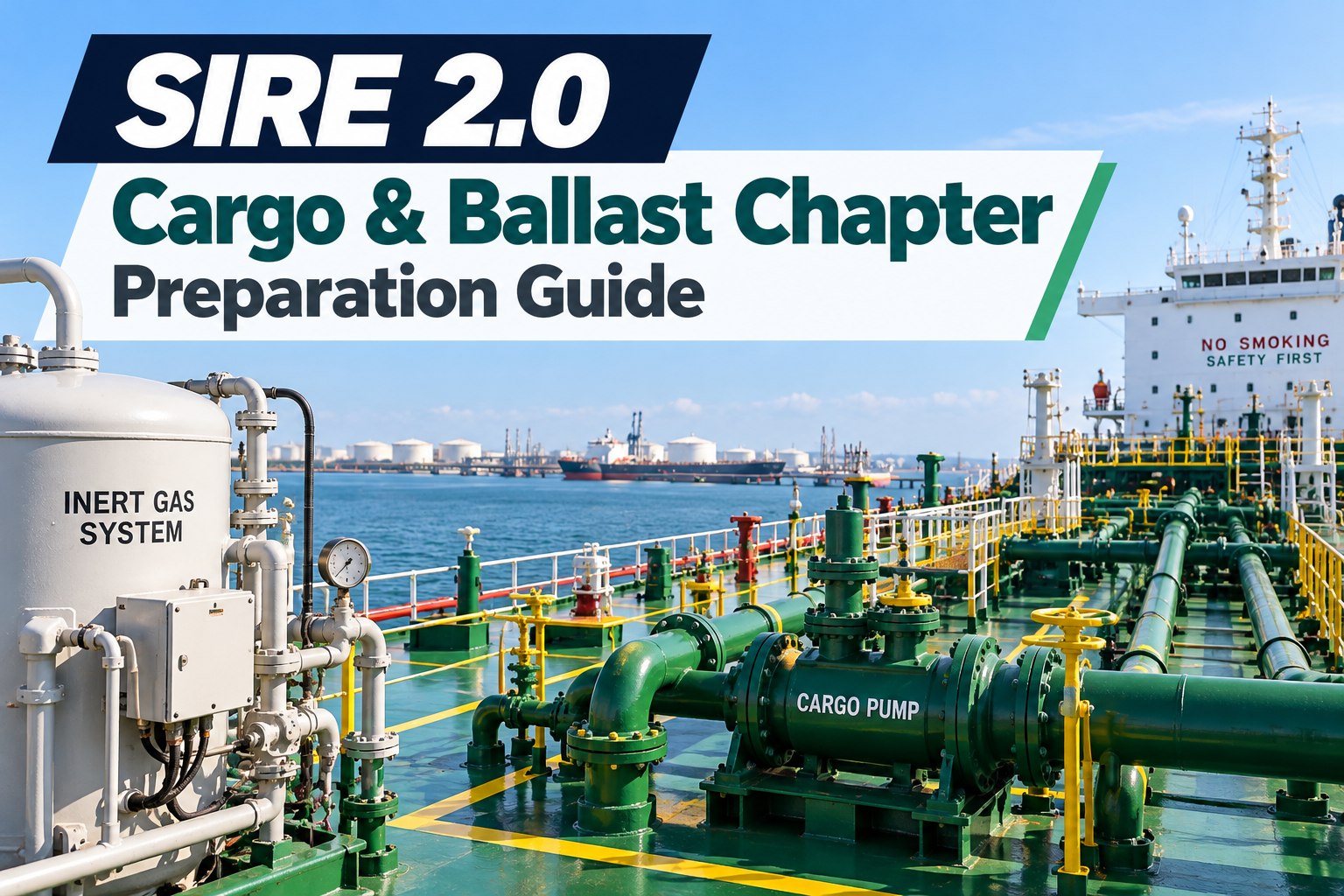
Chapter 8 is the only chapter of the inspection that is substantially different on every ship. Its sub-sections open by cargo type, so an oil tanker, a chemical carrier and a combination vessel are assessed against materially different question sets under the same chapter number. What does not change is the shape of the questions themselves: almost every one begins by asking whether the master and officers knew the company procedure, and ends by asking whether the records agree with it. The plant is the setting rather than the subject.
SIRE 2.0 · Chapter 8
Cargo and ballast is a chapter about procedures and records
Inert gas, crude oil washing, tank venting and tank cleaning are all asked the same way — did the people know the company procedure, was it applied as written, and does the paperwork show it. Preparing the hardware without preparing those two answers prepares the wrong thing.
Chapter 8 divides by cargo and vessel type. Knowing in advance which blocks open removes most of the uncertainty from preparing it, and a vessel certified for more than one trade opens more than one.
8.1
Oil
Inert gas, crude oil washing, tank venting isolation and cleaning after volatile cargoes. The largest block and the one most fleets prepare by default.
8.2
Chemicals
Inerting under SOLAS and the IBC Code, inhibited cargoes, cargo information from the P&A Manual and Certificate of Fitness, and cleaning after toxic cargoes.
8.3
Oil and chemical
Vessels certified for both carry the overlap, which in practice means two sets of procedures and crews who must know which one governs the cargo currently aboard.
8.4
LPG
Pressurised and refrigerated carriage, reliquefaction, and the cargo handling procedures that go with a product kept in condition rather than simply contained.
8.5
LNG
Cryogenic handling, boil-off management and the containment arrangements, assessed alongside the gas questions common to every vessel under the IGC Code.
8.6
Gas, all IGC vessels
The questions common to every gas carrier regardless of product, which open alongside the LPG or LNG block rather than instead of it.
8.7
Shuttle tanker operations
Offtake-specific cargo operations, which bring their own procedures and their own interaction with the positioning and mooring questions elsewhere in the set.
8.8
Combination carriers
Vessels switching between oil and dry bulk, where the change of trade is itself the risk and the procedures around conversion carry the weight.
8.99
All types
The questions that apply whatever the cargo. These open on every tanker and are the ones no vessel can argue out of scope.
One pattern, repeated through the chapter
Read the published questions side by side and the construction repeats. The inert gas question asks whether the master and officers knew the company procedures for the system and whether it was used in line with industry guidance, keeping tanks inert except when gas-free for entry. The crude oil washing question asks about planning, conduct and records. The tank cleaning questions ask about planning, risk assessment and supervision by a responsible officer. Procedure, application, record — three times over.
Question
Subject
What settles it
8.1.1
Inert gas on oil tankers — company procedures, use in line with industry guidance, tanks kept inert except when gas-free for entry
Officers describing the procedure, and the tank atmosphere record agreeing with the operation
8.1.2
Crude oil washing — planning, conduct and records, the oxygen check before washing, the qualifications of the person in charge, the pressure check before arrival
The washing plan, the oxygen readings, the named officer’s certification and the completed record
8.1.3
Isolating a tank from the common venting system — valve settings, locking arrangements and records
The isolation log, and valves found in the state the log describes
8.1.4
Cleaning after volatile cargoes — planning, risk assessment, supervision, gas-freeing records
A risk assessment specific to the cargo, and gas-freeing readings with times and names
8.2.1
Inerting on chemical tankers, against SOLAS and the IBC Code as well as company procedure
Procedures that cite the right instrument for the cargo currently carried
8.2.2
Inhibited cargoes, including oxygen-dependent inhibitors and when inerting may begin
The inhibitor certificate read and applied, with the oxygen dependency understood by the officer on watch
8.2.3
Cargo information — the P&A Manual, Certificate of Fitness, IBC Code and the relevant MEPC circular
Officers using those documents rather than naming them
8.2.4
Cleaning after toxic cargoes — planning, risk assessment and responsible officer supervision
The same evidence as 8.1.4, with the toxicity handled explicitly in the assessment
Question numbering and content belong to the published library and are revised over time, so confirm against the current issue before building a preparation pack. The programme mechanics sit in our SIRE 2.0 inspection guide.
Records that carry the chapter
Six record families answer most of chapter 8. Each one is produced during an operation rather than written afterwards, and each is checked against something physical.
Tank atmosphere readings
Oxygen content before washing and through the operation, with times, locations and the instrument used. Checked against the instrument’s own calibration record.
The washing plan as executed
Which tanks, which machines, what duration, and what actually happened against what was planned. Plans with no deviations recorded over many voyages read as unused.
Venting isolation log
Which tank was isolated, the valve positions, the locking applied and by whom. The one record an inspector can verify physically in under a minute.
Cargo-specific risk assessments
Written for the cargo actually carried rather than for the operation in general. A generic tank-cleaning assessment reused across products is the common weakness here.
Inhibitor and cargo certificates
The inhibitor certificate with its oxygen dependency and expiry, read against the carriage conditions rather than filed on receipt.
Person-in-charge qualifications
Who supervised the operation and what qualifies them to. Named in the record, with the certification behind the name reachable in the same place.
Inert gas, where most of the weight sits
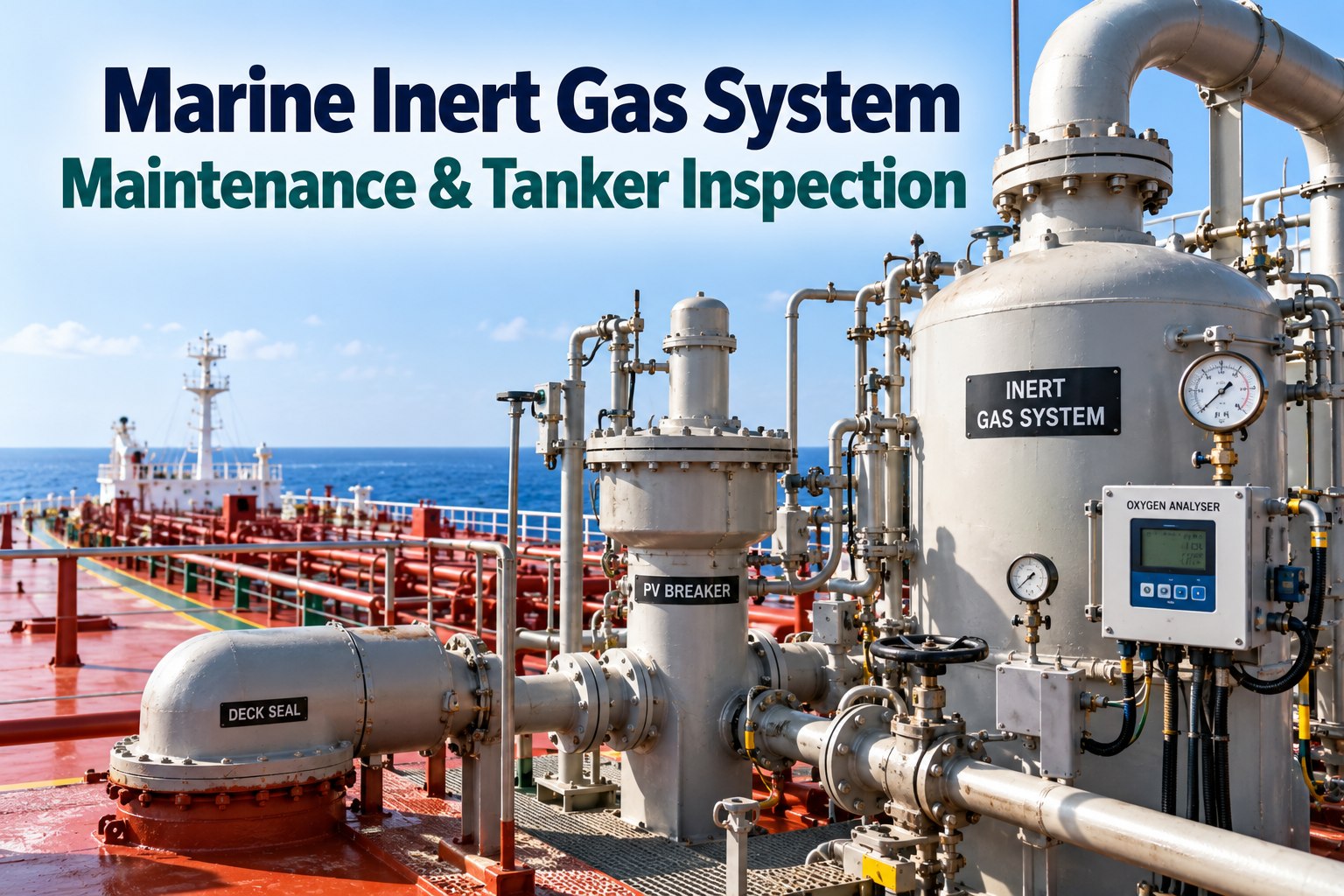
The inert gas question opens the chapter for both oil and chemical tankers, and it is constructed to be answered by people rather than by plant. An officer who can explain when tanks may be other than inert, and what the company procedure says about re-inerting after entry, has answered most of it.
1
The condition, stated as a rule
Tanks remain inert except where they have been deliberately gas-freed for entry. The officer should state that as the operating rule rather than reason toward it, because reasoning toward it under questioning reads as unfamiliarity.
2
The procedure, not the principle
Industry guidance sets the principle; the question asks about the company procedure. Answers that quote the guidance and cannot locate the company document miss the half that was being examined.
3
The record alongside the operation
Oxygen content and pressure logged through the operation, consistent with what the cargo record says was happening at that time. Two records that disagree generate more than one observation.
4
The alarms, proven rather than assumed
Low pressure and high oxygen alarms tested and recorded at their stated interval. Equipment in service for years without a documented test is the quiet failure in this group.
Chemical vessels carry the same question against SOLAS and the IBC Code, and the inhibited cargo question sits beside it — including which inhibitors depend on oxygen being present, and therefore when inerting may begin at all. Getting that sequence wrong is a cargo problem before it is an inspection problem.
Operational records produced by the operation itself
Marine Inspection captures atmosphere readings, wash plans, isolations and risk assessments as the work happens, with the responsible officer named and their certification attached — so chapter 8 is answered from records rather than reconstructed from memory.
The chapter is titled cargo and ballast systems, and ballast gets a fraction of the preparation attention that cargo does. That imbalance is understandable and it is also where a well-prepared vessel loses marks, because the ballast questions sit at the join between two systems that must never meet.
Segregation is the whole point
The integrity of the separation between cargo and ballast is what an inspector is examining, whatever form the question takes. Valves, lines and any arrangement that could connect the two carry more weight than the ballast operation itself.
Records have to agree across systems
The ballast record, the cargo record and the oil record book describe the same hours of the same voyage. Where they disagree about what was happening and when, the disagreement is the finding rather than any single entry.
Treatment plant is maintenance, not paperwork
Ballast water management equipment is judged on whether it runs and is maintained, in the same way as any other installed system, and crew familiarity with operating it is examined alongside the record of its use.
Tank condition is part of the answer
Coating condition and structural state in ballast tanks feed the structural questions elsewhere in the set, and an inspector who has seen a ballast tank forms a view that colours the rest of the visit.
The practical preparation is to walk the ballast system with the same seriousness as the cargo system once before an inspection is due, checking that the valve states match the log and that the three record sets tell one story. You can book a demo to see cargo and ballast records held against the same voyage so the inconsistencies surface before an inspector finds them.
Several questions turn on supervision: the person in charge of crude oil washing and the responsible officer supervising tank cleaning both have to be identifiable and qualified. Fleets lose marks here for administrative reasons rather than competence ones.
The record names a rank, not a person
“Chief Officer” does not identify who supervised when three people have held that position in eight months. Record the name, and the rank follows from it.
The certification lives somewhere else
A named officer whose qualification takes twenty minutes to locate has effectively not been evidenced. Keep the competence record reachable from the operation record.
Supervision was nominal
Where the named officer was demonstrably on watch elsewhere, the record is worse than no record. Supervision assignments need to survive comparison with the watch schedule.
Nobody briefed the relief
An operation spanning a watch change needs the handover recorded, otherwise the second half of it has no supervisor named at all.
SCScope and procedures
You know which sub-sections open for this vessel’s certification and trade
Company procedures exist for each operation those sub-sections cover
Officers can locate the company procedure, not only the industry guidance
Procedures cite the instrument that governs the cargo currently carried
Dual-certified vessels have both sets, and crews know which one applies
RCRecords and people
Atmosphere readings carry times, locations and the instrument used
Instrument calibration records are current and reachable
Wash plans show what actually happened, including deviations
Risk assessments are cargo-specific rather than generic
Supervising officers are named, qualified and consistent with the watch schedule
Anything unmarked in the right-hand column converts straight into an observation, because those are the items an inspector verifies rather than discusses. Broader preparation across the whole question set is covered in our SIRE inspection checklist, and you can book a demo to see cargo records held against each vessel.
Runs the chapter 8 checkpoints as an internal check before an external one, and captures atmosphere readings, wash plans and isolations as the operation is carried out rather than after it.
Document ControlProcedures · Manuals · Cargo Information
Keeps the company cargo procedures, the P&A Manual, the Certificate of Fitness and cargo documentation at their current revision at the point of use, so an officer finds the governing document rather than a superseded one.
Holds the inert gas plant, alarms and measuring instruments on routines with their calibration dates, which is what turns an alarm test from an assumption into a record.
Links the supervising officer named in an operation record to their certification and familiarisation, so the person-in-charge question is answered in one place instead of two systems.
Risk & PermitsAssessment Library · Permit to Work
Produces cargo-specific assessments from a library rather than reusing one generic document, and ties the permit to the operation it governs with the supervisor recorded on it.
Shows where the same chapter 8 weakness is recurring across vessels, which is where a procedure revision does more than another visit to one ship.
Cargo and ballast chapter: frequently asked questions
Which chapter covers cargo and ballast?
Chapter 8, Cargo and Ballast Systems, in the published question library. It sits alongside mooring and anchoring, machinery spaces, general appearance and ice operations in the second part of the library.
Does every tanker get the same chapter 8?
No. The chapter divides into sub-sections by cargo and vessel type — oil, chemicals, oil and chemical, LPG, LNG, gas questions common to vessels under the IGC Code, shuttle tanker operations, combination carriers, and a block applying to all types. A dual-certified vessel opens more than one.
What does the inert gas question actually ask?
Whether the master and officers knew the company procedures for the system, and whether it was used in line with industry guidance, with tanks kept inert except where deliberately gas-freed for entry. Chemical vessels carry the same question against SOLAS and the IBC Code as well.
What is examined around crude oil washing?
Planning, conduct and records, including the oxygen check before washing begins, the qualifications of the person in charge, and the pressure check before arrival. The plan, the readings, the named officer and the completed record together answer it.
Where do fleets most often lose marks?
Generic risk assessments reused across different cargoes, supervising officers recorded by rank rather than by name, instrument calibration records that cannot be produced alongside the readings they support, and officers who can quote industry guidance but cannot find the company procedure the question is actually about.
How should the chapter be prepared?
Establish which sub-sections open for the vessel, confirm a company procedure exists for each operation they cover, make sure officers can locate those procedures, and check that the records produced during operations carry times, names, instruments and deviations. The hardware matters, but the questions are built around procedure, application and record.
Chapter 8 readiness
Prepare the two answers the questions are actually built on
Marine Inspection keeps company cargo procedures current at the point of use, captures operational records with their readings, instruments and named supervisors, and holds the competence behind each name — so procedure, application and record all point the same way.