On the day of a SIRE 2.0 inspection there are two photo libraries in play. One belongs to the inspector, who works from a handheld device and photographs what they find to corroborate their observations. The other belongs to you, and it is the only one you can do anything about. Most operators spend their preparation on the ship and almost none on that second library — which is how a vessel in genuinely good condition arrives at an inspection with a photo repository that is eighteen months stale, half-labelled, and quietly working against her.
SIRE 2.0 · evidence and documentation
The inspector photographs what they find. You photograph what you maintain. Only one of those is still editable.
SIRE 2.0 photo evidence: why the operator’s library matters
SIRE 2.0 runs as a digital inspection. The inspector works from a handheld device, records observations in real time and takes photographs as evidence to corroborate findings. That changes the character of the whole exercise: an observation now arrives attached to an image, and an image is considerably harder to argue with afterwards than a line of text.
The operator’s response to that is not to dispute photographs. It is to arrive with a photographic record of their own — one that shows the condition the ship was maintained in, when, and by whom. Where the two records agree, the inspection is short. Where the operator has no record at all, the inspector’s photographs are the only evidence that exists.
The standardised photo repository and the six-month rule
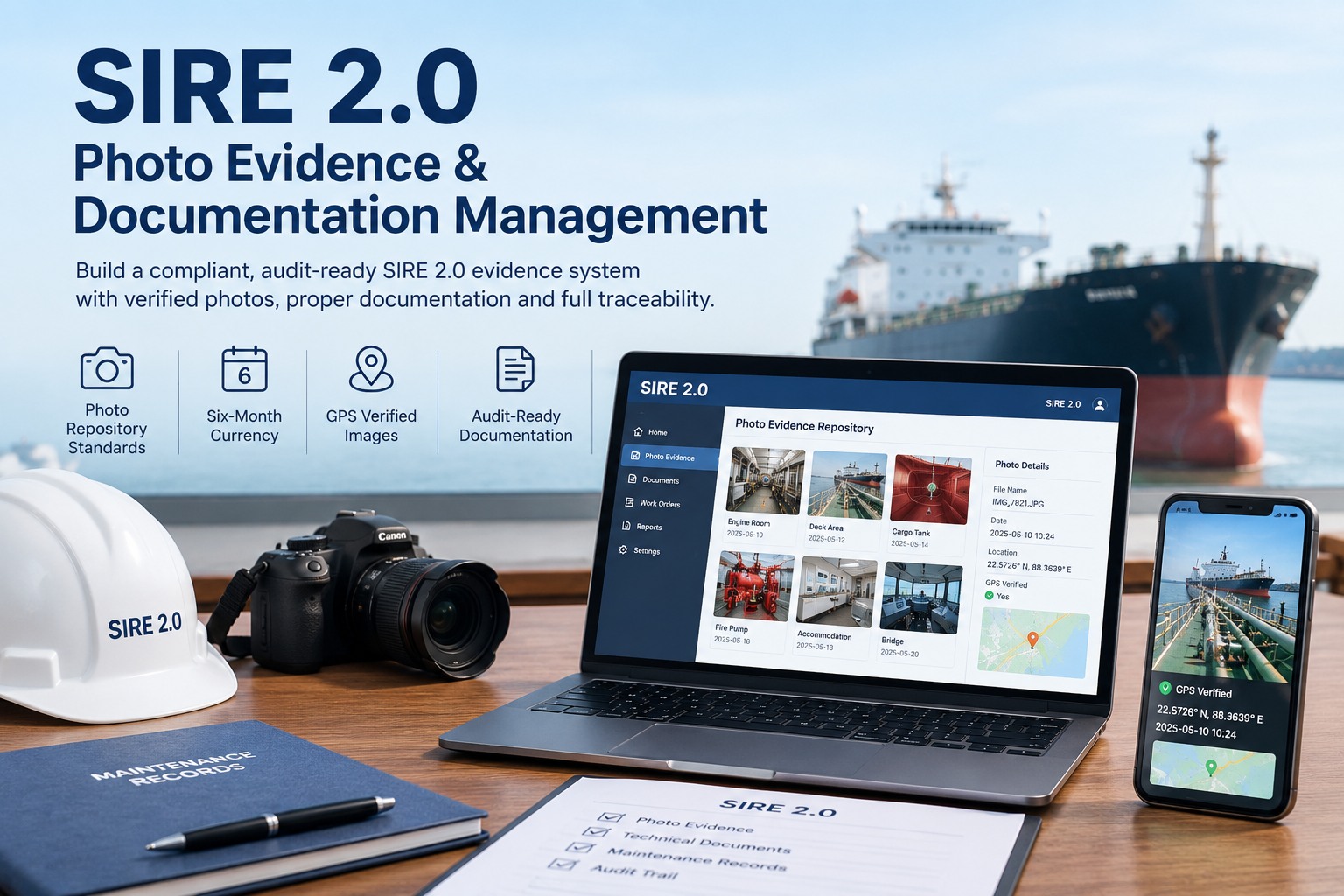
Operators are expected to hold a repository of standardised vessel photographs, following OCIMF’s guidance on what to capture and how, covering safety-critical equipment and spaces. The working rule of thumb across the industry is that the repository is refreshed within the last six months. A stale or incomplete repository is an avoidable finding before the inspector has even boarded.
6 months
Working currency for the repository as a whole
Standardised
Taken to the published guidance, not to local preference
Safety-critical
Equipment and spaces first, cosmetics never
Complete
Gaps read as avoidance, not as oversight
Six months is a rhythm rather than a deadline, and the ships that keep it are the ones that attach the photograph to the job rather than to a photo session. A valve overhauled in March is photographed in March, as part of closing the job, and the repository stays current without anybody organising a campaign.
What belongs in the repository
The coverage below is the practical shape of a repository that answers questions rather than raising them. It follows the areas an inspection actually works through.
Cargo and ballast systems
Manifolds and drip trays, cargo pumps and seals, relief valves with their settings legible, IG deck seal and non-return arrangements, tank cleaning and COW equipment, vapour return connections.
Mooring and deck
Winches and brakes with their test records visible, line and tail condition and markings, bitts and fairleads, the mooring arrangement as rigged, pilot ladder and access arrangements.
Machinery spaces
Main and auxiliary engine condition, purifiers, bilge and oily water equipment with seals intact, emergency generator and its starting arrangement, engine room cleanliness as it normally is.
Safety and life-saving
Lifeboat and davit condition, release gear, fire-fighting equipment with its service labels readable, fixed system controls and instructions, escape routes clear.
Navigation and bridge
Equipment in its working state, publications and charts, the bridge as it looks during a normal watch rather than after a tidy-up.
Structure and coatings
Tank internals from the last entry, deck plating and fittings, ballast tank condition against the last survey, areas previously noted as needing attention.
The photographs that do damage
A repository is a record, not a brochure. Images taken after a one-off clean-up of a space that does not normally look like that opens a gap between the evidence and the ship, and an inspector who walks into that gap now has two findings instead of one. Photograph the ship as she is maintained, and fix what the photograph shows you.
What makes a photograph defensible
Most photographs on most ships prove very little, because they show a thing without showing which thing, when, or how big. Four attributes separate an image that settles a question from one that starts one.
01
A wide shot and a close shot
The wide frame establishes location and context; the close frame carries the detail. Either alone is arguable. Together they are not.
02
Something for scale
A rule, a coin, a gloved hand. Without it, a 2 mm crack and a 20 mm crack look identical on a screen, and the reader will assume the worse of the two.
03
Enough light
Underexposed images of machinery spaces and tanks are the commonest failure. If the detail is not visible on a phone screen in daylight, the photograph has not been taken.
04
Identification attached
Which unit, which tank, which hatch. A filename of four digits from a camera is not identification, and renaming two hundred files later never happens.
Position data, timestamps and metadata
A word of precision here, because it gets overstated. Nothing in the inspection regime requires an operator’s photographs to carry position data. Geotagging and verified timestamps are not a compliance requirement; they are an evidential control that the operator chooses to apply because it changes how the photograph behaves when somebody questions it.
What they buy you is simple. A photograph with a date, a time, a position and a unit identifier attached cannot be mistaken for another vessel, another tank, or another voyage, and it cannot be quietly recycled from a previous inspection. A photograph without them relies on somebody remembering, and the person who remembers has usually been relieved.
Date and timeProves currency against the six-month expectation and against the job it closes
PositionTies the image to a voyage and a port call, which matters when an item was signed off at sea
Unit or space identifierRemoves the ambiguity that makes a photograph useless as evidence of anything specific
Who took itGives the record an owner, which is what turns a file into testimony
Photographs taken at the job, not at a photo session
Marine Inspection captures the image inside the inspection or the work record, stamps it with the date, position and unit, and files it against the vessel — so the repository stays current because the work keeps it current.
Evidence types, what each proves, and how each fails
Photographs are one evidence type among several, and an inspection draws on all of them. The failure column is the useful one: each type has a characteristic way of being unconvincing.
Evidence type
What it proves
How it characteristically fails
Photographs
Physical condition at a known moment
No scale, no identification, no date — or taken after a clean-up that does not reflect normal condition
Maintenance records
That the work was planned, done and closed
Jobs closed with no result recorded, so the record proves attendance rather than outcome
Test and reading logs
That equipment performs to its figures
Identical readings week after week, which reads as a form being completed rather than a measurement taken
Certificates and reports
That a third party verified something
Held ashore rather than on board, or expired without anybody tracking the date
Training and familiarisation
That the crew were prepared for their duties
Signed sheets with no content behind them, contradicted the moment somebody is asked to demonstrate
Close-out evidence
That a previous observation was actually resolved
A statement that action was taken, with nothing attached showing the state afterwards
Questionnaire data
That the operator knows their own vessel
Particulars carried forward from an earlier version and no longer matching the ship
Programme requirements are published by OCIMF and are revised from time to time. Treat the published guidance as governing and this page as a way of organising the work behind it.
The questionnaires: evidence that arrives before the inspector
Two documents reach the inspection ahead of the ship. The Harmonised Vessel Particulars Questionnaire describes what the vessel is; the Pre-Inspection Questionnaire describes how she is operated and maintained, and it feeds the risk model that helps decide which questions appear in the inspection at all.
That last point is worth dwelling on, because it is where operators underestimate the stakes. The questionnaire is not an administrative formality submitted to unlock an inspection date. It shapes the inspection. Particulars that are inaccurate do not merely look careless; they undermine the whole exercise from the start, because the question set has been assembled around a description of a ship that does not match the one the inspector boards.
Review on a schedule, not on demand
Both questionnaires are reviewed and refreshed regularly rather than revisited when an inspection is booked. A ship that only touches them under time pressure will carry forward last year’s answers.
Verify against the vessel, not the file
Particulars, equipment fits and arrangements change. The check is against the ship as she is today, done by somebody who has been on board.
Keep the photo set alongside
The repository and the questionnaires are one package. A complete, current photo set submitted with accurate particulars sets a tone before anybody arrives.
Closing out observations with evidence
Every inspection leaves items, and the next one begins by looking at how the last ones were closed. This is the single highest-value piece of evidence an operator holds, because it answers the question the whole programme exists to ask: does this organisation act on what it is told?
1
State the observation as received
In the inspector’s words, not a softened paraphrase. A rewritten observation reads as a disagreement being managed rather than a problem being fixed.
2
Record the cause, not the symptom
A loose cable tray is a symptom. The absence of a routine that would have found it is the cause, and the cause is what stops it recurring on the sister ship.
3
Attach the after state
A photograph of the corrected condition, with date and identification, alongside the job record from the planned maintenance system that carried the work.
4
Push it across the fleet
The same observation on three ships is the finding that matters. Closing it on one and waiting to be told about the others is how repeat observations are born.
Retention, versioning and who owns the file
An evidence system that cannot be retrieved is not an evidence system. Three questions settle whether yours is real, and all three are usually answered by accident rather than by decision.
How long is it kept?
Long enough to cover the inspection cycle and any dispute that follows it, which in practice means years rather than months. Photographs are small; the storage argument is not a real one.
Which version is the record?
One repository, one current set, with superseded images retained rather than overwritten. Two copies in two places means the wrong one gets sent.
Who can get it out?
If the evidence lives inside a supplier’s system, the ability to export it in a usable form is a contract question as much as a technical one — the same ground covered by data ownership and lock-in clauses.
The adjacent discipline is record books. Evidence of maintenance sits beside the statutory record set, and an inspection that finds an immaculate photo repository alongside a ragged set of pollution prevention record books has learned something about where the organisation’s attention goes.
Building the evidence system in ninety days
This is a standing capability rather than a campaign, but it has to be started somewhere, and ninety days is enough to go from nothing to current.
Weeks 1 – 2Define the shot list from the published guidance and the areas above. Name every required image, with the unit or space identifier it must carry. The list is the system; everything else is execution.
Weeks 3 – 6Capture the backlog, one area per week, in normal working condition. Fix what the camera shows rather than staging around it — that is the point of doing this before an inspection rather than during one.
Weeks 7 – 8Attach capture to the job. From here, an image is taken when work is closed, not when a repository refresh is scheduled. This is the change that makes six months sustainable.
Weeks 9 – 10Verify the questionnaires against the ship with somebody who has been on board, and file the photo set as one package with them.
Weeks 11 – 12Work back through the last inspection’s observations and attach after-state evidence to each. Any you cannot evidence are still open, whatever the file says.
OngoingA monthly check that nothing in the repository has passed six months, handled as a due date like any other rather than as a project.
Does SIRE 2.0 require operators to hold photographs?
Operators are expected to maintain a repository of standardised vessel photographs following OCIMF’s guidance on what to capture and how, covering safety-critical equipment and spaces, and to keep it current. Separately, the inspector photographs findings on a handheld device during the inspection itself.
How current must the photo repository be?
The working rule of thumb is refreshed within the last six months. A stale or incomplete repository is treated as an avoidable finding, because it is entirely within the operator’s control and costs nothing but attention.
Do photographs need GPS data?
No. Position data and verified timestamps are not a programme requirement. They are an evidential control an operator applies because a photograph carrying a date, position and unit identifier cannot be confused with another ship, tank or voyage, and cannot be recycled from a previous inspection.
What makes a photograph useful as evidence?
A wide shot establishing location and a close shot carrying the detail, something in frame for scale, enough light that the detail reads on a screen, and identification of the unit or space attached to the file rather than remembered by the person who took it.
What is the PIQ and why does it matter so much?
The Pre-Inspection Questionnaire describes how the vessel is operated and maintained, and it feeds the risk model that helps decide which questions appear in the inspection. Inaccurate particulars undermine the inspection from the start, because the question set was assembled around a description that does not match the ship.
How should previous observations be closed out?
State the observation in the inspector’s own words, record the cause rather than the symptom, attach evidence of the state afterwards with a date and identification, and apply the finding across sister vessels rather than closing it on one ship and waiting.
Is it a problem to tidy a space before photographing it?
Yes, if the result does not reflect how the space is normally maintained. The repository is a record rather than a brochure, and a gap between the photographs and the ship gives an inspector two findings instead of one.
Where should the evidence be stored?
Somewhere with one authoritative current version, retained across the inspection cycle rather than overwritten, and exportable in a usable form. If it lives in a supplier’s system, the ability to get it out is a contractual question as much as a technical one.
Evidence, not assurance
Make the record defend the ship
Marine Inspection holds the photo repository, the maintenance record and the close-out evidence against the vessel — images captured at the job with date, position and unit attached, currency visible at a glance, and the whole set exportable across the fleet.