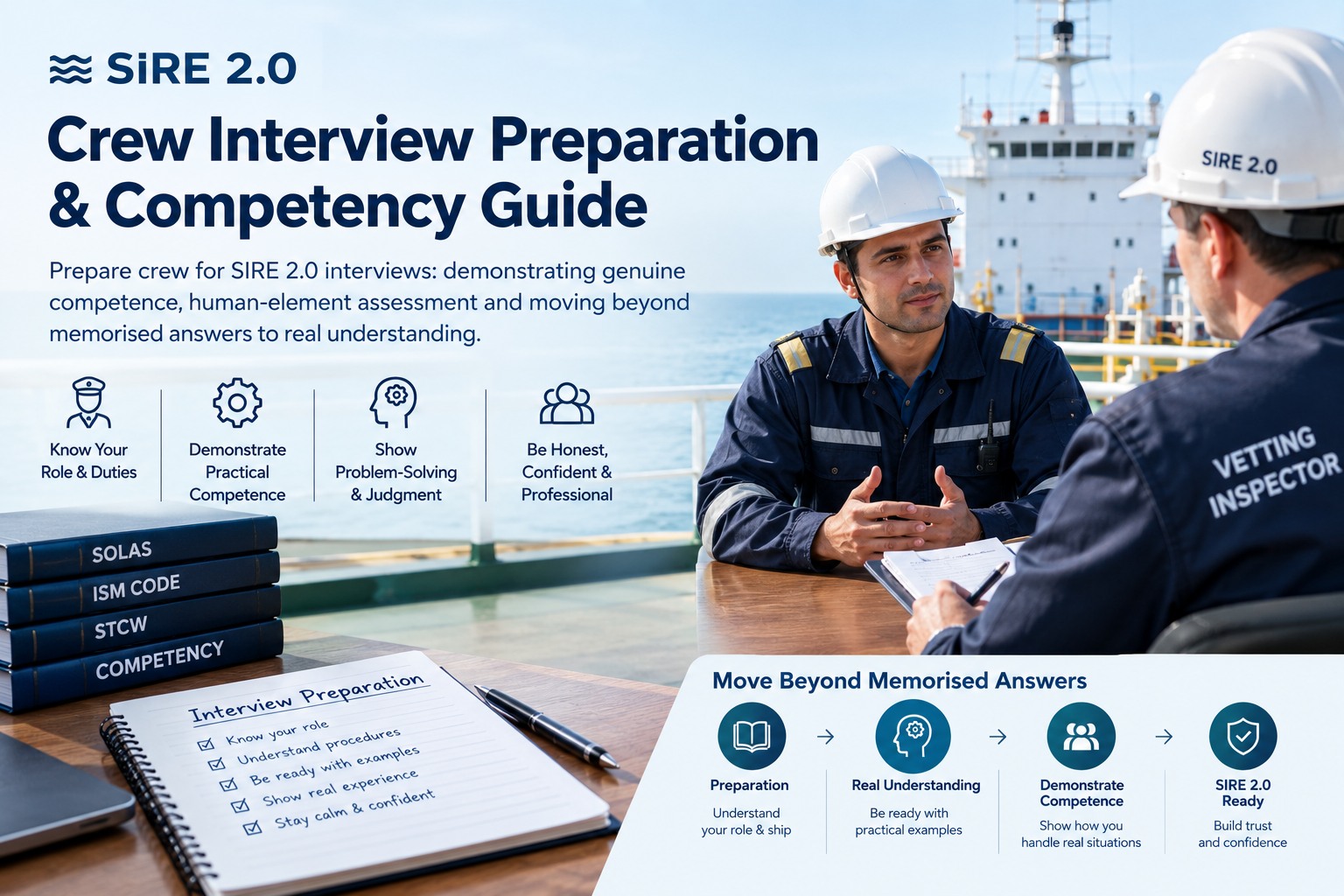
There is a moment in every SIRE 2.0 inspection that no amount of paintwork prepares a ship for. The inspector stops in front of an ordinary seafarer, asks an ordinary question about an ordinary task, and then asks a second question about the answer. The first question can be survived on memory. The second one cannot.
That second question is the whole of the human-element assessment in miniature. The regime assesses hardware, process and the human element together, every observation links to at least one performance influencing factor, and crew are observed and questioned on whether they actually understand and can perform their tasks rather than on whether a procedure exists on paper. Memorised, scripted answers are precisely what the approach was built to see through.
Human element · crew interviews
The question is never the test. The follow-up is.
Familiarisation, training and competence records, closed on the day they happen
The human-element evidence has to exist on paper as well as in practice. Marine Inspection keeps both against the vessel and the person.
What the SIRE 2.0 crew interview is actually assessing
It is tempting to read the interview as a knowledge test, and to prepare for it the way one prepares for an examination. That misreads what is happening. The inspector is not trying to find out what the seafarer knows. They are trying to find out whether the management system reached them — whether the procedure written ashore became a practice on board, and whether this particular person was equipped to carry it out.
That is why the assessment considers how well personnel are trained and familiar with their tasks, particularly the high-risk ones, and why every observation is linked to a performance influencing factor. A seafarer who cannot explain a task is rarely the finding. The finding is usually what put them in that position.
Not this
Does the crew know the answer?
A knowledge check that a good memory passes and a good seafarer can fail on a bad morning. Nothing about it predicts how the ship behaves at three in the morning.
This
Did the system reach this person?
Whether they were familiarised, trained, given a usable procedure, and left with enough time and support to do the task the way it is written.
And this
Can they do it, not just say it?
Explaining and physically demonstrating the task, speaking to the procedure, the equipment and why the step matters — in their own words.
Why memorised answers make things worse
Crews are often coached before a vetting inspection, and the coaching is usually well meant. It is also the single most reliable way to turn a recoverable situation into a bad one, for three reasons.
1
A script invites the follow-up
A fluent, textbook answer from someone who then cannot say when they last performed the task is the clearest signal an experienced inspector gets all day. The polish is what draws the second question.
2
It converts one gap into two
An honest “I would check the procedure, it is here” is a competent answer. A recited paragraph that falls apart under one further question becomes a question about the organisation as well as the individual.
3
It frightens the people who know the job
Crews told to produce specific wording become afraid of saying the wrong thing, and a nervous expert gives a worse account of themselves than a relaxed competent one. The coaching produces the hesitancy it was meant to prevent.
The regime rewards vessels that run well every day and exposes those that only prepare for the inspection. There is no preparation technique that substitutes for the year before it.
Who is interviewed, and what each role is asked about
Interviews reach well beyond the senior officers. Ratings are asked about the tasks they actually perform, which is often where preparation has been thinnest, and where the gap between what the system says and what the ship does is widest.
Role
Likely ground
Competence looks like
A memorised answer looks like
Master
Safety management system ownership, risk assessment, how decisions are made under commercial pressure
Describes a real decision taken on this ship, including one that cost time, and what the system did with it afterwards
Describes the policy rather than any occasion on which it was applied
Chief Officer
Cargo and ballast operations, enclosed space entry, permit to work, mooring arrangements
Walks through the operation at the equipment, naming the checks and the reason behind each one
Recites the sequence correctly but cannot say what would stop the job
Opens the record, shows the last job and its result, and explains what the readings have been doing
Knows the interval by heart but reaches for somebody else when asked for the last result
Officer of the watch
Bridge procedures, equipment in use, passage plan, what happens when an alarm sounds
Shows the settings actually in use on this watch and explains why they are set that way here
Quotes the standing orders without reference to tonight’s passage
Engine watchkeeper
Alarms, routine checks, response to a known fault, familiarity with the space
Describes what they personally check each round and what they did the last time something was wrong
Lists the checks in the order printed on the rounds sheet
Ratings
Their own tasks, personal protective equipment, mustering duties, who they report to
Explains their job plainly and knows where to find the instruction if unsure
Gives a rehearsed phrase, in a language they are not comfortable in, then stops
Newly joined, any rank
Familiarisation: what they were shown, by whom, and when
Can describe the walk-round they were given and point to the equipment involved
Signed the familiarisation form and cannot recall the walk-round it records
Two of these rows are worth preparing for specifically because they are so commonly weak. The watchkeeping answers sit directly on the SOLAS Chapter V navigation safety ground, and the pollution prevention questions — oily water equipment, record books, what the engineer does when a reading looks wrong — follow the same lines as the MARPOL annex requirements an engineer already works to.
The four observation outcomes, and what moves a crew between them
Inspectors rate what they see on a scale, and the interview feeds it like anything else. Knowing the ladder helps, mostly because it shows how modest the gap is between the middle two rungs.
Exceeds expectations
Best practice. Typically a crew that has thought about the task beyond the procedure and can say why their way is better.
As expected
The standard is met. This is the target, and it is reached by ordinary competence described plainly.
Largely as expected
Acceptable, with room to improve, and it may prompt further questions — which is where a thin answer turns into a longer conversation.
Not as expected
Falls short, and a negative observation follows, attributed to hardware, process or the human element.
The useful insight is in the third rung. “Largely as expected” may prompt further questions, and further questions are how a single soft answer becomes an afternoon. Crews that answer plainly and completely the first time are not just scoring better; they are shortening the inspection.
Competence you can evidence, not just assert
Familiarisation walk-rounds, drills, task-based training and competence assessments recorded against each seafarer and each vessel — so when an inspector asks what this person was shown and when, the answer takes a few seconds.
Performance influencing factors: what the answer is really about
Because every observation links to at least one performance influencing factor, a weak interview answer is traced to a cause rather than recorded as a failing. Those factors are the conditions an organisation puts its crew in, and they are where the corrective action lands.
Read the list honestly and most interview weakness becomes predictable. A seafarer who joined eight days ago in a port call that allowed no proper handover will struggle, and the cause is the handover. An engineer pulled through a week of short rest will answer thinly about auxiliary engine maintenance they genuinely understand. Fixing those conditions improves interview performance far more reliably than briefing people on what to say.
How to prepare a crew properly
What works
Have people walk through their own tasks at the equipment, out loud, to a colleague — weeks ahead, as routine rather than as rehearsalTell crew plainly that “I check the procedure, it is here, and here is the last time I did it” is a strong answer, not a weak oneClose familiarisation and training records as they happen, so the paper and the practice agreeMake sure every person can name the two or three high-risk tasks in their own role and say what makes each one riskyFix the conditions — rest, handover, usable procedures — because those are the findings behind most thin answersLet the person who does the job answer about the job, rather than routing every question through the Master
What backfires
Issuing model answers or a question bank to learn, which is the pattern the approach was designed to detectBriefing crew to keep answers short and defer upward, which reads as a crew that has been told not to speakA week of intensive preparation before arrival, which raises the contrast between the ship on the day and the ship all yearBackdating or tidying familiarisation records, which turns an improvable gap into an integrity questionTelling anyone to answer in English beyond their comfort rather than asking for the question to be rephrasedTreating a weak answer in practice as the individual’s failing instead of looking for what put them there
Language, nerves and saying “I do not know”
Three practical matters decide more interviews than technical knowledge does, and all three are within an operator’s gift to handle well.
Language
A seafarer working in a second language should be told it is entirely acceptable to ask for a question to be put another way, or to say they have understood it differently. Inspectors deal with this constantly. Guessing at a misheard question produces a wrong answer about a task the person performs correctly every day.
Nerves
Most crew have never been questioned by a stranger about their work. Normalise it beforehand by doing it internally, calmly, more than once, so that the inspector is not the first person who ever asked.
Not knowing
“I do not know, this is where I would look, and this is who I would ask” demonstrates exactly the behaviour a safe operation depends on. An invented answer does the opposite, and it is almost always detected.
An eight-week preparation approach
Eight weeks of ordinary practice beats a week of rehearsal, and most of what follows is work the ship should be doing anyway.
Weeks 1 – 2Confirm familiarisation and training records are complete and genuinely reflect what each person was shown. Where a record is thin, redo the walk-round properly rather than improving the paperwork.
Weeks 3 – 4Each department identifies its high-risk tasks and has the people who perform them talk through one each week, at the equipment, to a colleague. No scripts, no wording to learn.
Weeks 5 – 6Officers ask open questions on routine rounds — why this check, what stops the job, what was the last result. The aim is that being asked becomes unremarkable.
Week 7Look honestly at the performance influencing factors: rest hours, handover quality, whether procedures are usable at the equipment, whether anybody is carrying two roles. Address what can be addressed.
Week 8A short, calm brief on what to expect and how the interview works — not what to say. Reiterate that checking a procedure and admitting uncertainty are both good answers.
Well beyond the senior officers. The crew rather than only the hardware is under direct assessment, and ratings are questioned about the tasks they personally perform. The newly joined, of any rank, are a particular focus because familiarisation is directly testable.
Should we prepare model answers for the crew?
No. Crew are expected to explain and physically demonstrate critical tasks in their own words rather than recite them, and memorised, scripted answers are exactly what the approach is designed to see through. Coaching tends to turn a recoverable gap into a worse finding.
Is it acceptable for a seafarer to consult the procedure?
Yes, and it is often the better answer. Knowing where the instruction is, being able to find it quickly and being able to explain why the step matters demonstrates the behaviour a safe operation relies on. Reciting from memory without that does not.
What if a crew member does not know the answer?
Saying so, then saying where they would look and who they would ask, is a competent response. An invented answer is detected almost immediately and casts doubt on everything else that person said.
How does the human element affect the observation itself?
Inspections assess hardware, process and the human element, and every observation links to at least one performance influencing factor. Where an issue spans more than one dimension, the response is structured so each is answered separately rather than blended into a single statement.
What are performance influencing factors in practice?
The conditions that shape how well a person performs: familiarisation on joining, training for the actual task, fatigue and rest, workload and manning, the usability of procedures, and communication and language. They are the organisation’s responsibility, not the seafarer’s.
How long before an inspection should preparation start?
Eight weeks of ordinary practice is more effective than a week of rehearsal, and the honest answer is that the preparation is the year of operating the ship properly. The regime rewards vessels that run well every day and exposes those that only prepare for the inspection.
What about crew working in a second language?
Tell them plainly that asking for a question to be rephrased is normal and expected. Inspectors handle it routinely. A wrong answer to a misheard question is a worse outcome than a short pause.
Do training records still matter if the crew answer well?
Yes. The familiarisation and training loop has to be closed so the human-element evidence exists on paper as well as in practice. A strong answer with no record behind it leaves the question of how the person came to be competent unanswered.
The year of records behind the five-minute answer
Marine Inspection holds familiarisation, drills, task training and competence assessments against each seafarer, alongside the inspection history and close-out evidence for the vessel — so the human-element side of a SIRE 2.0 inspection is already documented before anybody asks.