Every other inspection regime examines the ship. The Maritime Labour Convention examines the ship and then asks the crew whether the paperwork is true. Port state control officers use private seafarer interviews as one of their primary inspection tools, conducted without the master or officers present, precisely to establish whether living and working conditions on board actually match what the Declaration of Maritime Labour Compliance says they are. That single feature changes what readiness means. A fleet can produce immaculate rest-hour records and still fail if a seafarer tells an inspector that the hours worked bear no relation to the hours recorded, or that they have never seen a copy of their own employment agreement, or that wages arrived late. The most cited deficiencies across recent inspections are exactly the ones this dynamic produces: rest-hour records that are incomplete or inconsistent, wages not paid within required timeframes, and declarations that no longer describe the ship. This guide covers how an inspection actually runs, the rest-hour discipline, employment agreements and wages, the physical and posted requirements, and what happens when findings arise. To keep welfare records honest and current across your fleet, book a demo or start a free trial.
COMPLIANCE GUIDE · CREW WELFARE
MLC 2006 Inspection Readiness and Crew Welfare Records
The one inspection that interviews your crew privately to check whether the records are true. Here is how it runs, where deficiencies concentrate, and what welfare documentation needs in order to survive a flag state or port state welfare inspection.
Rest hours
Employment agreements
Wages
Accommodation
Complaints
The Inspection That Interviews Your Crew
The private seafarer interview is the mechanism that makes MLC compliance qualitatively different from documentary regimes, and understanding how it is used reframes what preparation should aim at. Interviews are held confidentially, without the master or officers present, and the seafarer is encouraged to speak honestly. The purpose is not to catch out the crew but to verify that conditions on board correspond to the declaration the ship carries.
What the inspector is testing is the gap between the documented and the actual — and every common MLC deficiency lives in that gap.
Rest-hour records that appear falsified. Seafarers unable to access a copy of their contract details. Wages paid below what the agreement specifies. Accommodation that does not meet the standards described in the declaration. None of these are discovered by reading a folder; all of them surface when someone asks the crew. The practical implication for a fleet manager is uncomfortable but clarifying: there is no version of MLC readiness that consists of improving the paperwork alone. If recorded rest hours do not reflect what is actually worked, the correct response is to fix the rostering, not the record, because the record will be tested against a person. To keep records that hold up when the crew are asked, book a demo or start a free trial.
How an Inspection Runs
A welfare inspection moves from documents outward into the ship and then to the people, and each stage can stop the process or escalate it.
Documents
The Maritime Labour Certificate, Declaration Parts I and II, seafarers' employment agreements, hours of rest records, and financial security certificates covering abandonment and liability.
The ship
If documents are in order, a detailed examination of accommodation, food storage and preparation areas, galley hygiene, medical facilities and the posted complaint procedures.
The crew
Private, confidential interviews held without the master or officers present, testing whether lived reality matches the documented position.
Two points about scope are worth noting. The certificate and declaration are required for ships of five hundred gross tons and above, with inspections at intervals not exceeding thirty-six months. And the no-more-favourable-treatment provision means vessels flagged in non-ratifying states are still inspected against equivalent standards at ratifying ports — with ratification covering the overwhelming majority of world tonnage, no commercial fleet sits outside its reach.
Rest Hours and the Reconciliation Problem
Hours of work and rest generate more MLC deficiencies than anything else, for a structural rather than negligent reason: the limits are strict, operations are unpredictable, and the record must reconcile with several other documents the inspector reads alongside it.
10hours rest per 24, in no more than two periods
6hours minimum for the longer period
14hours maximum interval between rest periods
77hours rest in any seven-day period
12hours minimum for seafarers under eighteen
Expressed as work limits rather than rest, the equivalent maximums are fourteen hours in any twenty-four and seventy-two in any seven days. Drills and emergencies may interrupt rest, but compensatory rest must follow. The record itself carries formal requirements that are often missed: it must be completed daily and signed by both the seafarer and the master or chief officer at least weekly, with copies held on board and at the manager's office, and a printed version available for inspection even where an electronic system is used.
The record is never read in isolation
Inspectors compare rest records against deck and engine logbooks, watch schedules and manning arrangements, port call timings and cargo operations, and drill and exercise registers. A record showing compliant hours during a period when the logbook shows extended cargo work, or a drill register shows an exercise the seafarer apparently did not attend, is exactly what produces a finding that records appear falsified. Reconciling across these sources as you go is therefore part of maintaining the record honestly, not an audit afterthought — and it is far easier done daily than reconstructed under inspection.
Agreements, Wages and Accommodation
Beyond rest hours, deficiencies concentrate in four areas that a vessel should be able to evidence on demand.
Employment agreements
Every seafarer holds a signed agreement containing the particulars the convention specifies, in a language they understand — and can actually obtain a copy on board. An inspector asking for a contract and being told the seafarer has no access to one is a finding in itself, whatever exists ashore.
Wages
Paid at the rate the agreement specifies and within the legally required timeframe. Underpayment against contract is a leading deficiency and a demonstrated detention trigger — a joint concentrated inspection campaign centred on wages and agreements produced detentions on exactly this ground.
Leave
Paid annual leave accruing at a minimum of two and a half calendar days per month of employment, tracked accurately across contracts — which becomes genuinely difficult where a seafarer serves consecutive agreements without a clean reset.
Living conditions
Accommodation, food and medical provision meeting the standards described in Part II of the declaration — a specific comparison rather than a general impression, since the inspector reads what the ship claims and then looks at it. Galley hygiene maintained, a certificated cook where the crew complement requires one, medical chest complete with medications in date.
Records that reconcile, before anyone checks
Rest hours that agree with logbooks, drills and port calls. Employment agreements accessible to the seafarers they cover. Complaint records handled and retained. Accommodation and catering checks evidenced on schedule. Marine Inspection captures welfare records at the point they happen and keeps the fleet position visible, so what the documents say and what the crew say are the same thing.
Book a demo to see it on your vessels, or
start a free trial.
The Readiness Checklist
Working back from where findings actually arise, these are the items a vessel should be able to satisfy at any port call without preparation.
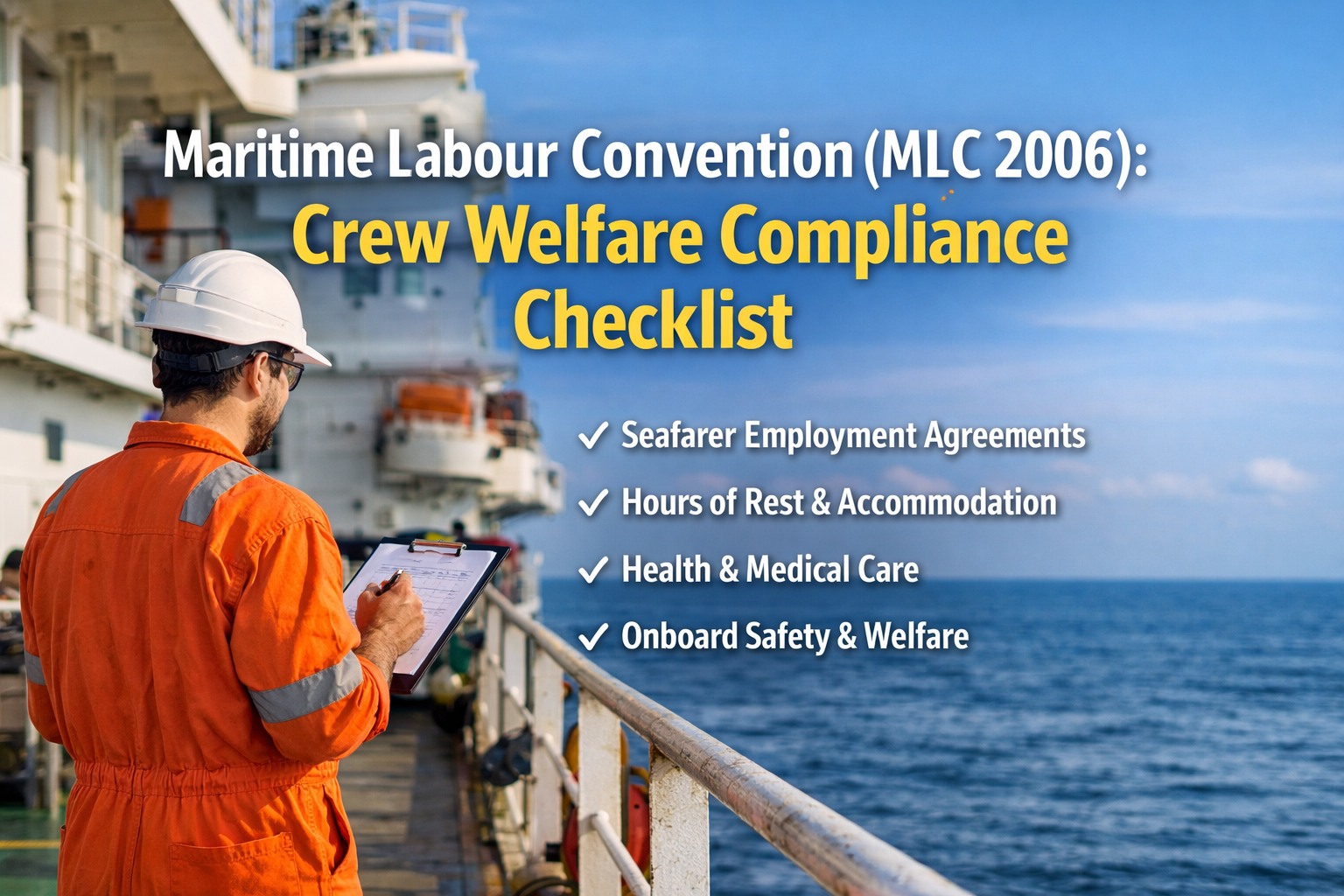
Rest-hour records completed daily, signed weekly by seafarer and master, and reconciled against logbooks and drill registers
A printed rest-hour record available even where an electronic system is in use
Signed employment agreements for every seafarer, with a copy each seafarer can access on board
Wage payments matching contract terms and made within the required timeframe, with records that reconcile to the agreements
Declaration Parts I and II current, accurately describing the ship, and posted where the crew can see them
Onboard complaint procedure posted and genuinely available, with handled complaints recorded and resolved
Accommodation, galley and medical provision matching what Part II claims, with checks evidenced on schedule
Financial security certificates for abandonment and liability valid and on board
Crew able to describe their entitlements, hours and complaint route confidently and consistently
The last item is the one no document produces. It follows from the others being genuinely true rather than merely recorded, which is why it functions as a useful self-test: if a fleet would be uncomfortable with its crew being interviewed privately, that discomfort is the finding waiting to happen. Two small items also catch vessels regularly — the declaration must be displayed somewhere visible and accessible to the crew, and the complaint procedure must be posted. Both are trivial to satisfy and both appear in deficiency lists, usually because a notice came down during maintenance and never went back up.
Complaint records deserve particular attention because they are evidence about culture rather than paperwork. A vessel with a posted procedure and no complaints ever recorded invites the question of whether crew feel able to use it. Handled complaints, recorded with the resolution reached, demonstrate a functioning welfare system far more convincingly than an empty register. To keep these checks evidenced on schedule across the fleet, book a demo or start a free trial.
When Deficiencies Are Found
MLC findings follow a distinct resolution path, and knowing it helps a fleet respond correctly rather than defensively. Where a deficiency cannot be rectified before departure, a plan of action is agreed setting out how and when it will be corrected. That plan is attached to the inspection report as a supporting document, and the deficiencies it covers are recorded against it in the final report.
This is a constructive mechanism rather than a penalty, but it carries a tail. The port state authority at the next port may be informed, so the vessel arrives with the finding already known, and in serious cases the flag state and the International Labour Organization may be notified, with the officer's report transmitted alongside any flag state reply. Serious deficiencies can result in detention until conditions are rectified. The management lesson is that a plan of action is a commitment the next inspector will check — treating it as a way to leave port rather than as a corrective action with an owner, a deadline and evidence of completion is how a single finding becomes a pattern.
Welfare deficiencies are also particularly likely to be fleet-wide, because rostering practices, contract templates, payroll timing and catering standards are usually set at company level rather than aboard one ship. Closing a finding on a single vessel while leaving the practice unchanged elsewhere simply relocates the deficiency to the next port call on another ship. Cascading each finding across the fleet, and correcting the underlying practice rather than the local symptom, is what stops a welfare issue recurring under a different flag state a month later. To hold that closure discipline fleet-wide, book a demo or start a free trial.
Frequently Asked Questions
Do inspectors really interview crew privately?
Yes, and it is one of their primary inspection tools. Private seafarer interviews are conducted confidentially, without the master or officers present, and seafarers are encouraged to speak honestly. The purpose is to verify that living and working conditions on board actually match what the Declaration of Maritime Labour Compliance states. This is what makes MLC different from documentary regimes: the inspector is testing the gap between the documented and the actual, and the common deficiencies all live in that gap — rest records appearing falsified, seafarers unable to access their own contract, wages below what the agreement specifies, accommodation not matching the declaration. The practical consequence is that readiness cannot consist of improving paperwork alone. If records do not reflect reality, the underlying practice is what needs to change.
What are the rest hour limits?
Seafarers must have at least ten hours of rest in any twenty-four-hour period, divided into no more than two periods, one of which must be at least six hours, with the interval between consecutive rest periods not exceeding fourteen hours. Across any seven-day period, at least seventy-seven hours of rest are required. Expressed as work limits, the equivalent maximums are fourteen hours in any twenty-four and seventy-two hours in any seven days. Seafarers under eighteen have stricter requirements, with at least twelve hours of rest. Drills and emergencies may interrupt rest, but compensatory rest must be provided afterwards. The record must be completed daily, signed by both the seafarer and the master or chief officer at least weekly, held on board and at the manager's office, with a printed version available even where electronic systems are used.
Why are rest hour records the most cited deficiency?
Partly because the limits are strict against unpredictable operations, and partly because inspectors do not read the record in isolation. Rest records are compared against deck and engine logbooks, watch schedules and manning arrangements, port call timings and cargo operations, and drill and exercise registers. A record showing compliant hours during a period when the logbook shows extended cargo work, or a drill register shows an exercise the seafarer apparently did not attend, is exactly what leads to a finding that records appear falsified. The most commonly recorded issues are records that are poorly maintained, incomplete or inconsistent. Maintaining them honestly therefore means reconciling across these sources as you go, rather than completing forms retrospectively and discovering the contradictions when an inspector does.
What do inspectors check on employment agreements and wages?
That every seafarer holds a signed agreement containing the particulars the convention requires, written in a language the seafarer understands; that the seafarer can actually obtain a copy of it on board; and that wages match the agreement and are paid within the legally required timeframe. Each of these appears in common deficiency lists — seafarers without signed agreements or with agreements missing required information, seafarers unable to access their contract details, and underpayment against contract terms. Paid annual leave accrues at a minimum of two and a half calendar days per month and must be tracked accurately across consecutive contracts. This area has been a focused enforcement priority: a joint concentrated inspection campaign centred on crew wages and employment agreements produced detentions where seafarers were underpaid or contract terms did not match reality.
Does MLC apply to ships flagged in non-ratifying states?
In practice yes. The convention's no-more-favourable-treatment provision means port state control officers must not treat vessels from non-ratifying states more favourably, so those ships can still be inspected against equivalent standards when calling at the ports of ratifying states, and detained if serious deficiencies are found. With ratification now covering well over ninety per cent of world gross tonnage across more than a hundred countries, there is effectively no commercial fleet outside the convention's reach. Ships of five hundred gross tons and above on international voyages are required to carry the Maritime Labour Certificate and the Declaration of Maritime Labour Compliance, with inspections at intervals not exceeding thirty-six months, and port state inspections can occur at any call in between.
What happens if deficiencies cannot be fixed before departure?
A plan of action is agreed, setting out how and when the deficiencies will be corrected. That plan is attached to the inspection report as a supporting document and the covered deficiencies are recorded against it in the final report. It carries consequences worth understanding: the port state authority at the next port may be informed, so the vessel arrives with the finding already known, and in serious cases the flag state and the International Labour Organization may be notified, with the officer's report transmitted along with any flag state reply. Serious deficiencies can lead to detention until conditions are rectified. The important management point is that a plan of action is a commitment the next inspector will verify, so it should be treated as a corrective action with an owner, a deadline and documented evidence of completion.
When the Records Match the Reality
MLC is the inspection where the crew are asked whether the paperwork is true, so readiness means welfare records that reconcile with logbooks, rosters and lived experience — not documentation improved before a port call. Marine Inspection captures rest-hour records, accommodation and catering checks, complaint handling and certification at the point they happen, with fleet-wide visibility so practices set at company level are corrected everywhere at once.
Book a demo or
start a free trial.