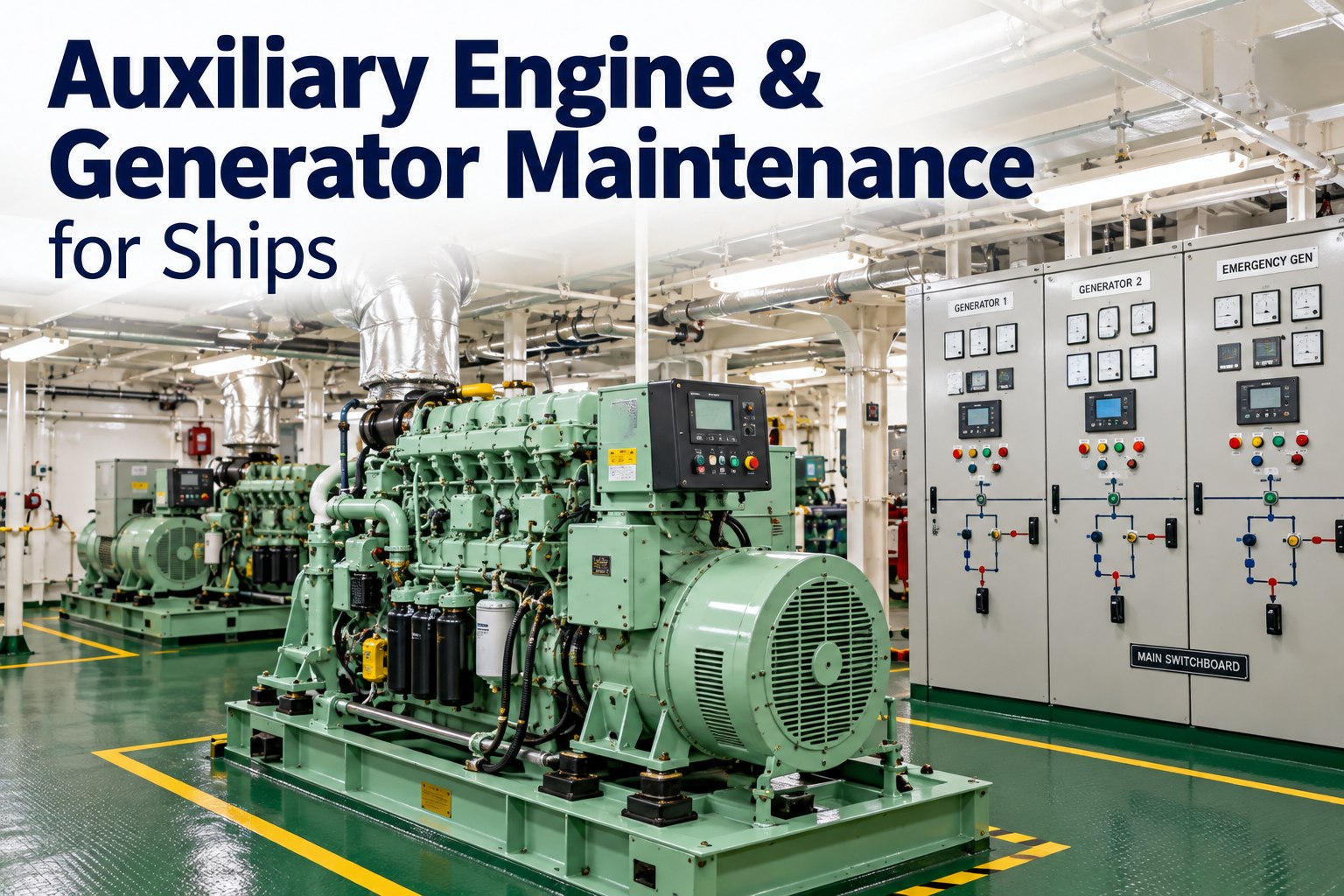
Auxiliary engines rarely get the attention the main engine does, yet they decide whether the ship keeps steering, cooling, pumping and lighting. A blackout at sea is not only a technical failure, it is a loss of manoeuvrability that turns into a reportable incident, a PSC finding or worse if it happens in traffic or heavy weather. Most blackouts are traceable to the same short list: fuel or air supply problems, governor and load-sharing faults, protection settings nobody has tested, a standby set that failed to start, or low-load running that fouled the engine over months. This guide covers the upkeep that keeps power available: load sharing and standby arrangements, generator overhaul intervals and what to record, alarm and trip testing, emergency generator routines against the SOLAS requirements, and the switchboard checks that are easy to defer and expensive to skip. If your alarm tests and running hours live on paper, try Marine Inspection free and keep them with the machinery record.
Load sharing, standby starting, protection settings and the emergency set are all things that look fine until the day they are needed. Test them, record them, and keep the evidence where a surveyor can see it.
The rules behind emergency power
These are the figures a surveyor or PSC officer works from. They shape the test routine for the emergency generator and the recovery plan after a blackout.
How blackouts actually develop
A blackout is usually a chain, not a single failure. Each link is somewhere maintenance or testing can break it before the busbar goes dead.
- Fuel supply loss: filter blocked, booster pump, changeover error
- Cooling or lube oil low pressure trip
- Governor or AVR fault, load swings
- Overload after a heavy consumer cuts in
- Earth fault or short circuit on a feeder
- Load sharing unbalanced, one set trips on overload
- Preferential trips not set or not working
- Standby set fails to start or breaker does not close
- Protection settings wrong or untested
- Bus tie configuration leaves no redundancy
- Standby start and auto-synchronising tested on schedule
- Preferential trip and protection tested and logged
- Fuel system upkeep, clean filters, correct changeover
- Even load sharing and balanced running hours
- Blackout recovery drilled, sequence known by the watch
Maintenance intervals for medium-speed auxiliaries
Four-stroke auxiliary engines are opened far more often than the main engine, and their intervals depend on fuel, load profile and maker. Use these as planning bands only, and set the real figures from the engine manual. Record every job against running hours so the trend, not the calendar, drives the next decision.
| Item | Planning band | What to record | Why it matters |
|---|---|---|---|
| Lube oil sample and analysis | Every few hundred hours | Viscosity, BN, water, wear metals, insolubles | Earliest warning of bearing or liner trouble |
| Fuel injector overhaul and test | Every 2,000–4,000 h | Opening pressure, spray pattern, leak-off | Combustion, exhaust temperatures, fouling |
| Cylinder head, valves and seats | Every 6,000–12,000 h | Valve clearance, seat condition, rotator function | Compression and exhaust valve burn-through |
| Piston, rings and liner | Every 12,000–18,000 h | Ring gaps, groove wear, liner bore and ovality | Blow-by, oil consumption, crankcase deposits |
| Main and big end bearings | Per maker and class cycle | Clearances, shell condition, bolt tightening | Catastrophic failure risk if missed |
| Turbocharger and air coolers | Per maker, with condition checks | Fouling, vibration, air and gas temperatures, pressure drop | Charge air, load capability, surging |
| Generator end and windings | Periodic, plus after any wetting | Insulation resistance, bearing hours, air gap, cleanliness | Earth faults and winding failure |
Balance the running hours across the sets
Uneven running concentrates wear on one set and leaves the others under-proven. Long periods at low load on a set kept online "just in case" also cause fouling, turbocharger deposits and unburnt fuel in the exhaust. Rotate duty so hours stay comparable, and run sets at a sensible load band rather than lightly loaded for weeks.
One set carries the fleet, one is barely proven.
Overhauls fall due predictably and every set is proven.
Illustrative example of hours per generator over twelve months, not measured data.
Alarm, trip and protection testing
Protection that has never been tested is an assumption. Build these into the planned maintenance system with a record for each test, because this is exactly what surveyors sample. Keep the method and the result, not just a tick.
Emergency generator: the routine that matters
The emergency set spends its life waiting. A test run on no load proves the engine starts, but not much else, so build the routine around what the regulations actually require it to do.
- Run the engine and check parameters, leaks and batteries
- Confirm fuel level, and that the tank is topped and clean
- Check the space heater, ventilation and access are clear
- Test the automatic start on loss of main power, timed against the 45-second requirement
- Run on load, not just on no load
- Test both starting means, including the secondary
- Prove the emergency switchboard supplies its services
- Test the dead ship recovery arrangement, timed to the 30-minute requirement where it applies
- Check protection settings, insulation resistance and battery capacity
Switchboard and electrical upkeep
Most electrical failures announce themselves first as heat, moisture or a drifting insulation reading. These checks are simple, easy to defer and cheap compared with a burnt breaker or a lost generator.
Frequently asked questions
Common shipboard practice is a weekly run and a monthly test that includes automatic start on loss of main power and running on load, with the exact routine set by the company SMS and the maker's instructions.
Fuel supply problems, cooling and lube oil trips, governor or AVR faults, overload after a heavy consumer starts, and standby sets that fail to start. Each is addressed by routine testing rather than by more equipment.
Extended light loading leads to poor combustion, fouling, turbocharger deposits and unburnt fuel in the exhaust system. Match the number of sets online to the load rather than keeping one lightly loaded indefinitely.
The emergency source must supply its services for 18 hours on cargo ships and 36 hours on passenger ships, with a transitional source covering the first 30 minutes.
Running hours, overhaul records with measurements, alarm and trip test sheets with set points and results, insulation resistance trends, and emergency generator test logs. See our guide to weak maintenance records.
Marine Inspection captures alarm tests, insulation readings, overhaul measurements and photos at the panel or the engine, offline, and builds the survey pack from the same data.