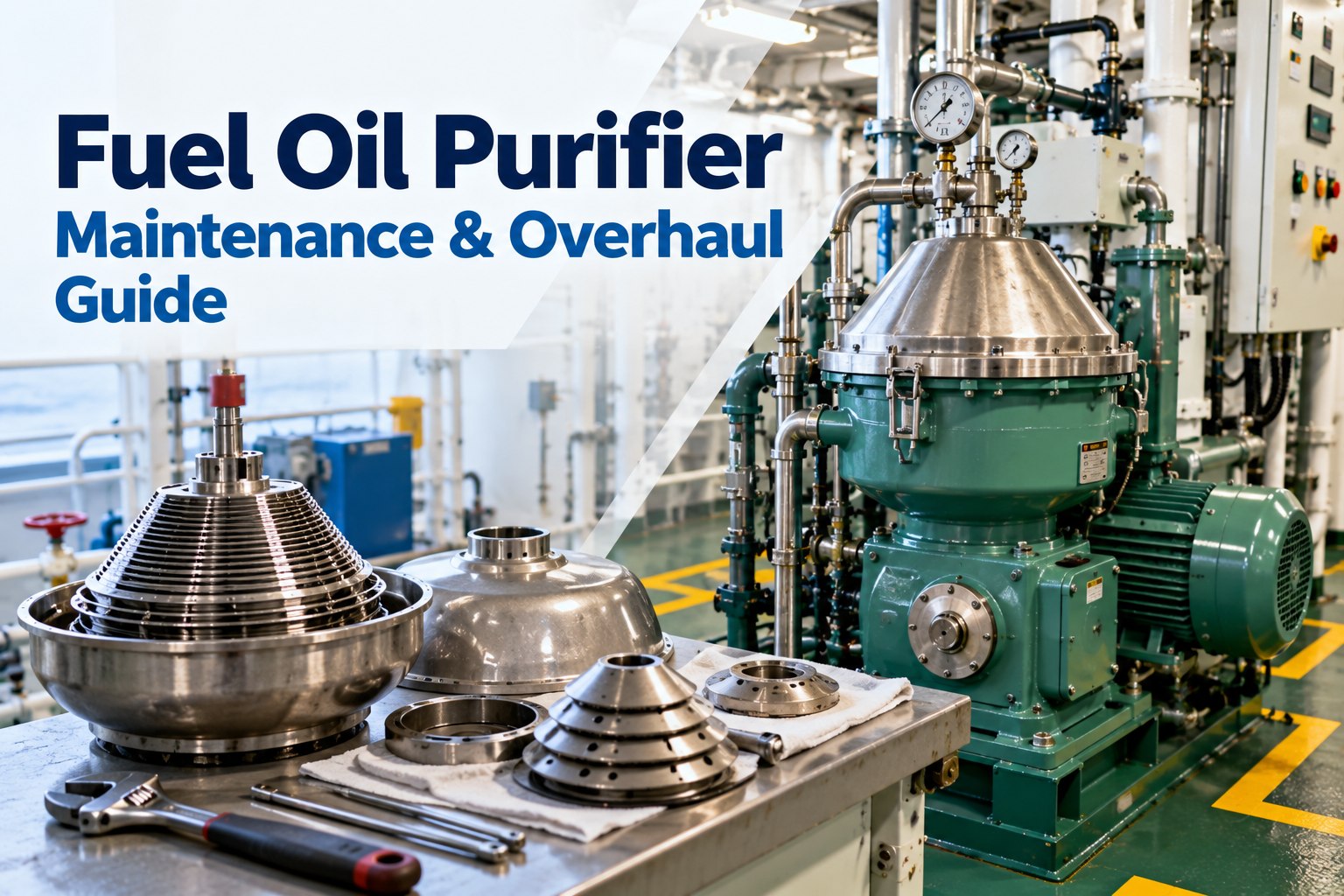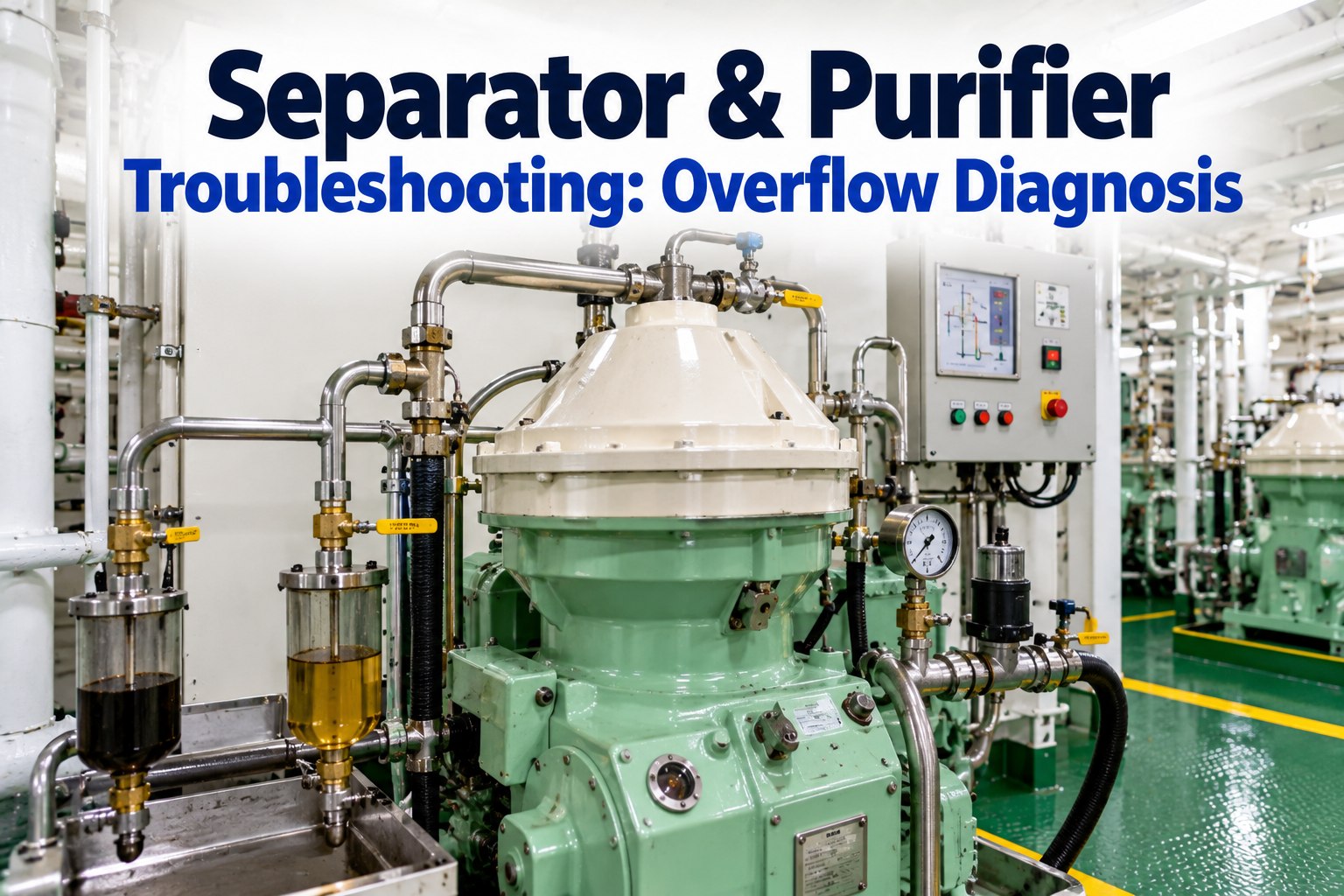
A purifier that overflows wastes fuel, fills the sludge tank and takes the second engineer away from everything else for hours. Overflow is a symptom, not a fault. The oil is leaving through the wrong exit, and the exit it takes points to the cause: a broken water seal, a bowl that will not close, the wrong back pressure or a worn seal ring. This guide works through purifier troubleshooting by symptom, then covers back pressure, bowl problems and the settings that stop overflow and poor separation. Book a demo to see purifier faults, readings and fixes logged against each machine.
Purifier troubleshooting: follow the oil to find the overflow
Purifier overflow: which exit is the oil taking?
Before touching any setting, look at where the oil is coming out. Each route has its own short list of causes.
Oil from the water outlet
The oil and water interface has moved too far out and the water seal has broken.
Oil from the sludge ports
The bowl is not closed, or has opened again, so oil goes straight to the sludge tank.
Overflow at the frame or cover
The oil has nowhere to go on the clean side, so it backs up out of the machine.
Purifier troubleshooting matrix: symptom to cause
This summary draws on Merchant Navy Decoded’s Alfa Laval troubleshooting notes and Marine Insight’s start-up checks. Always confirm against your separator manual.
| Symptom | Likely causes | First checks |
|---|---|---|
| Oil at water outlet on start | No water seal, oil fed too early, feed too hot or too cold | Re-establish the seal, then open the feed slowly |
| Oil at water outlet while running | Gravity disc too big for the fuel, back pressure too high, flow too high | Back pressure, feed rate, fuel density against disc chart |
| Oil at sludge ports all the time | Bowl not closed: low operating water, faulty solenoid, worn main seal ring | Operating water tank and pressure, solenoid, seal ring |
| Overflow straight after desludge | Bowl slow to close, pilot valve or water block filter dirty | Water block filter, pilot valve, closing water timing |
| Water in clean oil | Interface too far in: disc too small, back pressure too low | Disc size, back pressure, sample after the purifier |
| Low speed, high current | Brake on, dirty bowl, sludge build-up, bearing or friction fault | Brake released, bowl clean, gear case oil level |
| Vibration | Sludge in the bowl, wrong assembly, worn spindle bearings | Stop at once; clean and check bowl assembly |
| No sludge discharge | Blocked ports, faulty high-pressure water solenoid, low pressure | Clean the ports, test the solenoid, check water pressure |
Purifier back pressure: the setting that moves the interface
The back-pressure valve on the clean oil outlet does more than keep the line full. It moves the oil and water interface inside the bowl. Raise it and the interface moves outward, towards the water outlet. Lower it and the interface moves inward, towards the disc stack.
An IJMEIR study of an Alfa Laval P626 lube oil purifier on an LNG carrier linked repeated bowl leakage to a worn back-pressure regulating valve. Pressure fell to 0.1 bar against a normal 1.8 to 2.5 bar. Figures are for that machine only; use your own manual.
Gravity disc choice works together with back pressure. Our purifier gravity disc and separation tuning guide covers disc sizing by density and temperature in detail, so this page keeps to the fault side.
Stop fixing the same overflow twice
Record each purifier fault with the readings, the cause and the fix, and see when the same machine starts heading the same way again.
Purifier bowl problems: operating water, seals and closing
When oil leaves through the sludge ports, the bowl is not sealing. Closing depends on a chain of parts, and any weak link leaves the sliding bottom open.
Water tank
Low level, no closing water
Solenoid
Coil or valve fault
Water block filter
Scale cuts the flow
Pilot valves
Dirty or sticking
Sliding bottom
Does not lift fully
Main seal ring
Worn or cracked
The fix in that case was a new water block filter, chemical cleaning of scaled parts and an extra water filter upstream. A separate IJMEIR study on a fuel oil purifier that kept overflowing found worn O-rings, seal rings and gravity discs, incorrect assembly and debris blockages.
Purifier settings that stop overflow and poor separation
Most overflow and poor separation comes back to a handful of settings. Each one goes wrong in both directions.
Feed temperature
Feed rate
Gravity disc
Back pressure
Desludge interval
Seal water
Every unplanned discharge ends up in the sludge tank and in the Oil Record Book, which links purifier performance to MARPOL Annex I. For the wider rules, see our MARPOL Annex I to VI guide.
Purifier start-up checklist to prevent overflow
Based on Marine Insight’s ten start-up checks. Most overflows on start come from missing one of these.
How Marine Inspection helps with purifier troubleshooting
Marine Inspection turns each purifier fault into a record: the symptom, the readings at the time, the cause found and the fix. Each one is linked to the machine’s job in your planned maintenance system. The fault ticket below is illustrative.
Purifier overflow: frequently asked questions
Why does my purifier overflow on start?
Why is oil coming out of the sludge ports?
What does high back pressure do in a purifier?
How do I know the gravity disc is wrong?
What is the difference between a purifier and a clarifier?
Every overflow has a cause. Keep the record that finds it faster next time.
Log readings, causes and fixes for every purifier on board, and spot repeat faults before they cost another tank of fuel.