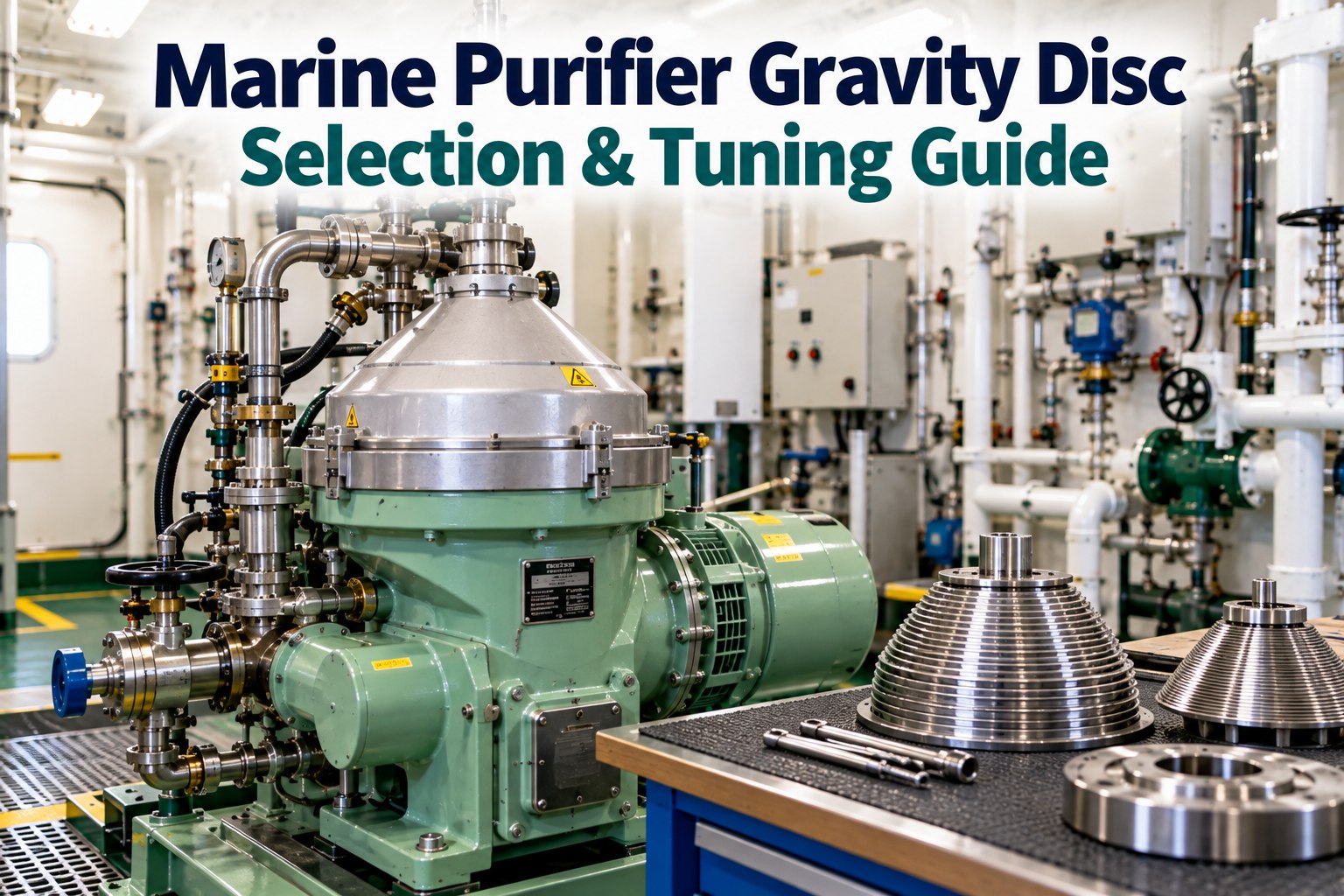
A purifier with the wrong gravity disc still spins, still discharges sludge and still sends oil to the service tank. It just does it badly, either losing fuel over the side with the water or passing water and cat fines on to the engine. This guide covers how to size the disc from density and temperature, tune throughput and prove the result with samples. Log disc changes and fuel samples free.
Purifier gravity disc sizing and tuning that puts the interface where it belongs
Inside the bowl, oil and water meet at a line. The gravity disc decides where that line sits. Too far out and oil escapes with the water; too far in and water rides out with the oil.
How the purifier gravity disc sets the oil and water interface
In purifier mode the bowl holds a ring of water at its outer edge. Oil is fed in, spun, and leaves from the centre, while water and heavy dirt are thrown out to the seal. The gravity disc is the outlet the water passes through, and its inner diameter fixes the radius where oil and water balance. For the wider separator routine, see our separator and purifier maintenance guide.
Interface pushed outward
- Oil leaves through the water outlet; the purifier overflows
- Water seal breaks, especially at start-up
- Same effect from high throughput or low temperature
Interface pulled inward
- Water carried over in the clean oil
- Interface sits inside the disc stack, so separation suffers
- Same effect from low throughput or high temperature
Effects summarised from common purifier training material and maker guidance; your purifier's manual is the reference for its own bowl.
Gravity disc sizing by oil density and temperature
The disc is chosen from the maker's nomogram for that exact bowl, using the oil's density, the separation temperature and the planned throughput. The figure is not carried over from the last bunker; every new fuel gets checked. See density-to-disc records in a demo.
Get the real density
Use density at 15°C from the fuel analysis or bunker delivery note for the oil now in the settling tank.
Fix the temperature
Use the separation temperature you will actually hold: 98°C for heavy fuel, kept constant.
Set the throughput
Decide the flow first; the nomogram reads density against flow for that bowl.
Read and fit
Read the disc size, fit it, and check the water outlet at start-up for any oil.
Adjust one step
If the seal breaks, go one size smaller. If water appears in the clean oil, one size larger.
Which way each setting moves the interface
As oil density approaches water's, there is less density difference to separate on, and a gravity disc can no longer hold a reliable interface. That is why 991 kg/m³ became the practical ceiling for conventional purifiers, and why Alfa Laval's ALCAP system, which does away with the gravity disc in favour of a flow control disc and a water transducer in the oil outlet, was developed to treat oils up to 1010 kg/m³.
Purifier throughput tuning for separation efficiency
Every particle needs time in the bowl to be thrown out. Lower flow gives it that time, so the best separation comes from the lowest flow that still keeps up with consumption, at a steady temperature. Track flow and temperature against results free.
Separator efficiency: claimed against found
Brookes Bell in-service tests, cited by UK P&I Club. Causes named included wrong gravity discs, low inlet temperature and high feed rate.
- Run slow, not fast. Set flow to the lowest rate that still meets the ship's consumption, not the rated capacity.
- Consider two in parallel to halve the flow through each bowl, as UK P&I suggests.
- Hold 98°C for heavy fuel and keep it constant; viscosity, and so separation, follows temperature.
- Do not throttle the feed pump or return oil to its suction to cut flow; it disturbs the interface.
- Change one thing at a time and sample after each change, or you will not know what helped.
Every bunker, the disc fitted for it, and the efficiency it achieved
Density, temperature, flow, disc size and before-and-after sample results on one purifier record, so the next engineer starts from what actually worked.
Diagnosing purifier overflow and poor separation
Not every overflow is the disc. Seals, valves, speed and dirt can all break the water seal, and changing the disc to cover a mechanical fault only moves the problem. Fuel delivery problems further down the line are covered in our fuel injection troubleshooting guide.
| Symptom | Setting causes | Mechanical causes to rule out |
|---|---|---|
| Oil at the water outlet, overflow | Disc too large for the density; flow too high; temperature too low | Oil outlet valve closed or restricted; damaged O-ring under the gravity disc; torn gasket |
| Seal breaks at start-up | Disc at the limit for this fuel | Not enough priming water; low water pressure to the bowl |
| Water in the clean oil | Disc too small; flow very low; temperature too high | Interface sitting in the stack; check the water seal is formed |
| High cat fines after the purifier | Flow too high; temperature low; wrong disc | Sludge-packed disc stack; discharge interval too long |
| Seal breaks during running | Temperature or flow swings | Low bowl speed; worn seal ring or piston lip; poor bowl assembly |
Causes drawn from separator makers' seal-break guidance (Dolphin Centrifuge) and purifier troubleshooting material; confirm with your maker's chart.
Gravity disc choice for VLSFO and changing fuel density
Lube oil keeps the same density for years, so its disc rarely changes. Low-sulphur fuel blends do not. Alfa Laval warns that their fluctuating density makes the wrong disc a constant risk, so every bunker deserves its own check. Our bunker fuel management guide covers getting reliable analysis in the first place.
Proving separation efficiency: sampling before and after the purifier
The only proof that the disc and flow are right is what comes out. Cat fines are the hard test, because they wear liners and pumps quickly once they get past the purifier. Pair this with our fuel oil inspection checklist.
Working out separator efficiency
Efficiency % = (Al+Si before − Al+Si after) ÷ Al+Si before × 100Example: 48 mg/kg into the purifier and 14 mg/kg out gives (48 − 14) ÷ 48 = about 71%. Illustrative figures only. Test for ash, water and density at the same time, as UK P&I suggests.
Purifier tuning record: what to log with every change
Disc sizing problems repeat because nobody wrote down what worked last time. A few figures, logged together, turn each bunker into a reference for the next.
| Record | Why |
|---|---|
| Fuel density at 15°C and bunker reference | The input the nomogram needs |
| Separation temperature held | Shows the disc was read for the real condition |
| Throughput set | Lets you compare efficiency at like-for-like flow |
| Gravity disc size fitted, with a photo | Ends the "which disc is in there?" question |
| Paired sample results and efficiency | Proves the setting worked |
| Overflow or seal-break events | Shows when a setting reached its limit |
How Marine Inspection connects each bunker to the right purifier setting
The density is on the delivery note, the disc is in the bowl, and the sample result arrives by email two weeks later. Marine Inspection puts the three side by side for each bunker. Start your purifier log free.
Illustrative example; disc numbering and results depend on your purifier and fuel.
A disc check task on every bunker
Each bunkering raises a task to read the density, check the nomogram and confirm the disc, with a photo of the disc fitted.
Samples linked to settings
Before-and-after results attach to the same record as the disc and flow, so the efficiency is tied to the setting that produced it.
Overflow becomes a work order
A seal break or high cat fines result raises a job to check the disc, the seals and the bowl, tracked to closure.
Purifier gravity disc and separation tuning: FAQs
How do I choose the right gravity disc?
Read it from the maker's nomogram for your purifier, using the oil's density at 15°C, the separation temperature and the throughput. Check it again whenever the fuel changes.
What happens if the gravity disc is too large?
The interface moves outward, oil escapes through the water outlet and the purifier overflows or breaks its seal. Fit a disc with a smaller hole.
What happens if the gravity disc is too small?
The interface moves inward toward the disc stack and water is carried over with the clean oil, while separation efficiency falls.
What temperature should heavy fuel be purified at?
98°C, held constant, is the usual figure for heavy fuel oil. Going higher risks boiling the seal water; going lower raises viscosity and pushes the interface outward.
Why can a conventional purifier not handle very dense fuel?
Near 991 kg/m³ the density difference between oil and water is too small for a gravity disc to hold a steady interface. Systems without a gravity disc, such as ALCAP, were built for oils up to 1010 kg/m³.
How can I check the purifier is working well?
Take paired samples before and after the purifier, compare aluminium plus silicon, and work out the efficiency. See efficiency tracking in a demo.
Put the interface in the right place, and keep the proof for every bunker
Density, disc, temperature, flow and sample results on one purifier record, ready for the chief engineer, the office and the next bunker.