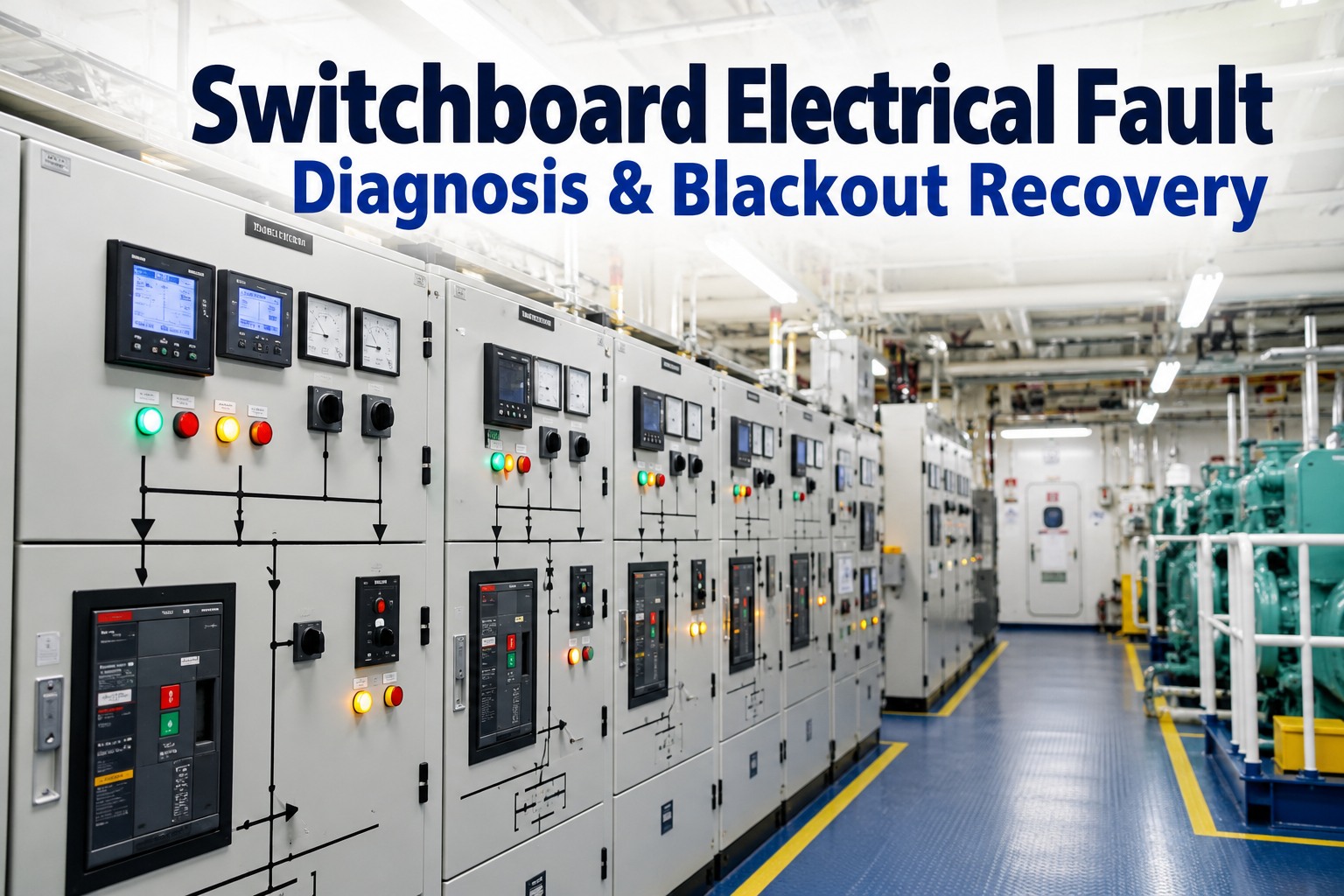
When the main switchboard goes dead, the ship loses propulsion, steering and the pumps that keep the engines alive. Most blackouts start with something small: falling lube oil pressure, a clogged fuel filter, a protection setting that trips a generator when it shouldn’t. This guide is for ETOs and engineers who have to find the fault fast and restore power safely. It covers breaker trips, earth faults, a structured diagnosis method and the blackout recovery sequence. Book a demo to track electrical faults and blackout tests.
Switchboard fault diagnosis and blackout recovery: find the cause, then restore power safely
What causes a switchboard blackout
Gard defines a blackout as a loss of power from the main switchboard, usually from an electrical or mechanical failure in generation, distribution or propulsion. DNV lists the failures it sees most often.
Lube oil pressure loss
Pumps, purifiers, filters or low sump levels on running generators.
Fuel problems
Clogged filters, fuel starvation, water in fuel, thermal shock at changeover.
Control and safety systems
Malfunctions and incorrect safety device or protection settings.
Common maintenance faults
The same work done on several generators at once, so they fail together.
Gard describes a 2019 cruise ship blackout off Norway: low lube oil in every running generator’s sump, combined with heavy rolling. The ship came within a ship’s length of grounding, and the alarm system did not separate critical from minor alarms.
Blackout rules: SOLAS, ISM and class
SOLAS Chapter II-1 regulations 40 to 44 set performance requirements for main and emergency power, and class societies add their own. For routine switchboard inspection, see our marine switchboard and electrical distribution inspection guide.
Summary from Gard and SOLAS II-1. Check your ship’s class rules and approved electrical load analysis.
Breaker trip diagnosis: what each protection tells you
A trip is the switchboard protecting itself. Read which protection operated before resetting anything, because resetting into the same fault can cause a second blackout.
| Protection | What it means | First checks |
|---|---|---|
| Overcurrent | Load above the generator or feeder rating for too long | Load at the time, preferential trip operation, number of sets on line |
| Short circuit | Very high current from a fault in a cable or equipment | Insulation test the outgoing circuit before closing again |
| Reverse power | Generator motoring, often from engine-side failure | Fuel supply, governor and engine shutdowns on that set |
| Under-voltage | Bus voltage collapsed or AVR fault | AVR, excitation and what happened just before the trip |
| Preferential trip | Non-essential loads shed to protect generators | Why load rose; restore non-essentials only after stability |
Typical protections; settings and names vary by maker. Use the protection relay records and the switchboard manual.
Earth fault diagnosis on an insulated system
Most ship main power systems are insulated from the hull, so a single earth fault does not trip anything. The danger is a second earth fault on another phase, which becomes a short circuit and can trip a feeder or a generator.
General method. Never switch off essential services such as steering without a plan; follow your SMS and permit-to-work for electrical isolation.
Every trip, earth fault and fix on one timeline
Log electrical faults with the protection that operated, link the corrective job, and spot repeat faults before they cause a blackout.
A structured switchboard troubleshooting method
Under pressure, it is tempting to reset and hope. A fixed method finds the real cause and protects the evidence.
Gard recommends periodic infrared camera surveys of switchboards to find hot connections before they fail.
Blackout recovery sequence
DNV describes recovery as two parallel processes: restarting the main power system and starting the emergency generator. A typical order is below; follow your ship’s blackout procedure. For generator care, see our auxiliary engine and generator maintenance guide.
Blackout drills and power tests
Gard and DNV both recommend realistic blackout tests and drills, so crews can recover fast when it happens for real.
Full blackout test
Prove main power restart and emergency generator start, in different failure scenarios.
Emergency generator on load
Test regularly under realistic loads, not just a no-load run.
High-risk machinery state
Define generators on line, bus-tie position and manning for berthing and heavy weather.
Use the FMEA
The power management system FMEA is a training and reference tool.
Switchboard and blackout readiness checklist
Use this for routine electrical checks and before high-risk operations.
How Marine Inspection supports switchboard fault diagnosis
Marine Inspection logs each electrical fault with the protection that operated, links it to the corrective job and the generator’s planned maintenance, and schedules blackout tests. It works alongside your planned maintenance system. The timeline below is illustrative.
Switchboard fault and blackout FAQs
What causes most ship blackouts?
DNV lists lube oil pressure loss, fuel problems, control and safety system faults, and the same maintenance done on several generators at once.
How fast must the emergency generator take over?
Under SOLAS, the emergency generator starts and connects automatically within 45 seconds of main power failing.
Why doesn’t a single earth fault trip the supply?
Ship main power systems are usually insulated from the hull. A first earth fault only shows on the monitor; a second on another phase becomes a short circuit.
Should I reset a tripped breaker straight away?
No. Read which protection operated and find the cause first, or the same fault can trip the next generator.
How often should blackout tests be done?
Regularly, under your SMS and class requirements. ISM 10.3 requires standby arrangements to be tested; Gard and DNV recommend realistic full blackout tests.
Can Marine Inspection track electrical faults?
Yes. Book a demo to see fault logs, repeat alerts and blackout test records.
Power back, cause known
Read the trip, find the fault, restore in order and record it, so the next blackout is shorter or never happens.