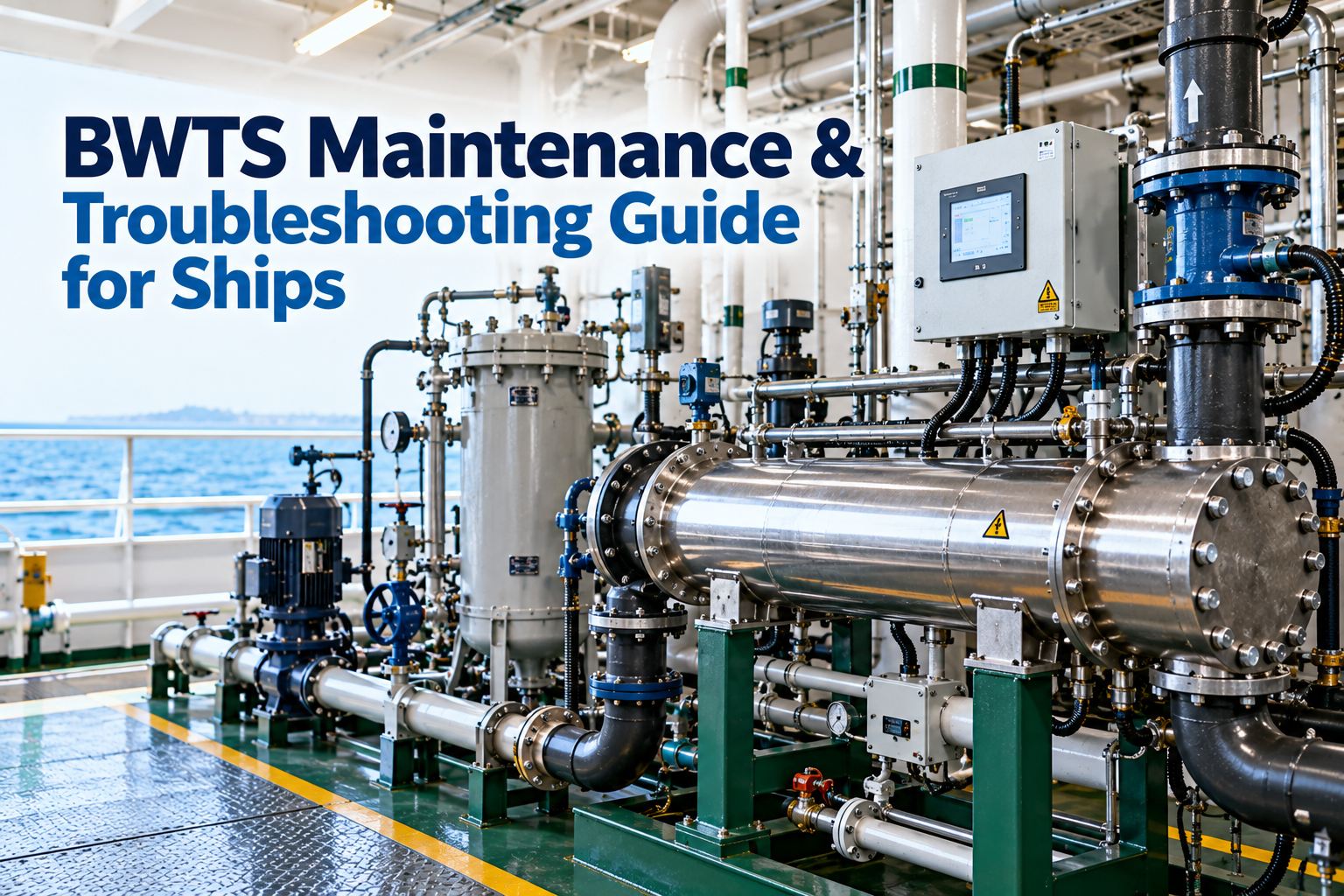
Ballast water treatment system maintenance is the routine of keeping a ship’s BWTS able to meet the IMO D-2 discharge standard every time it runs: filter and backflush checks, UV lamp and quartz sleeve care or electrochlorination and TRO sensor calibration, alarm response and the records inspectors ask for. It matters because a BWTS that fails in port leaves the master choosing between delay, contingency measures and non-compliance. Get it wrong and the cost is a failed compliance sample, a port state control finding, ballast operations held up and a crew working round the clock on alarms.
D-2 every time you ballast: keeping the treatment system clean, calibrated and alarm-free
Filter, UV and TRO care, alarm fixes and ballast records in one routine your engineers can run before every operation.
Free sign-up · Offline checklists at sea · Signed PDF reports
Illustrative screen
Most ships now carry a type-approved ballast water management system, typically either a filter followed by ultraviolet treatment or a filter followed by electrochlorination with neutralisation on discharge. Both work well when they are maintained and operated as designed. Both fail quietly when filters clog, sleeves foul, sensors drift or the system sits unused for weeks and then has to work in muddy port water.
This guide covers the D-2 standard and why compliance testing catches ships out, how UV and electrochlorination systems differ, filter, UV and TRO maintenance, intervals and a checklist, troubleshooting common alarms and what port state control checks. To run the pre-ballasting checks and maintenance on your crew’s phones, offline, you can start logging BWTS checks free.
Ballast water treatment system maintenance and the D-2 standard
The D-2 standard in the Ballast Water Management Convention sets how many viable organisms treated ballast water may contain at discharge. All ships to which the Convention applies have had to meet it since the end of the implementation schedule in September 2024.
Commissioning testing proves a newly installed system works on the day. It does not prove it still works two years later. A manufacturer, BIO-UV, has cited figures showing that while about 95% of systems passed commissioning tests, over 30% then failed D-2 compliance sampling at port state control. Organisms surviving in uncleaned tanks and poorly maintained systems were named among the causes.
Passing on day one is not passing in service (manufacturer-cited figures)
Figures as cited by BIO-UV to Ship & Bunker; no sample size was published. An earlier Intertanko figure, reported by Seatrade Maritime in 2018, put members’ problem rate at roughly 60–80% of installed systems.
BIMCO’s 2025 survey of operators, published in February 2026, describes the problems as systemic and recurrent: alarm cascades, sensor faults, shutdowns in poor water quality and, in several cases, defects that took more than two months to fix because service engineers and spare parts were hard to reach. Good maintenance cannot fix poor port water, but it removes most of the faults that are within the crew’s control. For the wider regulatory picture see IMO compliance.
UV and electrochlorination BWTS: what each system needs
Most systems combine a filter with one of two treatment methods. The filter work is similar; the treatment side needs different care.
| Point | Filter + UV | Filter + electrochlorination |
|---|---|---|
| How it treats | UV light damages organisms as water passes the lamps | Electrolysis produces oxidant; TRO kept at a set level |
| Treats at | Uptake and again at discharge | Uptake; neutralised at discharge |
| Main wear parts | UV lamps, quartz sleeves, wipers, UV sensors | Electrodes, TRO analyser, dosing pumps |
| Sensitive to | Low UV transmittance in muddy or coloured water | Low salinity or cold water, depending on design |
| Key calibration | UV intensity sensors | TRO sensors and neutralisation monitoring |
| Chemicals on board | Usually cleaning agents for sleeves only | Neutraliser and reagents to store and handle safely |
General comparison; your system’s type approval and manual set the actual limits and parts. BIMCO’s survey found UV systems especially sensitive to challenging water quality.
BWTS filter cleaning and backflush checks
The filter removes larger organisms and sediment before treatment and protects UV lamps or electrodes. When it clogs, flow falls, the system alarms and ballasting slows or stops. Filters in filter-integrated systems can also clog when crews carry over old habits such as gravity ballasting without the system running, as a manufacturer told Seatrade Maritime.
Watch differential pressure
Log filter differential pressure during every operation. A rising baseline means the screen is not cleaning fully.
Prove the backflush
Confirm automatic backflush starts at the set pressure, the flushing valve opens and the backflush line is clear.
Open and inspect
At the maker’s interval, open the filter, inspect the screen for damage and fouling, and clean as the manual directs.
Check seals and drives
Inspect the scraper or suction scanner, its drive, seals and gaskets for wear and leaks.
Every ballast operation, filter reading and lamp hour, logged once and ready for PSC
Pre-ballasting checks, maintenance and alarms recorded on board, with photos and parts attached.
Free to start · Works offline on board · Export to signed PDF
BWTS UV lamp replacement and quartz sleeve cleaning
In a UV system, treatment depends on enough UV light reaching the water. Lamps lose output with age, sleeves foul with scale and biofilm, and UV sensors drift. Any of the three can trigger low UV intensity alarms or shutdowns, especially when the water itself has low UV transmittance.
- Track running hours against the maker’s replacement interval
- Replace lamps that fail to strike or show low output
- Handle with gloves; never touch the lamp glass
- Dispose of used lamps as the maker directs; they contain mercury
- Check automatic wipers or cleaning-in-place cycles work
- Clean sleeves with the approved cleaning agent at the set interval
- Inspect for cracks, scratches and stubborn deposits
- Renew seals when sleeves are removed
- Clean sensor windows with the sleeves
- Calibrate or replace when calibration expires
- Compare readings across reactors to spot drift
- Record calibration dates and results
Intervals vary by system. Use the maker’s figures for lamp life and sleeve cleaning, and adjust for your trading area’s water quality.
TRO sensor calibration for electrochlorination BWTS
Electrochlorination systems control treatment by total residual oxidant (TRO). If the TRO sensor reads high, the system under-doses and organisms survive; if it reads low, it over-doses and the neutralisation has more to do. Either way the record shows the wrong thing.
Check reagents and expiry
Reagents for the analyser have a shelf life. Out-of-date reagents give false readings.
Zero and span as the maker directs
Follow the analyser’s calibration routine, with reference samples or a handheld test kit as specified.
Compare with a manual test
Take a manual reading during operation and compare it with the analyser. A gap means drift or a fouled cell.
Prove the neutralisation
On discharge, confirm the neutraliser doses and the discharge TRO stays below the limit in the type approval.
Record every calibration
Date, readings before and after, reagents used and who did it, kept with the system’s records.
BWTS maintenance checklist and intervals
Set the routine from the maker’s manual and your Ballast Water Management Plan. Alfa Laval’s maintenance tips stress following the vendor schedule, recalibrating sensors when calibration expires, an annual vendor health check and logging any time spent in bypass.
System start-up check, alarms clear, valves lined up, filter and treatment unit ready.
Flow, differential pressure, UV intensity or TRO, alarms and any bypass logged.
Sleeve cleaning, lamp hours review, sensor checks, filter inspection as the maker sets.
Vendor health check with water sample analysis; calibrations renewed.
Inspect before start-up; consider re-commissioning by the maker.
Build these into the preventive maintenance schedule so nothing depends on memory.
BWTS troubleshooting: common alarms and faults
Most BWTS alarms trace to water quality, fouling or sensors. Work through the likely causes before resetting, and record what you found.
| Alarm or fault | Likely cause | Check | Fix |
|---|---|---|---|
| Low UV intensity | Fouled sleeves, ageing lamps, drifting sensor, muddy water | Sleeve condition, lamp hours, sensor reading against another reactor | Clean sleeves, renew lamps, calibrate sensor; reduce flow if the maker allows |
| Filter high differential pressure | Heavy sediment, backflush not working, damaged screen | Backflush valve and line, scraper drive, screen | Clear the backflush line, repair drive, clean or renew screen |
| TRO low | Electrode wear, low salinity, dosing fault | Electrode current, salinity, analyser against manual test | Follow maker’s low-salinity procedure, repair dosing, renew electrodes |
| TRO reading erratic | Expired reagents, fouled analyser cell, air in sample line | Reagent dates, cell, sample flow | Renew reagents, clean cell, bleed sample line, recalibrate |
| Neutralisation alarm | Neutraliser tank low, dosing pump fault | Tank level, pump, discharge TRO | Refill, repair pump, stop discharge until within limit |
| Low flow or shutdown | Valve line-up, pump, filter clogging | Valve positions, pump pressure, filter differential pressure | Correct line-up, clean filter, restart per manual |
| System in bypass | Fault, safety or emergency, or poor water quality | Reason recorded, contingency measures in the BWMP | Notify as the BWMP requires; record and repair before next use |
Ballast water system inspection: what PSC checks
BIMCO’s survey found BWMS findings at inspection are frequent: malfunctions, alarms, documentation and showing compliance when contingency measures were used. Inspectors usually start with the paperwork and then ask to see the system.
Certificate and approval
International Ballast Water Management Certificate and the system’s type approval documents.
Ballast Water Management Plan
Ship-specific, approved, with operating and contingency procedures the crew can explain.
Ballast Water Record Book
Every uptake, treatment and discharge recorded, matching the system’s own data.
Self-monitoring data
The system’s logged operation, alarms and bypass events, which the inspector may compare with the record book.
Commissioning report
For systems commissioned from 1 June 2022, the commissioning test report with sample results.
Maintenance and calibration
Lamp, filter and sensor records showing the system is maintained, plus crew able to operate it.
How Marine Inspection supports BWTS maintenance
Marine Inspection links the ballast water routine before, during and after each operation, offline, with the evidence an inspector expects.
Repairs and spares run through maintenance work orders; for plans by fleet size see Marine Inspection pricing.
Ballast water treatment system maintenance: clean, calibrated, recorded
Ballast water treatment system maintenance is less about the treatment chemistry and more about discipline: keep the filter and backflush working, keep sleeves clean and lamps within their hours or TRO sensors calibrated, test the system before you need it and record every operation, alarm and bypass. Do that and the system has the best chance of meeting D-2 in service, not just on commissioning day. Keep the operational records alongside the rest of the ship’s data in a digital logbook.
Make sure your BWTS records show a system that is maintained, not just installed
Free sign-up · Offline at sea · Signed PDF reports