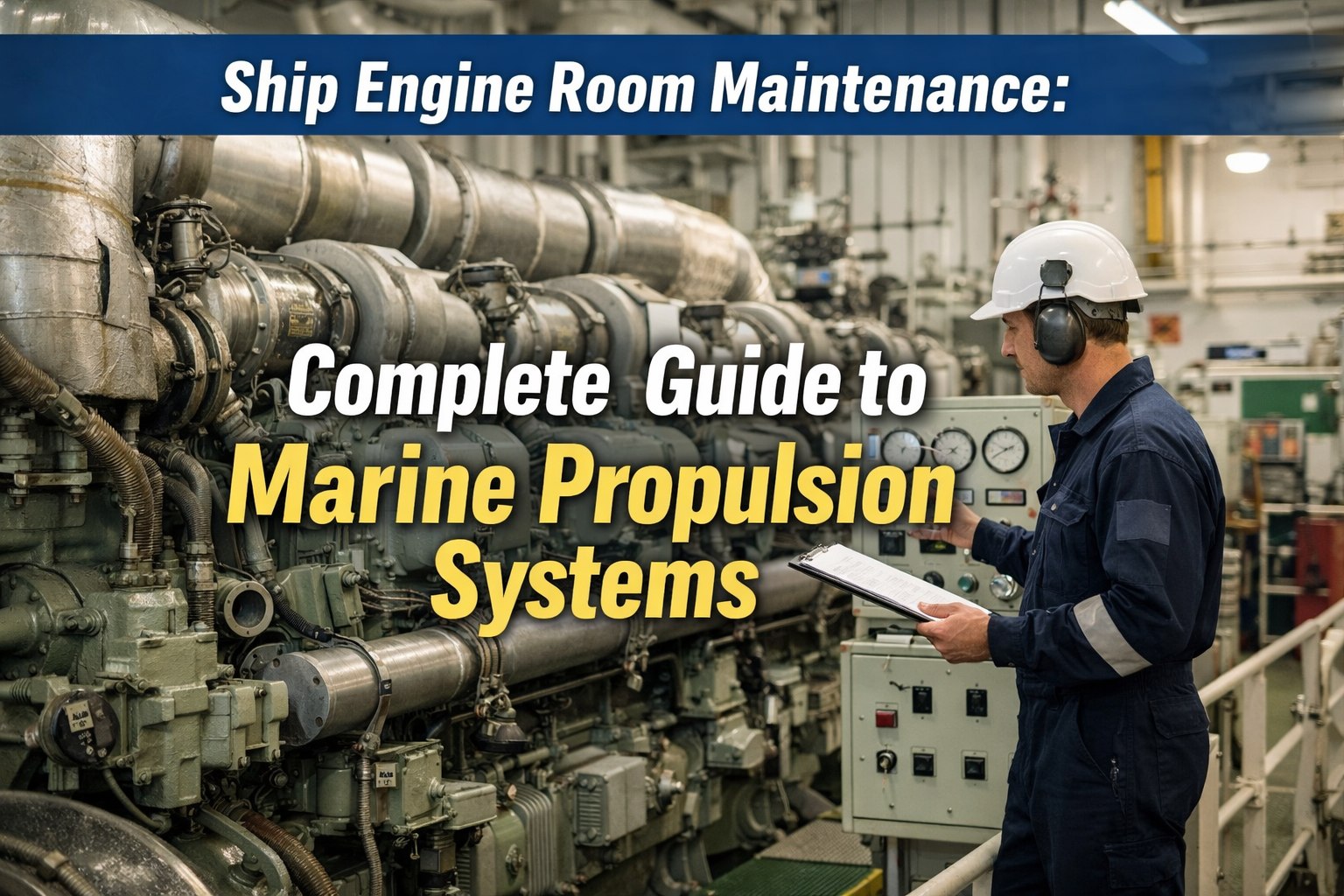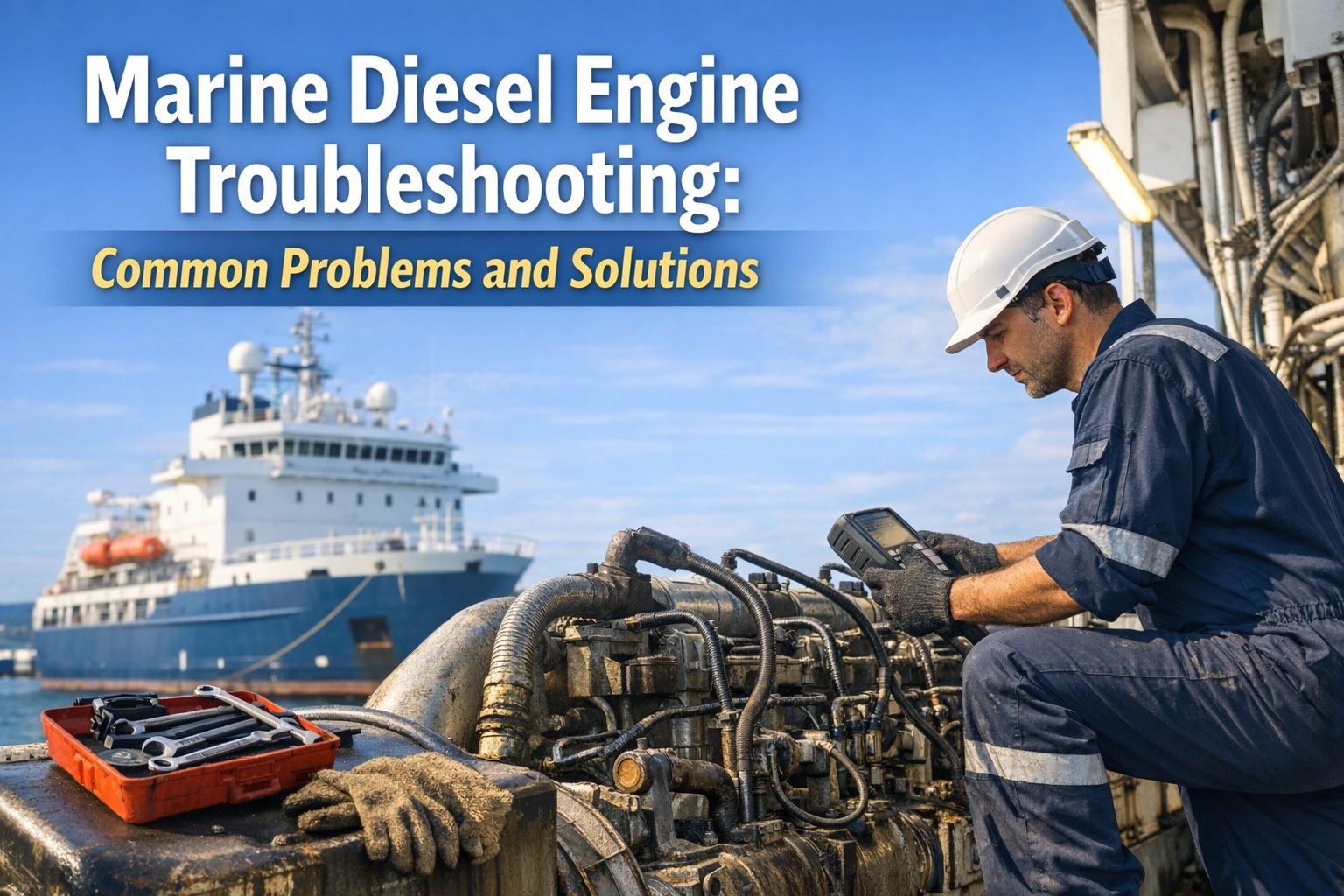
When a marine diesel engine fails at sea, the consequences cascade immediately — loss of propulsion, safety risk to crew and vessel, off-hire penalties that can reach tens of thousands of dollars per day, and PSC detention at the next port if the failure reveals ISM maintenance deficiencies. The difference between a chief engineer who resolves an engine problem in hours and one who loses days is not luck — it is systematic diagnostic skill built on understanding how symptoms map to root causes. Every engine failure leaves clues: exhaust smoke colour, temperature deviations, pressure changes, unusual sounds, and vibration patterns. The engineers who decode these clues quickly are the ones who have a structured troubleshooting framework that eliminates possibilities systematically rather than guessing. This guide maps the most common marine diesel engine symptoms to their root causes and solutions — giving marine engineers and superintendents the diagnostic reference that turns engine room emergencies into manageable maintenance events. Engineers building systematic maintenance and troubleshooting documentation can start a free trial of Marine Inspection to digitalise corrective action tracking, maintenance evidence, and defect reporting across every engine room system.
The 10 Most Common Marine Diesel Engine Problems
The following table maps the ten most frequently encountered marine diesel engine problems to their symptoms, root causes, and corrective actions. This is the diagnostic reference that every engine room should have accessible — and the troubleshooting data that your planned maintenance system should be built to prevent. Operators who book a Marine Inspection demo can see how the platform tracks these defect types with corrective action workflows.
| # | Problem / Symptom | Most Likely Causes | Diagnostic Steps | Corrective Actions |
|---|---|---|---|---|
| 1 | Engine fails to start | Insufficient starting air pressure; fuel supply blocked; air in fuel system; low compression; governor fault; safety interlock engaged | Check air bottle pressure. Verify fuel at injectors. Bleed fuel system. Check safety trips. Test governor module separately. | Charge air bottles. Clear fuel filters. Bleed fuel lines. Reset safety interlocks. Test compression if persistent. |
| 2 | Overheating under load | Raw water pump impeller failure; blocked sea strainer; scaled heat exchanger; thermostat failure; low coolant; charge air cooler fouling | Check raw water flow at overboard discharge. Inspect impeller. Measure temps at heat exchanger in/out. Check coolant level and expansion tank. | Replace impeller. Clean sea strainer. Descale heat exchanger. Replace thermostat. Top up coolant. Clean charge air cooler. |
| 3 | Black exhaust smoke | Air restriction; turbocharger inefficiency; overloading; faulty injectors; exhaust restriction; boost leak | Check air filter differential. Log turbocharger RPM vs boost pressure. Check injector spray pattern. Verify engine load vs rated capacity. | Replace air filters. Overhaul turbocharger. Recalibrate fuel rack. Replace faulty injectors. Reduce engine load. Check exhaust for blockage. |
| 4 | White exhaust smoke | Water in combustion chamber; poor fuel atomisation; low compression; cold running; cracked head/liner | Pressure-test cooling system. Check injector spray quality. Take compression readings. Monitor coolant consumption. | Replace head gasket. Overhaul/replace injectors. Investigate liner/head cracks. Ensure proper warm-up procedures. |
| 5 | Blue exhaust smoke | Oil entering combustion — worn piston rings, valve seals, turbo seals; overfilled crankcase; liner glazing | Check crankcase oil consumption rate. Inspect turbocharger for oil leaks. Measure cylinder liner wear. Check crankcase oil level. | Replace piston rings. Renew valve stem seals. Overhaul turbocharger seals. Correct oil level. Hone glazed liners. |
| 6 | Loss of power | Fuel starvation; dirty filters; turbocharger fouling; exhaust restriction; worn injectors; governor malfunction; propeller fouling | Check fuel pressure at injectors. Verify filter differential pressures. Log turbo boost. Check exhaust back-pressure. Inspect propeller if accessible. | Replace fuel filters. Clean/overhaul turbocharger. Replace worn injectors. Check governor settings. Clean propeller. |
| 7 | Abnormal knocking / noise | Fuel timing issues; bearing wear; loose components; detonation; injector dribbling; excessive valve clearance | Use stethoscope to localise. Check crankshaft deflections. Inspect bearings. Verify fuel timing marks. Check tappet clearances. | Adjust fuel timing. Replace worn bearings. Torque loose fasteners. Overhaul dribbling injectors. Re-set valve clearances. |
| 8 | Excessive vibration | Engine misalignment; mount deterioration; coupling wear; propeller damage/imbalance; crankshaft deflection out of limits | Check engine-to-gearbox alignment. Inspect flexible mounts. Measure crankshaft deflections. Check coupling condition. Inspect propeller. | Realign engine. Replace deteriorated mounts. Renew coupling elements. Balance/repair propeller. Investigate foundation. |
| 9 | High exhaust temperatures | Individual cylinder: faulty injector, poor compression, valve seat damage. All cylinders: turbocharger fouling, air cooler restriction, overloading | Compare exhaust temps across cylinders. Isolate deviating cylinder. Check injector. Take compression readings. Log turbo performance. | Overhaul faulty injector. Lap exhaust valve seats. Clean turbocharger. Clean air cooler. Reduce engine load to rated. |
| 10 | Lube oil pressure drop | Low oil level; oil dilution (fuel leak to sump); worn bearings; blocked oil cooler; failing oil pump; incorrect oil viscosity | Check sump level immediately. Sample oil for fuel contamination. Check oil temperature. Inspect oil pressure relief valve. Measure bearing clearances. | Top up oil. Investigate fuel pump seal if diluted. Replace worn bearings. Clean oil cooler. Overhaul/replace oil pump. Renew oil. |
Emergency Scenarios: Scavenge Fire and Crankcase Explosion
Two engine room emergencies require immediate, specific responses that every marine engineer must know instinctively. These are not troubleshooting exercises — they are survival procedures where seconds matter. Sign up for Marine Inspection to document emergency drill records and crew competency evidence for these critical procedures.
The Systematic Troubleshooting Approach
Professional marine diesel troubleshooting follows a structured elimination process — not trial and error. Work through systems in order: fuel, air, cooling, lubrication, electrical, then mechanical. This methodology ensures you identify the root cause, not just the symptom, and prevents the common mistake of replacing components that were never the problem.
Expert Review: The Engineer's Diagnostic Mindset
The most effective marine engineers share a common trait: they treat the engine logbook as their most valuable diagnostic tool. A single temperature reading tells you the current state; a trend of readings over weeks tells you the trajectory. The chief engineer who notices that cylinder 4 exhaust temperature has increased by 15 degrees over three voyages, correlates it with the fuel injector's running hours approaching the 4,000-hour overhaul interval, and schedules the overhaul at the next convenient port — that engineer prevents the injector failure, the piston crown damage, and the PSC detention that the failure would have triggered.
This is where digital maintenance platforms transform troubleshooting from reactive crisis management to proactive trend analysis. When every parameter reading, every maintenance task completion, and every corrective action is digitally recorded and trend-analysed, the troubleshooting work has largely been done before the problem manifests. The symptom-cause-solution matrix in this guide is essential knowledge for when things go wrong — but the goal is to make it a reference you rarely need because your maintenance system catches developing conditions before they become failures. Schedule a walkthrough to see how Marine Inspection turns engine room data into preventive intelligence.
Conclusion
Marine diesel engine troubleshooting is a systematic discipline — not guesswork. Every engine failure leaves diagnostic clues in exhaust smoke colour, temperature patterns, pressure readings, sounds, and vibration signatures. The ten most common problems — starting failures, overheating, abnormal smoke, power loss, knocking, vibration, high exhaust temps, and lube oil pressure drops — all follow predictable symptom-to-cause pathways that experienced engineers navigate through structured elimination: fuel, air, cooling, lubrication, electrical, then mechanical. The engineers who resolve problems fastest are those who combine real-time observation with historical trend data from well-maintained engine logs. Marine Inspection provides the digital platform that captures that data, tracks corrective actions, and builds the maintenance evidence trail that prevents problems from recurring — sign up today to turn your engine room troubleshooting into systematic prevention.