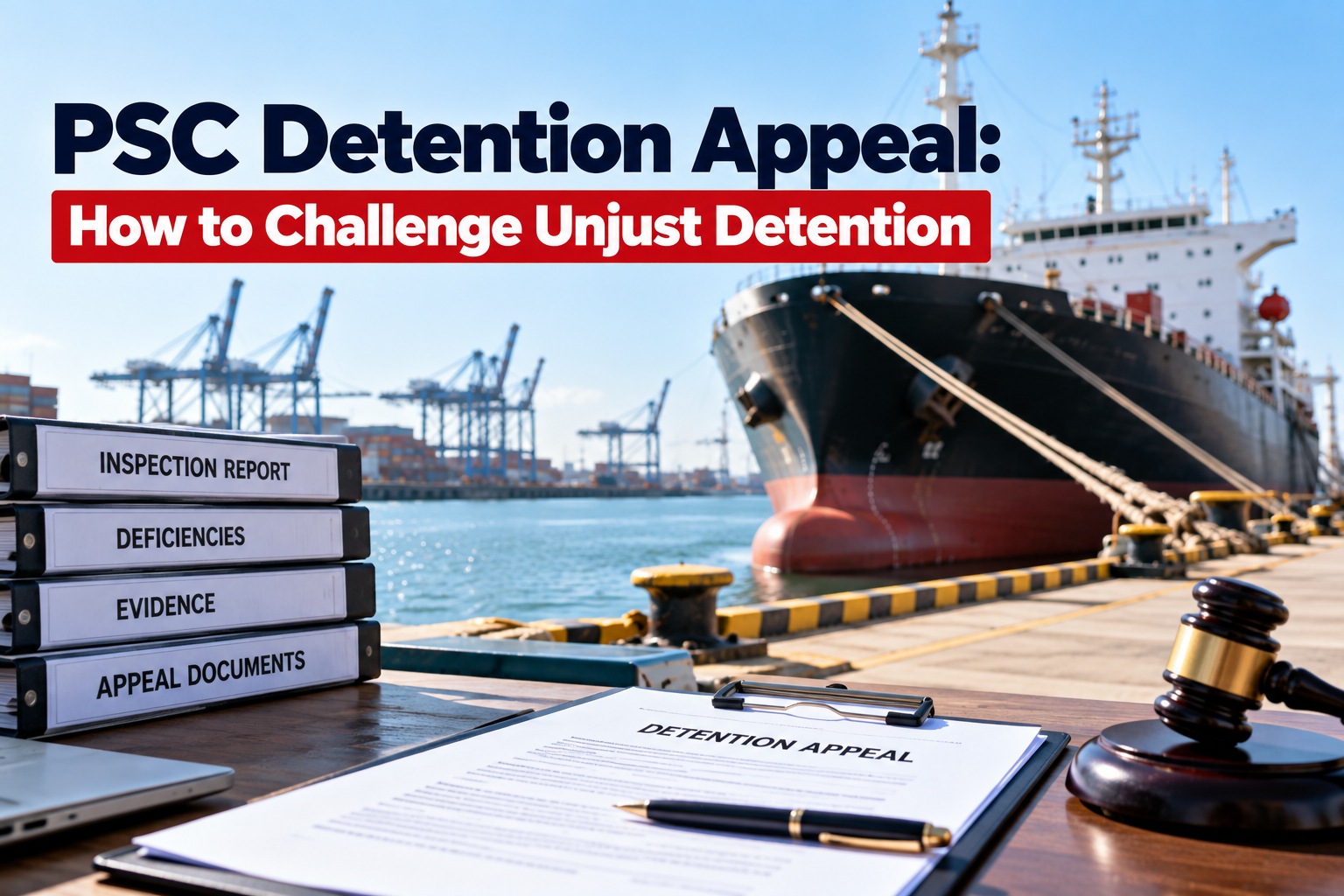
PSC Detention Appeal: How to Challenge Unjust Detention
A detention you believe is wrong can be challenged, but under the Paris MoU review procedure the owner and the operator cannot lodge the request at all — only the flag State or the recognised organisation can — and the detention stays in force throughout. That shapes everything about how a challenge is run. This guide covers the grounds worth arguing, what to capture while the ship is still alongside, both routes available, the 120-day clock, and what a favourable finding actually changes.
PSC detention appeal · routes and limits
You cannot appeal it. Your flag State can — and the clock starts at release, not at detention.
The evidence that wins an appeal is captured before the ship sails
Challenges fail for a short list of reasons, and most of them trace back to one of these being misunderstood at the outset.
01
The detention is not suspended
Lodging a challenge does not release the ship. The commercial damage happens regardless, which means the decision to appeal is about the record rather than about this port call.
02
You are not the one who lodges it
Only the flag State or the recognised organisation may submit a request to the review panel. Your task is to build a case strong enough that they take it up, which makes the first call after a detention a call to your flag.
03
The findings are not binding
The panel considers the procedural and technical aspects of the inspection and gives an opinion. It cannot overturn the port State, though its view may lead that authority to reconsider and amend the record.
Grounds worth arguing
A challenge that amounts to disagreeing with the officer’s judgement will not succeed. The ones that get taken seriously fall into a small number of categories, and the distinction between procedural and technical grounds matters because the panel examines both.
Ground
What it claims
Evidence it needs
Realistic prospect
Factually wrong
The condition recorded was not the condition on board
Dated photographs, records, and ideally a third party who saw the same item
Strongest ground, and the rarest — it requires evidence captured at the time
Wrongly classified
The finding was real but should not have been treated as detainable
The intended voyage, available redundancy, and the equipment actually in service
Good, where redundancy can be demonstrated rather than asserted
Outside the convention
The requirement applied does not apply to this ship, trade or date
The instrument, the applicability provisions and the ship’s particulars
Good where it is clear-cut, and it is usually clear-cut or hopeless
Procedure not followed
The inspection itself departed from the agreed procedures
The sequence of events, what was examined, and what was recorded when
Taken seriously, because the panel examines procedural aspects directly
Already accepted elsewhere
Flag or class has formally accepted the arrangement in question
The approval, exemption or equivalence, in writing and in date
Strong, and the reason flag involvement helps beyond the lodging requirement
Disagreement with judgement
The officer was too severe
Opinion
None — this is the most commonly attempted and least successful
The first 24 hours decide whether you have a case
This is the part that matters most and is attended to least, because the first day of a detention is consumed by rectification and by explaining the situation upwards. The evidence that supports a challenge exists only while the ship is still in the condition that was inspected.
Photograph the item as foundBefore anything is touched, with something in frame that fixes the date, and from enough angles that the condition is not arguable. Once it is repaired, the evidence of what it looked like is gone.
Record the sequence of the inspectionWho boarded, when, what was examined in what order, what was asked and what was demonstrated. Procedural grounds depend on this and nobody reconstructs it accurately a week later.
Capture the operational contextThe intended voyage, the equipment in service, the redundancy available. Classification arguments turn on this and it is rarely written down at the time.
Gather the approvalsAny flag exemption, class approval or accepted equivalence covering the arrangement, pulled out while there is time rather than after the ship has sailed.
Ask for the reasoning, politelyUnderstanding precisely why the officer considers the item detainable is both useful information and the basis of any later submission. It is a reasonable question asked at the time and an awkward one asked afterwards.
Tell flag immediatelyNot as a notification but as the opening of a conversation with the only party that can lodge a review. A flag brought in on day one is in a very different position from one approached on day ninety.
Route one: the national appeal procedure
Every port State operates its own appeal route, and that is where a challenge properly begins. Owners are expected to pursue the official national procedure first; the MoU review panel exists as a secondary avenue where that route has been exhausted or rejected.
It is the port State’s own process
Timescales, forms and the body that hears it differ by country. Find the procedure for that State rather than assuming a common shape.
It is the fastest route to a correction
Where the authority accepts the point, it can amend its own record directly — no panel opinion required, no further waiting.
It builds the file either way
The submission and the response become part of what goes to the review panel if the matter continues, so it is never wasted work.
Route two: the MoU detention review panel
Where the national route does not resolve it, the review panel procedure applies. The mechanics are specific and the deadline is unforgiving.
Who lodges
The flag State or the recognised organisation. Not the owner, not the operator, not the manager.
The deadline
Within 120 days from the date of release of the vessel from detention.
What goes in
All information relevant to the detention, in electronic format and in the English language, on the submission form provided.
Who considers it
A body comprising the Secretariat and four MoU Authorities taken on a rotating basis, excluding the port and flag States involved.
What it examines
The procedural and technical aspects of the inspection — both, which is why procedural grounds are worth preparing properly.
What it can do
Give an opinion. The findings are not binding, but they can lead the port State to reconsider its decision and amend the database record.
The requirement for everything in English, in electronic format, on the correct form, is not administrative fussiness — a submission assembled in a hurry from scanned paper in another language is a submission that is hard to consider on its merits. Build the file in the format it will eventually be submitted in, from day one.
What a favourable finding changes
Expectations need managing here, with the board as much as with the ship.
It does not undo the port call
The time lost, the cost of rectification and the schedule disruption are all spent. Nothing in either route returns them.
It can change the record
Where the port State reconsiders, the database entry can be amended — and the record is what drives the risk profile, the targeting frequency and what a charterer sees.
It is slower than the damage
A review takes months. During that period the detention sits on the profile and on the company score exactly as if it had not been challenged.
It is not a substitute for the operational response
Appeal and rectify in parallel. A challenge that becomes a reason not to address the underlying finding converts one problem into two.
Because the record is what carries the consequence, the operational response matters more than the outcome of any challenge — how deficiency and detention history feeds targeting is set out in our guide to the inspection regime and targeting, and the findings that most often produce a detention in the first place are in our guide to top detainable deficiencies.
If the flag State will not lodge it
This is the position operators find hardest, because the case can be strong and still go nowhere. A flag that declines is usually telling you something worth hearing, but not always.
Ask what would change their mind
A refusal is often about the strength of the file rather than the merits. Find out which part they could not stand behind, and whether it can be supplied.
Try the recognised organisation
The RO may also lodge. Where the finding touches an arrangement the society itself approved, it has its own reason to care about the outcome.
Pursue the national route regardless
The port State’s own procedure does not depend on the flag taking the case up, and a correction made there achieves the same practical result.
Record the disagreement internally
If the same point arises again, a documented position is what turns a second instance into a pattern worth raising rather than another isolated complaint.
Treat it as information about the flag
A registry that will not support a well-evidenced case on a matter within its own remit is telling you something about the service you are buying, and that belongs in the next flag review.
Deciding whether to challenge at all
Is there evidence, or only a view?If nothing was captured before the item was repaired, the case rests on recollection against a written report. That is not a case.
Will the flag carry it?They have to lodge it. If the flag is unconvinced after seeing the file, the matter ends there regardless of how strongly the owner feels.
Does the record matter enough?For a vessel approaching a vetting round or a charter negotiation, amending an unjust entry is worth real effort. For an isolated entry on a ship with a clean history, it may not be.
What does it cost in relationship?A well-founded, evidenced challenge is a normal part of the system. A speculative one, pursued hard, is remembered by an authority you will meet again.
How Marine Inspection supports a challenge
Every ground worth arguing depends on evidence that existed for a few hours and was not captured. That is not a legal problem; it is a records problem, and it is solved before the detention rather than after it.
Condition captured as found
Photographs and readings attached to the item with their date, taken as routine during inspections, so the state of equipment before any rectification is already on record rather than reconstructed.
The maintenance history behind the itemWhat was done to it, when, by whom and with what result — the file that answers a claim the equipment was neglected.
Approvals and equivalences to handFlag exemptions and class acceptances held against the vessel, retrievable in minutes rather than found after the window has closed.
The inspection recorded as it happenedFindings logged with their codes and timings, which is what procedural grounds are built from.
One export for the flag StateThe whole file assembled in one place, in the electronic form a submission requires, inside a deadline measured from release.
A case is won with records, not with argument
Marine Inspection holds the as-found condition, the maintenance history, the approvals and the inspection record against each vessel — so the file your flag State needs already exists on the day you ask them to lodge it.
Not to the Paris MoU review panel. Only the flag State or the recognised organisation may submit a request for review. The owner or operator builds the case and persuades the flag or RO to lodge it, which is why the flag should be involved from the first day.
Does appealing release the ship?
No. An appeal will not cause the detention to be suspended. The ship is released when the deficiencies are rectified and verified, independently of any challenge, so the decision to appeal concerns the record rather than this port call.
How long do you have to lodge a review request?
Within 120 days from the date of release of the vessel from detention — not from the date of detention. Both the national appeal and any subsequent review request have to fit inside that window.
Which route comes first?
The port State’s own national appeal procedure. The MoU review panel is a secondary avenue for cases where that route has been exhausted or rejected, and the national submission and response become part of the file either way.
Who sits on the review panel?
A body comprising the Secretariat and four MoU Authorities taken on a rotating basis, excluding the port State and flag State involved. It considers the procedural and technical aspects of the inspection.
Is the panel’s decision binding?
No. The findings are not binding. The panel gives an opinion, which may lead the port State to reconsider its decision and amend the database record — which is the practical outcome worth pursuing, since the record is what drives targeting and what counterparties see.
What evidence actually matters?
Dated photographs of the item as found before any repair, the sequence of the inspection, the intended voyage and available redundancy, and any flag exemption or class approval covering the arrangement. Almost all of it has to be captured while the ship is still in the condition that was inspected.
What format does a submission take?
All information relevant to the detention, in electronic format and in the English language, using the submission form provided. Assembling the file in that form from the outset is considerably easier than converting it under deadline.
Should we rectify while appealing?
Yes, always. The two run in parallel. The ship is not released until the deficiencies are addressed, and a challenge used as a reason to defer the underlying work turns one problem into two.
Before you need it
The file that makes a challenge possible is built on an ordinary day
Marine Inspection keeps as-found condition, maintenance history, approvals and the inspection record against every vessel, ready to hand over as one file — so if a detention ever needs challenging, the evidence is already there.