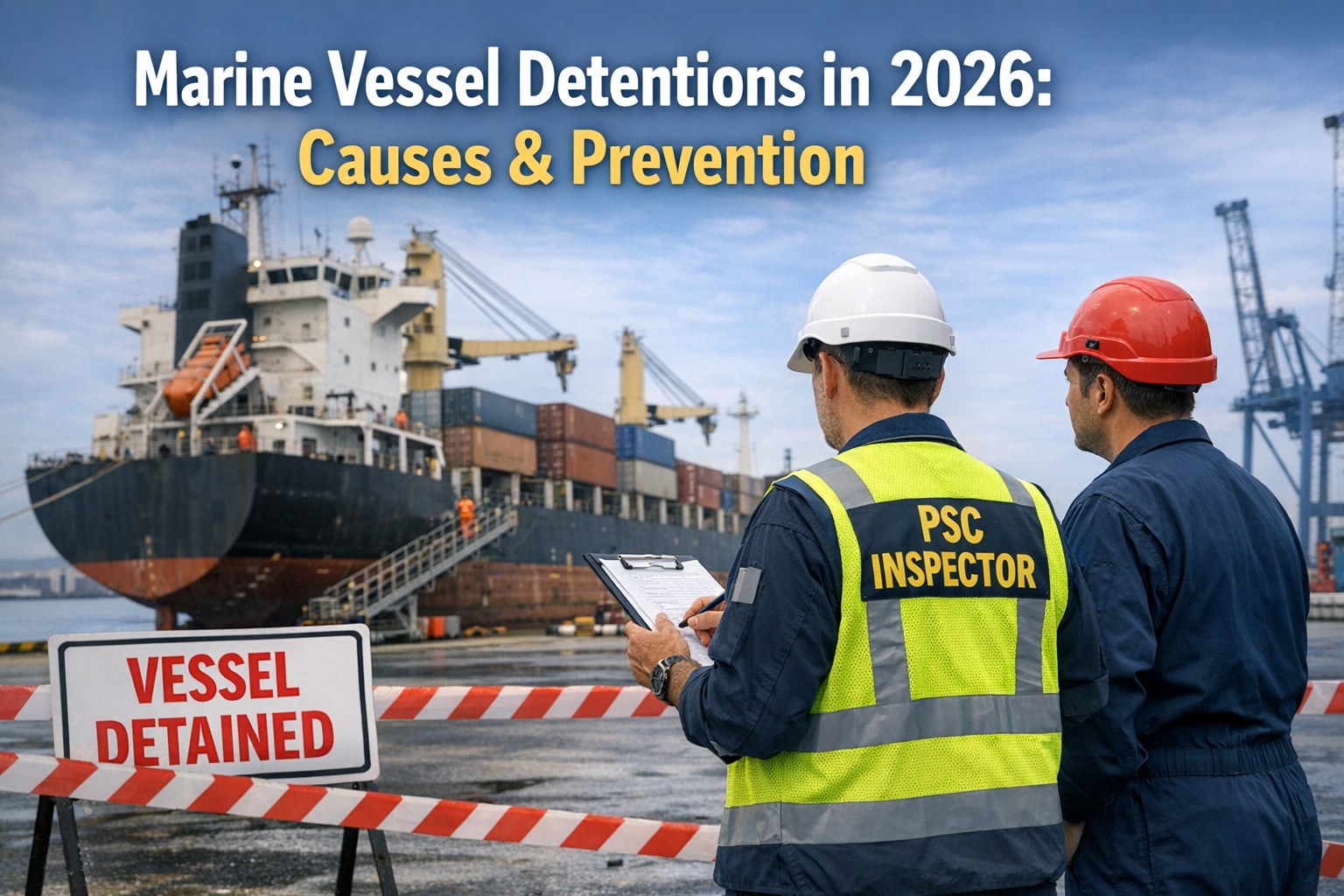
Detentions are rarely caused by one catastrophic discovery. Analysis of over a hundred and twenty-five thousand Tokyo MoU inspection records found that vessels accumulating five or more deficiencies in a single inspection face a high probability of detention, and the Paris MoU recorded well over four thousand detainable deficiencies across fewer than seven hundred detentions in a recent year — roughly seven findings for every ship held. The picture that emerges is not of a vessel undone by a single dramatic fault, but of one that collected a string of individually unremarkable items until the inspector concluded that the safety management system itself was not functioning, which is detainable in its own right. That changes what prevention actually means. It is not about surviving a bad moment during an inspection; it is about never arriving with an accumulation, and about ensuring that nothing found last time is still open this time. This guide covers how to read your own risk before arrival, which deficiency categories inspectors genuinely write up, how the inspection has shifted from reading documents to watching crews perform, and why disciplined closure tracking is the mechanism that stops small findings compounding into a detention. To build that discipline across your fleet, book a demo or start a free trial.
PREVENTION GUIDE · TRADING FLEETS
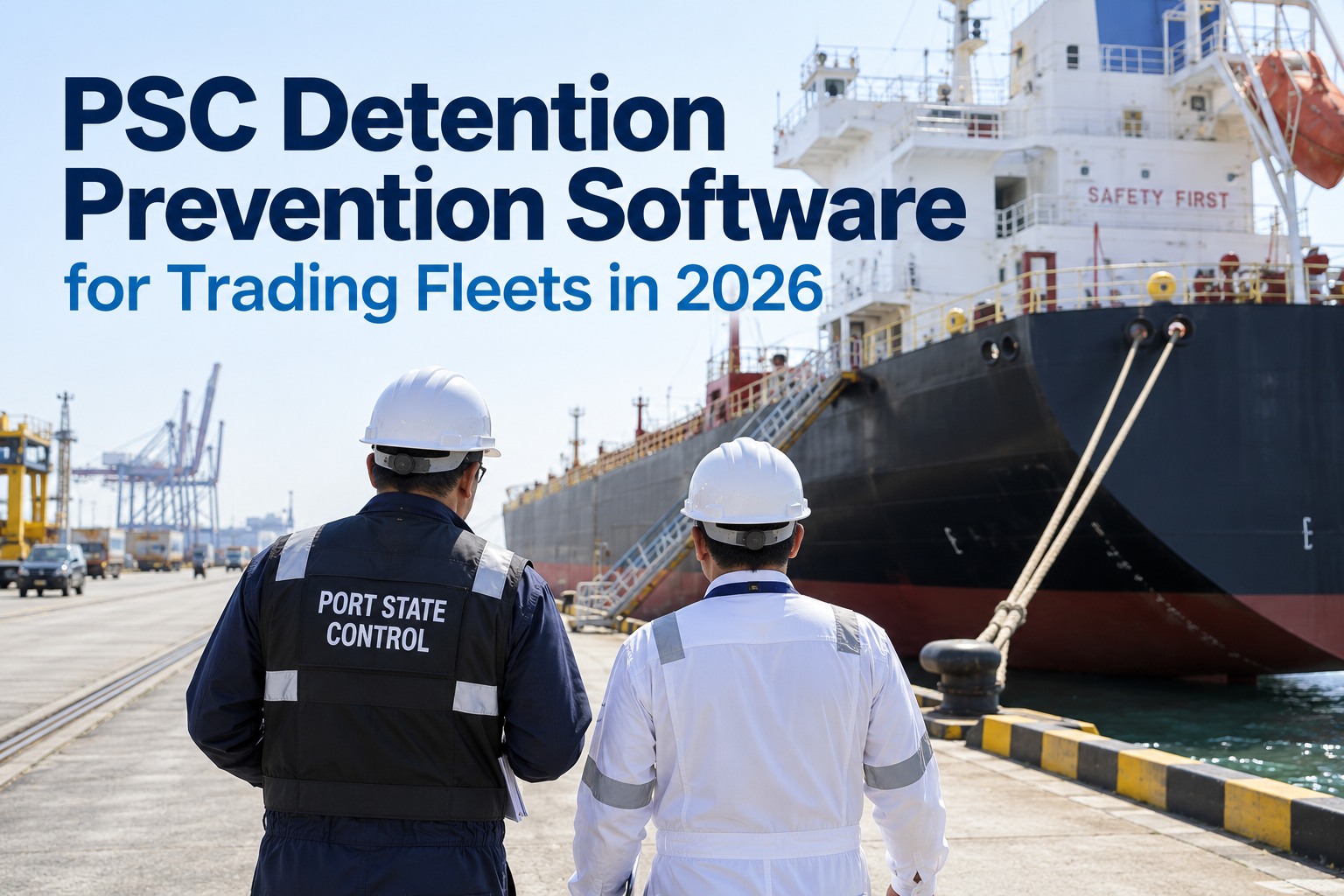
PSC Detention Prevention for Trading Fleets in 2026
Detention is an accumulation, not an accident. Here is how to read your own risk before arrival, target the categories inspectors actually record, prepare for functional verification, and close findings before they compound.
Detention Is an Accumulation
The most useful reframing available to a fleet manager is that detention risk is largely a function of deficiency count, not deficiency drama. Individual minor findings feel survivable in isolation, and they are — until enough of them sit on one report.
5+
Deficiencies in a single inspection significantly raises detention probability, according to analysis of more than 125,000 Tokyo MoU inspection records.
~7
Detainable deficiencies per detention on average in the Paris MoU — over 4,700 detainable findings across fewer than 700 detentions in a recent year.
83%
Of recent quarterly detentions in one class society's fleet were container, bulk carrier and general cargo vessels, with around 84% recorded in the Paris and Tokyo MoUs.
The mechanism behind the threshold is worth understanding precisely, because it explains why unrelated small items matter. When findings pile up across genuinely unconnected areas — a lifejacket light here, an out-of-date drill record there, a maintenance task overdue elsewhere — the inspector stops treating them as separate faults and starts treating them as evidence about the management system. That conclusion, that the safety management system is not working, is itself a detainable finding. It is why ISM consistently tops the detainable deficiency tables and why the most cited codes relate to ISM implementation and to maintenance of ship and equipment. A vessel does not usually get detained for its worst deficiency; it gets detained for what its deficiencies collectively imply.
Read Your Own Risk Before Arrival
Much of a vessel's inspection exposure is knowable in advance, because the targeting system is transparent and the underlying record is accessible to operators as well as inspectors.
The Ship Risk Profile drives inspection frequency
Every ship carries a profile calculated from ship type, age, flag state performance, classification society track record, company ISM performance and its own deficiency and detention history. That profile sets the inspection window — roughly five to eight months for a high-risk ship against twenty-four to thirty-six months for a low-risk one.
Your history is public to the inspector
Regional databases hold each vessel's inspection history, recorded deficiencies and detention record, and this is the same data a PSCO consults when deciding whether to inspect. Reviewing your own record before arrival tells you what the inspector will already know and where they are likely to probe.
Expanded inspections are predictable
Expanded inspections apply to high-risk ships and to categories including oil, chemical, gas and NLS tankers, bulk carriers and passenger ships above a certain age. They follow a predefined list of risk areas by ship type, typically take a full day, and include operational controls — so a vessel in scope can prepare against a known shape.
Company performance follows the fleet
Because company ISM performance feeds the profile, a detention on one vessel degrades the position of every ship under the same management. Prevention is therefore a fleet-level discipline, not a per-vessel one.
The practical upshot is that no vessel should arrive without knowing its own profile, its open history and whether it falls within an expanded-inspection category. That information shapes how much preparation the port call warrants. To keep that picture current across the fleet, book a demo or start a free trial.
The Categories Inspectors Actually Write Up
Deficiency distribution is remarkably stable year to year and region to region, which makes targeted preparation possible. These are the areas that dominate the statistics.
Category
What gets recorded
Fire safety
The leading detainable category in recent annual data. Fire detectors, fire pumps and the emergency fire pump, fire dampers and doors, and fixed carbon dioxide and foam systems.
Life-saving appliances
Findings appear in roughly a quarter of inspections. Lifeboat release mechanisms, davits, fall ropes, emergency beacons and immersion suits.
ISM implementation
The most frequently cited detainable item at individual level. Safety management documentation drift, non-conformities closed beyond their window, and master familiarisation gaps.
Maintenance of ship and equipment
A primary category in the Tokyo MoU and United States. Critical equipment not maintained to the planned schedule, with records missing to prove otherwise.
Emergency systems
Prominent in detainable findings. Emergency generators failing to take load, emergency lighting and emergency power arrangements.
Certificates and documentation
Around a sixth of inspections. Expired or missing certificates, lapsed endorsements and incomplete record books.
MARPOL and navigation
Oil Record Book entries inconsistent with operations, overdue separator alarm tests, fuel changeover logs, chart update currency and voyage data recorder function.
Two observations make this list actionable. First, nothing here is obscure — these are core systems every trading vessel maintains, which means findings usually indicate a verification gap rather than genuine neglect. Second, fire safety and life-saving appliances together account for the largest share of detentions globally, so a fleet that verifies those two categories rigorously before arrival removes a disproportionate slice of its risk.
5+
deficiencies and detention probability climbs sharply
Preventing detention means arriving with a short list, not defending a long one. Marine Inspection runs pre-arrival checks against the categories inspectors actually record, tracks every finding through to evidenced closure, and keeps certificate and maintenance status visible fleet-wide — so items are resolved before they accumulate.
Book a demo to see it on your vessels, or
start a free trial.
Functional Verification, Not Documentary Review
The most consequential shift in how inspections are conducted is that officers increasingly want to see systems operate and crews perform, rather than read that they should. A folder of correct paperwork no longer carries an inspection on its own.
Emergency generator started and taking load on the emergency switchboard under simulated blackout conditions
Emergency fire pump tested and delivering, with the system proven rather than described
Remote closing of ventilation flaps and dampers demonstrated to operate
Abandon-ship drill conducted with a boat actually lowered
General alarm tested and audible throughout
Crew performing their roles correctly, in the right protective equipment, using communications properly
Recent published examples illustrate how exacting this is. An emergency generator that failed repeatedly to take load in automatic mode during a blackout test produced a deficiency, as did a fire drill in which firefighters wore communications headsets incorrectly and one crew member was without a helmet. Neither is a documentation failure; both were observed in performance. The preparation implication is direct: drills should be run as they will be watched, equipment should be function-tested rather than visually checked, and crew should practise the tasks rather than review the procedure. The inspection covers the human element too — ISM implementation, certification, hours of rest and living conditions — so rest-hour discipline and crew familiarity need the same treatment as machinery.
The Pre-Arrival Window
Preparation is most effective when it is structured and repeatable rather than improvised per port. A workable sequence looks like this.
Well before arrival
Check the vessel's own inspection record and risk profile, confirm whether it falls into an expanded-inspection category, and identify any finding from a previous inspection that remains open. Anything unresolved from last time is the single easiest deficiency for an inspector to record.
Category verification
Work through the dominant categories deliberately — fire safety, life-saving appliances, emergency systems, certificates, maintenance records, and the MARPOL record books — verifying function rather than presence, and raising anything found as a tracked defect rather than a mental note.
Certificates and surveys
Confirm nothing statutory or class-related expires near the port call, and that endorsements and record books are complete. Expired or missing certificates sit among the most commonly recorded categories and are entirely avoidable with forward visibility.
Functional readiness
Test the systems an inspector is likely to ask to see operating, and rehearse drills as performances rather than paper exercises. Confirm the crew who would actually perform each emergency role are aboard and know it.
Campaign awareness
Check whether a concentrated inspection campaign is running, since a themed questionnaire is added to normal inspections during campaign periods and regional authorities also run their own focused campaigns. Campaign topics are published in advance, so this is entirely foreseeable preparation.
None of this is exotic, and that is the point. The fleets that avoid detention are not doing anything an ordinary well-run operation could not do; they are simply doing it consistently, before every call, rather than reactively after a bad inspection.
Closure Tracking Stops Accumulation
If detention is an accumulation, then closure discipline is the mechanism that prevents it. Every finding that is genuinely resolved and evidenced is one that cannot contribute to a future pile-up, and every one left open is a finding waiting to be recorded again.
Good closure has a specific shape. The finding is captured with enough detail that someone other than the person who raised it can act on it. It carries a named owner and a deadline rather than sitting in a general queue. Its root cause is identified, because a repaired symptom recurs and a recurring deficiency is worse than a first-time one. Completion is evidenced with records and photographs attached at the time of the work, not asserted afterwards. And it is verified closed by someone other than the person who did the work where the finding is significant. This matters beyond the immediate item, because deficiency and detention history feeds the risk profile that determines how often the vessel is inspected, and that history runs over a multi-year window — so improvement accrues slowly and only starts when the underlying behaviour changes.
The fleet dimension is equally important. Because company ISM performance forms part of every vessel's profile, a finding on one ship signals exposure on sister vessels running the same systems and procedures. Cascading each finding across the fleet, and closing it wherever it applies, is the cheapest prevention available and the clearest demonstration that the management system is actually working — which is precisely the judgement that decides whether an accumulation of small items becomes a detention. To hold that closure discipline across every vessel, book a demo or start a free trial.
Frequently Asked Questions
01
How many deficiencies lead to a detention?
There is no fixed number, but the pattern is well evidenced. Analysis of more than 125,000 Tokyo MoU inspection records found that vessels with five or more deficiencies in a single inspection face a significantly higher probability of detention. Paris MoU figures point the same way: over four thousand seven hundred detainable deficiencies were recorded against fewer than seven hundred detentions in a recent year, roughly seven findings per ship detained. This reflects how detention decisions are actually reached — not usually through one catastrophic fault, but through an accumulation of items across unrelated areas that leads the inspector to conclude the safety management system is not functioning, which is itself detainable. A single critical safety finding can of course detain a vessel on its own, but the common route is accumulation.
02
Which deficiency categories should we prioritise?
Fire safety and life-saving appliances first, since together they account for the largest share of detentions globally — fire safety leads recent annual detainable-deficiency data, and life-saving findings appear in roughly a quarter of inspections. Then ISM implementation, which is the most frequently cited detainable item at individual level, covering documentation drift, non-conformities closed beyond their window and master familiarisation gaps. Maintenance of ship and equipment is a primary category in the Tokyo MoU and United States, typically where critical equipment has not been maintained to schedule or the records cannot prove it was. Emergency systems, certificates and documentation, and MARPOL record-keeping complete the list. None of these are obscure areas, which means findings usually reveal a verification gap rather than genuine neglect.
03
Can we predict how likely our vessel is to be inspected?
Largely, yes, because the targeting system is transparent. Every ship carries a risk profile calculated from ship type, age, flag state performance, classification society track record, company ISM performance, and its own deficiency and detention history. That profile sets the inspection window, which runs from roughly five to eight months for a high-risk ship out to twenty-four to thirty-six months for a low-risk one. Regional databases also hold each vessel's inspection history, recorded deficiencies and detentions, and this is the same record a port state control officer consults when deciding whether to inspect — so reviewing your own history before arrival shows what the inspector already knows and where they are likely to probe. Vessels in expanded-inspection categories can additionally prepare against a predefined list of risk areas for their ship type.
04
What does functional verification mean in practice?
It means the officer wants to watch systems operate and crews perform rather than read that they should. Typical operational controls include starting the emergency generator and confirming it takes load on the emergency switchboard under simulated blackout conditions, testing the emergency fire pump, demonstrating remote closing of ventilation flaps, running an abandon-ship drill with a boat actually lowered, and testing the general alarm. Recent published examples show how exacting this is — an emergency generator that repeatedly failed to take load in automatic mode produced a deficiency, as did a fire drill where crew wore communications headsets incorrectly and one was without a helmet. Neither was a paperwork failure. Preparation should therefore involve function-testing equipment rather than visually checking it, and rehearsing drills as they will be observed.
05
Why does a detention on one vessel affect the rest of the fleet?
Because company ISM performance is one of the inputs to every vessel's risk profile. When one ship is detained, the management company's record degrades, and that feeds into the profile of every vessel under the same management — raising inspection frequency and scrutiny across the fleet rather than on the detained ship alone. The effect persists, since deficiency and detention history is assessed over a multi-year window, so recovery is gradual and begins only when the underlying practice changes. This is why prevention has to be managed as a fleet-level discipline. It is also why cascading findings matters: a deficiency raised on one vessel usually indicates the same exposure on sister ships running identical systems and procedures, so closing it fleet-wide is both the cheapest prevention available and evidence that the management system genuinely works.
06
What makes a finding properly closed?
Closure needs a specific shape to actually reduce risk. The finding should be captured in enough detail that someone other than the person who raised it can act on it. It should carry a named owner and a deadline rather than sitting in a general queue. Its root cause should be identified, because a repaired symptom recurs and a repeat deficiency is treated more seriously than a first occurrence. Completion should be evidenced with records and photographs attached at the time of the work rather than asserted later, since that evidence is what an inspector or auditor tests. And significant findings should be verified closed by someone other than the person who performed the work. Anything left open is simply a deficiency waiting to be recorded again at the next inspection, and an unresolved prior finding is the easiest item an inspector can write up.
Arrive With a Short List
Detention comes from accumulation — small findings across unrelated areas that together suggest the management system is not working. Marine Inspection prevents that build-up: pre-arrival checks against the categories inspectors actually record, function-tested equipment evidenced at the point of work, findings tracked to verified closure with root cause, and fleet-wide visibility so a finding on one vessel is closed on its sisters.
Book a demo or
start a free trial.