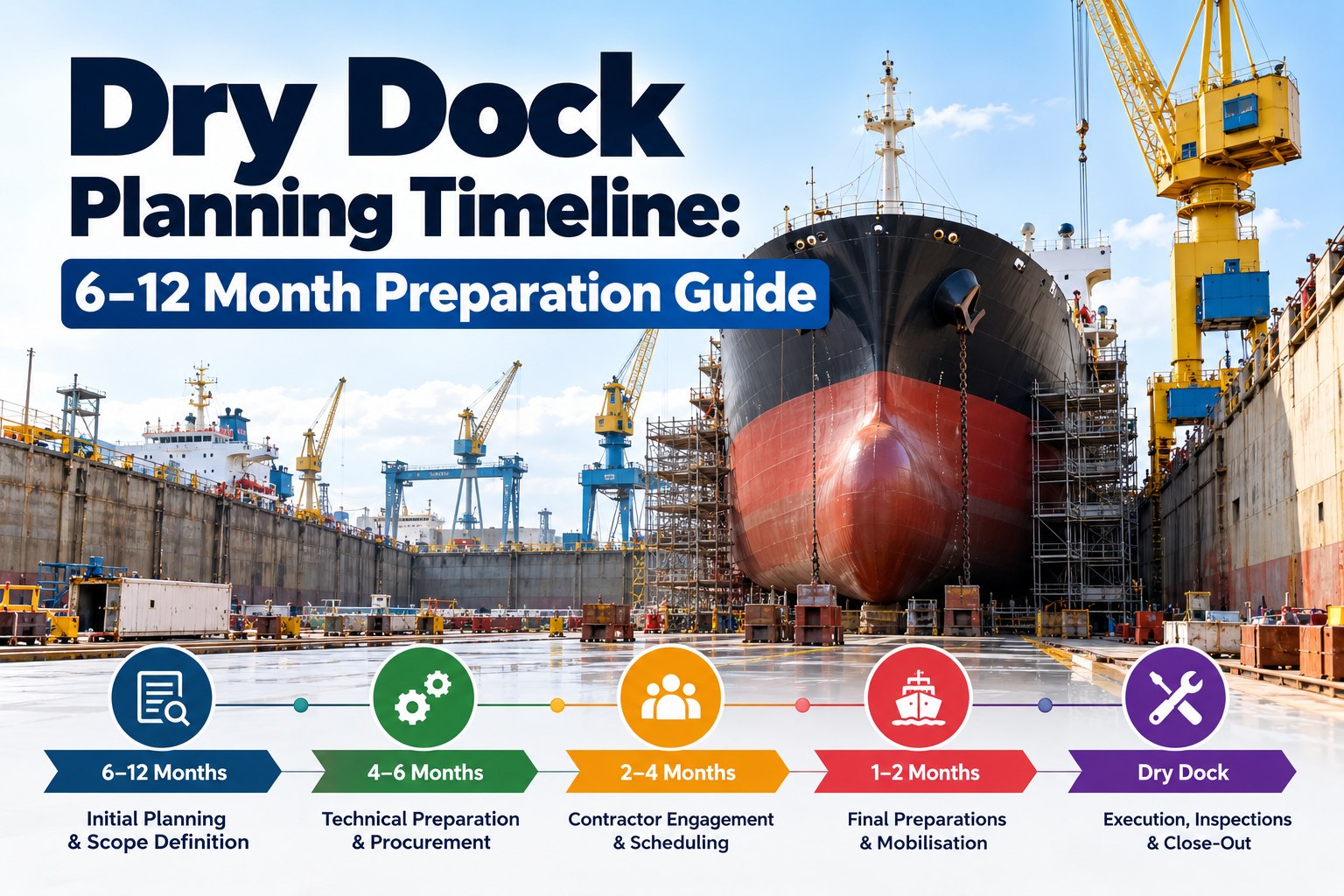
A dry dock planning timeline of 6 to 12 months is the difference between a docking that finishes on time and on budget and one that drifts into extra days and extra cost. For a Technical Superintendent, the dock is the largest single project of the ship's maintenance cycle, and most of its outcome is decided long before the ship reaches the yard. This guide sets out the six phases month by month, the budget and scope controls that hold the cost, the class drivers behind the schedule, and the gate reviews that keep the project honest. Start a free trial of Marine Inspection to run the dock project from one place.
- Plan 6 to 12 months ahead, and start condition assessment even earlier for large programmes.
- The specification is the most important document. Write it early, with a clear split between must-do and deferrable work.
- Scope creep is the most consistent cost control challenge. Set a scope freeze date and rules for variation orders.
- Track estimated, committed, actual and forecast cost every day in dock.
- Marine Inspection's dry dock guide puts overruns at 15 to 25% without systematic project management, a figure we could not confirm independently.
Why Dry Dock Planning Starts 6 to 12 Months Early
A dry docking combines compulsory survey work, hull coating, machinery overhaul and sometimes steel renewal in a short, expensive window. Yards sell slots in advance, specialist contractors and spares have lead times, and class surveyors must be booked. Starting late reduces your bargaining power and pushes scope decisions into the dock, where every extra item costs more.
What drives the dock window
- Class and flag intervals. Under the UK guidance we reviewed, a ship needs two bottom inspections in any five-year period, no more than 36 months apart, with one out of the water.
- Charter commitments. Docking in a charter gap or a seasonal low can limit off-hire cost.
- Condition of the ship. Equipment trends and outstanding defects decide what has to be done this time.
- Yard availability. Marine Inspection's guide notes that Korean yards in particular need advance booking.
How long a dry docking takes
Marine Inspection's guide gives 5 to 21 days as typical. Other sources put intermediate dockings at 10 to 21 days and special surveys at 20 to 30 days or more, with unexpected repairs adding 5 to 15 days. Duration depends heavily on the amount of steel and machinery work, which is why scope control matters.
The Six-Phase Dry Dock Timeline
| Phase | Timing | Main outputs | Key decision |
|---|---|---|---|
| 1. Planning and strategy | 6 to 12 months before | Docking window, budget, off-hire assumption, condition assessment | Which survey window and which charter gap? |
| 2. Specification | 4 to 6 months before | Work list with class items, must-do and deferrable split | What is in scope and what is deferred? |
| 3. Tender and yard selection | 3 to 5 months before | Bids compared, yard slot booked, contract terms | Which yard, at what price and slot? |
| 4. Pre-arrival preparation | 1 to 3 months before | Spares ordered, documents sent, underwater inspection, crew plan | Is the scope frozen and the ship ready? |
| 5. Execution | In dock | Daily progress and cost tracking, controlled variation orders | Do we approve extra work or defer it? |
| 6. Close-out | After undocking | Defect list, final cost reconciliation, lessons learned | What goes into the next docking? |
Dry Dock Planning, Phase by Phase
Phase 1: Planning and strategy (6 to 12 months before)
Set the objectives: which survey window, which charter gap, what budget and what off-hire assumption. Use condition data, such as equipment trends, outstanding maintenance and deficiencies, to build a first list of likely work. Agree who owns the project and who approves changes.
Phase 2: Specification (4 to 6 months before)
The specification defines the work scope, the acceptance standards and the inspection requirements the yard will price and deliver. Include class and flag items, then mark each remaining item as must-do or deferrable. Decide early which high-cost materials you will supply yourself, since owner-furnished materials can control cost.
Phase 3: Tender and yard selection (3 to 5 months before)
Issue the specification to a short list of yards, compare bids line by line and confirm the slot. Price is only one factor. Check the yard's capacity, past performance on similar ships and its approach to variation orders. Marine Inspection's guide reports that Chinese and regional yards can run 30 to 50% below South Korean pricing, so the trade-off between price, location and quality needs a conscious decision.
Phase 4: Pre-arrival preparation (1 to 3 months before)
Freeze the scope, order long-lead spares, send the yard its document package (30 to 60 days before arrival, per the guide), carry out underwater inspection and agree the crew and superintendent plan. A ship that arrives with the scope frozen and the spares on site gives the yard little room to delay.
Phase 5: Execution in dock
Run daily progress and cost reviews against the plan. Hold every extra item to a variation-order process with a stated price, a time impact and a clear approve-or-defer decision. Maintain inspection records as the work proceeds.
Phase 6: Close-out
Reconcile final cost against budget, issue the post-dock defect list, and record what surprised the team. Feed those lessons into the next dock specification and the planned maintenance system.
Budget and Overrun Control
Four cost numbers to track every day
- Estimated cost: the approved budget.
- Committed cost: purchase orders and subcontracts placed.
- Actual cost: invoices and labour incurred.
- Forecast to completion: your best view of the final figure.
These four baselines, described in a ship repair project cost article, show the gap between what you planned, what you have committed and where you are heading. A rising forecast is the early warning that an overrun is coming.
Worked example (our own, illustrative). If extra work adds 5 days at an assumed $35,000 of off-hire per day, the delay costs $175,000 before any repair cost. Use your own daily figure when you build the business case for a tighter scope.
Scope Management: Must-Do, Deferrable and Opportunistic
Scope creep is the most consistent cost control challenge. It comes from work added in dock for unforeseen conditions and from opportunistic additions that seemed small. A simple three-way split controls both.
Class and Flag Drivers Behind the Schedule
| Requirement | What it says | Source |
|---|---|---|
| Two bottom inspections in any five years | Maximum interval between them 36 months | UK MGN 217, for ships under SOLAS and the Load Line Convention |
| One out-of-water | One inspection must be out of the water, ideally with the renewal survey | UK MGN 217 |
| In-water survey for intermediate inspections | Allowed where a dry-dock survey is not required | UK MGN 217 |
| Ships over 15 years | In-water survey needs special consideration. Oil tankers and bulk carriers over 15 years under the Enhanced Survey Programme are not eligible | UK MGN 217 |
Gate Reviews: Six Checkpoints for the Dock Project
Common Dry Dock Planning Mistakes
Systems for Dry Dock Projects
Spreadsheets and email can hold a dock plan, but they strain under version control, yard document packages and daily cost tracking. Marine Inspection supports specification development with version control, distribution of the yard documentation package, daily progress tracking with Gantt charts, real-time cost monitoring and digitisation of the post-dock defect list, as described in its own dry docking guide. Book a walkthrough to see a dock project from specification to defect list.