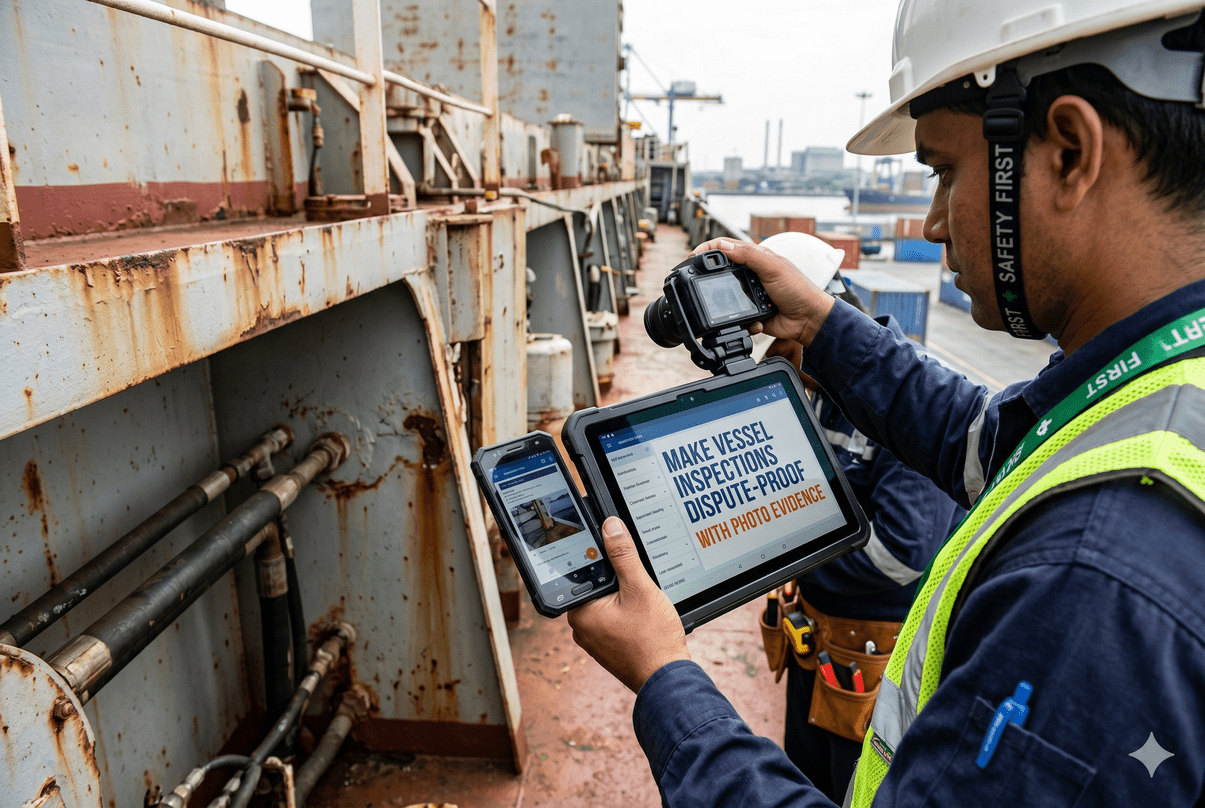
A vessel inspection without photo evidence is an inspection that did not happen. Six months after a charter dispute opens, three months after a PSC detention is challenged, or one week after a SIRE 2.0 negative observation is recorded, the question is always the same: can you produce the timestamped, GPS-tagged, annotated photo proving what was found and when. OCIMF SIRE 2.0 mandates a dedicated Photo Repository updated within a 6-month window, with inspectors corroborating uploaded photos against actual vessel condition on inspection day. PSC detention challenges require completion photos with responsible-officer signature. Charter disputes resolve on visual evidence with court-grade chain of custody. Photo evidence is now the operational currency through which inspection outcomes are settled. Start a free trial of Marine Inspection to capture dispute-proof photo evidence across every inspection on your fleet.
Photo Evidence Vessel Inspection · 2026
Every Finding. Every Photo. Every Annotation. Every Timestamp. Dispute-Proof.
GPS-stamped photo capture, annotation toolkit, voice notes, video clips, supervisory verification, SIRE 2.0 Photo Repository alignment — every piece of evidence court-grade and immutable.
FINDING
CO2 pressure low
12 Apr · 14:32 UTC
PASS
Fire main test
12 Apr · 14:18 UTC
ALERT
Corrosion port frame
12 Apr · 13:55 UTC
VERIFIED
Lifeboat davit
12 Apr · 13:42 UTC
Four Scenarios Where Photo Evidence Decides The Outcome
Photo evidence is not background documentation. In four specific scenarios it directly determines whether the operator wins or loses. Each scenario plays out daily across global fleets in 2026.
A
SIRE 2.0 Photo Repository Match
Inspector boards tanker, opens OCIMF portal, compares uploaded Photo Repository images against actual vessel condition. Mismatch produces negative observation. Repository older than 6 months produces negative observation. Photo currency directly affects vetting outcome.
B
PSC Detention Challenge
PSC officer issues deficiency or detention. Operator challenges the finding. Without timestamped completion photos, responsible-officer signatures, and chain-of-custody preservation, the challenge fails. With dispute-proof photo evidence, deficiencies close before detention escalates.
C
Charter Dispute Months Later
Cargo damage claim or off-hire dispute opens six months after the voyage. Arbitrator requests visual evidence of vessel condition at the relevant time. Reconstructed photos from email threads fail evidential standards. Native timestamped, GPS-tagged captures stand up to scrutiny.
D
Vetting Rejection Recovery
Negative SIRE 2.0 observation generated. Operator works the corrective action. Re-vetting requires completion evidence with photo, timestamp, responsible-officer signature. Without dispute-proof closure documentation, the observation remains open and the vessel remains rejected — costing hundreds of thousands in lost charter revenue.
The Six Properties That Make A Photo Dispute-Proof
Not every photo holds up under scrutiny. Six structural properties separate court-grade visual evidence from screenshots and casual phone snaps. A credible photo evidence platform builds all six into every capture.
GPS Coordinates Embedded
Latitude, longitude, altitude captured at the moment of shutter activation and embedded in the EXIF metadata. Cannot be modified after capture. Proves location of the finding.
Cryptographic Timestamp
Capture time signed against authoritative time source. Cannot be backdated or modified. Establishes when the finding was documented relative to the inspection cycle.
Inspector Identity Bound
Identity of the capturing inspector cryptographically bound to the photo. Cannot be reassigned. Establishes responsible-officer chain of custody for audit and dispute defence.
Tamper-Evident Storage
Any modification to the captured photo produces detectable evidence. Cropping, colour adjustment, annotation, redaction all logged with full audit trail. Original preserved.
Linked To Finding
Photo bound to the specific inspection item that triggered it. Cannot be repurposed across findings. Each finding's photo set retrieves together for the audit pack.
Supervisory Verification
Master or chief engineer counter-signature on critical photos. Cannot be added retroactively without surfacing the change. Adds the second authority required for high-stakes findings.
The Inspector Annotation Toolkit
A photo without annotation is half the evidence. Five annotation tools turn a raw capture into a deployable piece of evidence — circling the deficiency, indicating measurement, calling out the regulatory reference. The toolkit must be fast on a tablet at the inspection site, not a desktop reconstruction.
Mobile Capture Vs Desktop Reconstruction
The single most consequential decision in photo evidence design is when the capture happens. Mobile at the site versus desktop reconstruction after the fact produce fundamentally different evidence quality and dispute resilience.
DESKTOP RECONSTRUCTION
Photos taken on personal phone
Emailed back to office after inspection
Manually attached to inspection record
Annotations done from memory days later
No timestamp integrity preserved
No chain of custody chain
Vulnerable to dispute challenge
MOBILE CAPTURE AT SITE
Capture inside the inspection app on tablet
GPS and timestamp embedded automatically
Bound to the finding at the moment of capture
Annotated on site while observation fresh
Cryptographic chain preserved
Court-grade evidence by default
Offline capture, auto-sync on connectivity
Photo Evidence Demo · 30 Minutes
See How Photo Evidence Resolves Disputes In Minutes
A 30-minute session walking through SIRE 2.0 Photo Repository alignment, mobile capture on tablet, annotation toolkit, and dispute defence pack assembly. Bring a real inspection scenario from your fleet.
Five Workflows That Photo Evidence Software Should Cover
Beyond capture itself, five workflows define a complete photo evidence platform. Each addresses a specific point in the inspection lifecycle where visual evidence drives the outcome. Book a workflow demo to see each one operate on a real fleet inspection.
A
SIRE 2.0 Photo Repository Maintenance
Standardized photos captured on the 6-month cycle. OCIMF guidelines compliance verified. Repository updated before next vetting cycle. Inspector pre-inspection review supported.
B
Finding Documentation
Every finding captured with paired before-and-after photos, annotations, measurements, voice notes, regulatory tags. Linked to corrective action workflow from the moment of capture.
C
Corrective Action Close-Out
Completion photo with responsible-officer signature. Comparison view against original finding photo. Closure workflow triggers shore review and audit pack generation.
D
Dispute Defence Pack
Charter dispute, PSC challenge, insurance claim opens. Platform produces evidence pack with photos, timestamps, GPS data, annotations, signatures, regulatory references. Days collapses to minutes.
E
Trend Analysis Across Fleet
Photo evidence aggregated across vessels surfaces recurring defect patterns — same corrosion zone across the fleet, same equipment failure mode, same PSC focus area. Capex and operational decisions informed by visual data.
Why Marine Inspection For Photo Evidence
Marine Inspection delivers court-grade photo evidence built on the six dispute-proof properties, five-tool annotation kit, and five lifecycle workflows. Start a free trial or book a 30-minute demo to see the platform.
SIRE 2.0 Repository Aligned
6-month update cycle enforced. OCIMF photo guidelines built into capture templates. Inspector pre-inspection review supported. Repository ready when vetting request submitted.
Six Dispute-Proof Properties
GPS coordinates, cryptographic timestamp, inspector identity binding, tamper-evident storage, finding linkage, supervisory verification — every property built into every capture by default.
Mobile-First Capture
Tablet capture at the inspection site with full offline mode. Engine room, cargo deck, lifeboat platform supported. Auto-sync on connectivity. Annotation while observation is fresh.
Frequently Asked Questions
What is dispute-proof photo evidence in vessel inspection?
Dispute-proof photo evidence is visual documentation that holds up under audit, PSC challenge, charter dispute arbitration, or insurance claim defence. Six structural properties separate dispute-proof photos from casual phone snaps. GPS coordinates embedded in EXIF metadata at moment of capture. Cryptographic timestamp signed against authoritative time source. Inspector identity cryptographically bound to the photo. Tamper-evident storage where any modification produces detectable evidence with full audit trail. Photo linked to the specific inspection item that triggered it. Supervisory verification from master or chief engineer for critical findings. Together these properties produce visual evidence that survives the scrutiny applied months or years after the original inspection — when charter disputes open, PSC detentions are challenged, or insurance claims arise.
How does SIRE 2.0 Photo Repository work?
OCIMF SIRE 2.0 requires tanker operators to maintain a dedicated Photo Repository in the OCIMF portal with standardized photos of vessel-specific equipment, cargo areas, accommodation, and engine spaces. Photos must follow OCIMF guidelines for angle, lighting, and content. The repository must be updated within a 6-month window — photos older than 6 months trigger negative observations. When a vetting request is submitted, the inspector reviews uploaded photos before the inspection and corroborates them against actual vessel condition on inspection day. Mismatch between repository photos and on-board reality produces negative observations. A credible photo evidence platform enforces the 6-month update cycle, provides templated capture matching OCIMF guidelines, and supports inspector pre-inspection review.
What annotation tools does effective photo evidence need?
Five annotation tools cover the substantial majority of marine inspection scenarios. Circle and arrow — tap to circle the deficiency, tap-and-drag to draw an arrow, with multiple per photo on an overlay layer that preserves the original. Measurement callout — measurement text with units (mm, cm, bar, percentage) plotted at the relevant point for crack length, gap width, corrosion depth, pressure reading. Voice note attach — tap-and-hold to record voice annotation capturing inspector observation in real time when typing on tablet at the inspection site is impractical. Regulatory tag — link the photo to specific regulation reference (SOLAS, IMO A.1206(34) deficiency code, SIRE 2.0 question) with one-tap from a regulation picker. Video and time-lapse — short video clips for dynamic findings (pump operation, drill execution) plus time-lapse capture for slow processes like settling, drainage, leak progression.
Why does mobile capture beat desktop reconstruction?
The single most consequential decision in photo evidence design is when the capture happens. Mobile at the site versus desktop reconstruction after the fact produce fundamentally different evidence quality and dispute resilience. Desktop reconstruction means photos taken on personal phones, emailed back to office after inspection, manually attached to inspection records, annotated from memory days later — with no timestamp integrity, no chain of custody, and vulnerability to dispute challenge. Mobile capture at site means photos taken inside the inspection app on tablet with GPS and timestamp embedded automatically, bound to the finding at the moment of capture, annotated on site while the observation is fresh, with cryptographic chain preserved and full offline mode for engine room and cargo deck. The mobile path produces court-grade evidence by default; the desktop path produces evidence that fails under scrutiny.
What workflows does photo evidence software support?
Five workflows define a complete photo evidence platform. SIRE 2.0 Photo Repository Maintenance — standardized photos captured on the 6-month cycle with OCIMF guidelines compliance verified. Finding Documentation — every finding captured with paired before-and-after photos, annotations, measurements, voice notes, regulatory tags linked to corrective action workflow from the moment of capture. Corrective Action Close-Out — completion photo with responsible-officer signature, comparison view against original finding photo, closure workflow triggering shore review and audit pack generation. Dispute Defence Pack — charter dispute, PSC challenge, or insurance claim triggers evidence pack assembly with photos, timestamps, GPS data, annotations, signatures, regulatory references collapsing days to minutes. Trend Analysis Across Fleet — photo evidence aggregated across vessels surfaces recurring defect patterns (same corrosion zone, same equipment failure mode, same PSC focus area) informing capex and operational decisions.
How do we get started with Marine Inspection?
Two paths. Start a free trial directly — the platform loads with sample inspection data including pre-configured Photo Repository templates aligned with OCIMF SIRE 2.0 guidelines, annotation toolkit demonstrations, and dispute defence pack examples so DPAs, technical superintendents, and crew managers can explore the six dispute-proof properties, mobile capture flow, and five workflows before any commitment. Or book a 30-minute photo evidence demo with a Marine Inspection product expert — bring a real inspection scenario from your fleet, walk through SIRE 2.0 Photo Repository alignment, mobile capture on tablet, annotation toolkit, and dispute defence pack assembly. Both paths converge if you decide to implement with phased onboarding and full multi-vessel photo evidence deployment within a fiscal quarter.
Ready When You Are
Every Finding Documented. Every Dispute Defended. Every Photo Court-Grade.
SIRE 2.0 Photo Repository alignment, six dispute-proof properties built in, five-tool annotation kit, mobile-first capture, five-workflow lifecycle — all in one platform built for the 2026 photo evidence reality.