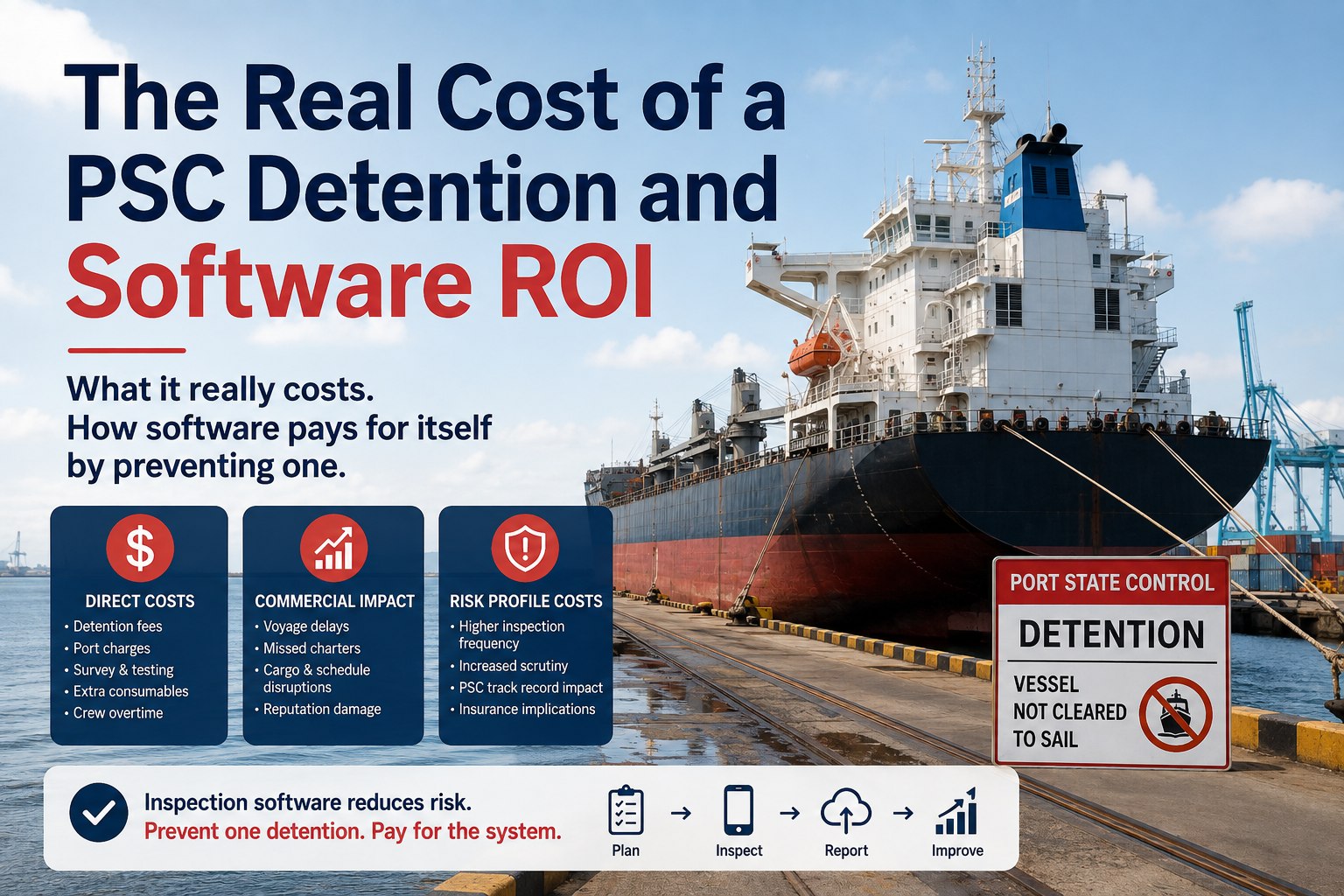
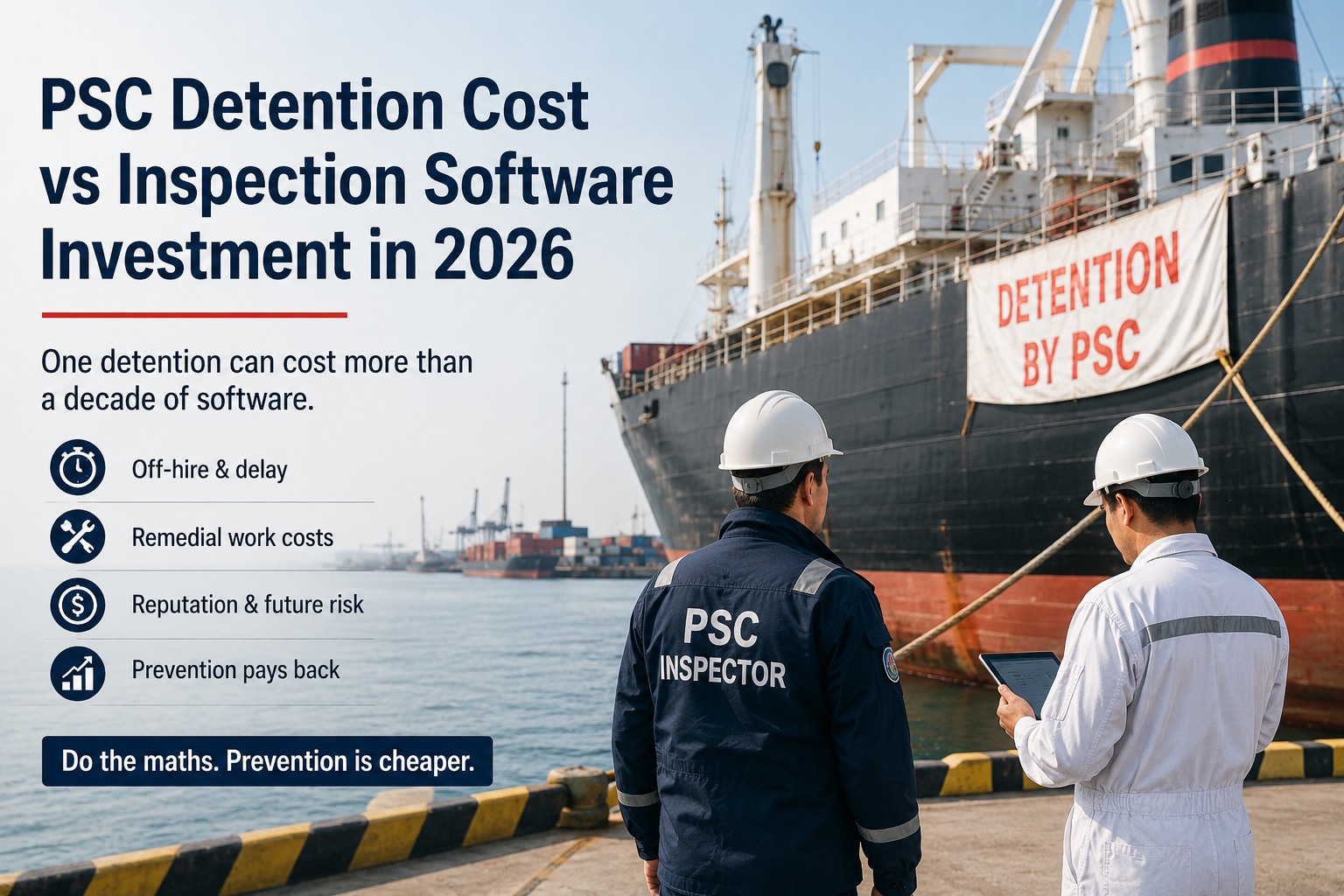
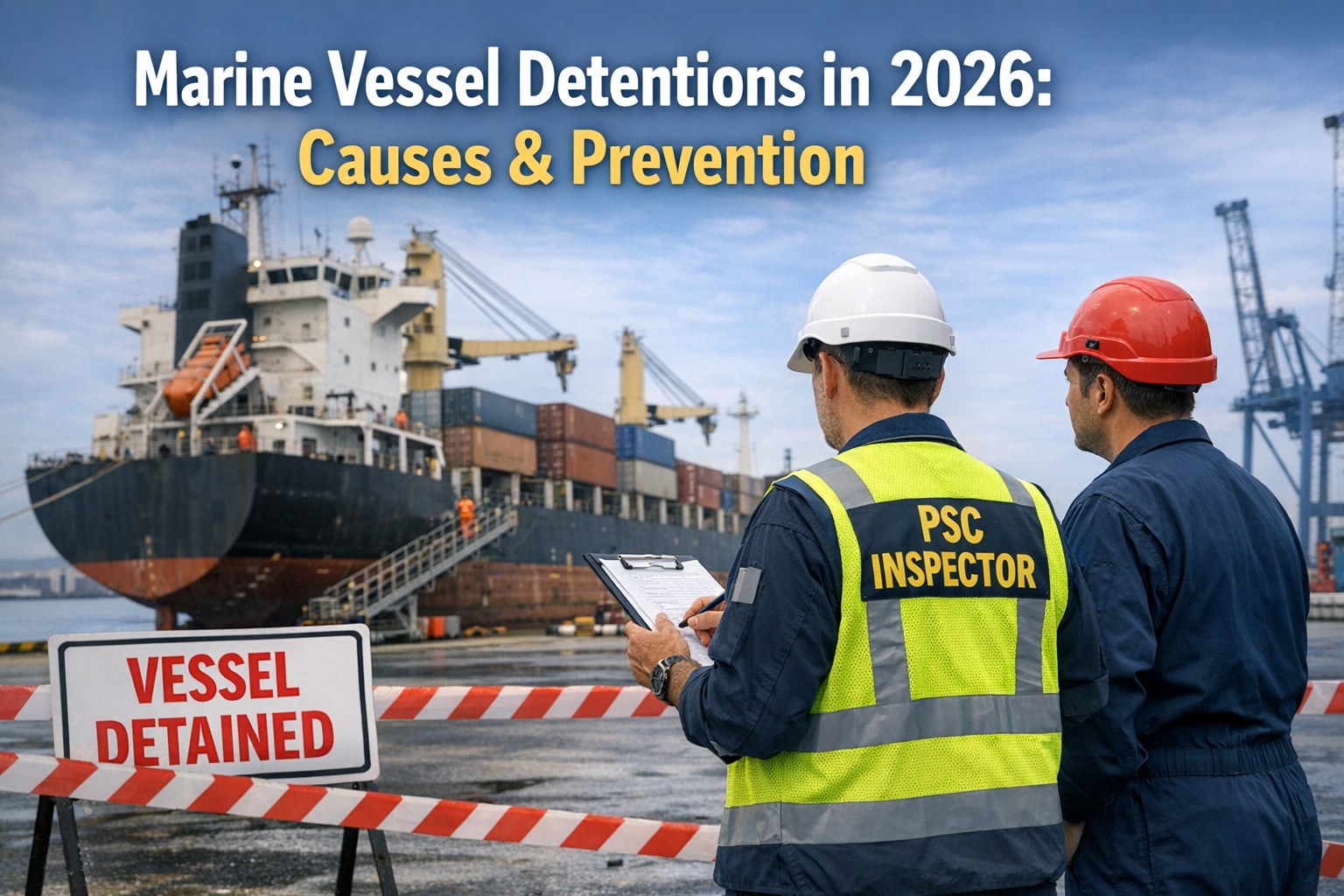
A Port State Control detention is rarely a single, tidy cost. It is a cascade — off-hire, port charges, demurrage, cargo-delay claims, a broken charter, a scarred risk profile — that compounds for every day the ship is held, and the total is almost always far larger than operators expect. Industry analysis puts a single detention day anywhere from tens of thousands to over a million dollars once every line is counted, and a typical two-to-three-day detention rarely costs less than eighty to a hundred and fifty thousand dollars per vessel. The frequency is rising sharply too: detentions have climbed around seventy per cent over five years while the number of inspections has stayed flat, and on current trends roughly one in seven merchant vessels will be detained at least once in the next three years. Set against numbers like these, the cost of the inspection software that helps prevent a detention is not really an expense to be justified — it is a rounding error against the loss it avoids. This page makes that case in the plainest financial terms: what a detention actually costs, line by line; the durable damage that outlasts the port stay; and the simple arithmetic by which preventing a single detention pays for the software many times over. To see this arithmetic run against your own fleet's charter rates and vessel count, book a demo or start a free trial.
BUYER RESOURCE · THE ROI CASE
The Real Cost of a PSC Detention — and How Software Pays for Itself
A detention is not one cost but a cascade of compounding losses. Here is what it actually costs line by line, the durable damage that outlasts the port stay, and the arithmetic by which preventing a single detention pays for inspection software many times over.
$80K–$150K
Typical cost of a 48–72 hour detention, per vessel
+70%
Rise in detentions over five years, with inspections flat
1 in 7
Merchant vessels likely detained in the next three years
Detention Is an Iceberg, Not a Line Item
The mistake in budgeting for detention risk is treating it as a single, visible cost — the repair, or the day alongside. The direct rectification is the tip; the mass sits below the waterline in commercial and consequential losses that are larger and harder to see. A detention triggers off-hire for the whole period of rectification, and while the ship sits idle it is not earning, its schedule unravels, and the knock-on effects ripple outward into every downstream commitment.
This is why the same event can be quoted at wildly different figures. A conservative estimate counting off-hire and port costs might land near fifteen thousand dollars a day; a full accounting that includes lost charter hire, demurrage, cargo-delay claims and a broken charter party runs into the hundreds of thousands or beyond. Both are correct — they are just measuring different depths of the same iceberg. To budget honestly for detention risk, and to weigh prevention against it, you have to count all the lines, not just the one on the repair invoice. The ledger below sets them out. To see which of these lines your fleet is most exposed to, and how prevention changes the math, book a demo or start a free trial.
The Seven-Line Cost Ledger
A detention is best understood as a cascade of distinct cost lines that compound over the period the vessel is held. These are the components industry analysis consistently identifies, with the ranges reported across recent sources.
Cost line
Reported range
What drives it
Lost charter hire
$25K–$150K / day
Vessel size and market rate, compounding daily while the ship is off-hire and not earning.
Demurrage at port
$15K–$40K / day
Berth occupancy and port tariffs while the vessel is held and unable to move.
Cargo-delay claims
$50K–$500K
Cargo value and contractual liability per delayed shipment — potentially the single largest line.
Direct rectification
Variable
Extra port charges, overtime, express freight for parts, and mobilised service engineers.
Commercial / charter breach
Often the heaviest
Charter-party penalties and a lost berth window — almost always the largest single item.
Risk-profile damage
Multi-year
A degraded profile means more frequent, more searching future inspections across the fleet.
Insurance & reputation
Ongoing
Possible premium impact, and a published detention that charterers and vetting inspectors read.
Combined, per detention day
$250K – $1M+
Not every line applies to every detention, and the ranges are wide because they scale with vessel size, cargo value and market conditions. But the structure is the point: because these lines compound, a detention that looks like a modest repair bill on the surface routinely totals six figures once the commercial and consequential losses are added, and a prolonged or repeated detention scales the impact by an order of magnitude.
The Costs That Outlast the Port Stay
Even after the ship sails, three costs follow it, and these are often more damaging than the days lost alongside because they compound over years rather than hours.
Risk-profile damage
A detention enters the ship's thirty-six-month history and the ISM company's performance record, affecting the risk profile of every vessel under that management. Under the New Inspection Regime, a high-risk ship sees an inspector every five to six months while a low-risk one may go twenty-four to thirty-six months between inspections — so a detention makes future inspections both more frequent and more searching, in a cycle that is hard to break.
Banning from a region
In the Paris MoU region, a ship on a black-listed flag can be refused access after three detentions in thirty-six months, and one on a grey-listed flag after three in twenty-four months. A first ban runs a minimum of three months, a second twelve, a third twenty-four, then permanent — and changing flag, company or name does not clear it. Nineteen ships were banned in 2025.
Reputation with charterers and insurers
Detentions are published by name, with the ship, flag, ISM company and recognised organisation all listed, and charterers, insurers and vetting inspectors read them. For tanker operators, the SIRE consequences of a detention can take months to recover from, directly affecting the vessel's employability and the premiums it attracts.
Run the detention-cost math on your own fleet
The industry rule of thumb is blunt: at typical charter rates, quality PSC preparation pays for itself by avoiding a single detention over three years. A demo walks the cost math through against your fleet's charter rates, vessel count and trade pattern, so you see the payback in your own numbers — or run a free trial with your own sample fleet data first.
The Arithmetic — Software Versus One Detention
Put the two numbers side by side and the business case makes itself. This is not a close call that needs a careful spreadsheet; it is an order-of-magnitude difference.
One detention
$80K–$1M+
A single detention event, from a conservative two-to-three-day hold to a fully-costed cascade with charter breach and cargo claims.
vs
Inspection software
A fraction of one day
Modern per-vessel SaaS costs a small fraction of a single detention day, and prevents the deficiencies that lead to detention across the whole fleet, all year.
The industry rule of thumb captures it: at charter rates of ten to eighteen thousand dollars a day, quality PSC preparation pays for itself simply by avoiding one detention over three years — and with one in seven vessels facing detention in that window, prevention is a deliberate financial decision, not an optional expense. To quantify that payback against your own fleet, book a demo or start a free trial.
What Actually Prevents a Detention
Software prevents detentions not by magic but by closing the specific, recurring gaps that cause them — and crucially, by producing the evidence inspectors demand. The mechanisms are concrete.
Certificates never lapse unnoticed
Every statutory and class certificate tracked with tiered expiry alerts at ninety, sixty and thirty days, so an expired certificate — a leading detention trigger, and one that draws fines of thousands of dollars on the spot — is caught long before an inspector finds it.
Maintenance is evidenced, not just done
When an inspector asks for the maintenance history of a smoke detector or a fire pump, the answer is ready in seconds rather than buried in a filing cabinet — turning the maintenance you already do into the proof that keeps the ship out of detention.
Findings close before they compound
Every deficiency flows into a tracked corrective action through to closure, so minor items are resolved and evidenced before they can accumulate into the systemic ISM conclusion that gets a ship held.
The fleet is visible before the port call
One live view of inspection status, open findings and certificate health across every vessel lets the office catch and fix risk ahead of arrival, rather than discovering it when the inspector is already aboard.
PSC penalises the absence of evidence, not the absence of maintenance
This is the single most important idea behind detention prevention, and behind the software's return. Ships are rarely detained because the work was not done; they are detained because it could not be shown to have been done — the maintenance history was untracked, the certificate lapse went unnoticed, the corrective action was never recorded. Inspectors verify evidence. A platform that captures and organises that evidence continuously turns a fleet's existing effort into the demonstrable proof that keeps ships trading, which is precisely why the return on it is measured against detention losses rather than against its modest cost. The vessel that can produce a complete, current record in seconds is the vessel that does not get held.
The conclusion writes itself from the numbers. One detention can cost anywhere from eighty thousand dollars to well over a million once the cascade is fully counted, it damages the risk profile of the whole fleet for three years, and it is published for every charterer and insurer to see — while the software that prevents it, by keeping certificates current, maintenance evidenced, findings closed and the fleet visible, costs a small fraction of a single detention day. With detentions up seventy per cent and one in seven vessels facing one in the next three years, the question is no longer whether prevention justifies its cost, but how many detentions a fleet is willing to risk before treating prevention as the financial decision it plainly is. To see that decision quantified against your own fleet, book a demo or start a free trial.
Frequently Asked Questions
How much does a PSC detention actually cost?
It depends on what you count, which is why estimates vary so widely. A conservative figure counting off-hire and port costs lands around fifteen thousand dollars a day, and a typical forty-eight to seventy-two hour detention rarely costs less than eighty to a hundred and fifty thousand dollars per vessel. A full accounting that includes lost charter hire, demurrage, cargo-delay claims and a broken charter party can reach between two hundred and fifty thousand and over one million dollars per day. The wide range reflects vessel size, cargo value and market conditions, and the fact that a detention is a cascade of compounding cost lines rather than a single charge. A prolonged or repeated detention scales the impact by an order of magnitude, and the commercial cost of a broken charter is almost always the heaviest single line.
How does inspection software pay for itself?
By preventing detentions and the deficiencies that cause them, at a cost that is a small fraction of a single detention. Modern per-vessel SaaS pricing runs a fraction of what one detention day costs, and the software works across the whole fleet all year. The industry rule of thumb, from recent analysis, is blunt: at typical charter rates of ten to eighteen thousand dollars a day, quality PSC preparation pays for itself simply by avoiding one detention over three years. The software prevents detentions concretely — tracking certificate expiries with tiered alerts so none lapse unnoticed, making maintenance history retrievable in seconds when an inspector asks, closing findings before they compound into an ISM conclusion, and giving the office fleet-wide visibility to catch risk before a port call. Against a background of detentions rising seventy per cent and one in seven vessels facing one in three years, that return is not marginal — it is an order-of-magnitude difference.
What are the costs that continue after the ship is released?
Three durable costs follow the vessel well beyond the port stay, and they often exceed the days lost alongside. First, risk-profile damage: the detention enters the ship's thirty-six-month history and the ISM company's performance record, worsening the risk profile of every vessel under that management and making future inspections more frequent and more searching. Second, banning: in the Paris MoU region, three detentions in thirty-six months on a black-listed flag, or three in twenty-four months on a grey-listed flag, can lead to refusal of access, starting at three months and escalating to permanent, and changing flag or name does not clear it. Third, reputation: detentions are published by name with ship, flag, company and recognised organisation, and charterers, insurers and vetting inspectors all read them, affecting employability and premiums — with SIRE consequences for tankers taking months to recover.
Why are detentions rising, and does that change the ROI case?
Detentions have risen around seventy per cent over five years while the number of inspections has stayed flat, which analysts read as a structural signal that maintenance and documentation standards are slipping across parts of the fleet. On current trends, roughly one in seven merchant vessels will be detained at least once in the next three years. This strengthens the ROI case rather than changing it: as the probability of a detention rises, the expected cost of doing nothing rises with it, while the cost of prevention stays flat. A fleet weighing software against detention risk is effectively buying down a probability that is increasing, which makes prevention a better financial decision now than it was a few years ago. The rising trend is precisely why analysts now frame proactive preparation as a deliberate risk-management decision rather than a discretionary expense.
Does the software guarantee we will not be detained?
No software can guarantee a particular inspection outcome, because a detention depends on the vessel's actual condition and the inspector's findings on the day. What software does is systematically close the gaps that most often cause detentions and produce the evidence inspectors demand — keeping certificates current, making maintenance history instantly retrievable, closing findings before they accumulate, and giving the office fleet-wide visibility to act before a port call. The key principle is that Port State Control penalises the absence of evidence of maintenance, not the absence of maintenance itself, so a platform that captures and organises that evidence continuously materially reduces detention risk. The return is measured in the detentions avoided across a fleet over time, which is why the arithmetic works even without any single outcome being guaranteed. The best proof is to run the platform on your own vessels and see the readiness difference.
How much does the software cost compared with a detention?
Modern marine inspection software is priced on a transparent per-vessel SaaS basis, and the annual cost per vessel is a small fraction of what a single detention day costs once the full cascade is counted. Because a detention runs from tens of thousands to over a million dollars while the software works across the whole fleet for the entire year, avoiding even one detention over several years covers the cost many times over — which is the basis of the industry rule of thumb that quality preparation pays for itself by preventing a single detention across a three-year window. Exact pricing depends on your fleet size, the number of users and the modules you enable, so the most accurate way to see the payback is to have the figures run against your own fleet. Booking a demo gives you a fleet-specific view of both the cost and the return.
Weigh Prevention Against the Real Number
One detention costs anywhere from eighty thousand dollars to over a million once the cascade is counted, damages the whole fleet's risk profile for three years, and is published for every charterer to see — while the software that prevents it costs a fraction of a single detention day. With detentions up seventy per cent and one in seven vessels facing one in the next three years, prevention is a financial decision, not an optional expense. See the detention-cost math run against your own fleet.