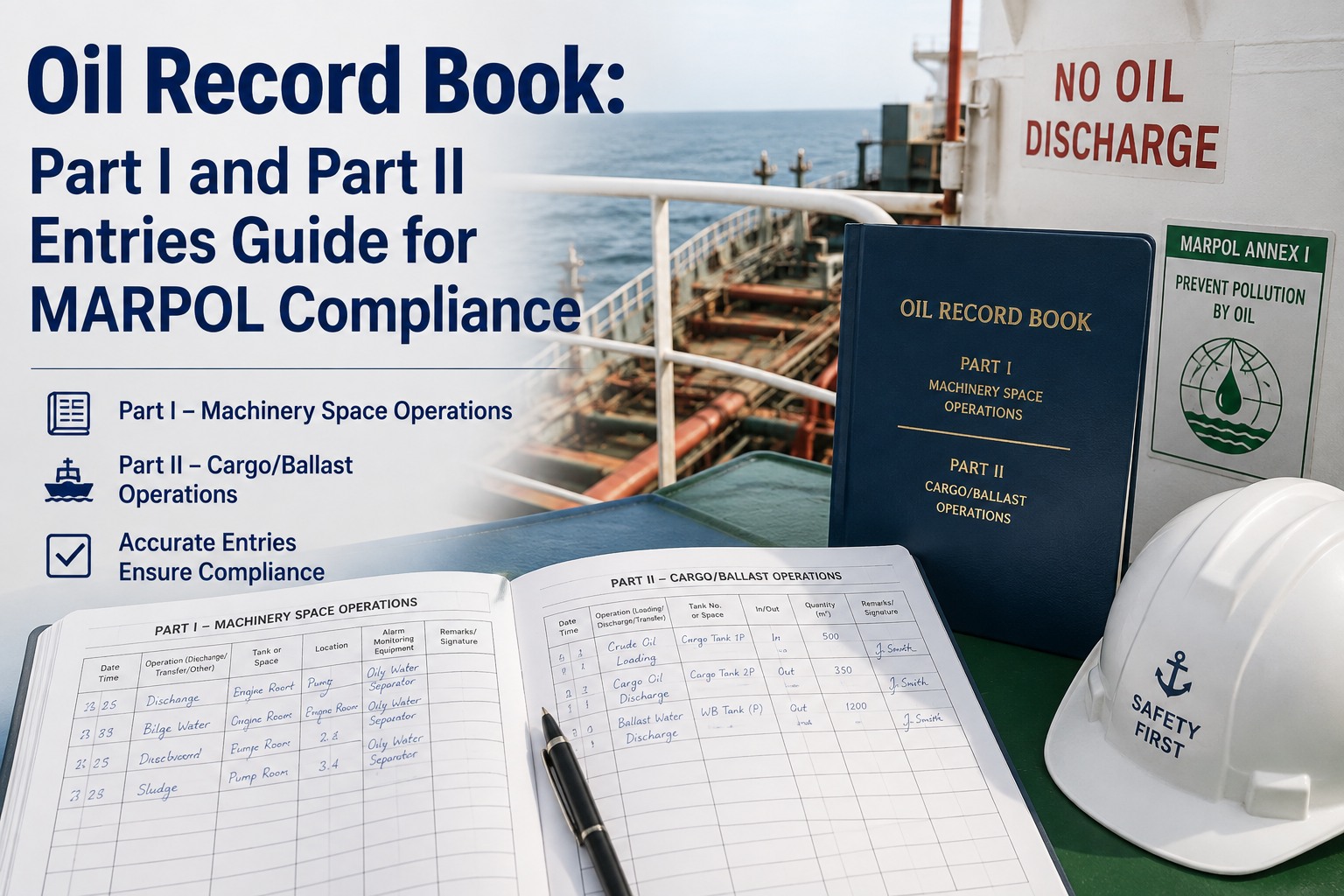
Port State Control inspectors often open the oil record book before they open the engine room door. A missing signature or a wrong code is a deficiency; a quantity that does not reconcile is grounds for a deeper look; a false entry can end in a criminal case. This guide lists the errors inspectors find, code by code, and the checks a DPA can run to catch them first. Book a demo to see digital ORB reviews.
MARPOL Annex I oil record book errors: what PSC finds, and how to find it first
Most ORB problems are record-keeping, not pollution. But inspectors cannot tell the difference until the numbers reconcile.
Why oil record book errors turn into MARPOL detentions
The ORB is the ship’s own evidence of how it handled oil. An inspector who finds entries that do not match tank soundings, the 15 ppm alarm memory or shore receipts has clear grounds for a more detailed inspection, and a detention or prosecution can follow. For the basics of making entries, see our ORB Part I and II entries guide; this page focuses on what goes wrong. Try the platform free.
Annotated ORB page: spot the oil record entry errors
The page below is an illustrative Part I extract with seven common errors. Each margin note explains what is wrong and what the entry should look like, based on IMO guidance MEPC.1/Circ.736/Rev.2.
Tank name and capacity. Use the tank name exactly as listed in the IOPP Supplement (item 3.1 for sludge tanks) and record the quantity retained.
Date format. Use dd-MON-yyyy, for example 04-OCT-2026, so there is no doubt between day and month.
Missing positions. A D 15.1 overboard entry needs the ship’s position at start and stop, not only the times.
Blank line. Do not leave full lines blank between entries; it invites the question of what was removed or added later.
Wrong book. Oily rags and used filters are garbage. Record them in the Garbage Record Book, not the ORB.
Grades combined. Make a separate H entry for each fuel grade, with quantity and the tanks it went into.
Unsigned page. The master signs each completed page. Officers sign every entry they make.
ORB errors by code: where each Annex I compliance section goes wrong
Errors cluster by section. Use this as a quick reference when reviewing a ship’s ORB. Our MARPOL record book checklist covers the other record books. See a code-based review.
| Code | Covers | Common error | Correct practice |
|---|---|---|---|
| C 11 | Sludge collection | Weekly sludge inventory missed, or tanks named differently from the IOPP Supplement | Weekly C 11.1 entry for each sludge tank, with IOPP names and quantity retained |
| C 12 | Sludge disposal | Disposal method not approved in the IOPP Supplement; shore receipt missing | Use only approved methods; keep the shore receipt with the ORB |
| D | Manual bilge discharge or transfer | No positions; quantity larger than the OWS could process in the time stated | Record quantity, start and stop times and positions; check quantity against OWS capacity |
| E | Automatic bilge discharge | Automatic mode recorded when the system is set up for manual operation only | Use E only where automatic discharge is fitted and used |
| F | OWS or alarm failure | Failure not recorded, or no entry when the equipment was restored | Record time of failure, time restored and the reason |
| G | Accidental discharge | Spill handled under SOPEP but never entered | Record time, position, quantity if known and circumstances |
| H | Bunkering | Several grades in one entry; quantities differ from the bunker delivery note | One entry per grade, matching the delivery note |
| I | Other operations | Missed entries added without the original date; valve sealing not recorded | I entry with the original date, then the late entry under the current date |
Catch ORB errors before the inspector does
Review every vessel’s ORB pages, soundings and alarm records in one place, with findings tracked to close-out.
ORB gaps PSC looks for: six reconciliation tests
Inspectors rarely judge an ORB on its own. They compare it with other records on board. Run the same six tests during internal reviews. Our article on how oil records are audited covers the inspection sequence.
The capacity test, worked example (illustrative)
If the recorded quantity is more than the separator could physically process in the recorded time, expect the inspector to ask where the rest went.
Red flags that suggest oil records are wrong
None of these proves wrongdoing on its own, but each is a pattern inspectors are trained to notice. If an internal review finds one, find out why before a PSC officer does.
Correcting an oil record entry and recording missed operations
Errors happen. How they are corrected tells an inspector whether the book can be trusted. Never erase, overwrite or use correction fluid.
Wrong entry
Missed operation
Electronic ORB
Since 1 October 2020, an electronic record book may replace the paper ORB if the flag approves it under IMO guidelines MEPC.312(74). Keep the flag’s declaration on board, and confirm port states on your route accept it.
DPA monthly ORB review checklist for MARPOL oil compliance
Ask each ship for scans of the month’s ORB pages, sounding records and alarm printout, and tick these off. Our guide to bilge and oily water separator inspections covers the equipment side.
Format
Content
Reconciliation
How Marine Inspection keeps the oil record book inspection-proof
Marine Inspection turns the monthly ORB review into a routine the office can see. Ships attach photos of ORB pages, soundings and alarm printouts to a review checklist; the DPA sees every vessel on one board, and every flag becomes a finding with an owner and a due date. The board below is illustrative.
Oil record book errors FAQs
What are the most common oil record book errors?
Missing signatures, wrong date format, tank names that differ from the IOPP Supplement, missing positions on discharges, several fuel grades in one entry, and garbage recorded in the ORB.
Can a wrong ORB entry lead to detention?
A format error is usually a deficiency. Entries that do not reconcile with equipment and other records can lead to a detailed inspection, detention and, where entries are false, prosecution.
How should an ORB entry be corrected?
Strike the wrong entry through with one line so it stays readable, sign and date it, and write the correct entry below. Never erase or overwrite.
How long must the oil record book be kept?
On board, readily available for inspection, for at least three years after the last entry.
Is an electronic oil record book allowed?
Yes, since 1 October 2020, where the flag has approved it under MEPC.312(74) and the declaration is kept on board. Check acceptance with port states on your route.
How often should the office review the ORB?
Monthly is a practical rhythm, plus a review before calls at ports with strict PSC regimes. Book a demo to see a fleet ORB review board.
Make every ORB page one you would hand to PSC
Monthly reviews, reconciled numbers and tracked findings keep the oil record book from becoming the start of a detention.