Garbage is checked on almost every port State control inspection because it is easy to see: placards, bins, the record book and receipts. Most findings are small gaps between the plan, the bins and the book. This guide covers the categories, discharge rules, record book and the checks inspectors make. Book a demo to see digital garbage logs.
MARPOL Annex V garbage management: eleven categories, one record book, no plastics overboard
Everything on board that becomes waste falls into one of these categories, and each has its own route off the ship.
Who MARPOL Annex V applies to: placards, plan and record book
The discharge rules apply to every ship. The paperwork depends on size and the number of people on board, and since 1 May 2024 the record book reaches far smaller ships than before. Our MARPOL record book checklist covers all the books together. Try the platform free.
Garbage categories and the right disposal route
The category decides where garbage can go. When in doubt, the reception facility is the safe route; keep the receipt with the record book.
| Cat. | Covers | Examples on board | Usual route |
|---|---|---|---|
| A | Plastics | Packaging, bottles, synthetic ropes, plastic sheeting | Reception facility; never overboard |
| B | Food waste | Galley and mess food scraps | Overboard under distance rules, or ashore |
| C | Domestic waste | Paper, rags, glass, metal, bottles from accommodation | Reception facility or incinerator |
| D | Cooking oil | Used frying oil from the galley | Reception facility |
| E | Incinerator ashes | Ash and clinker from the shipboard incinerator | Reception facility |
| F | Operational waste | Oily rags, filters, soot, dunnage, maintenance waste | Reception facility or incinerator |
| G | Animal carcasses | Livestock that died during carriage | Overboard only far from land under IMO guidance |
| H | Fishing gear | Nets, lines, traps | Reception facility; report any loss |
| I | E-waste | Batteries, printer cartridges, electronic parts, lamps | Reception facility |
| J | Cargo residues, not harmful | Bulk cargo left after unloading and hold sweeping | Overboard under distance rules, or ashore |
| K | Cargo residues, harmful (HME) | Residues of cargoes classed as harmful to the marine environment | Reception facility |
Garbage disposal rules: what may go overboard, and where
All discharge must be with the ship en route and as far as practicable from land. Inside special areas the rules tighten. This summary is for quick reference; check the full regulation for your ship type.
Special areas include the Mediterranean, Baltic, Black Sea, Red Sea, Gulfs area, North Sea, Antarctic and Wider Caribbean. Mixed garbage follows the strictest rule for any part of the mix.
Waste segregation on board: the bin station
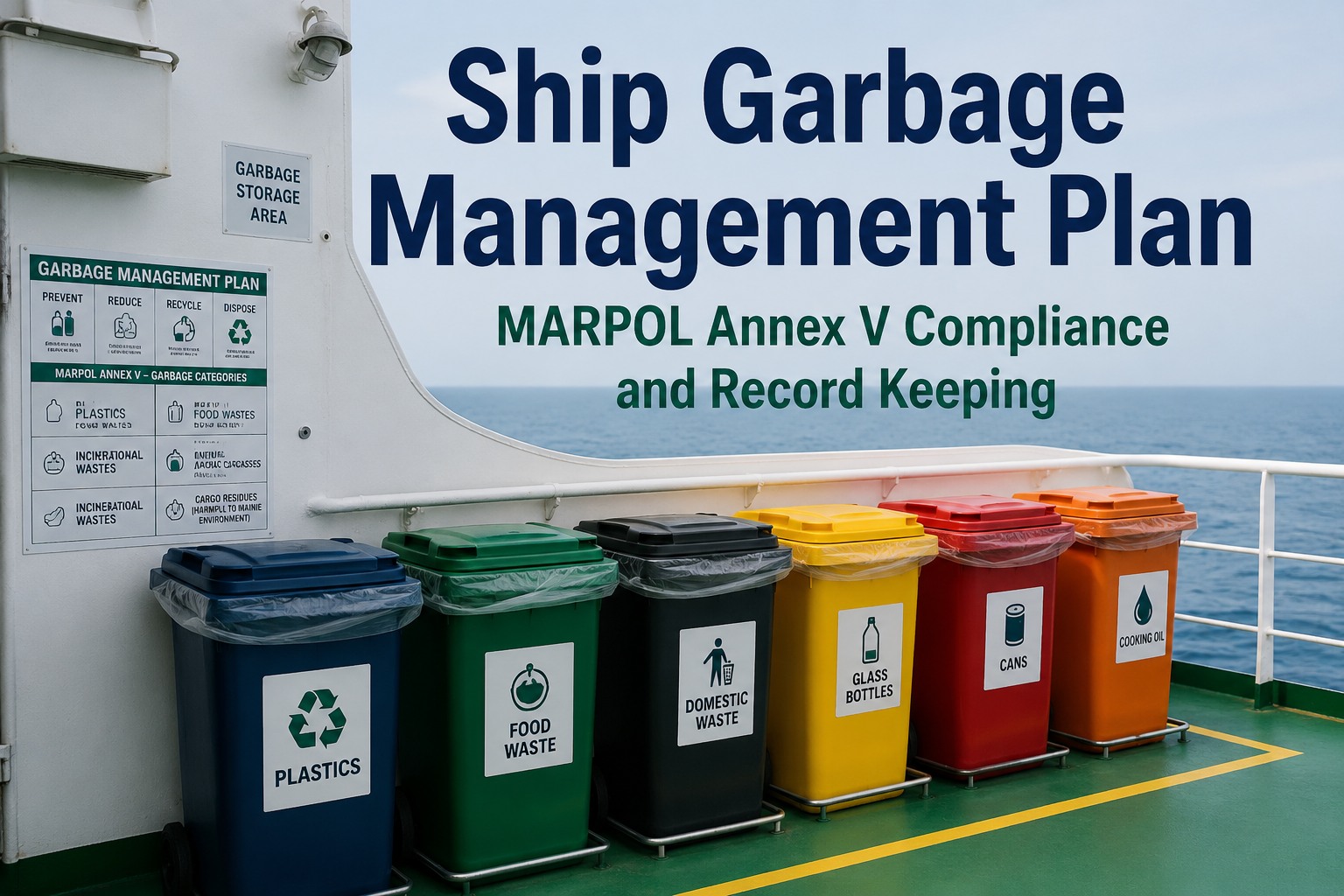
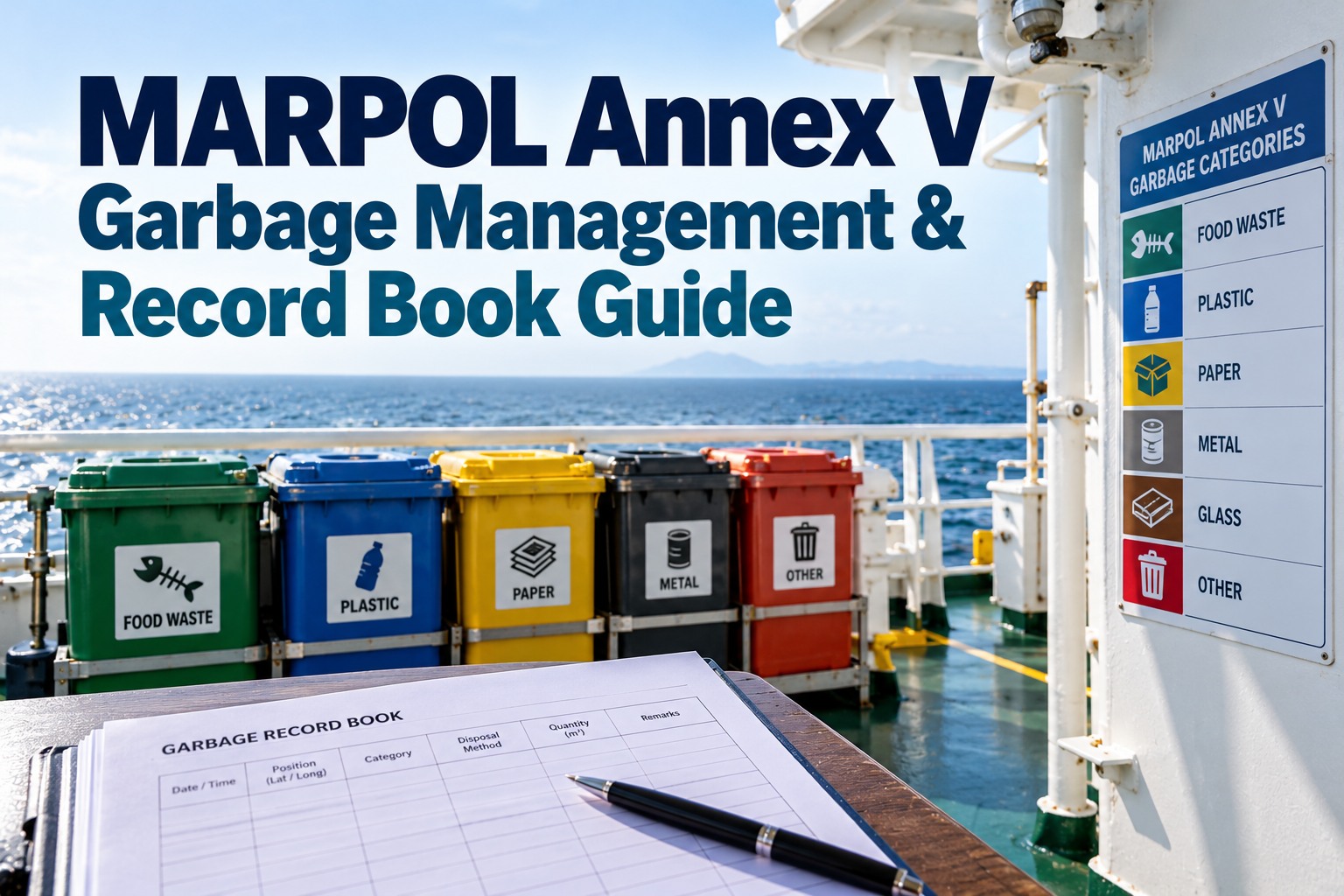
Segregation at source is what makes the rules workable. Inspectors look inside bins: plastic in the food waste bin is a finding in itself. Colours vary by company plan; what matters is that bins are labelled, match the plan, and crew know which goes where.
Illustrative bin station. Lid colours are an example only; follow your garbage management plan.
Keep garbage records ready for every boarding
Log each disposal with category, quantity and position on the device, attach the receipt photo, and let the office see it the same day.
Garbage record book entries: what each line needs
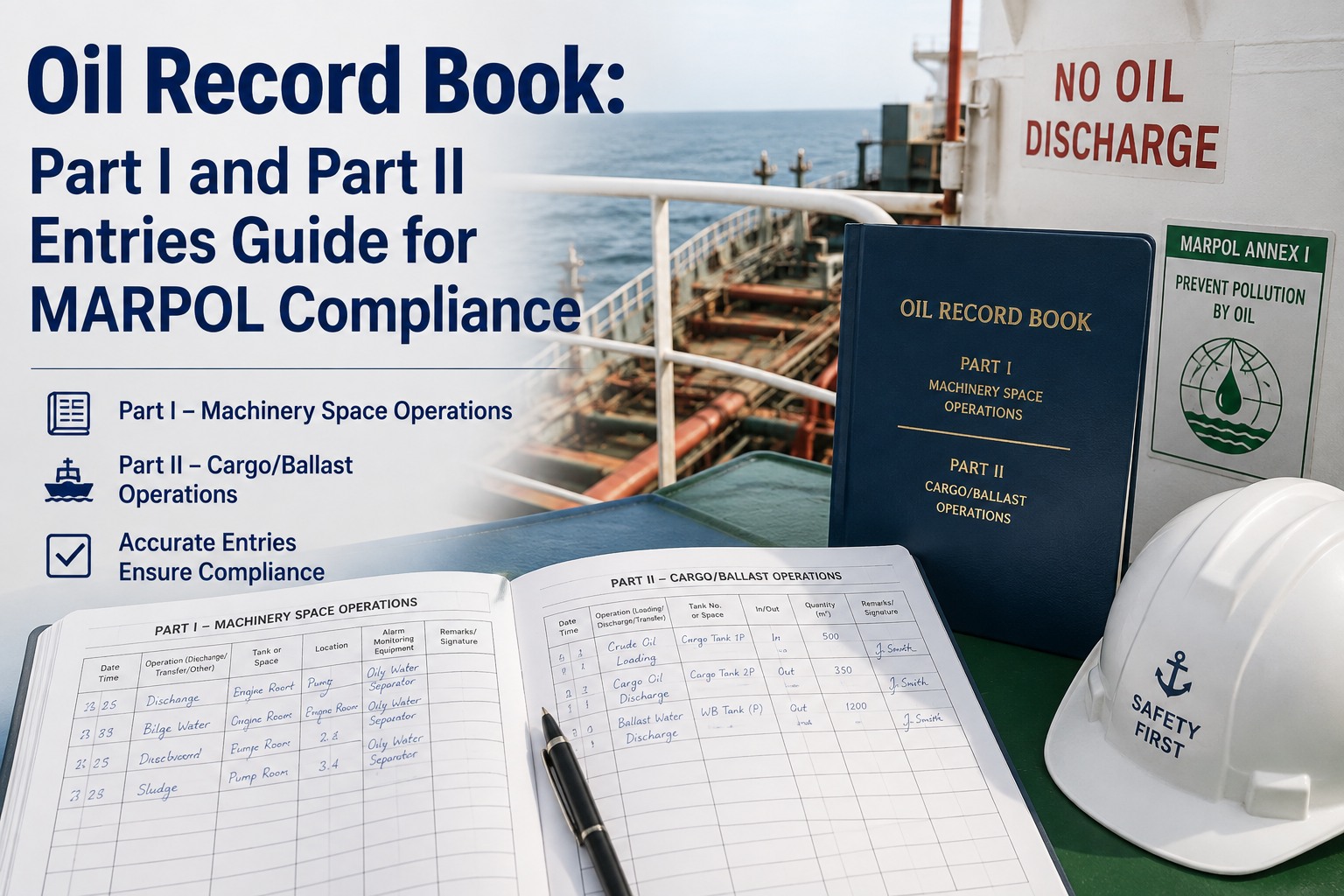
Part I records all garbage except cargo residues; Part II, for ships carrying solid bulk cargo, records cargo residues. Every discharge, incineration and delivery ashore is an entry, signed by the officer in charge, with each completed page signed by the master. See a digital record book.
Example Part I entry: delivery to a reception facility
Errors inspectors find
Illustrative entry. Use the record book format required by your flag; an approved electronic record book may be used in place of paper.
Garbage findings PSC checks on every inspection
Annex V checks follow a natural walk through the ship. In the Caribbean MOU’s 2024 campaign on Annex V, shipboard garbage handling and the record book were the most common garbage deficiencies. Our MARPOL compliance inspection checklist covers the other annexes.
Reconcile garbage handling: book, stores and receipts
The record book should tell a story that adds up. Garbage generated is either stored, incinerated, legally discharged or landed. If a ship never lands plastics, or lands far less than its crew size suggests, expect questions.
Annex V compliance checklist for garbage management
Run through these before arrival in port and during internal audits.
How Marine Inspection supports garbage management
Marine Inspection keeps garbage logging, inspections and receipts together. Crew log each disposal on the device, attach receipt photos, and run a short garbage check before every port; the office sees store levels and open findings for every ship. The panel below is illustrative.
MARPOL Annex V garbage management FAQs
Which ships need a garbage record book?
Since 1 May 2024, ships of 100 GT and above, and ships certified to carry 15 or more persons, on international voyages. Fixed and floating platforms also keep one.
What are the garbage categories in the record book?
A plastics, B food waste, C domestic waste, D cooking oil, E incinerator ashes, F operational waste, G animal carcasses, H fishing gear, I e-waste, J cargo residues not harmful, and K cargo residues harmful to the marine environment.
Can food waste be discharged at sea?
Yes, en route: at 3 nm or more if ground to 25 mm or less, or 12 nm or more if not ground. In special areas only ground food waste, at 12 nm or more.
How long must the garbage record book be kept?
On board for at least two years after the last entry, together with reception facility receipts.
Where must garbage placards be displayed?
Where crew and passengers will see them, such as mess rooms, galley and working decks, on every ship of 12 m or more in length.
Can Marine Inspection replace our paper garbage log?
It can hold your garbage logs, receipts and checks; whether it replaces the official record book depends on flag approval of an electronic record book. Book a demo to see it.
Segregate it, log it, land it, prove it
Clean bins, complete entries and matching receipts turn the garbage check into the easiest part of an inspection.