MARPOL Annex V starts from a presumption that surprises crews new to it: discharging garbage into the sea is prohibited, full stop, and the only things that may go overboard are a short list of specific exceptions under tightly controlled conditions. That reversal — from "you may discharge unless banned" to "you may not discharge unless permitted" — is the heart of the regulation, and getting it wrong is one of the most common reasons a ship picks up a Port State Control deficiency. For an environmental or deck officer, Annex V compliance comes down to a few disciplines done consistently: segregating waste correctly at the point it is generated, knowing the discharge rules for the ship's current area, keeping the Garbage Record Book accurate, and being able to demonstrate it all to an inspector. The rules have also tightened recently — the Red Sea became a special area on 1 January 2025, and the Garbage Record Book requirement now reaches ships of 100 gross tonnes — so a garbage management plan written a few years ago may already be out of date. This guide covers the garbage categories, the discharge rules inside and outside special areas, the record book, segregation and the garbage management plan, and the maintenance and training that hold it together. To manage your Garbage Record Book, segregation procedures, and Annex V compliance in one place, book a Marine Inspection demo.
Green shipping · MARPOL Annex V
Ship Garbage Management: MARPOL Annex V & Record Keeping
A practical guide to Annex V garbage compliance — the categories, the discharge rules inside and outside special areas, the Garbage Record Book, segregation, and the plan that keeps it all defensible at inspection.
The one absolute rule
Plastics may never be discharged at sea — no distance, no exception
The Core Principle
Annex V reverses the historical assumption about garbage at sea. Rather than allowing discharge based on the nature of the waste, it prohibits all discharge except for narrowly defined exceptions — chiefly certain food wastes, non-harmful cargo residues, and animal carcasses, each under specific conditions. Everything else is retained on board for disposal ashore. See compliance tracking in a demo.
Prohibition by default
All garbage discharge is banned unless a specific exception applies — the opposite of the old "discharge unless restricted" approach.
En route only
Any permitted discharge must be made while the ship is en route and proceeding, never while stopped or at anchor.
Retain when in doubt
Where a discharge is not clearly permitted, garbage is retained on board and landed to a port reception facility.
The Garbage Categories
Annex V divides ship-generated waste into lettered categories, each with its own discharge rule. Knowing which category a waste falls into is the first step in handling it correctly, because the category determines everything that follows.
MARPOL Annex V Garbage Categories
The practical takeaway is stark: the great majority of categories may never be discharged at sea. Only food waste, animal carcasses, and non-harmful cargo residues have a sea-discharge route, and each comes with conditions. Cooking oil, incinerator ash, operational and domestic waste, fishing gear, and e-waste must all be retained for shore disposal.
Discharge Rules Outside Special Areas
For the categories that can be discharged, the rules turn on distance from land and whether food waste has been ground. The principle is consistent: more processing and more distance for less restriction. See discharge logging in a demo.
Over 3 nm
Comminuted food waste
Food waste ground to pass through a screen no larger than 25 mm may be discharged beyond 3 nautical miles, en route.
Over 12 nm
Unground food waste & non-HME residues
Whole food waste, and non-harmful cargo residues that cannot be recovered, may be discharged beyond 12 nautical miles, en route.
Over 100 nm
Animal carcasses
Carcasses may be discharged beyond 100 nautical miles from land, at the maximum water depth possible, en route.
Two extra cautions apply. Floating dunnage, lining, and packing materials must not be discharged within 25 nautical miles of land even outside special areas, and many operators now retain them entirely. And cleaning agents in deck or hold wash water may only go overboard if they are not harmful to the marine environment — a point increasingly handled by switching to certified non-HME products.
Keep the record straight
Log Every Garbage Operation, Survive Every Inspection
Most Annex V deficiencies are record failures — missing entries, gaps, unsigned pages. Marine Inspection captures Garbage Record Book entries with date, position, category, and quantity, tracks segregation and disposal to reception facilities, and keeps the evidence an inspector expects against each vessel. Book a 30-minute demo to see Annex V record-keeping, or start a free trial today.
Special Areas: the Strictest Rules
Inside designated special areas, the rules tighten to near-total retention. These areas are defined for their particular sensitivity, and a ship transiting one must adjust its entire garbage routine.
The areas
The Baltic, Mediterranean, Wider Caribbean, Antarctic, and others — and since 1 January 2025, the Red Sea, a recent addition that many garbage plans still need to reflect.
The only exception
Inside a special area, generally the only garbage that may be discharged is comminuted food waste, at least 12 nautical miles from land, en route.
Everything else retained
All other garbage must be held on board for landing to a reception facility, so retention capacity must be planned before entering.
Polar & local rules
The Polar Code adds stricter limits in polar waters, and local rules go further still — California enforces a 25-mile no-discharge zone for all garbage.
The Antarctic carries further conditions: food waste must be discharged away from ice and never onto it, and introduced poultry products must be sterilised first. The lesson for any officer is that the applicable rule depends entirely on where the ship is at the moment of discharge — which is why area awareness is built into every good garbage routine.
The Garbage Record Book
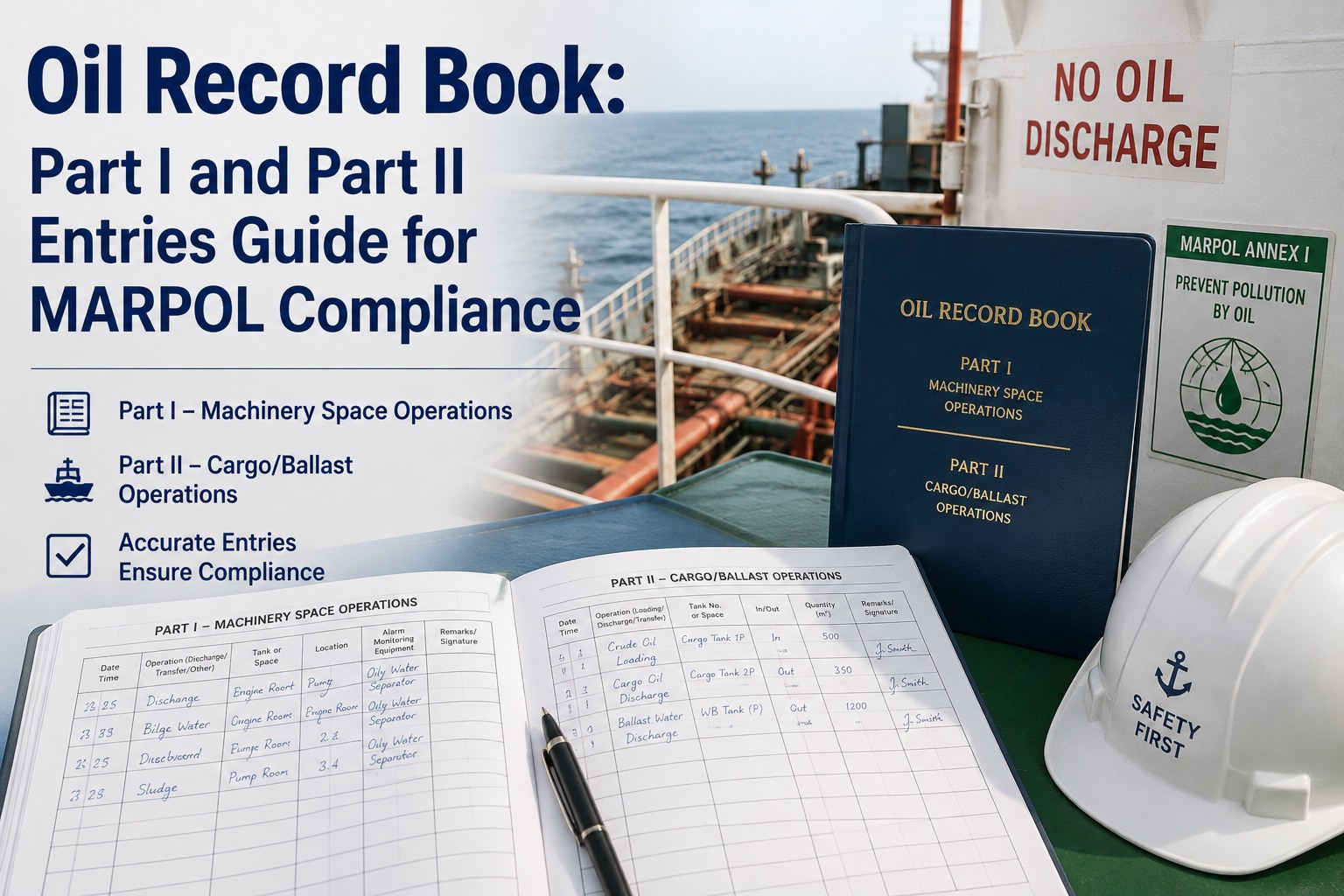
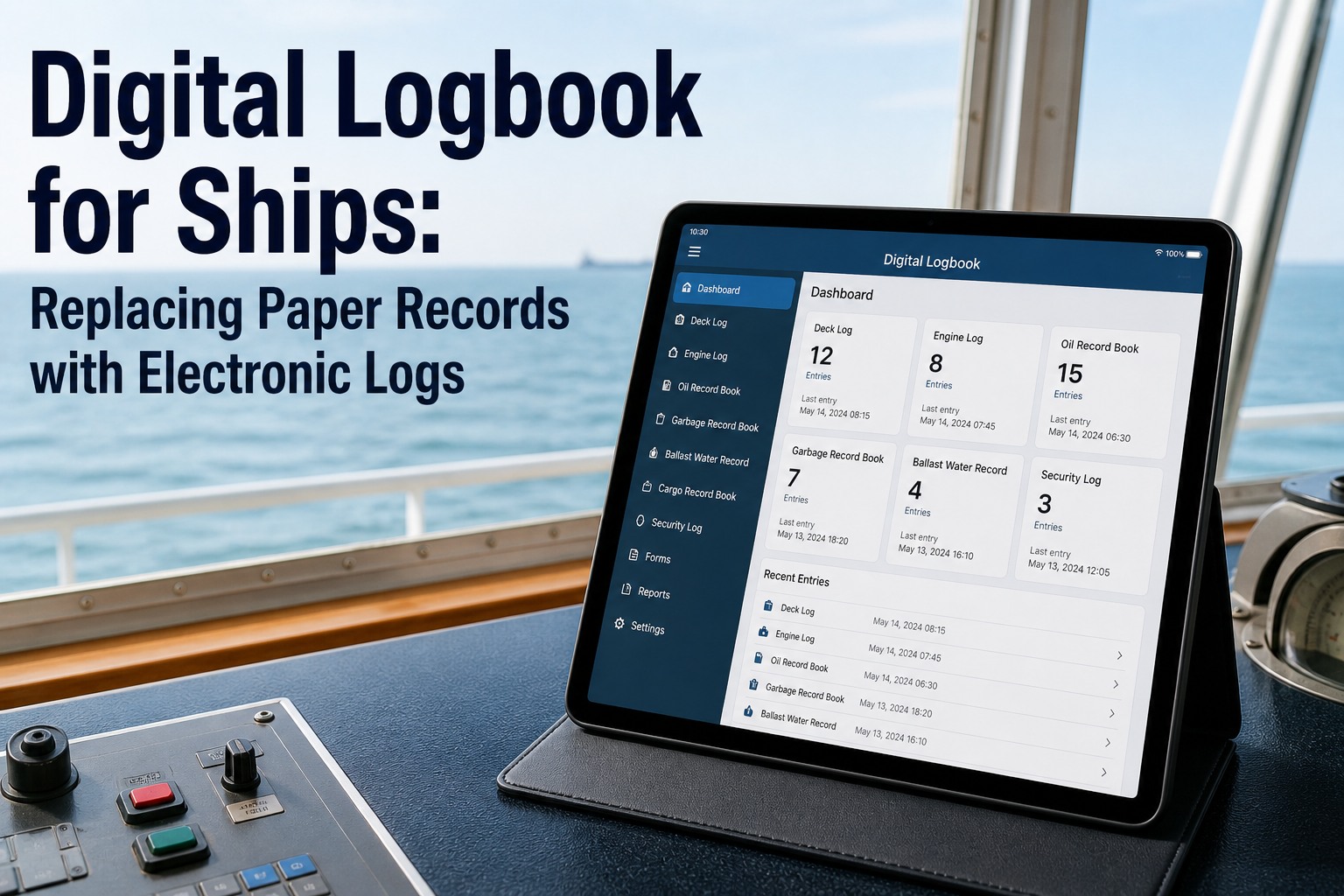
The Garbage Record Book is where compliance is proven, and it is the document a Port State Control officer reaches for first. Recent amendments have widened who must keep it. See GRB management in a demo.
Who must keep it
Ships of 100 gross tonnes and above, or certified to carry 15 or more persons — a threshold lowered to 100 GT in recent amendments.
Part I and Part II
Part I records operational garbage on all applicable ships; Part II records cargo residues and is required for ships carrying solid bulk cargoes.
What each entry needs
Date, time, position, garbage category, and estimated quantity for every discharge, landing to a facility, incineration, or accidental loss.
Retention
The completed Garbage Record Book must be kept on board for two years after the date of the last entry, available for inspection.
The most common Garbage Record Book deficiencies are mundane but costly: undated or unsigned entries, missing position data, and gaps between a disposal event and its entry. Because an inspector cross-checks the book against the garbage on board and the ship's movements, an accurate, contemporaneous record is the single strongest protection against a deficiency — and against being wrongly blamed for a discharge the ship did not make.
Segregation and the Management Plan
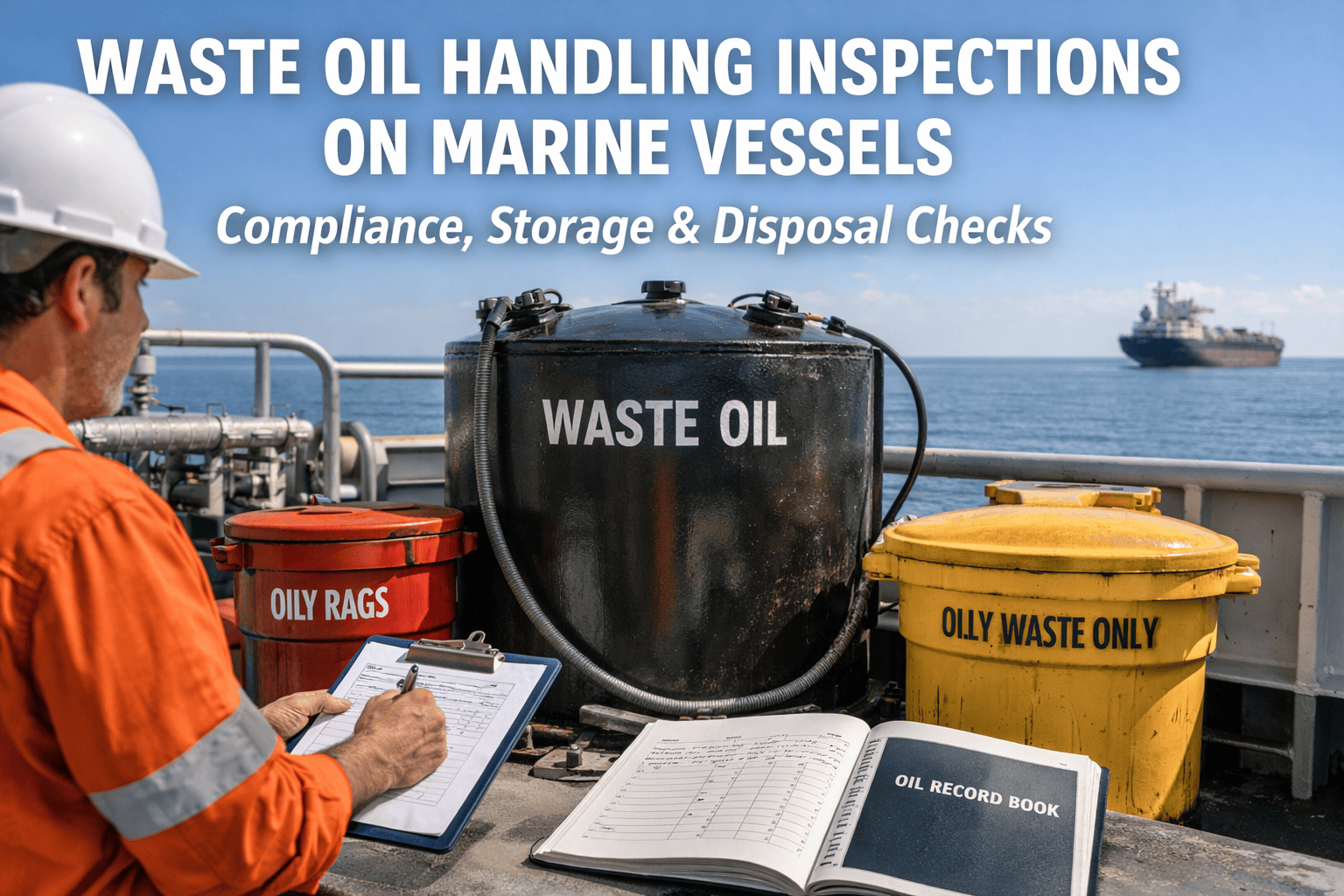
Everything upstream of the record book depends on segregation. Sorting waste correctly at the point it is generated is the foundation, because once categories are mixed, the options collapse. See segregation tracking in a demo.
Segregate at the source
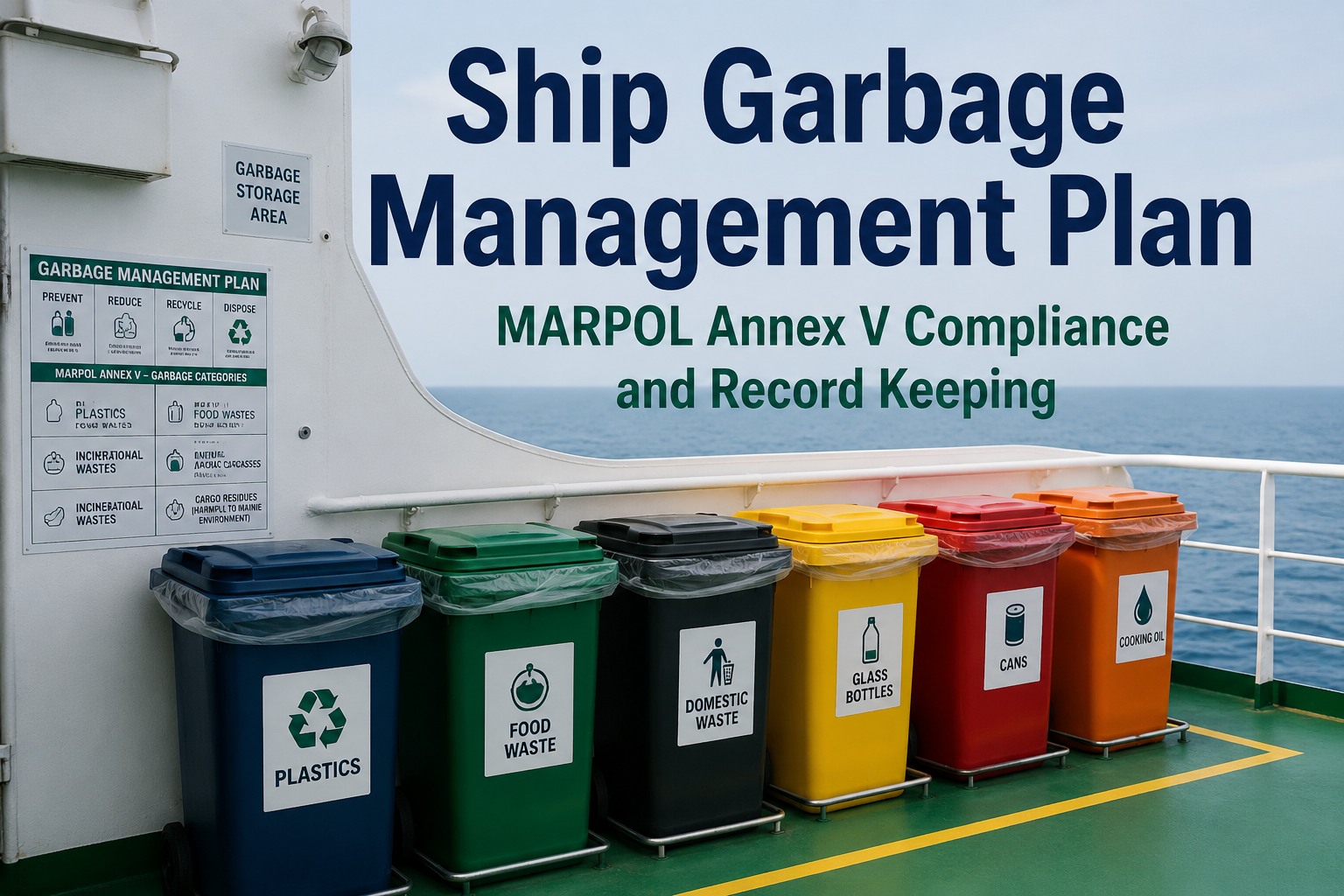
Waste is sorted into its categories as it is generated, using colour-coded bins marked with both the colour and the MARPOL category letter for any crew to follow.
The most stringent rule
Mix categories and the whole batch is treated as the most restricted one in it — mixing food waste with plastic makes the food waste non-dischargeable.
The Garbage Management Plan
A written plan describing the ship's procedures for collecting, segregating, processing, storing, and disposing of garbage, kept current with the latest amendments.
Placards
Ships of 12 metres and over must display placards of the discharge requirements in the crew's working language and in English, French, or Spanish.
The garbage management plan is not a document to be filed and forgotten. It must reflect the current regulation — including the Red Sea special area and the 100 GT record-book threshold — and the crew must actually follow it. A plan that does not match the bins, the placards, or the crew's practice is itself a deficiency waiting to be found.
Equipment, Training, and Why It Holds Up
Compliance also rests on working equipment and a competent crew. The best procedures fail if the comminutor is broken or the crew cannot explain the rules for the area they are in.
Processing equipment
Comminutors, compactors, and incinerators must be operational and maintained; an out-of-service unit with no defect record is a common deficiency.
Incinerator standard
Shipboard incinerators are built and operated to the standard specification, used only for materials the manufacturer permits.
Crew training
Crew must understand segregation and the discharge rules for their area, reinforced when entering a special area or when amendments take effect.
Reception facilities
Retained garbage is landed to port reception facilities, with receipts kept as evidence of proper disposal in the record book.
The thread through all of it is evidence. Annex V compliance is demonstrated by a current management plan, correct segregation matching the placards, working equipment, trained crew, and an accurate Garbage Record Book backed by disposal receipts. A ship that handles its garbage well but cannot show the record is exposed; one that captures everything routinely turns a garbage inspection into a formality — and protects itself against being wrongly accused of a discharge it never made. Book a demo to see Annex V compliance management.
Frequently Asked Questions
What is MARPOL Annex V?
MARPOL Annex V is the international regulation preventing pollution by garbage from ships. Its core principle is that all discharge of garbage into the sea is prohibited except for specific exceptions — chiefly certain food wastes, non-harmful cargo residues, and animal carcasses under controlled conditions. It requires garbage categorisation, segregation, record-keeping, and a garbage management plan.
Can plastics ever be discharged at sea?
No. The prohibition on discharging plastics is absolute, with no distance exception. It covers everything from synthetic ropes and fishing nets to plastic bags and foam. If a waste item contains any plastic component, it must be retained on board for shore-side disposal. This total plastics ban is the single most important rule in Annex V.
How far from land can food waste be discharged?
Outside special areas, food waste ground to pass through a 25 mm screen may be discharged beyond 3 nautical miles, and unground food waste beyond 12 nautical miles, with the ship en route. Inside special areas, only comminuted food waste may be discharged, and only beyond 12 nautical miles. Animal carcasses require at least 100 nautical miles.
Who must keep a Garbage Record Book?
Following recent amendments, ships of 100 gross tonnes and above, or certified to carry 15 or more persons, must keep a Garbage Record Book. Part I records operational garbage for all applicable ships, and Part II records cargo residues for ships carrying solid bulk cargoes. The book must be retained for two years after the last entry.
What are the special areas under Annex V?
Special areas include the Baltic, Mediterranean, Wider Caribbean, Antarctic, and others, with the Red Sea added on 1 January 2025. Inside these areas, generally only comminuted food waste may be discharged, at least 12 nautical miles from land and en route. All other garbage must be retained for landing ashore, so retention capacity must be planned.
Why does waste segregation matter so much?
Because of the most-stringent-rule principle: if categories are mixed, the whole batch is treated as the most restricted category in it. Mixing food waste with plastic makes the food waste non-dischargeable. Correct segregation at the source, using colour-coded bins marked with the MARPOL category, is the foundation that every later disposal decision depends on.
Built for MARPOL compliance
Sort It, Log It, Prove It
Record Garbage Record Book entries with date, position, category, and quantity, track segregation and disposal receipts, flag special-area rules by route, and keep the garbage management plan current — all against each vessel and ready for inspection. Marine Inspection keeps the garbage routine compliant and the Annex V record complete. Book a tailored walkthrough or start a free trial today.