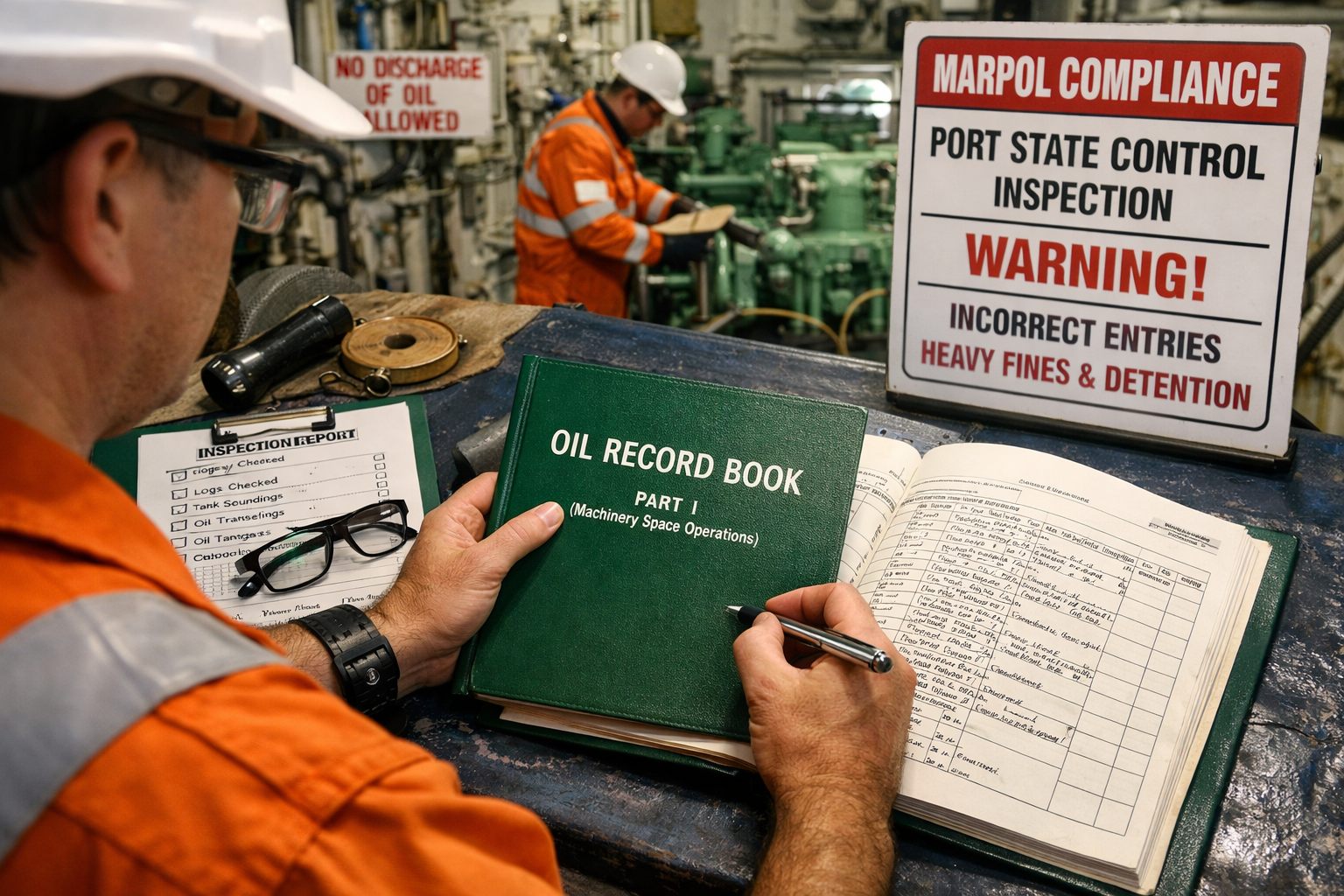
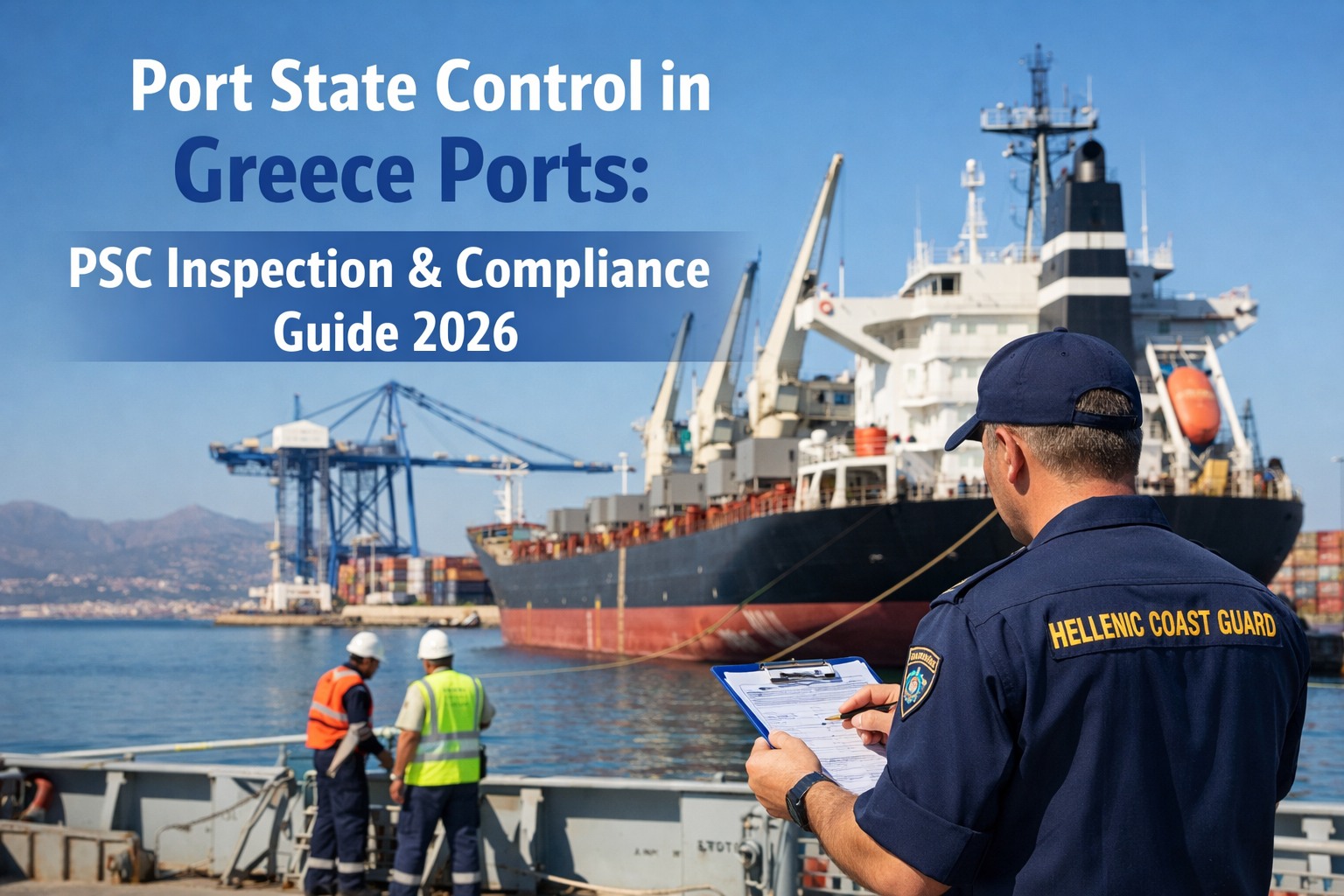
Port State Control inspectors board your vessel with one mission: verify compliance with MARPOL regulations. Within minutes of entering the engine room, they request your Oil Record Book—the single most scrutinized document during inspections. According to Paris MoU data, incorrect Oil Record Book entries rank as the most common recorded deficiency across all PSC inspections. A missing signature, delayed entry, or incorrect code letter can trigger extended inspection, detention, and fines reaching $40,000 per violation. Marine Inspection's software eliminates these risks through automated validation, real-time alerts, and instant compliance tracking you can start using today.
Most Common PSC Deficiency
#1
Incorrect Oil Record Book entries across all Port State Controls
Maximum Fine Per Violation
$40,000
U.S. penalties for inaccurate Oil Record Book maintenance
Record Retention Period
3 Years
MARPOL requirement from last entry date
What Inspectors Check During Oil Record Book Examination
Port State Control officers follow systematic inspection protocols when reviewing Oil Record Books. They verify entry completeness, signature authenticity, and chronological consistency. Inspectors cross-reference entries against electronic monitoring equipment data, tank soundings, and disposal receipts. Discrepancies between recorded operations and physical evidence immediately raise flags. The inspection typically takes 15-30 minutes for compliant vessels but extends to hours when irregularities surface. Marine Inspection's software automatically validates these seven critical compliance areas, alerting crews to potential issues before inspections occur.
6 Critical Inspection Focus Areas
1
Entry Completeness
Date, operational code, item number, quantity, time, position
Common Error: Missing tank identification or incomplete quantity data
2
Signature Requirements
Officer-in-charge signs each operation, Master signs each page
Common Error: Unsigned entries or missing Master endorsement
3
Chronological Order
Operations recorded immediately upon completion in sequence
Common Error: Batch entries made days after operations occurred
4
Code Letter Accuracy
Correct operational codes (A-O) match actual operations performed
Common Error: Wrong code selection for bilge discharge operations
5
Quantity Reconciliation
Sludge/bilge quantities balance with tank soundings and disposal receipts
Common Error: Mathematical discrepancies in volume calculations
6
Amendment Procedures
Single line through error, date of correction, proper justification
Common Error: Erasures, correction fluid, or missing amendment dates
The Five Most Common Oil Record Book Errors
Analysis of 10,000+ Port State Control inspections reveals five recurring Oil Record Book errors that trigger the majority of deficiencies. These range from simple omissions like missing signatures to complex quantity discrepancies. Each error carries different risk levels—falsification violations bring criminal penalties while administrative errors typically result in corrective action notices. Vessels implementing Marine Inspection's platform reduce Oil Record Book deficiencies by 78% through automated error detection and real-time validation.
1
Missing or Incomplete Signatures
Officer-in-charge fails to sign individual operations, or Master doesn't endorse completed pages. This appears in 42% of vessels with ORB findings.
Consequence: Code 17 deficiency requiring correction before departure. Repeated violations trigger enhanced inspection targeting.
Marine Inspection Solution: Automated signature reminders notify officers when entries await signature, preventing unsigned operations from accumulating.
2
Delayed or Batch Entries
Operations recorded days after occurrence rather than immediately. Inspectors identify delayed entries through timestamp analysis and crew interviews.
Consequence: Raises suspicion of falsification. May trigger full document review and equipment inspection for unreported discharges.
Marine Inspection Solution: Real-time entry prompts appear immediately after operations complete, with timestamp validation ensuring MARPOL compliance.
3
Quantity Discrepancies
Sludge/bilge quantities don't reconcile with tank soundings, disposal receipts, or previous entries. Mathematical errors or missing transfer records.
Consequence: Detention-level deficiency if inspectors suspect illegal discharge. Requires reconciliation before departure clearance.
Marine Inspection Solution: Automatic quantity reconciliation cross-checks entries against tank level sensors, flagging discrepancies before finalization.
4
Incorrect Code Letter Selection
Wrong operational codes applied. Common mistakes include using Code D (bilge discharge) when Code C (sludge transfer) is appropriate.
Consequence: Code 17 deficiency with educational component. Demonstrates inadequate crew training on MARPOL requirements.
Marine Inspection Solution: Operation-specific code selection guides present correct options based on equipment and activity type.
5
Missing Supporting Documentation
Disposal receipts referenced but not attached. Bunker delivery notes, sludge disposal certificates cannot be produced upon request.
Consequence: Code 17 deficiency requiring documentation production. May delay departure if receipts must be obtained from shore.
Marine Inspection Solution: Digital receipt attachment prompts link supporting documents to each entry with cloud storage for instant retrieval.
Eliminate Oil Record Book Deficiencies Today
Marine Inspection's software validates entries in real-time, sends signature reminders, reconciles quantities against tank sensors, and generates pre-inspection compliance reports. Reduce PSC deficiencies 78% while cutting administrative time by 65%.
How Marine Inspection Prevents Falsification Red Flags
Experienced Port State Control officers employ multiple detection methods to identify falsified or inaccurate Oil Record Books. They cross-reference ORB entries against 15ppm bilge alarm electronic data, compare handwriting consistency, interview crew about recent operations, verify tank soundings, and check disposal receipt dates. Marine Inspection's platform prevents these red flags by integrating with shipboard monitoring equipment, creating tamper-proof audit trails, and maintaining automated cross-validation between entries and actual equipment operation data. Our system creates authentic compliance records that inspectors trust—see the automated validation process in a live demonstration.
Inspector Detection Methods vs Marine Inspection Safeguards
Electronic Data Correlation
15ppm bilge alarm compared to ORB entries. Timestamp mismatches reveal unreported operations.
Marine Inspection automatically syncs equipment data with ORB entries.
Timestamp Analysis
Consistent handwriting suggests batch entries. Multiple authors indicate fabrication.
Digital entries with officer authentication eliminate handwriting concerns.
Quantity Verification
Physical tank measurements must match ORB within 3-5% tolerance.
Integration with tank level monitoring provides automatic quantity validation.
Crew Interviews
Junior engineers questioned about recent operations to catch discrepancies.
Real-time workflows ensure actual operators record operations immediately.
Receipt Alignment
Disposal receipt dates compared to ORB entry timestamps for consistency.
Digital receipt uploads linked directly ensure timestamp alignment.
Equipment Demonstration
Crew must demonstrate OWS operation matching documented use.
Maintenance tracking documents actual equipment operation history.
MARPOL Oil Record Book Requirements: Part I vs Part II
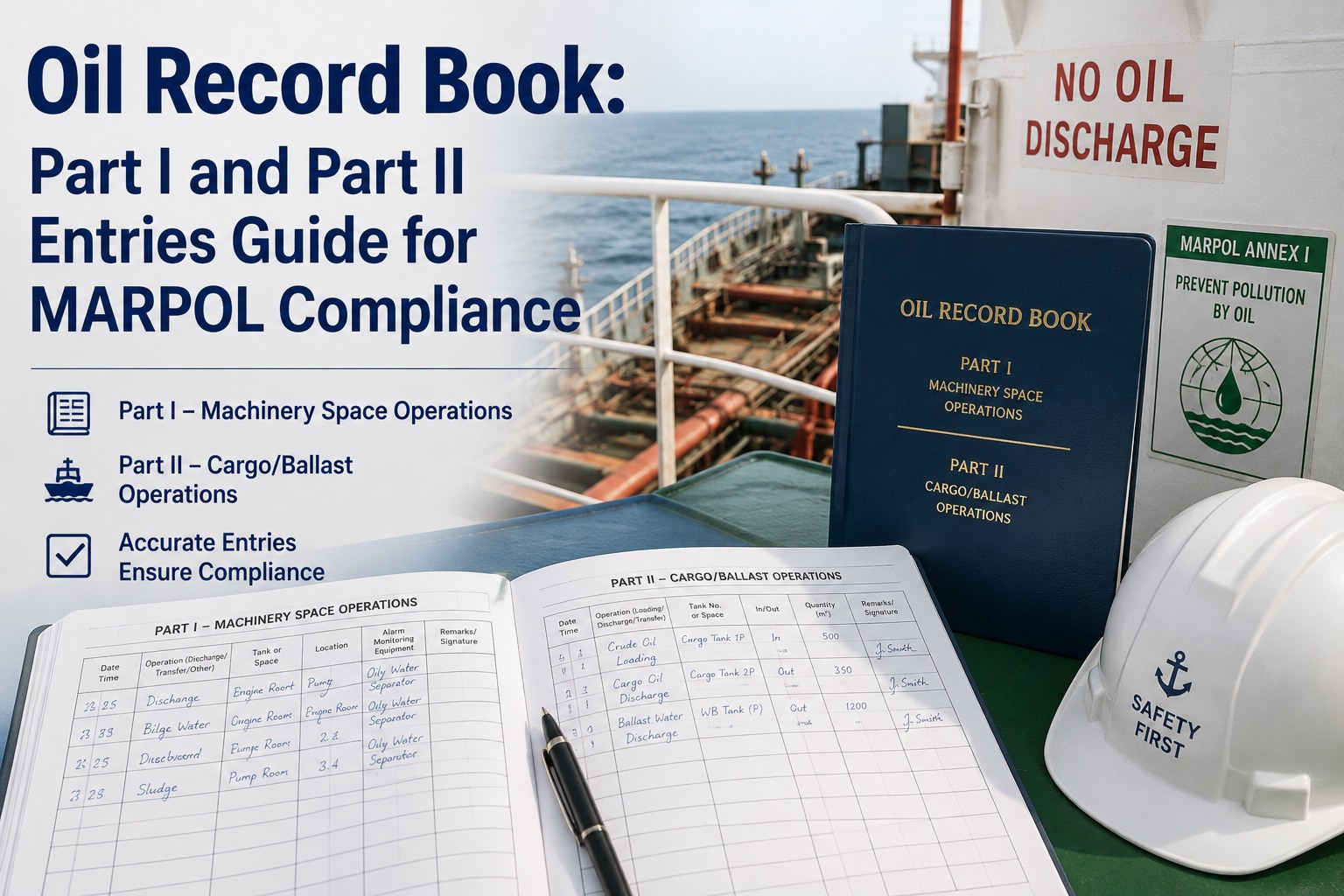
MARPOL Annex I establishes two distinct Oil Record Book types. Part I covers machinery space operations for all ships 400+ gross tons (oil tankers 150+ GT). Part I documents bilge discharge, sludge disposal, bunkering, and fuel transfers. Part II applies only to oil tankers 150+ GT, covering cargo and ballast operations including cargo loading/unloading, tank cleaning, and slop management. Most cargo vessels maintain Part I only, while tankers maintain both with required cross-references. Marine Inspection's software automatically routes operations to the correct book part based on vessel configuration while maintaining all MARPOL-compliant cross-references—start your free trial.
| Applicability |
All ships ≥400 GT, Oil tankers ≥150 GT |
Oil tankers ≥150 GT only |
| Operations |
Bilge discharge, sludge disposal, bunkering, fuel transfers |
Cargo loading/discharge, tank cleaning, ballast, slop management |
| Codes |
A through O (15 categories) |
A through R (18 categories) |
| Responsible Officer |
Chief Engineer |
Chief Officer |
| Retention |
3 years from last entry |
3 years from last entry |
| Marine Inspection |
Automated Part I templates with code validation |
Automated Part II workflows with cross-referencing |
Consequences of Oil Record Book Violations
Oil Record Book violations carry escalating consequences from administrative corrective actions to criminal prosecution. Simple errors—missing signatures or incorrect codes—result in Code 17 deficiencies requiring correction before departure. Repeated violations increase PSC targeting. Quantity discrepancies trigger vessel detention until resolved. Criminal falsification violations carry $40,000 per day fines, $8,000 additional fines for false statements, and up to 5 years imprisonment. The 2016 Princess Cruise Lines case resulted in $40 million in penalties. Marine Inspection's compliance tracking helps vessels avoid these consequences through proactive deficiency detection and automated compliance audits.
Violation Consequence Levels
Level 1: Administrative
Common Violations:
• Missing officer signatures
• Incorrect code selection (good faith errors)
• Minor formatting inconsistencies
Typical Penalty:
Code 17 deficiency - Correction before departure. Written warning to company.
Marine Inspection Prevention: Signature reminders and code validation prevent 95% of administrative errors.
Level 2: Operational
Common Violations:
• Delayed entries (batch recording)
• Missing supporting documentation
• Quantity discrepancies under 10%
Typical Penalty:
Enhanced inspection. Potential 12-24 hour detention. Increased future targeting. Company flagged in PSC database.
Marine Inspection Prevention: Real-time prompts and receipt workflows eliminate delayed recording and missing documentation.
Level 3: Serious Non-Compliance
Common Violations:
• Major quantity discrepancies (>10%)
• Evidence of unreported discharges
• ORB not matching equipment data
Typical Penalty:
Vessel detention until reconciliation. Fines $5,000-$15,000. Flag State notification. Full ISM audit. All sister vessels targeted.
Marine Inspection Prevention: Automatic reconciliation against tank sensors and equipment data integration prevent serious discrepancies.
Level 4: Criminal Violation
Common Violations:
• Deliberate falsification of entries
• Magic pipe bypass operation
• False statements to investigators
Typical Penalty:
Criminal prosecution. $40,000 per violation per day. Additional $8,000 per false statement. Imprisonment up to 5 years. Company penalties $1M-$40M.
Marine Inspection Prevention: Tamper-proof audit trails and equipment integration create verifiable compliance records.
"After 18 years conducting PSC inspections, I can identify problematic Oil Record Books within the first five entries. Perfectly uniform handwriting across months suggests batch entries. Quantity calculations rounded to convenient numbers rather than actual measurements raise red flags. When I see a 'perfect' Oil Record Book with zero corrections over six months, that's when I request the 15ppm alarm data for comparison. The most compliant vessels show authentic documentation with properly corrected errors and comprehensive receipts immediately accessible. Increasingly, I'm seeing digital systems that eliminate authenticity concerns through integrated equipment data and automated validation—those vessels pass inspection in half the time."
— Senior PSC Inspector, Paris MoU (15+ years experience)
Pass Every Oil Record Book Inspection With Confidence
Marine Inspection's software eliminates deficiencies through real-time validation, automatic signature tracking, quantity reconciliation, and pre-inspection audits. Reduce PSC deficiencies 78% while cutting administrative time 65%. Join 200+ vessels already using our platform to maintain flawless compliance records—
create your free account in under 3 minutes.
Frequently Asked Questions
How soon after an operation must entries be recorded in the Oil Record Book?
MARPOL requires entries "upon completion of the operation" or "without delay." Best practice is recording within 2 hours while details remain fresh. Delayed entries raise suspicion during inspections. Batch entries made days later are serious deficiencies indicating potential falsification. Marine Inspection sends real-time entry prompts immediately after operations complete, with timestamp validation ensuring MARPOL compliance and eliminating delayed entry concerns.
What should I do if I discover an error in a previous Oil Record Book entry?
Never erase, use correction fluid, or tear out pages. Draw a single thin line through the incorrect entry so original text remains legible. Write the correct information beside the error, add the correction date, and sign the amendment. Include brief explanation if significant. Inspectors expect occasional corrections in legitimate record books—absence suggests fabrication, excessive corrections suggest poor procedures. Marine Inspection handles amendments through controlled revision workflows maintaining complete audit trails while preserving original entries.
Can electronic Oil Record Books satisfy MARPOL requirements?
Yes, electronic Oil Record Books (ERBs) are permitted under IMO Resolution MEPC.312(74) if approved by the vessel's Flag State or authorized Recognized Organization. ERBs must meet technical requirements including tamper-proof audit trails, backup systems, and hard copy production capability. Marine Inspection's software platform meets these requirements and offers automatic timestamp validation, quantity verification, signature tracking, and equipment data integration—reducing administrative burden 65% while maintaining complete backup and instant printed report generation.
What triggers Port State Control to suspect Oil Record Book falsification?
Five primary red flags trigger scrutiny: (1) Uniform handwriting across months suggesting batch entries, (2) Quantity discrepancies that don't reconcile with tank soundings or receipts, (3) ORB entries contradicting 15ppm bilge alarm data, (4) Crew inability to explain recent documented operations during interviews, (5) Physical evidence inconsistent with recorded operations. Marine Inspection prevents these red flags through equipment integration that automatically validates entries against actual operations, creating authentic compliance records that withstand rigorous inspection.
How does Marine Inspection help vessels prepare for PSC inspections?
Marine Inspection provides comprehensive pre-inspection compliance audits that identify potential deficiencies before inspectors board. The software validates all entries against MARPOL standards, checks signature completeness, reconciles quantities against tank levels, verifies supporting documentation, and generates inspection-ready reports instantly. Vessels receive automated alerts when entries need attention, with guided workflows ensuring every operation meets regulatory requirements. The platform maintains tamper-proof records with complete audit trails that inspectors trust—vessels using our system reduce inspection time by 50% and PSC deficiencies by 78%.