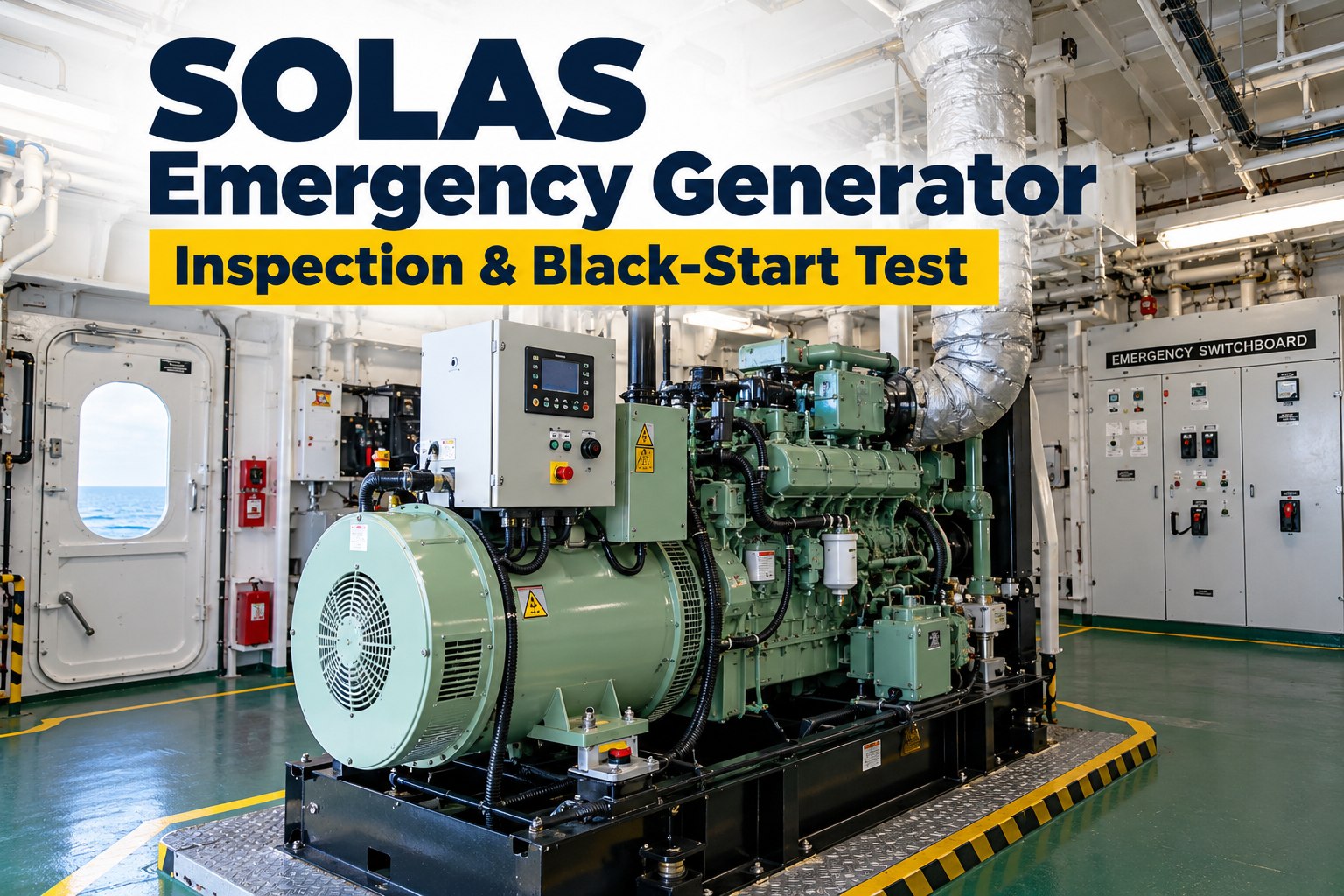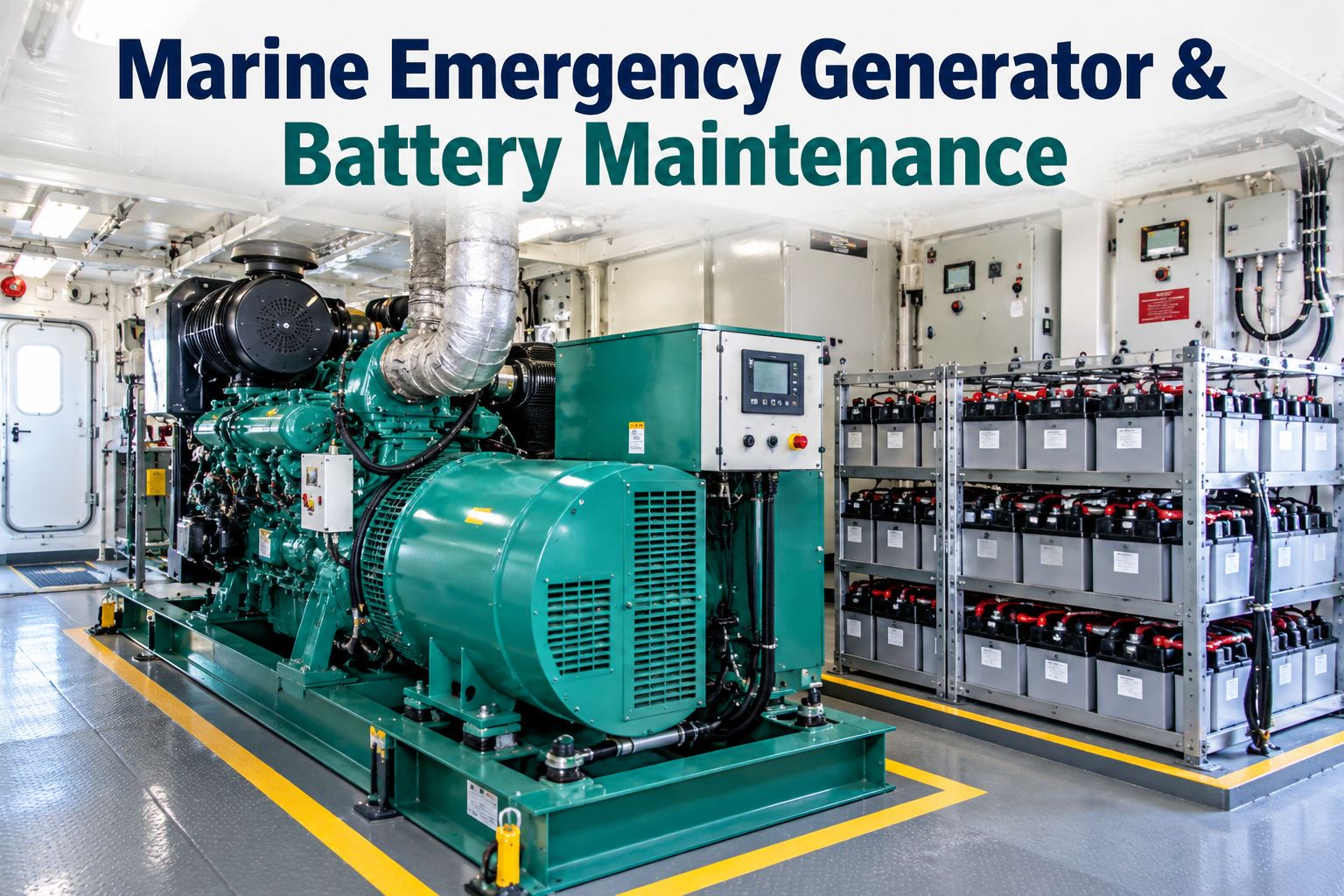
An emergency generator and its batteries spend almost their whole life waiting, which is why they fail quietly. A flat start battery, a dead charger or a transitional bank past its life stays hidden until the main board goes dark. This guide covers the maintenance that keeps that stored power ready and the checks inspectors run every time. Track every battery reading free in Marine Inspection.
Emergency generator and battery maintenance that holds up in a real blackout
Emergency power is stored energy: diesel in a day tank and charge in five or more battery banks. Maintenance is the work of proving that energy is still there, before the day it is needed.
Emergency battery banks on a ship: the five that matter
Most crews picture the emergency generator as the emergency power system. In practice the generator is one link, and most of the others are batteries, each with its own duty, its own rule and its own way of failing. See how each bank gets its own schedule in a demo.
Generator starting battery
Primary stored energy for the automatic start. SOLAS asks for at least three consecutive starts, with the battery kept charged from the emergency switchboard.
Transitional source
Carries emergency lighting and essential services automatically while the generator starts, holding voltage within ±12% of nominal without recharging.
Battery as the emergency source
Where a battery bank, not a generator, is the emergency source, it must carry the full emergency load for 18 hours on cargo ships or 36 hours on passenger ships.
GMDSS reserve source
Powers the radio installation if both main and emergency sources fail. Tested daily, condition checked monthly, capacity checked at least every 12 months in port.
UPS for control and monitoring
Keeps power management, alarm and control systems alive through the changeover. Gard warns that a weak UPS battery can delay the return of emergency power.
Emergency power PSC findings: where batteries fail inspections
The joint Paris and Tokyo MoU campaign on emergency systems ran from 1 September to 30 November 2019 and covered 4,009 ships in the Paris MoU region. Its sharpest finding was about batteries: where the emergency source was a battery bank, inspectors found the batteries or their switchboard in poor condition on 4.5% of ships, against 1.7% where it was a generator. Start a free emergency power log.
Share of ships failing each emergency-system check
Source: Paris MoU report on the 2019 Concentrated Inspection Campaign on Emergency Systems and Procedures. Each rate is the share of ships answered "no" among ships where the question applied.
The full IACS breakdown and the controlled blackout procedure are in our emergency generator black-start test guide.
What PSC officers wrote down in 2025
Detainable findings under code 04114 on Panama-flagged ships in Italian ports, as summarised by the Panama Maritime Authority (notice MMN-13/2026):
- Battery charger out of service with a temporary charger in use, beside a fuel tank close to empty
- Emergency generator left out of automatic mode
- Set stopping several times during the automatic start test
- No second source of energy for three further starts, and no manual starting means
- Quick-closing valve leaking gas oil onto the floor of the space
- AIS, radar and echo sounder not supplied from the emergency source
Battery bank maintenance by chemistry: lead-acid, VRLA and NiCd
The routine depends on what is in the box. A hydrometer tells you a great deal about a flooded lead-acid cell and almost nothing about a nickel-cadmium one, so the first line of any battery job card should name the chemistry. Book a demo of chemistry-specific job cards.
| Check | Flooded lead-acid | VRLA (sealed lead-acid) | Nickel-cadmium (NiCd) |
|---|---|---|---|
| State of charge | Specific gravity, corrected for temperature; about 1.280 at 15°C when full | Voltage or conductance reading; no access to electrolyte | Not by specific gravity, which barely moves; voltage stays flat over most of the discharge, so a capacity test is the real proof |
| Cell voltage | About 2.0 V nominal | About 2.0 V nominal | About 1.2 V nominal |
| Electrolyte | Dilute sulphuric acid; top up with distilled water only | Sealed; recombines most gas; no topping up | Potassium hydroxide; top up to the maker's level |
| Warning signs | Sulphation, one cell reading low, heavy gassing | Swelling or heat at the case | White potassium carbonate on cells, often a sign of overcharging |
| Gas on charge | Hydrogen, heavy on boost charge | Small vented fraction | Hydrogen; ventilation must run |
Emergency battery charger, space and ventilation checks
Port State Control looks at the cells and at everything around them: cable connections, leaking electrolyte, the charge indicator and the alarms on the emergency charge panel. Those surroundings are where most batteries are really lost. Turn these into recurring checks free.
Charger and alarm panel
Log charger output and float voltage. Test the power failure, voltage, over-current and insulation alarms. A temporary charger is a finding, not a fix.
Discharge indicator
SOLAS requires an indicator on the main switchboard or in the control room showing when emergency or transitional batteries are discharging. Prove it lights.
Ventilation and hydrogen
Charging releases hydrogen. Fans running, louvres clear, no ignition sources, and nothing stowed in the space that does not belong there.
Temperature
Hold the space at roughly 15 to 25°C. Industry guidance puts lead-acid life at about half for every 8 to 10°C of sustained heat above 25°C.
Terminals and connections
Tight, clean and lightly coated with petroleum jelly. Insulated tools only, with rings and watches off before anyone reaches in.
Location after refits
Emergency and transitional batteries must not share a space with the emergency switchboard unless gases are extracted to the Administration's satisfaction. Confirm nothing moved in a yard period.
Every battery bank, every reading, one emergency power log
Weekly voltages, monthly start tests, capacity results and charger faults in one place, captured offline on board and ready for the next surveyor or PSC officer.
Emergency generator maintenance, system by system
The emergency set rarely wears out. It degrades from standing: fuel ages, heaters fail, batteries sulphate and valves stick, all while the weekly no-load run still passes. Work through it by system, and use our auxiliary engine and generator maintenance guide for the running-hour overhaul side.
Fuel system
- Day tank level enough for 18 h (cargo) or 36 h (passenger) at emergency load
- Water and sediment drained from tank and filters on the maker's interval
- Quick-closing valve tested, reset and free of leaks; fuel flashpoint not below 43°C
Starting systems
- Primary stored energy good for three consecutive starts, kept charged from the emergency switchboard
- Second source (air, hydraulic or second battery) good for three more starts within 30 minutes
- Air bottle or accumulator pressure logged as a number, not a glance
Cooling and preheat
- Coolant level and inhibitor to the maker's figures
- Jacket water or space heater working wherever the space can fall below 0°C, the temperature SOLAS sets for ready starting
- Radiator, fan and belts in condition
Lubrication and engine
- Oil level and leaks at every run
- Oil and filters changed on maker's hours or calendar, whichever comes first
- Engine safety trips tested, with set point and actual value recorded
Air, exhaust and the space
- Inlet and outlet openings clear and able to close
- Space dry and free of stores
- "Not ready to start" alarm in the engine control room tested, as class rules require
Generator end and emergency switchboard
- Insulation resistance trended, not filed as a single pass
- Breaker, interlocks and mode switch back in AUTO after every test
- Services and indication on the board proven, as in our switchboard inspection guide
Emergency generator and battery maintenance schedule
A few intervals are set by regulation; most come from the maker and the company SMS. The schedule below keeps the two apart so nobody mistakes a habit for a rule. Pair it with our electrical panel inspection checklist for the wider board.
| Task | Interval | Basis | Record |
|---|---|---|---|
| GMDSS reserve batteries tested and brought to full charge | Daily | Rule | Voltage in the radio log |
| Emergency generator run; fuel, coolant, leaks and heater checked | Weekly | Practice | Readings and hours |
| Starting battery and charger checked by chemistry | Weekly | Practice | Bank or cell values |
| Automatic start on simulated loss of power, run on load | Monthly | Practice | Start time, kW, faults |
| Second starting means tested | Monthly | Practice | Pressure before and after |
| GMDSS battery condition, mounting and connections | Monthly | Rule | Condition notes |
| GMDSS battery capacity check, ship not at sea | Max 12 months | Rule | Capacity result |
| Transitional and emergency-source battery discharge test | Annual or per maker | Maker / class | Duration and end voltage against ±12% |
| Fuel drain, filter change, quick-closing valve test | Per maker | Maker | Date and findings |
| Every bank reviewed against its service life | Annual | Practice | Install date and test trend |
Weekly and monthly generator routines reflect common shipboard practice. Your SMS, the maker's manual and class set the intervals that apply to your ship.
Before the automatic start test: six readiness checks
A failed automatic start test is usually a maintenance failure that the test exposed. Clear these six first; the test itself, including the controlled blackout, is covered in the black-start guide linked above. See automatic start test scheduling in a demo.
How Marine Inspection keeps emergency generator and battery records PSC-ready
The problem is rarely that nobody checked. It is that the readings sit in four logbooks, the charger fault went into an email, and the battery install date is in a drawer. Marine Inspection puts every bank and the emergency set on one register. Set up your emergency power register free.
Illustrative screen. Bank names and intervals follow your own SMS.
A schedule per bank, not per ship
Each battery bank and the emergency set get their own recurring tasks and alerts, so the GMDSS daily test never hides behind the generator's monthly one.
Readings that trend
Voltages, gravities and pressures are entered as numbers on the job, so a slow decline shows before a failed start does.
From defect to work order
A dead charger or leaking valve found on a check becomes a work order with an owner, a deadline and photos, tracked to closure.
Offline on board, evidence ashore
Crews log on a phone with no signal; records sync when the link returns and export as a report for class or PSC.
Emergency generator and battery maintenance: FAQs
How long must a ship's emergency batteries last?
It depends on the bank. The transitional source must carry its services for at least 30 minutes. A battery that is the emergency source must carry the emergency load for 18 hours on cargo ships and 36 hours on passenger ships. The GMDSS reserve source is sized for 1 hour, or 6 hours on ships without a compliant emergency source.
How do you check the charge of a NiCd battery?
Not with a hydrometer. NiCd electrolyte gravity barely changes with charge and the cell voltage stays flat over most of the discharge, so the reliable proof is a controlled discharge or capacity test against the maker's figures.
How often should the emergency generator battery be checked?
Common practice is a weekly voltage and condition check, with the charger and its alarms watched continuously and a load proof at every monthly start test. Your SMS and the maker set the exact interval.
Can emergency batteries share a space with the emergency switchboard?
No, unless the gases they release are extracted to the Administration's satisfaction. Hydrogen and switchgear arcing are a dangerous mix, which is why the battery space is normally separate and ventilated.
Which emergency power faults lead to PSC detention?
Findings under code 04114 (emergency generator) and 04103 (emergency lighting, batteries and switches) can be detainable. Recent examples include a set left out of automatic mode, a dead charger, a near-empty fuel tank and a missing second starting means. See how the evidence is kept in a demo.
Do UPS batteries count as emergency power maintenance?
They should. Following the 2025 IACS campaign, Gard advised operators to review the UPS units behind power management and control systems and replace their batteries before degradation affects capacity, because a weak UPS can slow recovery from a blackout.
Prove the stored power is there before the day you need it
Battery banks, start tests, charger faults and fuel checks on one register, with every reading trended and every defect closed out. Ready when the inspector asks.