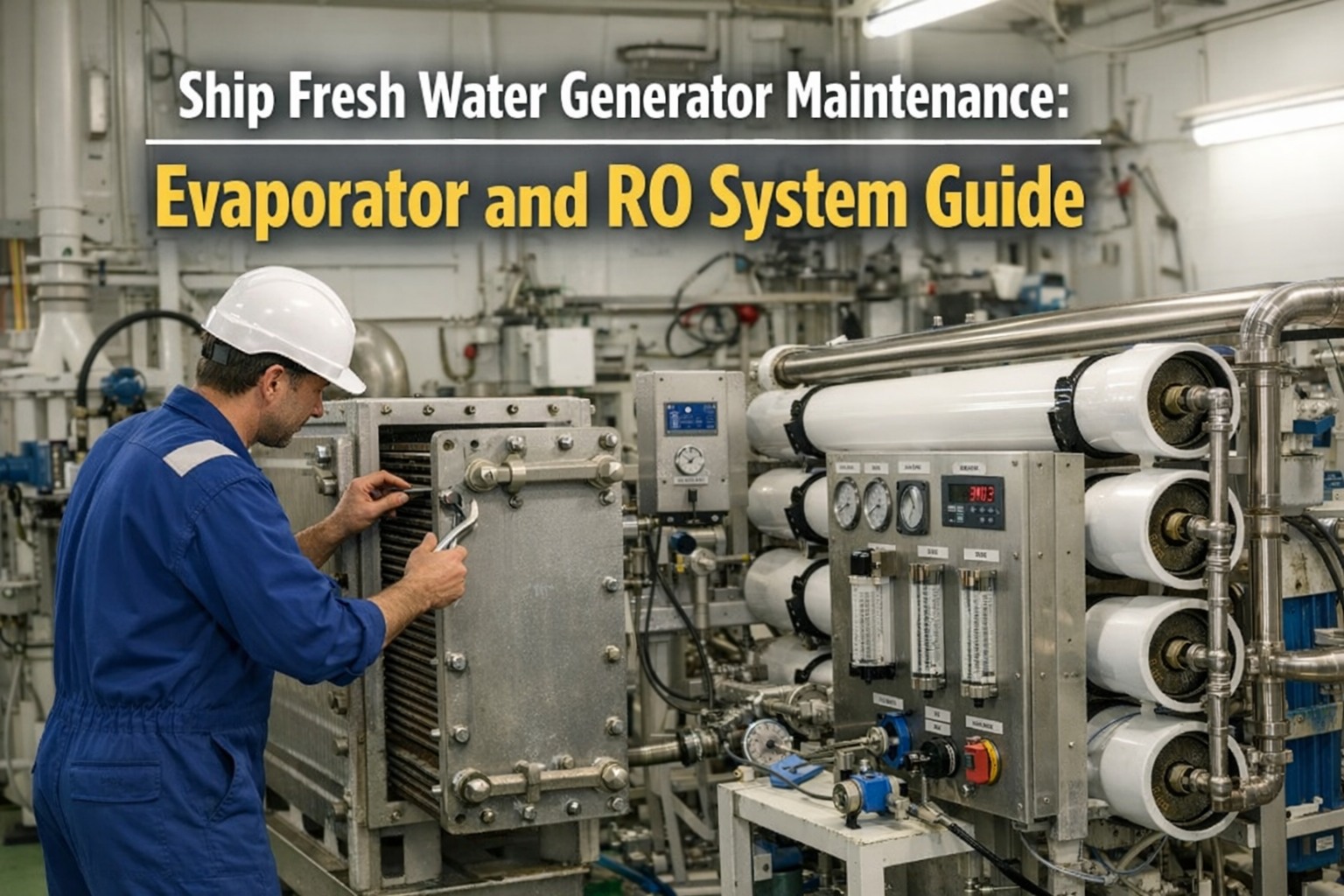
Ship Fresh Water Generator Maintenance: Evaporator and RO System Guide
Fresh water is the resource every vessel needs but cannot carry in sufficient quantity for long voyages. With crew consumption averaging 100 litres per person per day plus boiler make-up water, domestic hot water, cooking, laundry, cleaning, and engine auxiliary cooling demands, a commercial vessel can consume 5-15 tonnes of fresh water daily. The fresh water generator (FWG) — also called evaporator — is the equipment that makes long-haul voyages possible by converting seawater into distilled water using waste heat from the main engine jacket cooling water. Two technologies dominate: plate-type or tube-type vacuum evaporators using distillation (the standard choice on cargo vessels, leveraging free energy from 80°C jacket water), and reverse osmosis (RO) systems using high-pressure membrane filtration (preferred on passenger vessels with large continuous demand, but involving significantly higher maintenance costs than evaporators). Whichever technology is installed, the FWG is safety-critical: a fouled demister or leaking condenser contaminates the entire fresh water tank with seawater; a failed salinometer sends high-salinity water to crew drinking supply; a dirty evaporator plate reduces output at the worst possible time — mid-ocean with no port alternative. For marine engineers, FWG maintenance sits at the intersection of heat exchanger care, vacuum system discipline, water quality monitoring, and public health responsibility. To see how Marine Inspection digitalises FWG operating logs, salinometer calibration records, and water quality testing across your fleet, book a Marine Inspection demo.
100 L
Per crew member daily consumption
5-15 tonnes
Daily vessel fresh water demand
80°C
Jacket water temperature driving evaporation
<10 ppm
Salinometer max limit for distilled water
Two Technologies, Two Different Maintenance Worlds
FWG technology choice determines your maintenance regime, spare parts inventory, and operational discipline. Evaporators and RO systems solve the same problem with fundamentally different engineering — and require different skill sets. Marine engineers who book a Marine Inspection demo can see how the platform adapts maintenance schedules to whichever technology is installed on each vessel.
Vacuum Evaporator (Distillation)
PrincipleLow-pressure vacuum enables seawater to boil at ~50°C using 80°C jacket water heat
Sub-TypesPlate type (titanium plates) · Shell-and-tube type
Energy SourceWaste heat from main engine jacket cooling water — effectively free
OutputDistilled water (5-15 ppm salinity), requires mineralisation for potable use
Best ForCargo vessels with continuous main engine operation
PrincipleHigh-pressure seawater forced through semi-permeable membrane, salts rejected
Sub-TypesSpiral-wound membrane modules in pressure vessels
Energy SourceElectric power — high-pressure pumps drawing significant kW
OutputLow-TDS water (typically 300-500 ppm), closer to potable quality
Best ForPassenger vessels, cruise ships, vessels with high intermittent demand
Maintenance FocusMembrane replacement (costly), pre-treatment filters, high-pressure pump, chemical cleaning
Plate-Type Evaporator: Component Anatomy
Understanding what's inside the FWG shell is foundational to effective maintenance. Every component has a specific failure mode and maintenance implication.
Evaporator Plates
Corrugated titanium plates with chevron pattern. Seawater boils on one side; jacket water heats other side. Fouling from scale reduces heat transfer; chemical descaling required periodically.
Condenser Plates
Similar titanium plates. Cold seawater on one side condenses vapor on other side. Condenser tube/plate leaks cause salinity contamination — one of the most common failure modes.
Demister
Knitted wire mesh (Monel metal typically). Removes seawater droplet carry-over from vapor rising to condenser. Malfunctioning demister = high salinity output. Clean and inspect regularly.
Brine/Air Ejector
Creates and maintains 85-90% vacuum inside shell using seawater supplied by ejector pump. Also extracts brine (concentrated seawater) and incondensable gases. Poor vacuum = poor performance.
Seawater/Ejector Pump
Single-stage centrifugal pump. Supplies seawater to ejector (vacuum creation), condenser (cooling), and evaporator (feed water). Critical for entire FWG operation.
Distillate Pump
Single-stage centrifugal pump positioned at lowest point for best suction head. Extracts produced fresh water from condenser to salinometer then to storage tank.
Salinometer
Conductivity-based salinity meter with electrode on distillate pump discharge. LCD indicator 0.5-20 ppm range. Alarm setpoint usually 10 ppm; diverts high-salinity water to bilge automatically.
Feed Water Orifice
Fixed orifice at feed inlet controls seawater feed rate. Clogging reduces output. Sized to optimise evaporation without excessive salt concentration on plates.
FWG Operating Procedure: Start-Up and Shut-Down
Correct operating procedure determines whether your FWG runs for decades or requires repair every voyage. These procedures are compiled from standard marine engineering practice.
Start-Up Sequence
1Verify vessel is clear of coastal/polluted waters (minimum 20 nm offshore). Never operate in port or polluted water.
2Open overboard and seawater suction valves. Check seawater strainer clean.
3Close air purge valve on shell top (was open during shutdown).
4Start seawater ejector pump. Verify vacuum builds to 85-90% (reading on vacuum gauge).
5Open jacket water inlet and outlet valves gradually. Jacket water at ~80°C enters evaporator plates.
6Vacuum drops to ~85% indicating evaporation has started. Open feed water valve to evaporator.
7Open distillate pump discharge to drain initially. Start distillate pump. Taste water from drain.
8Switch on salinometer (usually auto-start). Verify reading below 10 ppm.
9Once salinity confirmed low and vacuum returned to normal, switch discharge from drain to fresh water storage tank.
Shut-Down Sequence
1Divert distillate discharge back to drain (prevents any contamination reaching tank).
2Close jacket water inlet valve first, then outlet valve.
3Stop distillate pump.
4Switch off salinometer.
5Stop seawater/ejector pump.
6Open air purge valve on shell top to restore atmospheric pressure slowly.
7Close seawater suction and overboard valves (normally non-return but close for safety).
8Never open bottom blow valve to restore pressure — seawater from heater can damage deflector plates.
How Marine Inspection Streamlines Fresh Water Generator Management
Fresh water generator maintenance generates substantial documentation across multiple compliance dimensions — salinometer calibration records, daily operating logs, water quality test results, cleaning and chemical treatment records, membrane replacement tracking (for RO systems), and port state control inspection evidence. Paper logbooks and spreadsheets lose this data between voyages, fragment it across watchkeepers, and make trend analysis practically impossible.
Marine Inspection provides the digital infrastructure that connects every FWG activity into one fleet-wide platform. Here's specifically how the software helps chief engineers and marine engineers managing fresh water generation:
Daily Operating Log Digitalisation
Replace paper logbooks with structured digital entries capturing vacuum pressure, jacket water temperature, seawater temperature, distillate production rate, salinometer reading, and running hours. All entries timestamped with engineer signature.
Salinometer Calibration Tracking
Automated reminders for salinometer calibration intervals. Capture test solution values, actual readings, deviations, and corrective adjustments. Class surveyors and PSC inspectors verify calibration evidence during surveys.
Capacity Trending & Early Warning
Trends daily FWG output against design capacity. Alerts when production drops — early indicator of plate fouling, vacuum issues, or demister problems before they become operational crises. Fleet-wide comparison across vessels.
Chemical Treatment Records
Track descaling chemicals used, dosage quantities, application dates, and cleaning intervals. Monitor chemical stock levels across fleet. Document compliance with manufacturer treatment specifications.
Water Quality Testing Logs
Capture bacteriological test results, chlorine residual readings, pH measurements, and silver ion sterilizer outputs. Critical for potable water compliance and crew health records. Trend water quality across voyage.
Survey-Ready Documentation
All FWG records accessible instantly during class surveys, PSC inspections, or flag state audits. No more scrambling through paper logbooks — produce 12 months of salinometer calibration, water tests, and maintenance evidence in seconds.
See Fresh Water Generator Management in Action
Book a personalised Marine Inspection demo. In 30 minutes, our team will walk you through how the platform manages FWG operations, salinometer calibration, water quality testing, and chemical treatment tracking across your fleet — with your vessel configuration.
FWG problems follow predictable patterns. Experienced marine engineers recognise symptoms and work through root causes systematically. Request a demo to see how Marine Inspection captures troubleshooting history so fleet-wide defect patterns become visible.
Common FWG Problems and Diagnosis
Symptom
Most Likely Causes
Corrective Actions
High salinity in distillate
Leaking condenser plates/tubes, demister malfunction, brine level too high, priming of evaporator, operating near coast with polluted feed
Pressure test condenser, inspect/replace demister, check brine level, move offshore
Reduced distillate output
Fouled evaporator plates (scale), insufficient vacuum, feed water orifice clogged, low jacket water temperature, condenser cooling issues
Chemical descaling, check ejector, clean orifice, verify jacket water flow
Poor vacuum
Air leakage into shell (gaskets, sight glass, valves), ejector pump pressure low, ejector nozzle worn, feed valve leaking air
Pressure test shell, check ejector pressure >3 bar, inspect ejector nozzle
Salinometer false high reading
Fouled electrode, temperature effect on reading, dissolved CO2 increasing conductivity, calibration drift
Clean electrode, recalibrate, check against reference solution
Unexpected vacuum loss
Sight glass seal leak, shell gasket failure, distillate pump seal issue, ejector failure
Systematic leak test; do not continue operation — contamination risk
Distillate pump losing suction
Air entry (vacuum issue), insufficient level in condenser, pump seal wear, strainer blockage
Restore vacuum first; then investigate pump-specific issues
Scale formation on plates
Excessive evaporation rate, feed water salinity concentration too high, inadequate brine extraction
Reduce evaporation rate, increase brine extraction, chemical treatment
Acidic/low pH distillate
Dissolved CO2 from feed water, cold seawater temperatures increasing CO2 solubility
Re-hardening filter after FWG, pH neutralisation unit
Common trap: high salinometer reading does not always mean salt — dissolved CO2 also increases conductivity. Verify with taste test and electrode inspection.
Preventive Maintenance Schedule
FWG preventive maintenance follows predictable intervals that catch deterioration before it affects water production or quality.
Daily
Record vacuum, temperatures (jacket water in/out, seawater in/out), distillate flow rate, salinometer reading. Visual check for leaks. Verify distillate diverter valve operation.
Weekly
Salinometer function test using test switch. Check distillate taste. Inspect ejector pump pressure. Verify feed water orifice not clogged. Monitor production rate against design.
Monthly
Salinometer calibration against reference solution. Clean salinometer electrode. Check demister condition through inspection hatch. Inspect gaskets. Verify safety relief valve operation. Bacteriological water test.
Quarterly
Chemical descaling of evaporator and condenser plates (or per manufacturer schedule based on fouling rate). Demister removal, inspection, and cleaning. Ejector nozzle inspection. Full water quality analysis.
Annually
Complete plate inspection (open and examine). Condenser leak test (pressure test). Replace gaskets. Overhaul ejector. Distillate and seawater pump service. Safety valve testing.
Dry Dock
Full FWG overhaul. Plate replacement if fouling recurring. Shell internal inspection. Major component renewals. UV sterilizer lamp replacement. Mineraliser filter replacement. Coating repairs if corrosion found.
Post-FWG Water Treatment: From Distilled to Potable
Distilled water straight from the FWG is not drinking water. It's aggressive (demineralised water corrodes piping and leaches metals), has low pH from dissolved CO2, and may contain residual bacteria from piping. Post-FWG treatment converts distilled water into potable water safe for crew consumption.
1
pH Correction / Re-hardening
Distilled water passed through re-hardening filter containing calcium carbonate (limestone). Corrects acidic pH, adds mineral content, reduces corrosivity. Filter media requires periodic replacement as it dissolves.
2
Mineralisation
Adds minerals required for palatability and human health. Fully demineralised water tastes flat and can cause mineral depletion over long voyages. Mineralisation filter media requires scheduled replacement.
3
UV Sterilization
UV lamp destroys bacteria, viruses, and other microorganisms. Lamp intensity decreases with age — replacement typically annually. Quartz sleeve around lamp requires cleaning to maintain UV transmission.
4
Silver Ion Sterilization
Electric silver ion sterilizer releases trace silver ions providing residual antimicrobial effect in storage tanks. Backup to UV sterilization for long-term storage protection.
5
Fresh Water Tank Storage
Storage tanks coated with non-toxic epoxy. Regular tank inspection and cleaning critical. Water quality testing (bacteriological, chemical) per flag state and WHO guidelines.
6
Hydrophore System
Pressurised tank with compressed air maintains distribution pressure throughout vessel. Automatic pump cut-in/cut-out based on pressure. Weekly pressure verification.
Regulatory & Health Compliance
Fresh water quality is not just engineering — it's public health. Multiple regulations govern potable water on vessels, including MLC 2006 (Maritime Labour Convention) crew welfare requirements, WHO Guide to Ship Sanitation, flag state health regulations, and port state health authority inspections (particularly rigorous in US, EU, and Australian ports).
MLC 2006: Crew must have access to sufficient good-quality drinking water. Quality testing records subject to MLC inspection.
WHO Guide to Ship Sanitation: International reference for water quality parameters, storage, distribution, and testing frequencies.
Ship Sanitation Certificate: Required under International Health Regulations. Renewed every 6 months. Port health authorities verify water quality evidence.
Distance Offshore: Most flag states require minimum 20 nautical miles offshore for FWG operation — prevents contamination from coastal waters with high bacterial loads.
Testing Frequency: Bacteriological testing monthly typical. Chlorine residual checked daily where chlorination used. pH and salinity continuous monitoring.
Record Keeping: Water quality test results, chemical treatment records, and system maintenance evidence retained for port health inspections.
Expert Review: The Commercial Value of FWG Reliability
Industry Analysis
FWG reliability affects vessel operations in ways that only become visible when the FWG fails. A vessel mid-voyage with a failed FWG faces difficult choices: ration water consumption (with crew welfare implications), divert to nearest port for water bunkering (commercial disruption and delay costs), or run auxiliary boilers harder to operate steam-driven evaporators where available. None of these options is commercially acceptable when the failure was preventable.
The trends shaping FWG management in 2025-2026 reflect broader maritime digitalisation. Real-time salinity and production rate monitoring integrated into engine room management systems surfaces deterioration trends that manual logbook entries miss. Predictive maintenance using operating parameter trending identifies plate fouling, vacuum leaks, and demister degradation before they impact production. Fleet-wide water quality databases enable benchmarking across vessels and identify systemic issues in ship management practices.
For chief engineers and marine engineers, the commercial case for systematic FWG management is straightforward: a well-maintained FWG delivers 15-25 years of reliable service; a poorly maintained one requires component replacement every few years and risks mid-voyage failures that damage commercial performance. Marine Inspection provides the digital infrastructure that turns FWG discipline from periodic inspection into continuous operational intelligence. Book a Marine Inspection demo to see the platform in action on your fleet configuration.
Conclusion
Fresh water generators — whether vacuum evaporators or reverse osmosis systems — are the quiet engine room workhorses making long-haul voyages possible. The plate-type vacuum evaporator, leveraging free waste heat from 80°C jacket water to produce distilled water at 85-90% vacuum, remains the standard for cargo vessels. RO systems suit passenger vessels with high intermittent demand, at the cost of higher maintenance expenses for membrane replacement. Regardless of technology, FWG maintenance discipline spans daily operating logs, weekly salinometer function tests, monthly calibration checks, quarterly chemical descaling, annual comprehensive inspection, and dry dock overhauls. Post-FWG water treatment (pH correction, mineralisation, UV sterilization, silver ion protection) converts distilled water into potable water meeting crew welfare and public health requirements under MLC 2006, WHO Guide to Ship Sanitation, and flag state regulations. Marine Inspection provides the digital platform that connects every FWG activity into one fleet-wide system — from daily vacuum readings to dry dock overhaul planning, salinometer calibration to bacteriological water testing. To see how the platform transforms your FWG management, book a live demo with our team today.
Frequently Asked Questions
How much fresh water does a commercial vessel need daily?
Crew consumption is typically 100 litres per person per day for drinking, cooking, washing, sanitation, and personal use. Beyond crew consumption, a commercial vessel needs fresh water for boiler make-up, cooling water top-up, machinery washing, cleaning, laundry, and cargo handling systems on some vessel types. Total daily demand for a typical cargo vessel with 20-30 crew ranges from 5-15 tonnes. Passenger vessels and cruise ships have dramatically higher demand — thousands of tonnes daily — justifying their typical use of high-capacity reverse osmosis systems rather than vacuum evaporators.
What is the difference between vacuum evaporator and reverse osmosis FWG?
Vacuum evaporators (plate or tube type) use low-pressure vacuum to boil seawater at ~50°C using 80°C waste heat from main engine jacket cooling water — effectively free energy. They produce distilled water at 5-15 ppm salinity requiring mineralisation for potable use. Best for cargo vessels with continuous main engine operation. Reverse osmosis systems use high-pressure pumps (drawing significant electrical power) to force seawater through semi-permeable membranes that reject salts, producing water at 300-500 ppm TDS closer to potable quality. Best for passenger vessels with high intermittent demand. Evaporators have lower operating costs but longer maintenance intervals; RO systems have higher operating costs but simpler continuous operation, offset by expensive periodic membrane replacement.
Why must FWGs be shut down near shore?
Flag states typically require minimum 20 nautical miles offshore for FWG operation. Coastal waters contain higher bacterial loads, industrial pollution, agricultural runoff, and contamination from port activities that cannot be removed by FWG distillation or RO. Operating near shore contaminates the entire fresh water tank with pathogens or chemicals that pose crew health risks. Port water typically contains sewage discharge, cargo operations runoff, and fuel contamination. The 20 nm offshore requirement ensures the FWG receives relatively clean ocean water as feed. Operating procedures must include verification of vessel position before FWG start-up.
What does the salinometer measure and why is it critical?
The salinometer measures electrical conductivity of the distillate, which correlates with dissolved salt content. Pure water has very low conductivity; dissolved salts increase conductivity proportionally. The salinometer electrode on the distillate pump discharge continuously monitors salinity. If salinity exceeds the setpoint (typically 10 ppm), a solenoid valve automatically diverts the high-salinity water back to the FWG shell or to the bilge instead of the fresh water tank, preventing contamination of the entire fresh water supply. Alarm signals to engine control room ensure engineer attention. A false high salinometer reading (fouled electrode, dissolved CO2) can divert good water to waste; a failed salinometer can allow saltwater into the drinking water tank — both require regular calibration and electrode cleaning.
What are the most common causes of FWG problems?
Top five issues: (1) High salinity in distillate from leaking condenser plates/tubes, malfunctioning demister, high brine level, or operating in polluted water. (2) Reduced output from fouled evaporator plates needing chemical descaling, clogged feed water orifice, or insufficient vacuum. (3) Poor vacuum from air leakage (gaskets, sight glass, valves), worn ejector nozzle, or ejector pump pressure below 3 bar. (4) Salinometer false readings from fouled electrode, calibration drift, or dissolved CO2 increasing conductivity (not actual salt). (5) Acidic/low pH distillate from dissolved CO2 — requires re-hardening filter downstream. Regular inspection of demister, condenser pressure testing, electrode cleaning, and chemical descaling prevent most common FWG problems.
Systematise Fresh Water Generator Management Across Your Fleet
Book a live Marine Inspection demo. See how the platform digitalises FWG operating logs, salinometer calibration, water quality testing, chemical treatment tracking, and survey-ready documentation — protecting vessel reliability, crew health, and compliance across your fleet.