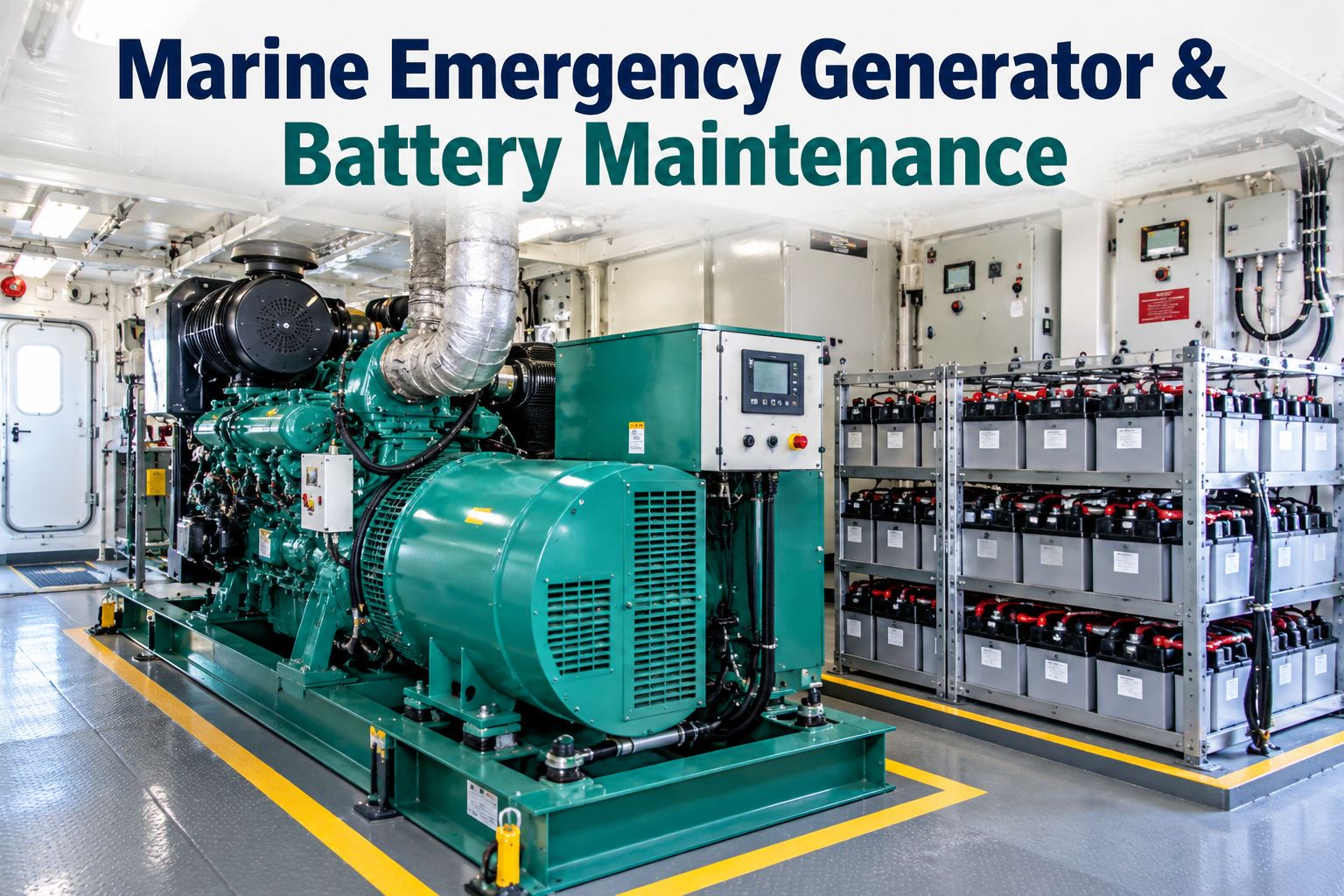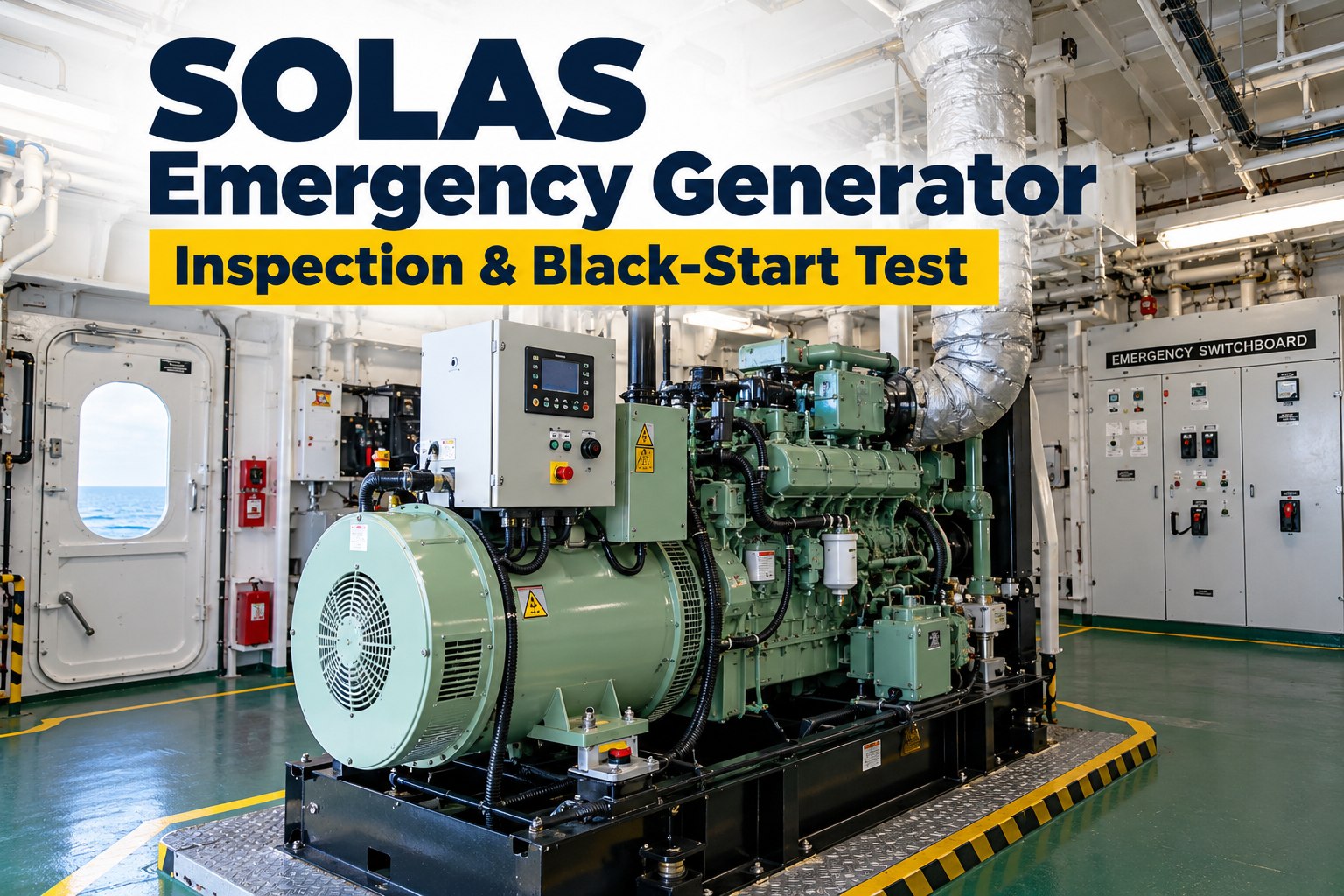
A SOLAS emergency generator inspection comes down to one question: if every main generator trips tonight, does the emergency source start, connect and carry the ship's safety services without help? For a Chief Engineer, a passed weekly test is not the same as proof. In 2025 IACS inspected emergency power systems on 36,723 ships and found that simulated blackout tests can give a false sense of readiness. This guide covers what SOLAS requires, what the campaign found, how to run a controlled blackout test and how to keep the evidence port state control and auditors ask for.
OPEN
- SOLAS Chapter II-1 Regulations 42 and 43 require an emergency source of power, with starting rules in Regulation 44 and a testing system that simulates blackout.
- Trade sources give 45 seconds to start and take load, and 18 hours of endurance on cargo ships. Verify these in the SOLAS text.
- In the 2025 IACS campaign, 853 of 36,723 ships (2.32%) had deficiencies, led by quick-closing valves, control units and starting arrangements.
- IACS found simulated blackout tests can pass where a controlled blackout fails, so write and run a controlled test procedure.
- Record times, readings and defects every time, and turn each defect into a task with an owner and deadline.
What SOLAS Requires of the Emergency Source of Power
SOLAS Chapter II-1 covers the emergency source in Regulation 42 for passenger ships and Regulation 43 for cargo ships, with starting arrangements in Regulation 44. We could not obtain the consolidated SOLAS text directly, so the table below combines interpretation texts, which quote the regulation, with trade sources, which state figures without citing paragraphs. The last column shows which is which. Confirm each figure in the SOLAS text and your flag administration's rules.
| Requirement | What it says | Where we found it |
|---|---|---|
| Position | Emergency source outside the main machinery area. Not forward of the collision bulkhead. On cargo ships of 100 m and over, the room should not be contiguous to category A machinery space boundaries or the main power source or switchboard. | Dutch inspectorate interpretation of SOLAS II-1/43.1 |
| Automatic start | Starts automatically after loss of main power and takes load within 45 seconds. | Trade sources. Not found in the interpretation texts we reviewed. |
| Endurance | At least 18 hours on cargo ships and 36 hours on passenger ships. | Trade sources. Confirm in the SOLAS text. |
| Cold start | Must start readily in cold condition at 0 degrees Celsius. | SOLAS II-1/44.1 as quoted in MSC/Circ.736 |
| Stored starting energy | Second source of energy for an additional three starts within 30 minutes, for automatically started sets, unless manual starting is shown to be effective. | SOLAS II-1/44.2 as quoted in MSC/Circ.736 |
| Starting options | Two batteries not paralleled, or one battery plus a second method such as manual, inertia or hydraulic, or an air starter with its own vessel and a second method. | Dutch inspectorate interpretation of II-1/44.2 |
| Testing system | A system that simulates the blackout situation as closely as possible, with a test button or position at the emergency switchboard. | Dutch inspectorate interpretation of II-1/43.7 |
| Parallel operation | Limited to a time-limiting device of about 10 seconds when the set supplies non-emergency circuits. | Dutch inspectorate interpretation of II-1/43.1.4 |
What the 2025 IACS Emergency Power Campaign Found
IACS ran a concentrated inspection campaign on emergency power supply from 1 January to 31 December 2025, prompted by Tokyo MoU concerns about the reliability of simulated blackout tests. Surveyors checked emergency generator starting arrangements, control units and circuits, quick-closing valves and blackout tests under SOLAS II-1 Regulations 42 and 43. The results were reported in May 2026.
What sits behind the numbers
- Recurring equipment failures. Quick-closing valves, control units such as boards and relays, and starting arrangements.
- Simulated tests miss paths. Sequential test selectors passed in some cases where a controlled blackout, created by opening the main switchboard bus tie, showed the set failed to start, supply transitional power or connect to the emergency switchboard (Gard summary).
- Procedures. Some company and shipboard SMS had no controlled blackout test procedure.
- Crew familiarity. Incorrect starting switch mode selection and unfamiliarity with the set.
- Fuel. Clogged filters made some sets stop shortly after starting or fail to reach rated load.
How to Run a Controlled Blackout Test
A controlled blackout test proves the whole chain, not only the engine. IACS recommends that ISM audits check a detailed procedure exists, and that it shows the whole emergency power system works. The seven steps below are our suggested sequence, based on the IACS and Gard findings and on a Marine Insight description of the automatic start test. Follow your SMS, the maker's instructions and class guidance, and never defeat safety devices to make a test pass.
What to check and what proves it
| Check | What to confirm | Why it matters |
|---|---|---|
| Fuel and filters | Service tank level, fuel type and condition, filters clean | Clogged filters stopped some sets early or kept them below rated load |
| Starting energy | Battery voltage, air or hydraulic pressure, both starting modes ready | Two starting means available, per trade guidance |
| Selector position | Starting selector in AUTO, not test or manual | Wrong mode was a campaign finding |
| Quick-closing valves | Fuel supply valve open and reset, trip tested | Largest campaign finding |
| Control unit | Control cards, relays and circuits healthy, no alarms | Second largest finding |
| Breaker and switchboard | Generator ACB closes, tie ACB interlocks work | Air circuit breaker malfunctions were reported |
| Consumers | Emergency lights, steering, fire pump, comms restart | No power to services was a campaign finding |
| Run on load | Temperatures, voltage, frequency, fuel flow stable | Short run may hide a fuel or load problem |
Measuring the 45-Second Limit
If your ship's rules include a 45-second limit, the test should measure it, not assume it. Time the sequence from loss of supply to the emergency switchboard being live, and note which stage takes longest. The chart shows how a budget can be split. The stage times are our own example, so use your measured values.
Test Schedule: Weekly, Monthly and Quarterly
Trade articles describe a rhythm of weekly unloaded battery starts, monthly checks of the alternative starting method and automatic start, and a run on load every three months. A weekly start proves the engine and batteries. The monthly automatic start and the on-load run are the ones that test the circuit and the fuel system.
Starting Arrangements and Fuel
Regulation 44 asks for two ways to start the set, as the table above shows. A Marine Insight article describes battery start as the primary method and hydraulic or air as the second, and says port state control may detain a ship, or allow time to correct the fault, if the second mode is not working. Test both modes on their own schedule, and keep records of battery voltage, accumulator or air pressure and the result.
- Batteries. Check voltage, charger output and age. Gard advises replacing batteries before degradation affects capacity.
- Air or hydraulic start. Check pressure, leaks and valve condition.
- Fuel. Check the service tank level, the type and condition of the fuel and the filters.
- Quick-closing valve. Test it and confirm it can be reset, since it was the top finding.
Port State Control, ISM and What Auditors Ask
AMSA says inspectors usually ask for a no-load demonstration, either a manual start or an automatic start simulating a blackout, and check start condition, starting means, crew familiarity and output voltage and frequency. Deficiencies, such as a generator that will not start or does not supply power, may lead to detention. The IACS campaign also points to ISM audits: auditors may check that a controlled blackout test procedure exists. Our ISM code guide explains how procedures and records are expected to connect, and our guide to pre-vetting audit preparation covers evidence for charterer inspections.
Common Emergency Generator Test Mistakes
Systems for Emergency Power Tests and Records
Emergency power tests only help if they are done on time and recorded. Marine Inspection supports checklists and observations turned into tasks with owners, deadlines and evidence, a dated photo repository and certificate and equipment tracking, as described in its dry docking guide for project work. For a Chief Engineer, that means each blackout test has a scheduled slot, a recorded stage time and a task for every defect, ready for the next audit or inspection.