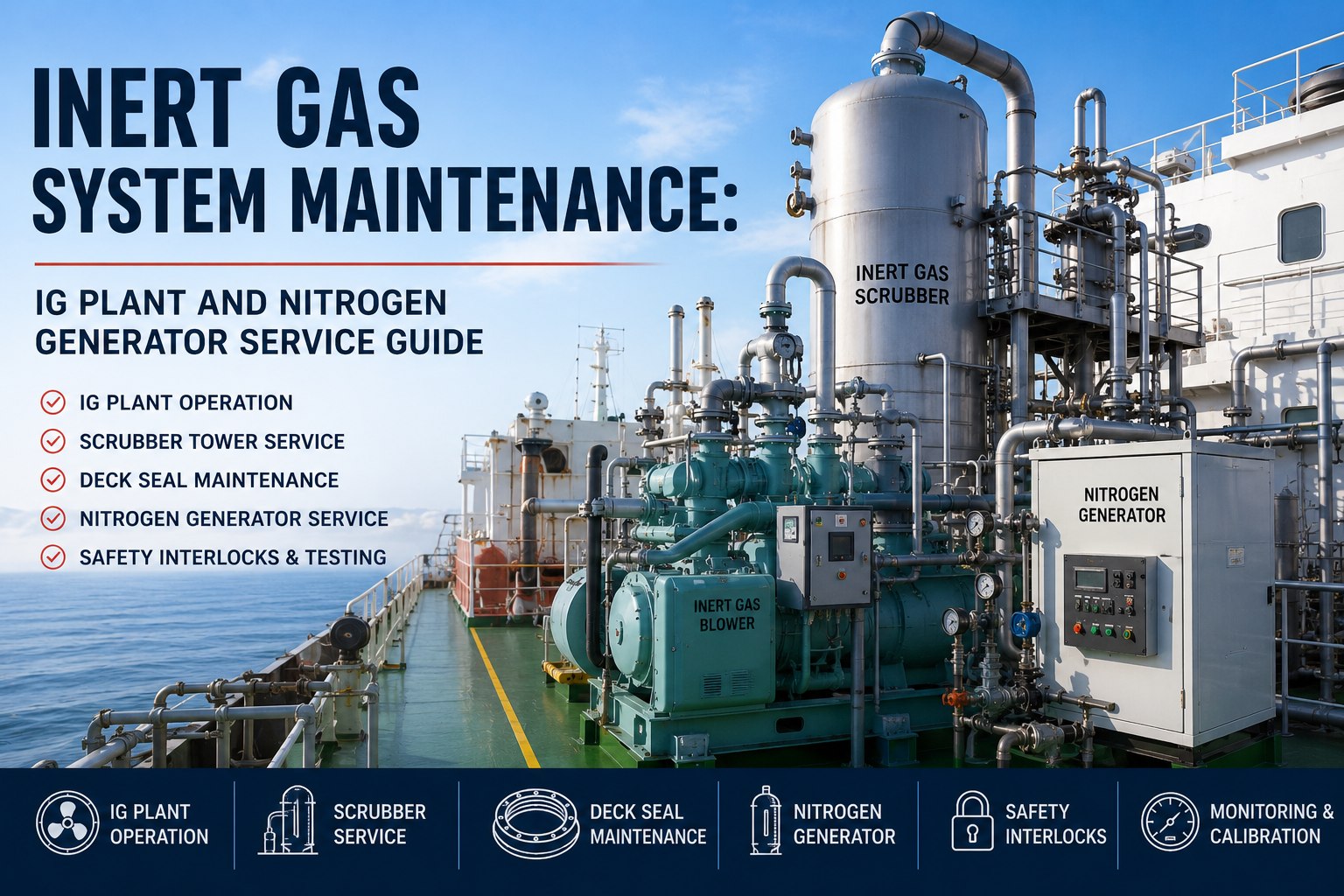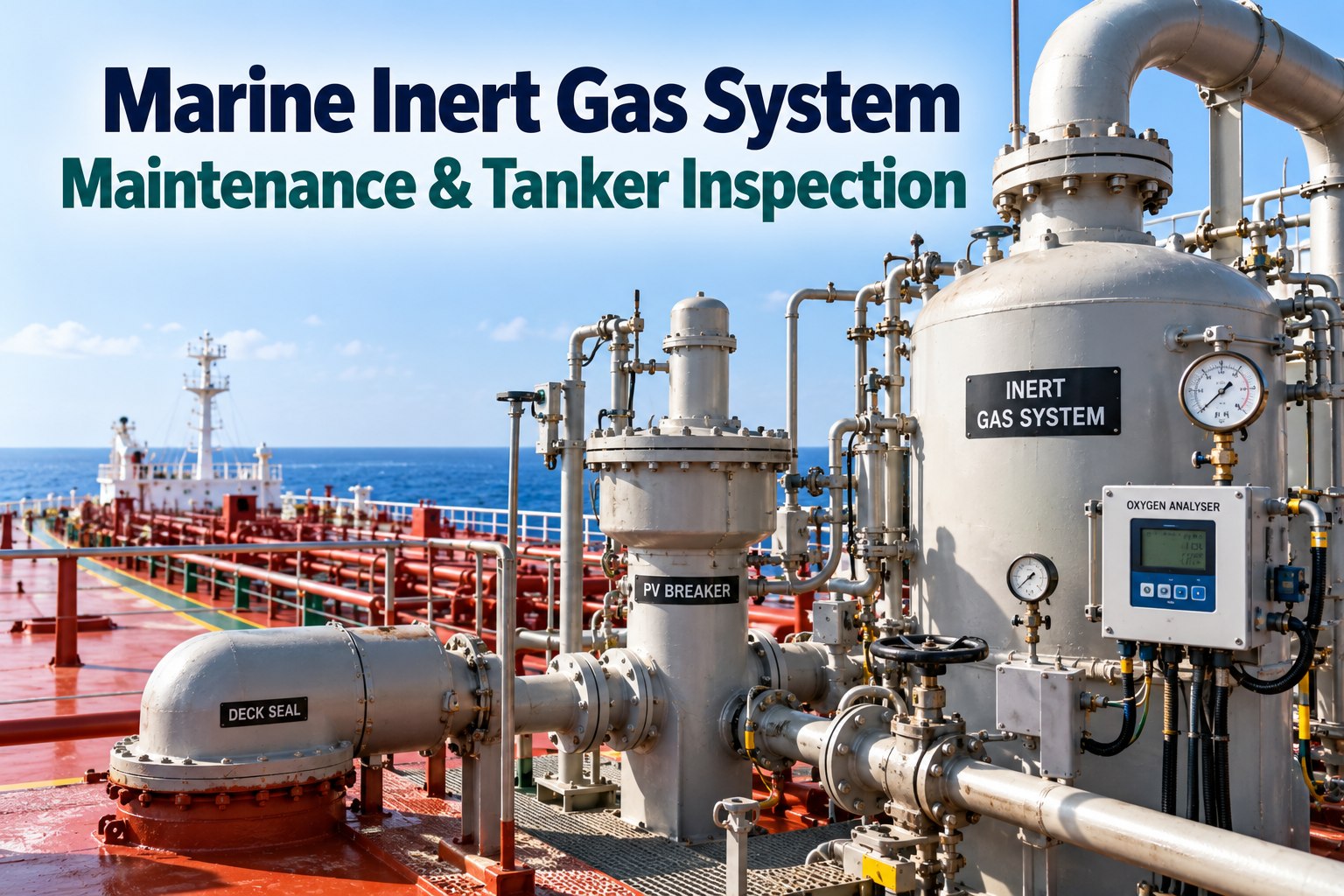
An inert gas system is only as good as its last proven reading. If the oxygen analyser drifts low, the deck seal runs dry or a trip is bridged, the cargo tanks look inerted while they slide back toward a flammable atmosphere. This guide covers the FSS Code limits, the checks inspectors run and the records that prove the barrier is real. Log IG readings and alarm tests free.
Inert gas system maintenance and inspection that proves every cargo tank stays below the line
Five numbers from FSS Code Chapter 15 define the barrier. Maintenance keeps them true; records let an inspector see they were true yesterday as well.
Inert gas system requirements under SOLAS and the FSS Code
Since 1 January 2016, SOLAS has required a fixed inert gas system on new oil tankers of 8,000 dwt and above carrying low-flashpoint cargo (previously 20,000 dwt), and on new chemical tankers carrying flammable cargoes. Chapter 15 of the FSS Code, as amended by MSC.367(93), sets what the system must do. For component-by-component upkeep, see our IG plant and nitrogen generator maintenance guide.
| Item | FSS Code Chapter 15 requirement | What an inspector looks for |
|---|---|---|
| Delivered gas | No more than 5% oxygen by volume at any required flow rate; gas above 5% vented to atmosphere automatically | Recorder trace during the last cargo operation |
| Tank atmosphere | 8% oxygen or less in any part of the tank, at positive pressure in port and at sea, unless gas-free | Tank readings logged before and during discharge |
| Capacity | At least 125% of the maximum cargo discharge rate | Discharge rate kept within plant capacity |
| Non-return devices | At least two, on deck in the cargo area: a deck seal or double block and bleed, then a non-return valve with positive closure | Seal water level, valve condition, overhaul history |
| Deck water seal | Supplied by two separate pumps; low level alarm at all times; protected from freezing; water loops on connected pipes | Both pumps proven, alarm tested, heating working |
| Indication and recording | Oxygen content and main pressure forward of the non-return devices continuously shown and permanently recorded | Unbroken records; pressure readout on the bridge |
| Pressure protection | System cannot exceed tank test pressure; tanks protected against over-pressure and vacuum when isolated | PV breaker and PV valves maintained and free |
| Manuals | Instruction manual covering operation, safety, maintenance, health hazards and fault procedures | Manual on board, crew familiar with fault actions |
Why tanker inerting matters: the cargo tank explosion record
Hydrocarbon vapour cannot burn below about 11% oxygen. The FSS Code holds tanks at 8% to keep a margin, and the record shows what happens without that margin. See how oxygen readings are trended in a demo.
The oxygen ladder a tanker officer works with
Sources: J. Spouge, DNV GL, IChemE Hazards 27 (2017); OCIMF analysis as reported by the Nautical Institute (2023).
Inert gas alarms and trips inspectors test
Every alarm below is a FSS Code requirement, and every one is defeated more often by habit than by failure. A nuisance trip that is bridged rather than diagnosed is the quickest route from a working plant to an inspection finding. Schedule alarm function tests free.
- Oxygen above 5% in the gas delivered
- Pressure below 100 mm WG in the IG main
- High gas pressure
- Power failure to indicating devices or to automatic control
- Low main pressure: independent alarm or automatic cargo pump stop
- Oxygen below 19% in the IG equipment space, alarmed inside and outside
- Deck seal low water level, active at all times
- Low cooling or scrubbing water pressure or flow
- High scrubber water level
- High gas temperature
- Blower failure
- Insufficient fuel supply (IG generators)
- Low feed-air pressure or flow, high air temperature
- Electric heater failure and high condensate level
Oxygen analyser calibration and the IG record
The fixed analyser is the only witness to what went into the tanks, and the permanent record is the only way to call that witness later. A low-reading sensor is the dangerous failure, because everything looks fine. Pair the fixed unit with the handheld meters covered in our atmosphere testing and gas meter calibration guide.
Zero and span
Check against oxygen-free reference gas and fresh air at 20.9% on the maker's interval and before each cargo operation. Log the found and left values.
Cross-check
Compare the fixed reading with a calibrated handheld meter at the same sample point. A gap is a finding even when both read under 5%.
Sample line
A blocked filter or leaking line reads wrong however well the cell is calibrated. Inspect, drain and leak-test it with the cell.
Permanent record
Oxygen and main pressure must be permanently recorded. Check the recorder works, the clock is right and the files are kept.
Every calibration, alarm test and seal check behind one IG record
Found-and-left analyser values, trip tests, seal pump checks and PV breaker readings, logged on deck offline and ready for the vetting inspector.
Deck seal and PV breaker inspection checks
These are the two devices that stand between cargo vapour and the machinery space, and between the tanks and structural damage. Both are simple, both sit outside on deck, and both fail quietly. See deck checks with photo evidence in a demo.
Deck water seal
- Water level correct and visible; low level alarm tested
- Both supply pumps proven, not just the duty pump
- Heating working in cold weather without boiling the seal
- Water loops on drain, vent and sensing lines intact
- Internals inspected for corrosion and demister fouling
PV breaker and PV valves
- PV breaker filled with the correct liquid to the correct level, checked with the main depressurised
- PV valves lifting and seating freely, no corrosion or cargo residue
- Flame screens and arrestors clean and intact
- Settings recorded against the tank test pressure
- Non-return valve overhauled and seating tight
Cargo tank atmosphere through the inerting cycle
The IG plant does different work at each stage of the cargo cycle, and each stage has its own target. Getting the purge wrong before gas freeing is how tanks pass through the flammable range. Our cargo tank cleaning guide covers the washing that sits between them.
Inerting
Displace air with inert gas until oxygen is 8% or less throughout the tank.
Topping up
Keep tanks at positive pressure at sea and in port; top up as pressure falls.
Purging
After washing, purge with inert gas until hydrocarbon is 2% or less by volume.
Gas freeing
Ventilate to a steady 20.9% oxygen and no more than 1% LFL, plus toxic limits where relevant.
Purge and gas-freeing targets follow common tanker practice under ISGOTT. Use your SMS and the ship's cargo manual for the values that bind your operation.
IG system inspection: PSC, SIRE 2.0 and class
Three sets of eyes look at the same plant for different reasons. Prepare for all three with the same evidence, and see our SIRE 2.0 cargo and ballast chapter guide for the vetting side.
Findings are coded 07102 (inert gas system) and 08106 (inert gas alarm), with handheld meters under 06105 (atmosphere testing instrument). Expect a recorder check and an alarm demonstration.
The inspector reviews records and asks the cargo officer to explain how the plant is run and what happens on an alarm. Hesitation about a bridged trip becomes a human-factors observation.
The system is surveyed with the cargo installation: function tests, alarm and shutdown proof, and condition of seal, valves and scrubber.
Inert gas system inspection and maintenance schedule
Regulation sets what the system must do; the maker and the SMS set how often you prove it. The schedule keeps those sources apart.
| Task | When | Basis |
|---|---|---|
| Oxygen and pressure recorded while IG is supplied | Continuous | FSS Code |
| Fixed analyser zero and span check | Before each cargo operation, and per maker | Practice |
| Handheld oxygen meters calibrated and bump-tested | Before each use | Practice |
| Deck seal level checked; both pumps proven | Daily in use; pumps per SMS | Practice |
| Alarm and shutdown function tests | Before cargo operations, and per SMS | Practice |
| PV breaker liquid level and condition | Per SMS, main depressurised | Practice |
| PV valves, flame screens and non-return valve | Per maker | Maker |
| Scrubber tower, demister and blowers inspected | Per maker | Maker |
| Full system survey with function tests | With the class survey cycle | Class |
How Marine Inspection makes inert gas compliance provable
An inspector's questions rarely surprise anyone. The answers usually sit in a recorder file, a deck log, a calibration sheet and someone's memory. Marine Inspection puts each answer where it can be found in seconds. Build your IG evidence trail free.
Inert gas system maintenance and inspection: FAQs
What oxygen level must inert gas be delivered at?
No more than 5% by volume at any required flow rate, under FSS Code Chapter 15. Gas above 5% must be vented to atmosphere automatically, not sent to the tanks.
What is the maximum oxygen in an inerted cargo tank?
8% by volume in any part of the tank, held at positive pressure in port and at sea, unless the tank has been gas-freed.
At what pressure does the IG low pressure alarm sound?
When pressure in the IG main falls below 100 mm water gauge. Low main pressure must also give an independent alarm or stop the cargo pumps automatically.
Which tankers need an inert gas system?
Oil tankers of 8,000 dwt and above carrying low-flashpoint cargo and chemical tankers carrying flammable cargo, keel-laid on or after 1 January 2016. Older oil tankers were covered from 20,000 dwt.
Why does the deck seal need two pumps?
The FSS Code requires two separate pumps so the seal keeps its water at all times; a seal that runs dry no longer stops cargo vapour flowing back toward the machinery space.
How should the oxygen analyser be checked?
Zero and span against reference gas and fresh air, cross-checked with a calibrated handheld meter, with the sample line inspected at the same time. See calibration records in a demo.
Keep every tank below the line, and keep the proof
Analyser calibrations, alarm tests, seal and PV breaker checks and every high-oxygen event on one record, ready for PSC, class or the next SIRE 2.0 inspection.