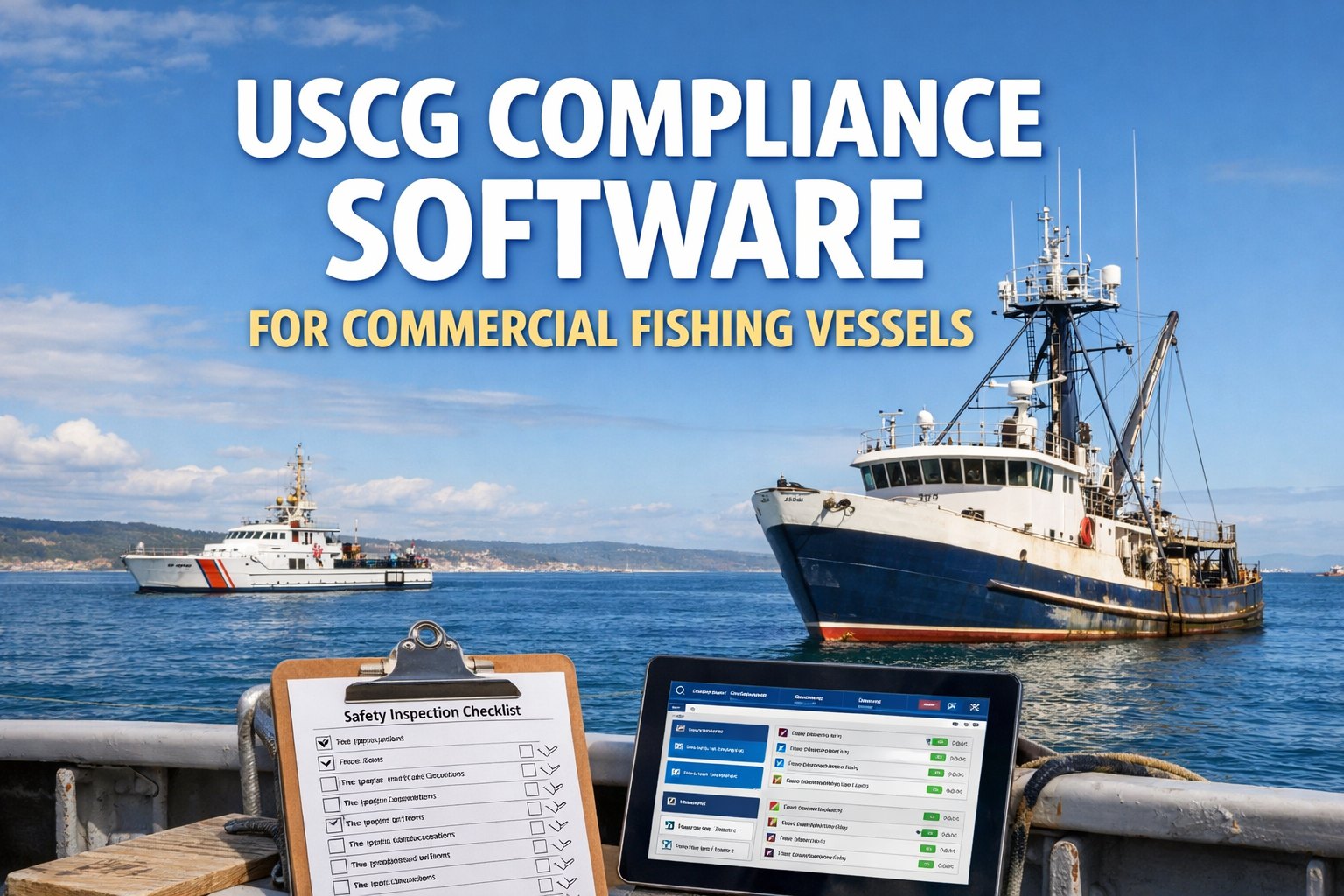
Commercial fishing is the deadliest occupation in the United States—fatality rates exceed 100 deaths per 100,000 workers, over 28 times the national average. NIOSH data from 2000-2019 documents 878 fishermen killed on the job, with 47% of deaths resulting from vessel disasters like sinkings and capsizings. Behind every one of those incidents is a compliance failure: expired safety equipment, incomplete drill documentation, deferred maintenance on critical systems, or gaps in the records that a USCG dockside examiner would have caught. The Coast Guard requires commercial fishing vessels operating beyond 3 nautical miles to complete dockside safety examinations—every 2 years for a CFVS decal or every 5 years depending on vessel category. Keeping equipment serviceable, documentation current, and crew training verified between exams is where most operators struggle. Marine Inspection gives fishing fleet operators a digital compliance system purpose-built for USCG fishing vessel requirements—so your next dockside exam is a confirmation of ongoing readiness, not a scramble to get compliant.
28x
Higher Fatality Rate
Than the average U.S. worker (NIOSH, 2000-2017)
47%
Deaths from Vessel Disasters
Capsizings, sinkings, and floodings (NIOSH CFID)
2-5 yr
Dockside Exam Cycle
CFVS decal (2 yr) or required exam (5 yr) per 46 USC 4502
What the USCG Dockside Examination Covers
The USCG Commercial Fishing Vessel Safety exam isn't a single checklist—it covers every system that keeps crew alive when something goes wrong. The scope varies by vessel size, operating area, and number of persons on board, but every exam evaluates the same core categories. Marine Inspection tracks compliance status across all of them continuously, so operators preparing for an exam can schedule a demo and see exactly where their fleet stands before the examiner arrives.
USCG Dockside Exam: Core Compliance Categories
Life rafts with capacity for entire crew, hydrostatic release units, inflatable raft service dates, EPIRB registration and battery expiration
Life raft service: annually. HRU: per manufacturer. EPIRB battery: per label date.
Proper type and quantity per person on board, immersion suits where required, PFD lights with unexpired batteries, retro-reflective material
PFD light batteries: per expiration. Immersion suit condition: each exam.
Fire extinguishers (USCG/UL/FM approved), gauge pressure or weighed and tagged, fire axes, galley grease extraction hoods
Extinguishers: annual inspection, tagged with date. Non-rechargeable: per expiration.
VHF radio with DSC and MMSI programmed, GPS interconnection, navigation lights, radar reflector (non-metallic hulls), charts
FCC Ship Station License: every 10 years. Radio function: tested prior to getting underway.
Electrical systems, fuel lines (marine type SAE J-1928/UL 1111), ventilation, bilge pumps, stability (scuppers clear, gear secured)
General alarm: tested weekly underway. Bilge systems: operational check each exam.
Station bill posted visibly, emergency procedures for fire/flooding/abandonment, crew drill records, first aid/CPR certification (2+ POB)
Drills: prior to getting underway. Station bill: updated when crew changes.
The Compliance Gap: Between Exams
Passing a dockside exam proves compliance on one day. But equipment expires, crew rotates, drills get skipped during heavy fishing seasons, and maintenance items slip between the cracks over 2-5 year exam cycles. The USCG Best Practices Guide (updated December 2024) emphasizes that less serious casualties—minor flooding, loss of power, steering failures—are risk factors for future vessel disasters, highlighting the importance of continuous preventive maintenance rather than exam-day compliance.
What Expires Between Dockside Exams
Life raft service certification
Annual
Expired service = non-compliant survival craft
EPIRB battery and NOAA registration
Per label date
Dead battery = no distress signal when needed
Hydrostatic release units
Per manufacturer
Failed HRU = raft doesn't deploy in sinking
PFD light batteries
Per expiration
No light = crew not visible in water at night
Fire extinguisher inspection tags
Annual
Untagged extinguisher = exam failure
First Aid/CPR crew certification
Per training provider
Expired cert with crew change = non-compliant
Fishing fleet operators managing multiple vessels across different exam cycles can sign up for Marine Inspection to see fleet-wide compliance status in a single dashboard, with automatic alerts for upcoming expirations across every vessel.
Stay Exam-Ready Between Dockside Visits
Marine Inspection tracks USCG safety equipment expirations, drill records, crew certifications, and maintenance status—so your fishing vessels are always compliant, not just on exam day.
Expert Review: USCG Commercial Fishing Vessel Safety in 2025
Industry Analysis
The USCG Commercial Fishing Industry Vessel Best Practices Guide, updated in December 2024, represents a collaboration between vessel owners, safety organizations, the Coast Guard, and the National Commercial Fishing Safety Advisory Committee (NCFSAC). Its central finding reinforces what NIOSH data has shown for decades: preventive maintenance and safety management systems are the most effective tools for reducing vessel casualties. Less serious incidents—minor flooding, power loss, steering failures—are precursors to the disasters that kill fishermen.
The regulatory framework under 46 CFR Part 28 and 46 USC 4502 establishes minimum safety equipment requirements, but the Best Practices Guide goes further, recommending safety management approaches that treat compliance as continuous rather than periodic. For fleet operators managing multiple vessels, this means tracking not just exam dates but the ongoing serviceability of every piece of safety equipment, the currency of every crew certification, and the completion of every required drill. Marine Inspection delivers this continuous compliance capability—schedule a walkthrough to see how the platform manages USCG fishing vessel requirements across your entire fleet.
Conclusion
USCG compliance for commercial fishing vessels isn't just about passing a dockside exam—it's about keeping the equipment, documentation, and crew readiness that prevent the vessel disasters responsible for nearly half of all fishing industry fatalities. Marine Inspection manages this compliance digitally: safety equipment expiration tracking, drill documentation, crew certification monitoring, and maintenance records all connected in a platform that shows fleet-wide compliance status in real time. Book a demo to see the fishing vessel compliance module, or sign up and start tracking your fleet's USCG readiness today.
USCG Compliance for Your Fishing Fleet
Marine Inspection keeps every vessel in your fleet exam-ready—tracking safety equipment, drill records, crew certifications, and maintenance across every USCG requirement, every day.
Frequently Asked Questions
What USCG inspections are required for commercial fishing vessels?
Under 46 USC 4502(f), commercial fishing vessels operating beyond 3 nautical miles from the baseline must complete a dockside safety examination at least once every 5 years. The Coast Guard recommends exams every 2 years. Some vessel categories require a Certificate of Compliance (COC) renewed every 2 years. Fish processing vessels 5,000 GT and greater must be inspected and certificated under the Coast Guard vessel inspection program. Marine Inspection tracks which exam cycle applies to each vessel in your fleet.
What happens if a fishing vessel fails a dockside exam?
There is no penalty for not passing a voluntary exam—the examiner provides a work list identifying items that need correction. However, vessels required to carry a valid CFVS decal that don't maintain compliance may receive a Notice of Violation, and the USCG Vessel Casualty Coordination Center can require corrective action. Marine Inspection helps prevent exam failures by tracking every checklist item continuously so deficiencies are corrected before the examiner arrives.
What safety equipment expires between dockside exams?
Multiple items expire on different schedules: life raft service certifications (annually), EPIRB batteries (per label date), hydrostatic release units (per manufacturer specification), PFD light batteries, fire extinguisher inspection tags (annually), and first aid/CPR crew certifications. Marine Inspection tracks all of these dates and sends automated alerts before expiration, ensuring no equipment lapses go unnoticed during the 2-5 year exam cycle.
Does Marine Inspection cover vessels of different sizes and operating areas?
Yes. USCG requirements vary based on vessel length (under 26 ft, 26-65 ft, 65+ ft), operating area (inland, coastal, beyond boundary line), and number of persons on board. Marine Inspection configures compliance checklists to match each vessel's specific regulatory profile, so you're tracking the requirements that actually apply—not a generic list that may include items irrelevant to your operation.
How does Marine Inspection help with drill documentation and crew training records?
The USCG requires emergency drills (fire, flooding, abandonment, man overboard) prior to getting underway and at least weekly while underway. Marine Inspection provides digital drill logging with date, participants, and completion verification. Crew training certifications—first aid, CPR, marine safety training—are tracked with expiration alerts. When crew rotates, the system flags any certification gaps so they're resolved before the vessel departs.