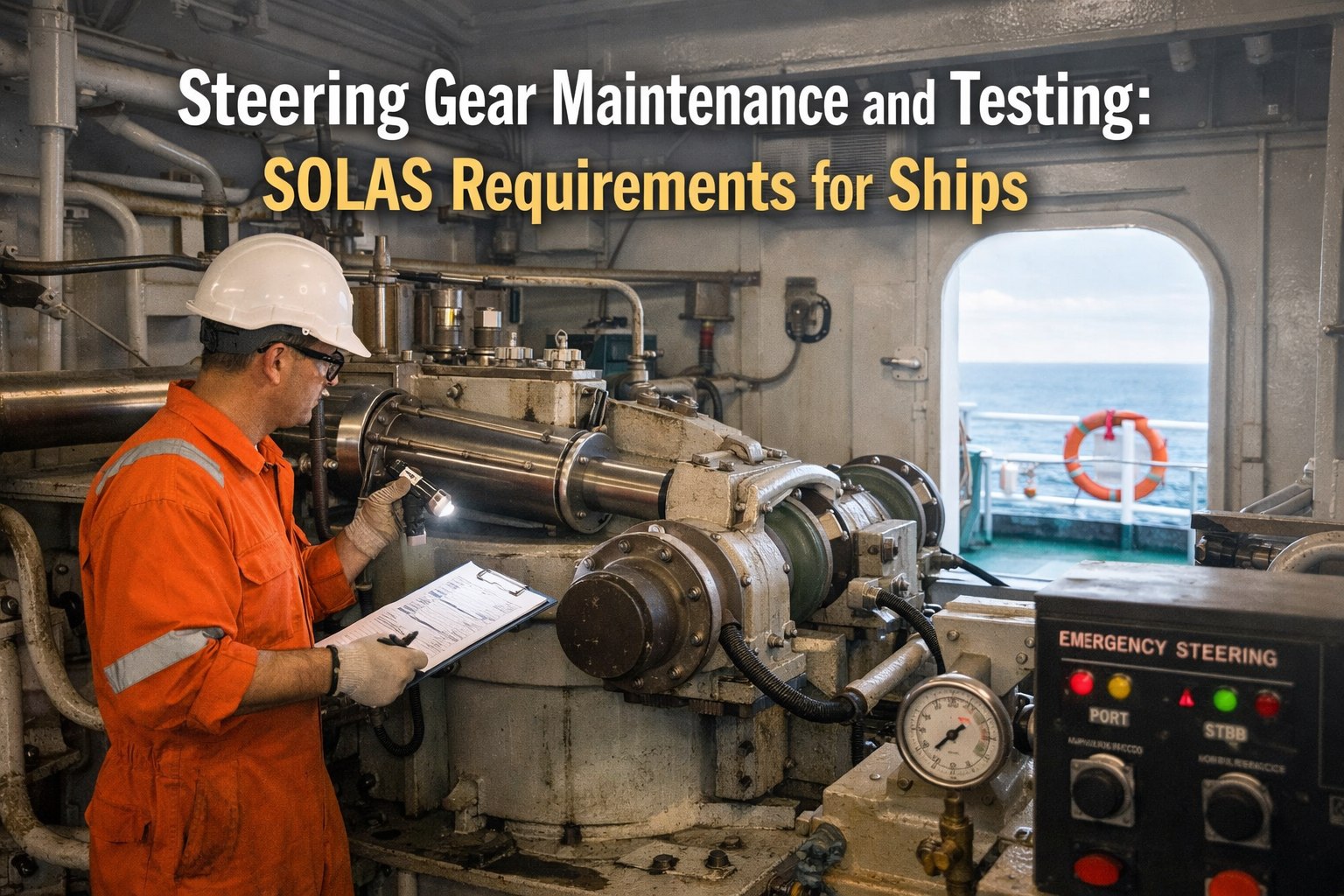
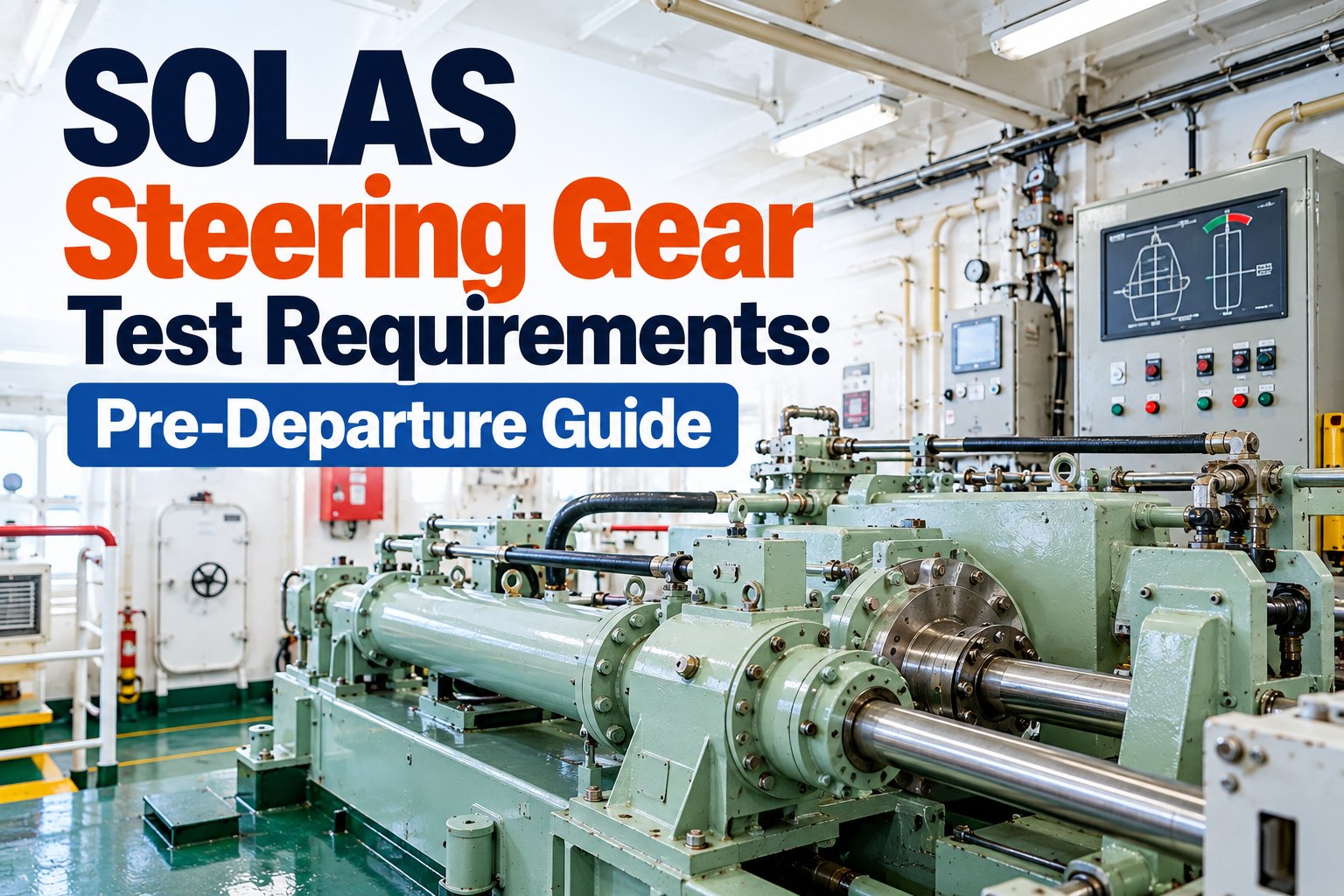
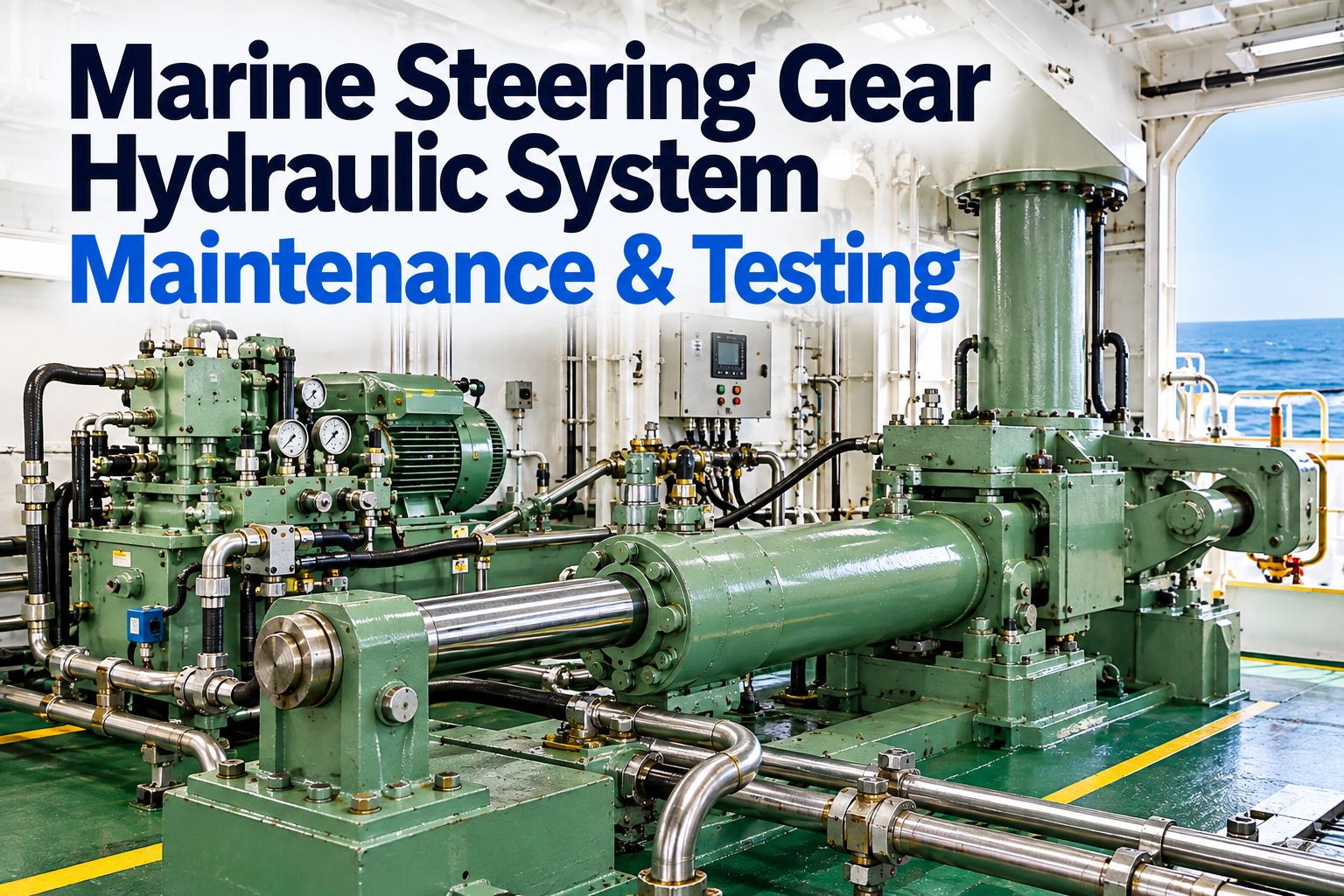
Steering Gear Maintenance and Testing: SOLAS Requirements for Ships
Steering gear failure is among the most catastrophic equipment failures a vessel can experience — the loss of directional control in open water can lead to grounding, collision, environmental disaster, and total vessel loss in minutes. This is why SOLAS Chapter II-1 imposes the strictest performance requirements of any ship system on steering gear, why Regulation V/26 mandates pre-departure testing within 12 hours of departure and emergency drills at intervals not exceeding three months, and why Port State Control inspectors treat steering gear deficiencies as among the highest priority findings during inspections. For marine engineers and deck officers, steering gear compliance is not optional background knowledge — it is front-line operational discipline where procedural lapses create immediate detention risk and real safety consequences. The steering gear's SOLAS requirements define not just performance (rudder hard-over 35° to 30° in 28 seconds at full sea speed) but redundancy (two independent power actuating systems), response (auxiliary capability within 45 seconds of main failure), control (independent bridge and compartment control), monitoring (low-level alarms, phase failure alarms, power failure alarms), and testing discipline (pre-departure checks, 3-monthly drills, recorded in logbooks). Marine engineers and deck officers building systematic steering gear compliance can start a free trial of Marine Inspection to digitalise pre-departure testing records, drill documentation, and maintenance evidence.
SOLAS Performance Requirements at a Glance
35°→30°
In 28 Seconds
Main steering gear, full sea speed and loaded draft
15°→15°
In 60 Seconds
Auxiliary steering gear, minimum 7 knots
45 sec
Auxiliary Response
After main failure on tankers 10,000 GT+
1.25x
Design Pressure
Minimum over working pressure for hydraulics
Steering Gear Types: What You're Actually Maintaining
Most SOLAS-regulated commercial vessels use electro-hydraulic steering gear in either ram-type or rotary vane configuration. Each type has distinct maintenance requirements, failure modes, and inspection priorities. Understanding which system you're operating is the first step in developing an effective maintenance programme. Operators who book a Marine Inspection demo can see how the platform tracks system-specific maintenance intervals.
Ram Type (Electro-Hydraulic)
How It Works
Hydraulic cylinders (rams) connected to a tiller arm or rudder quadrant rotate the rudder stock. Larger vessels typically use four-ram configurations for redundancy; smaller vessels use two-ram systems.
Typical Use
Large commercial vessels — VLCCs, Capesize bulkers, large container ships. Handles highest torque requirements.
Key Maintenance Focus
Ram seal condition, tiller arm bushing wear, hydraulic hose integrity, foundation bolts, cross-connection valves
Rotary Vane (Electro-Hydraulic)
How It Works
A rotor attached to the rudder stock sits inside a fixed stator housing. Hydraulic fluid pumped into compartments between rotor and stator vanes creates rotation, turning the rudder directly.
Typical Use
Medium-sized cargo vessels, offshore support vessels, modern mid-size container ships, cruise vessels. Compact and quiet.
Key Maintenance Focus
Internal vane seals (critical — internal leaks cause total steering loss), stator housing integrity, rotor-to-stock coupling, relief valve settings
SOLAS Testing Requirements: What Must Be Done and When
SOLAS Chapter V Regulation 26 and Chapter II-1 Regulation 29 together define a comprehensive testing regime that every SOLAS-regulated vessel must follow. These are not advisory best practices — they are mandatory procedures verified by flag state inspectors, classification surveyors, and PSC officers. Steering gear deficiencies are frequently cited during PSC inspections, and incomplete testing records are a detention risk. Sign up for Marine Inspection to maintain the digital testing records that satisfy flag state and PSC verification.
SOLAS Steering Gear Testing Schedule
Test Type
Frequency
What Must Be Tested
Documentation
Regulatory Basis
Pre-Departure Test
Within 12 hours before departure
Main & auxiliary steering gears, remote control systems, bridge steering positions, emergency power supply, rudder angle indicators, power failure alarms, automatic isolating arrangements
Engine and bridge logbooks
SOLAS V/26.1
Weekly Check
Weekly (short voyage vessels)
Alternative to pre-departure testing for vessels on short voyages where flag state permits
Engine logbook
SOLAS V/26.1 (waiver)
Emergency Drill
At least every 3 months
Direct control from steering gear compartment, bridge-to-compartment communication, alternative power supply operation, changeover procedures
Ship's logbook with drill details
SOLAS V/26.4
US 48-Hour Drill
Within 48 hours before entering US waters
Full emergency steering drill (unless drill logged within prior 3 months)
US Coast Guard records
33 CFR 164.25
Full-Rudder Test (Build)
New build / major modification
Rudder hard-over 35° to 30° in ≤28 seconds at full sea speed and loaded draft
Sea trial documentation
SOLAS II-1/29.3.2
Auxiliary Performance
Sea trial & periodic
Rudder 15° to 15° in ≤60 seconds at not less than 7 knots with ship fully loaded
Sea trial & class survey
SOLAS II-1/29.4.2
Tanker 45-Second Test
Periodic (tankers 10,000 GT+)
Steering capability regained within 45 seconds after loss of one power actuating system
Class survey records
SOLAS II-1/29.6
Power Failure Alarm Test
With pre-departure test
Audible and visual alarms on bridge and ECR for power failure, motor overload, phase failure (3-phase systems), low hydraulic oil
Engine logbook
46 CFR 58.25
Pre-departure testing cannot be waived for international voyages. Log entries must include test date, time, results, and officer signatures.
The Pre-Departure Testing Procedure
The pre-departure test is a coordinated procedure between the Officer of the Watch on the bridge and the Engineer Officer of the Watch in the steering gear compartment. It must be conducted within 12 hours of departure. Rushed or incomplete testing has contributed to numerous groundings and collisions when steering failures occurred shortly after departure.
1
Main Steering Gear Test
Run pumps 1 and 2 together. Test rudder movement through full range (hard port to hard starboard). Verify rudder angle indicator matches actual rudder position at wheelhouse and steering flat. Check hydraulic pressure readings match specifications.
2
Auxiliary Steering Gear Test
Switch to auxiliary pump/system. Verify rudder movement. Confirm auxiliary system responds within SOLAS time limits. Check that changeover does not interrupt steering capability.
3
Remote Control Systems
Test all bridge steering positions (main wheel, NFU lever, follow-up lever, autopilot). Verify smooth changeover between control positions. Check override functions.
4
Alarms & Communication
Test power failure alarms, low hydraulic level alarms, phase failure alarms (3-phase systems). Verify audible and visual indication on bridge and ECR. Test two-way communication between bridge and steering gear compartment.
5
Physical Inspection
Inspect all hydraulic lines and connections for leakage. Listen for abnormal mechanical noises during operation. Examine steering gear and linkages for visible defects. Check hydraulic oil reservoir level against minimum. Verify protective guards in place.
6
Logbook Entry
Record test date, time, results, any abnormalities, and officer signatures. Both engine room and bridge logs must reflect the test. Any defect identified must trigger corrective action before departure.
Never Miss a Test. Never Lose a Drill Record.
Marine Inspection automates pre-departure test scheduling, captures drill records with crew participation evidence, and produces the digital documentation trail that flag states, class surveyors, and PSC officers verify — protecting your vessel from detention over incomplete testing records.
Emergency steering drills are distinct from routine pre-departure tests. They simulate actual steering failure scenarios under realistic conditions and verify that crews can execute the changeover procedures. SOLAS V/26.4 mandates drills at intervals not exceeding three months, and all ship's officers concerned with steering gear operation or maintenance must be familiar with the systems and changeover procedures.
Scenario Simulation
Simulate loss of main steering gear. Crew must identify failure, communicate between bridge and compartment, and initiate changeover to auxiliary or emergency steering.
Direct Compartment Control
Practice steering directly from the steering gear compartment using local control handles. Test bridge-to-compartment communication (telephone, announcing system) under realistic conditions.
Alternative Power Supply
Test operation from alternative/emergency power source. Verify 45-second power availability where required. Confirm rudder angle indicator continues functioning during power transfer.
Timing & Performance
Measure and record changeover timing, response times, and rudder performance during drill. While not strictly required for routine tests, this creates a baseline revealing deteriorating hydraulic systems.
Debrief & Corrective Action
Gather feedback from all participants. Identify weaknesses in procedures, equipment, or communication. Record observations in logbook. Implement corrective actions for identified deficiencies.
Documentation
Record drill date, participants, scenario, timing measurements, observations, and corrective actions. Verify drill complies with 3-month interval requirement. Digital records prevent the accidental lapse that triggers PSC detention.
Core Maintenance Activities for Reliable Steering Gear
Steering gear maintenance is built on continuous attention to hydraulic system integrity, combined with periodic overhaul of mechanical components. The maintenance programme must align with classification society schedules, manufacturer specifications, and the class survey cycle.
Hydraulic Fluid Management
Check reservoir level daily. Low-level alarm testing weekly. Hydraulic oil sampling for contamination analysis quarterly. Filter replacement per manufacturer schedule. Maintain storage tank with sufficient capacity to recharge at least one power actuating system including reservoir.
Ram Seal / Vane Seal Condition
Ram systems: monitor for external leakage at seal plates. Rotary vane: monitor internal leakage (harder to detect — shows as reduced response speed or hydraulic pressure drop). Seal replacement during dry dock or as indicated by performance deterioration.
Control System Integrity
Test all bridge control positions monthly. Verify non-follow-up steering levers. Autopilot integration testing. Remote control cables and wiring inspection. Rudder order indicators verified against actual rudder position.
Mechanical Components
Rudder stock bearing clearance checks. Tiller arm bushings inspection. Foundation bolt torque verification. Coupling inspection. Rudder movement free of obstruction. Grease all specified grease points per schedule.
Relief Valve Setting
Verify relief valves set at not more than 1.25x design pressure. Test lifting pressure annually. Relief valve discharge paths clear. Pressure gauge calibration. Pressure cut-out settings verified.
Alarm System Verification
Monthly testing of power failure alarms, motor overload, phase failure (3-phase systems), low hydraulic oil level, high oil temperature. Verify audible and visual indication on bridge and in ECR. Alarm response procedures posted prominently.
Expert Review: The PSC Risk of Steering Gear Non-Compliance
Industry Analysis
Steering gear deficiencies are consistently among the top PSC findings globally, and the pattern of those deficiencies is remarkably consistent: incomplete testing records or logbooks, leaking hydraulic lines, low fluid levels, crew unfamiliarity with emergency steering procedures, and delayed switching to auxiliary power during drills. Each of these deficiencies points to a systemic issue — not a single equipment problem, but a failure of the operational discipline that SOLAS requires.
The common thread is documentation. A hydraulic line with a slight weep becomes a detainable deficiency when combined with an incomplete maintenance log that suggests the leak was not being monitored. Crew unfamiliarity with emergency procedures becomes a detention risk when the last drill record is four months old instead of three. Low hydraulic fluid level becomes a detention-class deficiency when the engine room log shows no check for eight days. The physical defects are easy to find; the operational discipline that would have caught them earlier is the real issue PSC inspectors uncover.
Digital maintenance platforms address this systematically by making testing schedules automatic, capturing completion evidence as the work is done, and surfacing upcoming drill and test dates before they are missed. For marine engineers and deck officers, this is not about replacing traditional seamanship — it is about ensuring that systematic work produces systematic evidence. Schedule a walkthrough to see how Marine Inspection protects your vessel from steering gear PSC findings.
Conclusion
Steering gear is the single equipment system whose failure carries the most immediate safety consequence — and SOLAS recognises this with the most comprehensive performance, redundancy, testing, and drill requirements imposed on any vessel system. Performance benchmarks (35° to 30° in 28 seconds, 15° to 15° in 60 seconds, 45-second auxiliary response for large tankers) are specific and non-negotiable. Testing discipline (pre-departure within 12 hours, 3-monthly emergency drills, weekly checks for short voyages) is mandatory and verified by flag states, classification societies, and PSC. The operators who avoid steering gear PSC findings are those whose daily operational systems produce the testing evidence, drill records, and maintenance documentation that inspectors verify. Marine Inspection provides the digital platform that turns steering gear SOLAS compliance from paper-based vulnerability into systematic operational discipline — sign up today to protect your fleet's steering gear compliance.
Frequently Asked Questions
What are the SOLAS performance requirements for steering gear?
SOLAS Chapter II-1 Regulation 29 specifies: Main steering gear must be capable of putting the rudder hard-over from 35° on one side to 30° on the other in not more than 28 seconds while running at full sea speed and loaded draft. Auxiliary steering gear must put the rudder from 15° on one side to 15° on the other in not more than 60 seconds with the ship fully loaded and speed not less than 7 knots. For tankers of 10,000 GT and above, steering capability must be regained within 45 seconds after loss of one power actuating system. Design pressure for hydraulic components must be at least 1.25 times maximum working pressure.
How often must steering gear be tested?
SOLAS V/26 requires steering gear testing within 12 hours before departure on every voyage. The test covers main and auxiliary steering gears, remote control systems, bridge positions, emergency power, rudder angle indicators, failure alarms, and automatic isolating arrangements. For vessels on short voyages, flag states may permit weekly checks instead of pre-departure testing. Emergency steering drills must be conducted at intervals not exceeding 3 months. US regulations add a requirement for drills within 48 hours before entering US waters unless a drill was conducted and logged within the prior 3 months.
What is the difference between ram type and rotary vane steering gear?
Ram-type steering gear uses hydraulic cylinders (rams) connected to a tiller arm or quadrant to rotate the rudder stock — large vessels typically use four-ram configurations. Ram systems are robust and widely used on VLCCs, large container ships, and Capesize bulkers. Rotary vane systems feature a rotor attached to the rudder stock housed within a fixed stator; hydraulic fluid pumped into compartments between rotor and stator vanes creates rotation. Rotary vane systems are compact, quieter, and common on mid-size vessels. Key difference in maintenance: rotary vane internal leaks are harder to detect than external ram seal leaks and can cause complete steering loss — making condition monitoring critical.
What must be included in an emergency steering drill?
SOLAS V/26.4 emergency drills must include: simulating loss of main steering gear, direct control from the steering gear compartment, bridge-to-compartment communication testing, operation of the alternative power supply, practicing changeover procedures, and involvement of all ship's officers concerned with steering gear operation or maintenance. While not strictly required, measuring and recording timing creates a performance baseline that identifies deteriorating hydraulic systems. Drill date, participants, scenario, observations, and corrective actions must be recorded in the ship's logbook. Drills must occur at intervals not exceeding 3 months.
What alarms are required for ship steering gear?
SOLAS and 46 CFR 58.25 require multiple alarms: low hydraulic fluid level alarm for each reservoir (audible and visual on bridge and ECR), power failure alarm, motor overload alarm, phase failure alarm for three-phase electrical systems (audible and visual on bridge), loss of hydraulic fluid detection with automatic isolation of the defective system while other systems remain operational, rudder angle indicator independent of steering control system, and communication systems between bridge and steering gear compartment. Simple operating instructions with a block diagram showing changeover procedures must be permanently displayed on the navigation bridge and in the steering compartment.
Systematise Steering Gear Compliance Across Your Fleet
From 12-hour pre-departure tests to 3-monthly emergency drills, hydraulic fluid monitoring to alarm system verification — Marine Inspection delivers the digital compliance infrastructure that turns SOLAS steering gear requirements into automated operational discipline.