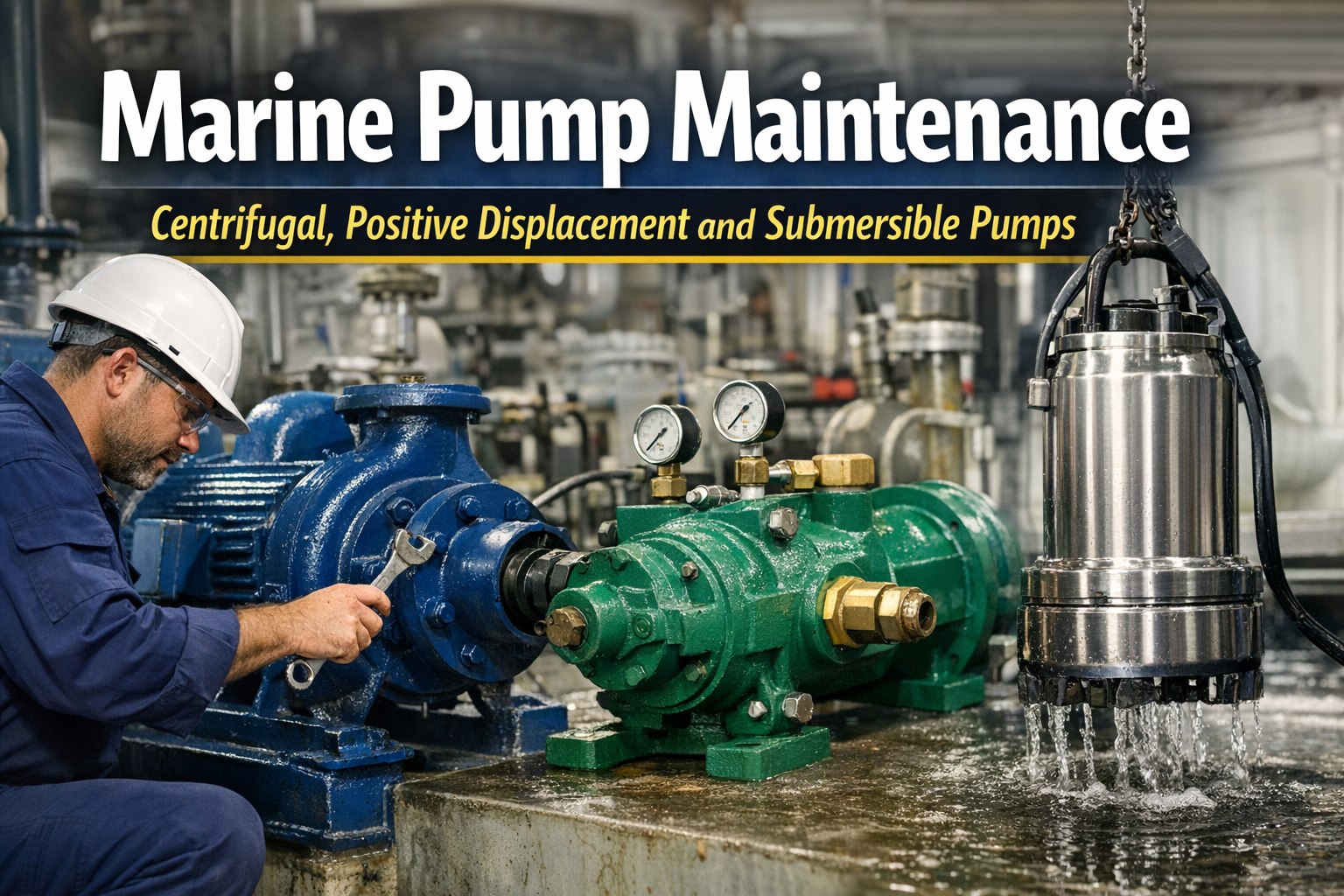
Marine pumps are the circulatory system of every commercial vessel — moving seawater through engine cooling circuits, transferring heavy fuel oil from bunker tanks to service tanks, lubricating main engine bearings, removing bilge water to prevent flooding, ballasting and deballasting for stability, and delivering firefighting water at regulatory pressures when emergencies strike. A modern commercial vessel can have 50-100+ pumps serving these critical duties, and pump failure propagates rapidly through dependent systems: a failed seawater cooling pump can shut down the main engine within minutes; a faulty fuel transfer pump can halt propulsion; a bilge pump that won't prime during a flooding emergency can sink a ship. Pump selection and maintenance are among the highest-leverage engine room disciplines — the right pump for the right fluid handled with systematic preventive maintenance delivers decades of reliable service, while the wrong selection or neglected maintenance creates recurring failures that drain operating budgets and compromise safety. This guide covers the four major pump families encountered on commercial vessels (centrifugal, gear, screw, and submersible/specialty), their specific applications and failure modes, preventive maintenance schedules, and the troubleshooting patterns that separate experienced marine engineers from those still learning. To see how Marine Inspection digitalises pump maintenance tracking, insulation monitoring, overhaul scheduling, and SOLAS fire pump compliance across your fleet, book a live demo with our team.
The Four Marine Pump Families
Understanding pump families is the foundation of marine pump maintenance. Each family operates on distinct hydraulic principles, handles specific fluid characteristics, and has its own failure modes. Using the wrong pump for a fluid — a centrifugal pump on heavy fuel oil, a gear pump on contaminated bilge water — guarantees poor performance, premature wear, or outright failure. Request a Marine Inspection demo to see how our platform catalogues pump-specific maintenance procedures across every family on your vessel.
Matching Pump to Application: The Decision Matrix
Wrong pump selection is a recurring source of marine pump failures. The critical variables are fluid viscosity, required flow rate, system pressure, fluid cleanliness, and whether self-priming is needed. This decision matrix captures the choices made on every commercial vessel. To see how Marine Inspection helps your team standardise pump specifications across fleet-wide procurement, schedule a platform walkthrough.
| Application | Fluid Characteristics | Recommended Pump Type | Typical Capacity | Critical Design Point |
|---|---|---|---|---|
| Main Engine Cooling | Seawater; low viscosity; high volume | Vertical centrifugal (in-line) | Up to 1,800 m³/h | Bronze or Duplex SS casing — cast iron fails via graphitic corrosion |
| Ballast Transfer | Seawater; very high volume | Double-suction centrifugal | Up to 6,200 m³/h | Vertical design 50% smaller footprint vs horizontal; motor above casing |
| Fire Main (SOLAS) | Seawater; pressure-critical | Centrifugal (self-priming preferred) | 1,000 m³/h at 10 bar typical | Interconnected with bilge/ballast via cross-over valves; ABS certification |
| Bilge Pumping (oily) | Contaminated water + oil mixture | Screw pump or vortex pump | Smaller flow rates | Never centrifugal — shearing action emulsifies oil, disabling OWS |
| Emergency Bilge | Flooding water; submerged operation | Submersible centrifugal | Independent; high capacity | SOLAS requirement passenger ships; operates submerged; emergency power supply |
| HFO Transfer | Heavy fuel oil; high viscosity | Gear pump or twin-screw | Moderate flow, high pressure | Heating required at suction; never centrifugal — efficiency collapses |
| Main Engine Lube Oil | Lube oil; moderate viscosity; continuous | Three-screw pump | Continuous supply | Quiet operation, pulsation-free flow critical for bearing health |
| Sludge / Dirty Bilge | Contaminated water, solids | Reciprocating (piston) or single-screw | Smaller volumes | Can run dry; handles debris; self-priming |
| Sewage Transfer | Waste water with solids | Submersible (large channels) | Moderate capacity | Anti-clog design; motor in waterproof housing |
| Hazardous Chemicals | Corrosive or flammable fluids | Diaphragm pump | Low to moderate | Leak-free operation; no shaft seal |
Preventive Maintenance: What to Check and When
Marine pump maintenance follows predictable intervals that catch deterioration before it causes failure. Salt-laden seawater, vibration, temperature cycling, and continuous duty accelerate wear in ways that shore-based pumps never experience — making systematic maintenance more critical at sea than anywhere else. To replace paper logs and spreadsheets with an integrated digital maintenance platform that tracks every pump across your fleet, book your Marine Inspection demo today.
Marine Pump Troubleshooting: The Patterns That Matter
Experienced marine engineers diagnose pump problems by pattern recognition. Specific symptoms point to specific failure modes — and the most expensive mistake is replacing a pump when the actual problem is system-related (suction strainer, valve position, piping). Request a demo to see how Marine Inspection captures troubleshooting history so defect patterns become visible across your fleet.
| Symptom | Most Likely Causes | Corrective Actions |
|---|---|---|
| No flow / no pressure | Pump not primed, air lock, suction valve closed, wrong rotation direction, strainer blocked, impeller damaged | Verify priming, check valves, confirm rotation, clean strainers, inspect impeller |
| Cavitation (gravel sound) | Insufficient NPSH available < NPSH required, blocked suction, high suction lift, pumping too hot liquid | Reduce suction lift, clear obstructions, reduce flow, check liquid temperature |
| Reduced capacity | Impeller wear, wear ring clearance excessive, partial blockage, air leak on suction side, reduced speed | Measure clearances, pressure test suction, check motor speed and coupling |
| Excessive vibration | Shaft misalignment, bent shaft, worn bearings, impeller imbalance, foundation loose, cavitation | Vibration analysis to identify source; never continue operation — damage accelerates |
| Seal leakage | Worn mechanical seal faces, abrasive fluid damaging seal, shaft deflection, dry running, improper installation | Replace seal; investigate root cause (don't just replace repeatedly) |
| Motor overload | Overcharged system, closed discharge valve, impeller fouled, bearing failure, wrong pump for fluid (centrifugal on HFO) | Verify system alignment, check discharge valve, inspect for bearing damage |
| Flexible impeller failure | Ran dry (burned rubber), debris tore vanes, heat damage, age | Replace impeller; verify priming before every start; never run dry |
| Graphitic corrosion | Cast iron casing used for seawater application | Replace with bronze or Duplex stainless steel; cast iron is wrong material for seawater |
SOLAS Fire Pump Requirements: What Surveyors Verify
Fire pumps carry specific SOLAS regulatory weight that routine service pumps do not. Port State Control inspectors verify fire pump operation, pressure, and SOLAS compliance during boardings — and deficiencies here are common PSC findings that can trigger detention. To digitalise SOLAS fire pump compliance evidence with automated test scheduling and inspection-ready documentation, book a Marine Inspection demo.
Material Selection: Why Cast Iron Fails on Seawater
One of the most expensive lessons in marine pump maintenance is the consequence of wrong material selection. Cast iron pumps fail rapidly in seawater service through a process called graphitic corrosion — the iron matrix corrodes away while the graphite skeleton remains, leaving a soft, structurally compromised casing that disintegrates under pressure. For seawater service (cooling, ballast, fire, bilge), always specify bronze or Duplex stainless steel casings and impellers. The higher initial cost delivers multi-decade reliability versus premature replacement on seawater duty. Marine engineers building procurement standards across fleet vessels can book a demo to see how Marine Inspection centralises material specifications and procurement records.
Expert Review: The 2025-2026 Trend Toward Digital Pump Management
Pump maintenance has historically been reactive — a pump fails, the crew opens it up, replaces the seal or impeller, and puts it back in service. The fundamental problem with this approach is that pumps rarely fail instantaneously. Mechanical seal failures develop over weeks as face wear progresses. Bearing failures announce themselves with vibration signatures that trend upward over months. Impeller wear shows as gradual capacity reduction that appears in pressure gauge readings over quarters. Every one of these failures has a detection window during which preventive action costs a fraction of the failure-driven repair.
The 2025-2026 shift toward IoT-enabled condition monitoring recognises this pattern. Vibration sensors, pressure transmitters, temperature probes, and flow meters connected to centralised platforms deliver the trend data that reveals developing problems. But the sensors alone are not the answer — the data has to be captured, analysed, and acted on within maintenance planning systems that connect condition monitoring to work orders, spare parts procurement, and crew scheduling. This is where digital maintenance platforms differentiate themselves from spreadsheet-based approaches.
For marine engineers, the practical implication is that pump maintenance has become a data discipline as much as a mechanical one. The engineers who consistently deliver reliable pumping systems are those whose maintenance records are captured digitally, trended systematically, and reviewed proactively. Book a Marine Inspection demo to see how the platform connects pump condition data with preventive maintenance planning across your fleet.
Conclusion
Marine pump maintenance spans four major pump families (centrifugal, gear, screw, and specialty) serving critical duties across cooling, ballast, fire, bilge, fuel transfer, and lubrication systems. Matching pump type to application is foundational — centrifugal pumps for low-viscosity high-volume fluids, positive displacement pumps for viscous fluids, screw pumps for quiet continuous duty, and specialty pumps for specific edge cases. Material selection matters: bronze or Duplex stainless steel for seawater service; cast iron fails rapidly via graphitic corrosion. Preventive maintenance follows predictable intervals (daily watchkeeping, weekly standby rotation, monthly inspections, quarterly deeper review, annual overhaul preparation, dry dock major overhauls). Troubleshooting is pattern recognition — cavitation sounds like gravel, bearing wear produces rumble, cast iron pumps on seawater fail in predictable ways. SOLAS fire pump requirements add specific regulatory discipline verified by Port State Control. The marine engineers who deliver reliable pumping systems across multi-year voyages are those whose maintenance records are captured systematically and reviewed proactively. To see how Marine Inspection transforms marine pump maintenance from reactive repair into systematic fleet-wide discipline, book a live platform demo with our team today.