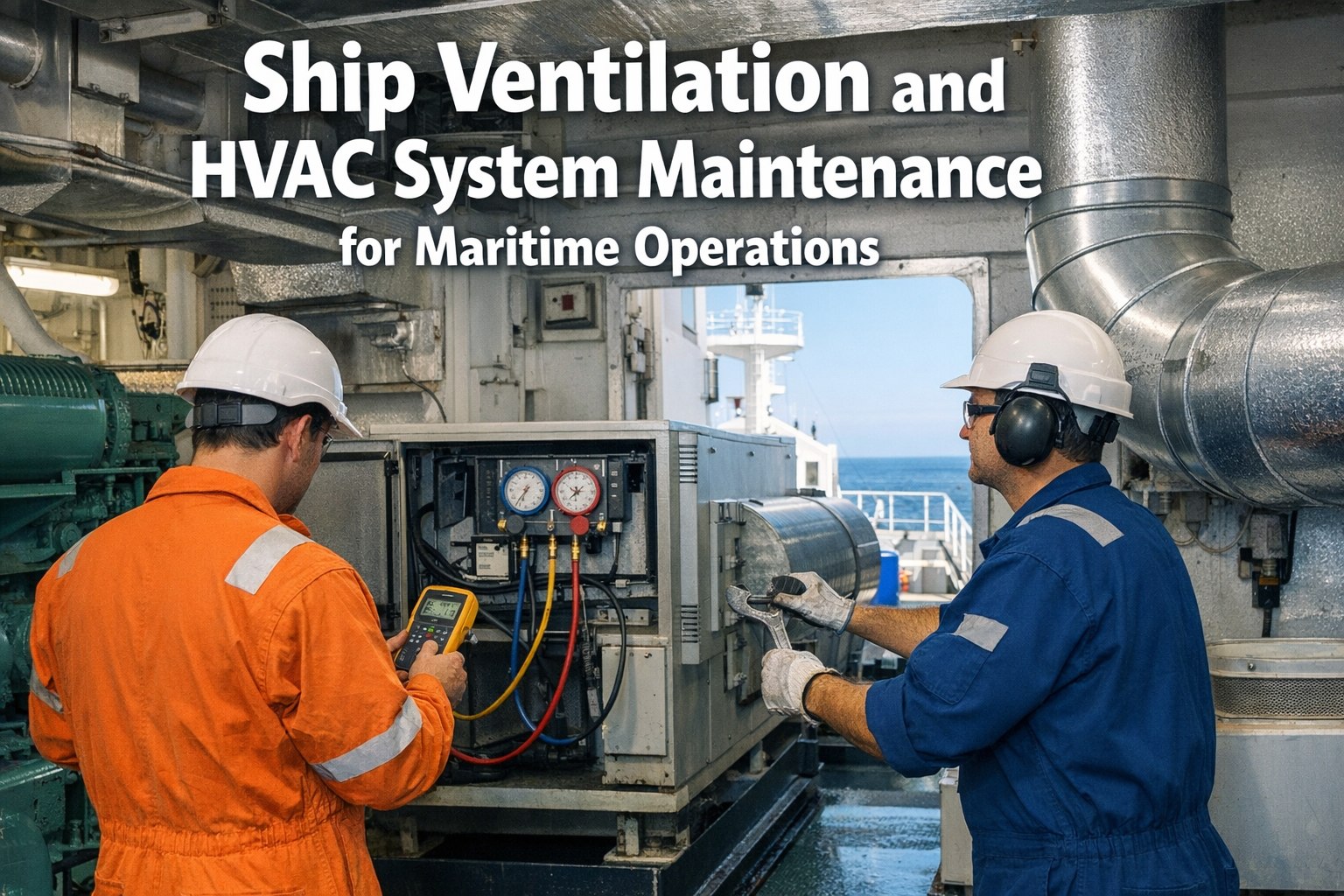
Marine HVAC and ventilation systems are often treated as the crew comfort systems — but for marine engineers, they are safety-critical infrastructure that protects sensitive electronics from overheating, supplies combustion air to main engines and generators, controls humidity that causes corrosion in electrical panels, maintains cargo integrity on refrigerated and temperature-sensitive cargoes, and removes the heat that would otherwise push engine room temperatures past the 45-50°C classification society limits. Up to 40% of HVAC failures at sea are attributed to improper maintenance or refrigerant leaks, and cruise ships can have HVAC systems serving over 100,000 m³ of internal space across multiple independent fire zones. Modern systems deployed with smart automation can reduce HVAC energy consumption by 20-30% — a significant operational saving as FuelEU Maritime and EU ETS make every kilowatt of auxiliary load a direct carbon cost. For marine engineers, HVAC maintenance spans four distinct system categories — engine room ventilation, accommodation air conditioning, cargo hold ventilation, and provision cooling — each with different regulations, maintenance disciplines, and failure modes. Marine engineers building systematic HVAC maintenance records can start a free trial of Marine Inspection to digitalise maintenance schedules, refrigerant records, and filter replacement tracking.
The Four Shipboard HVAC System Categories
Marine HVAC is not a single system — it is four distinct system categories, each serving different operational needs with different regulatory requirements and maintenance priorities. Understanding these categories is the first step in building an effective maintenance programme. Operators who book a Marine Inspection demo can see how the platform tracks maintenance across all four systems with category-specific schedules.
Engine Room Ventilation: Design Fundamentals
Engine room ventilation is the most safety-critical HVAC system on any motor vessel. Without adequate combustion air, diesel engines cannot develop rated power — affecting propulsion and generator capacity. Without adequate heat removal, machinery space temperatures exceed classification limits, degrading equipment reliability and creating dangerous working conditions. Sign up for Marine Inspection to track engine room ventilation system performance against design parameters.
| Parameter | Requirement / Target | Why It Matters | Regulatory Basis |
|---|---|---|---|
| Combustion Air (HFO) | 0.42 m³/kWh per engine | Insufficient air causes incomplete combustion, black smoke, power loss, and turbocharger stress | Manufacturer specification |
| Combustion Air (MDO) | 0.36 m³/kWh per engine | Lower fuel density requires less combustion air than HFO; critical during ECA transits on MDO | Manufacturer specification |
| Generator Margin | Add 15-20% for standby generators | Auto-start of standby generators during peak load requires immediate air availability | Class society rules |
| Max Engine Room Temp | 45-50°C maximum | Equipment degradation accelerates above limit; crew heat stress becomes hazardous | Class society rules |
| Static Pressure | 250-600 Pa typical | Insufficient pressure cannot overcome duct losses; excessive pressure wastes fan power | Design standard |
| Vessel Heel/Trim | Design for 15-22.5° heel | Airflow patterns and fan performance affected by vessel motion | Design standard |
| Supply Fan Type | Axial for high-volume low-pressure | Most economical for bulk air movement into engine rooms | Design standard |
| Exhaust Fan Type | Centrifugal for ducted systems | Higher static pressure capability for longer duct runs | Design standard |
| Regulatory Framework | SOLAS II-2 + IMO Resolution A.468(XII) | Minimum ventilation rates and fire safety requirements for machinery spaces | SOLAS II-2, IMO A.468(XII) |
The Core HVAC Maintenance Activities
HVAC maintenance is built on consistent attention to airflow, refrigerant integrity, cleanliness, and electrical systems. Marine environments accelerate wear through salt-laden air, constant vibration, and extreme temperature variations. Regular inspection every 1-3 months with deeper servicing during dry dock or annual surveys is the industry standard.
Common HVAC Problems and Solutions
HVAC failures follow predictable patterns. Identifying them early turns an expensive repair into routine maintenance. Sign up for Marine Inspection to document HVAC defect trends across your fleet.
| Symptom | Most Likely Causes | Corrective Actions |
|---|---|---|
| Reduced cooling capacity | Refrigerant leak, dirty coils, compressor wear, blocked filters, faulty expansion valve | Leak test and recharge, clean coils, replace filters, service compressor |
| High discharge pressure | Fouled condenser, low seawater flow, air in system, overcharge | Clean condenser, check seawater pump and strainers, evacuate air, correct charge |
| Low suction pressure | Low refrigerant, blocked filter/drier, faulty expansion valve, icing on evaporator | Leak test and recharge, replace drier, service expansion valve, defrost evaporator |
| Compressor short cycling | Low refrigerant, dirty condenser, faulty pressure controls, sensor fault | Investigate root cause; do not simply reset. Check pressure switches and controls |
| Humidity issues | Coil too warm (insufficient dehumidification), drain blocked, damper position | Verify setpoints, clear condensate drain, check damper actuators |
| Uneven temperature | Damper failure, blocked diffusers, air balance issue, faulty thermostat | Inspect dampers, clean diffusers, rebalance air distribution, calibrate thermostat |
| Engine room overheating | Failed supply fan, blocked intake, exhaust fan failure, damper stuck closed | Emergency: reduce engine load, open intake louvres manually, investigate fan |
| Abnormal fan vibration | Bent blades, bearing failure, imbalance, loose mounting | Shut down and inspect; vibration analysis to identify root cause |
Expert Review: HVAC as an Energy Cost Centre
HVAC systems were historically viewed as a fixed operational cost — you run them at design capacity and deal with the electrical load. The regulatory environment of 2025-2026 has changed that calculus completely. With EU ETS extended to maritime from 2024 and FuelEU Maritime GHG intensity requirements from 2025, every kilowatt of auxiliary load consumed by HVAC translates into direct carbon cost and potential regulatory penalty. Modern smart HVAC systems with variable frequency drives, zonal control, and AI-driven demand optimisation can reduce HVAC energy consumption by 20-30% — on cruise ships where HVAC may serve over 100,000 m³, that represents substantial commercial value.
The operational implication is that HVAC maintenance is no longer just about keeping systems running — it is about keeping them running efficiently. A fouled condenser coil that forces the compressor to work harder costs fuel. A leaking refrigerant charge that degrades cooling capacity forces the system to run longer. A failed damper that wastes conditioned air reduces zone control effectiveness. Each of these is both a maintenance issue and an energy cost issue, and the operators who track HVAC performance against design baselines capture fuel savings that directly improve CII ratings and reduce EU ETS exposure. Schedule a walkthrough to see how Marine Inspection turns HVAC maintenance into energy efficiency management.
Conclusion
Marine HVAC and ventilation systems span four distinct system categories — engine room ventilation (combustion air and heat removal), accommodation air conditioning (crew comfort and equipment protection), cargo hold ventilation (cargo integrity), and provision refrigeration (crew food and medical) — each with different regulatory requirements, failure modes, and maintenance disciplines. With up to 40% of HVAC failures attributed to improper maintenance or refrigerant leaks, and energy consumption reductions of 20-30% achievable with smart system management, HVAC maintenance is both a safety-critical activity and a significant commercial opportunity. The marine engineers who keep HVAC systems operating reliably and efficiently are those whose maintenance programmes are systematic, documented, and trend-analysed — catching coil fouling, refrigerant leaks, and filter degradation before they become operational problems. Marine Inspection provides the digital platform that connects every HVAC maintenance activity into one system — sign up today to build systematic HVAC maintenance across your fleet.