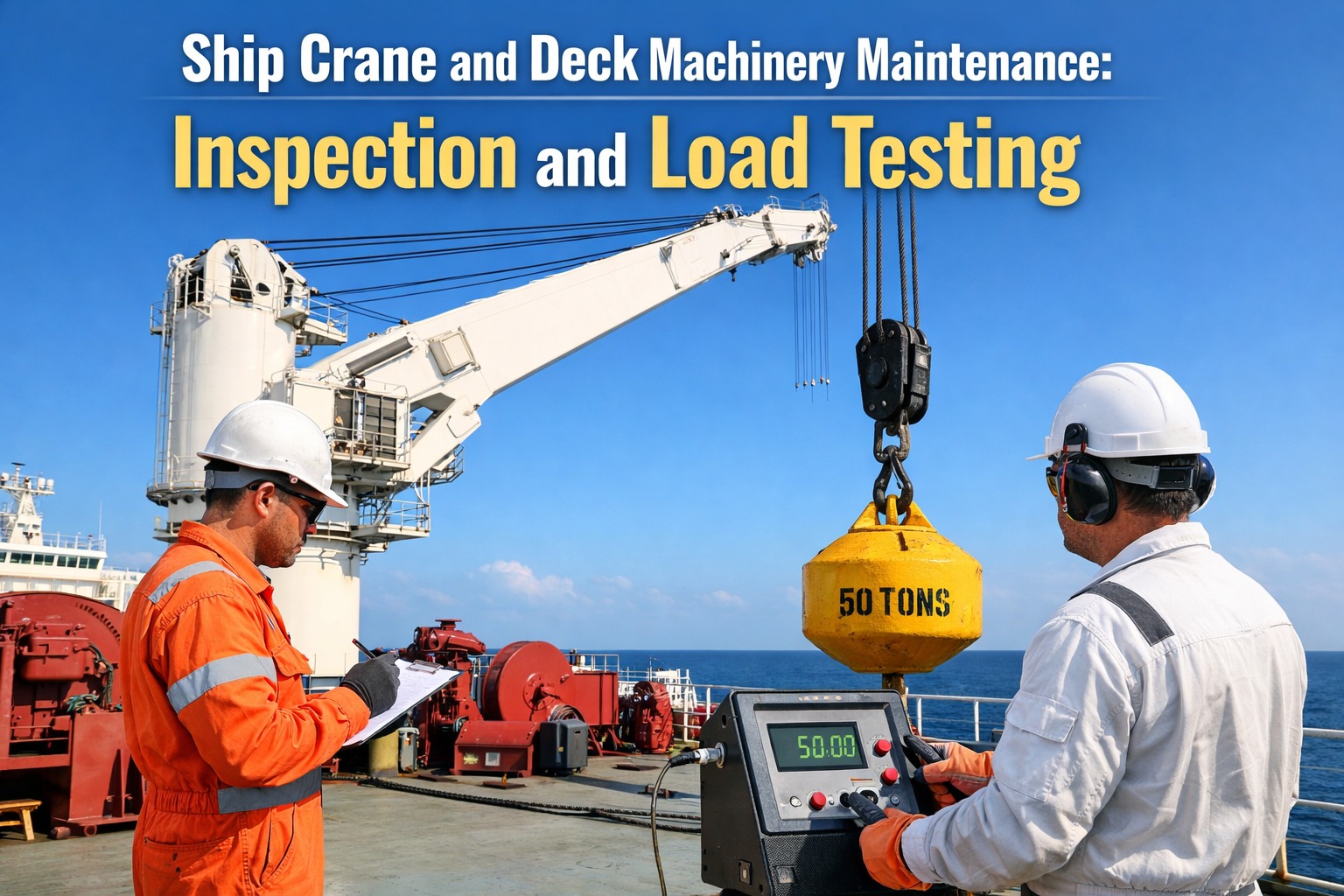
Ship Crane and Deck Machinery Maintenance: Inspection and Load Testing
Ship crane and deck machinery management has entered a fundamentally new regulatory era. SOLAS Regulation II-1/3-13, introduced via IMO Resolution MSC.532(107) and effective January 1, 2026, imposes comprehensive mandatory safety requirements on onboard lifting appliances and anchor handling winches — covering design, construction, installation, load testing, thorough examination, marking, documentation, and maintenance for cargo cranes, engine-room cranes, stores cranes, hose handling cranes, hatch cover systems, launch and recovery systems, and personnel handling cranes. The regulation expands scope far beyond the previous ILO Convention 152 (limited to cargo handling gear) and closes decades of regulatory gaps that contributed to preventable lifting accidents. For deck officers and superintendents, the operational implications are immediate and consequential: existing lifting appliances must be tested, thoroughly examined, permanently marked with SWL, and documented in a Register of Ship's Lifting Appliances and Cargo Handling Gear no later than the first renewal survey on or after January 1, 2026 — and compliance is verified against MSC.1/Circ.1663 Guidelines for Lifting Appliances. Beyond regulatory compliance, deck machinery reliability affects cargo operations commercial performance, crew safety, and vessel uptime: a failed cargo crane mid-voyage can delay cargo operations by days, a wire rope failure can kill, a slewing bearing failure can immobilise a crane requiring dry dock repair. To see how Marine Inspection digitalises the complete lifting appliance register, load test records, wire rope inspection logs, and SOLAS 2026 compliance documentation, book a Marine Inspection demo.
SOLAS II-1/3-13 — Effective January 1, 2026
New Appliances
Full compliance from Jan 1, 2026 — design approval + certification + load test before first use
Existing Appliances
Comply by first renewal survey on or after Jan 1, 2026 — load test, exam, SWL marking, documentation
Load Test Interval
Every 5 years — plus annual thorough examination
SWL <1,000 kg
Flag administration determines applicability — confirm with flag state
What Equipment is Covered Under SOLAS II-1/3-13
The new regulation dramatically expands the scope of equipment covered beyond what most operators previously tracked under ILO Convention 152. Provision cranes, engine-room cranes, stores cranes, and hose handling cranes that historically weren't in cargo gear books now require formal certification, periodic load testing, and documented thorough examination. Marine Inspection helps operators catalogue their complete lifting appliance inventory against the new regulatory scope — book a demo to see how.
Cargo Cranes
Deck cranes, pedestal cranes, gantry cranes for cargo loading/discharge
Engine Room Cranes
For machinery maintenance and component handling — now in scope
Stores/Provision Cranes
For supplies handling — previously outside ILO 152 scope
Hose Handling Cranes
For fuel, water, and fluid transfer operations
Hatch Cover Systems
Hold hatch cover and movable bulkhead raising/lowering systems
Launch & Recovery Systems
Tender boats and similar applications (excluding LSA davits)
Personnel Handling Cranes
Crew transfer and emergency operations
Loose Gear
Wires, shackles, hooks, blocks associated with lifting appliances
Testing and Examination Requirements Under MSC.1/Circ.1663
The Guidelines for Lifting Appliances (MSC.1/Circ.1663) define specific testing, examination, and inspection requirements that supplement the SOLAS regulation. These define what "compliance" means in practical operational terms.
Lifting Appliance Test & Examination Requirements
Test/Exam Type
Frequency
Performed By
Documentation
Initial Load Test
Before first use; after major repairs
Classification society or approved competent person
Certificate of Test and Thorough Examination (Appendix 1 format)
Quinquennial Load Test
Every 5 years
Competent person approved by Administration or RO
Certificate filed in Register of Lifting Appliances
Thorough Examination
Annually
Competent person approved by Administration or RO
Examination certificate, findings recorded
Routine Inspection
As per PMS (typically quarterly/monthly)
Ship's qualified personnel
Entry in PMS and onboard inspection records
Pre-Use Inspection
Before each lifting operation
Operator / duty officer
Operational log entry
After Repair/Modification
After any significant repair
Competent person + load test if structural
New certificate issued
Loose Gear Proof Test
Before first use; after repair
Manufacturer or competent person
Documentary evidence with serial number
Wire Rope Inspection
Monthly visual; detailed per ISO 4309
Ship's qualified personnel
Wire rope log with install date, inspection notes, discard decisions
Test load values per Table 1 of MSC.1/Circ.1663 paragraph 3.2.1.5 — typically 1.25× SWL for SWL ≤ 20 tonnes; SWL + 5 tonnes for SWL 20-50 tonnes; 1.1× SWL for SWL > 50 tonnes.
Wire Rope: The Most Failure-Prone Component
Wire ropes are the single most failure-prone component of any lifting appliance — and wire rope failures are among the most dangerous because they release stored elastic energy that can kill. ISO 4309 provides the international standard for wire rope inspection, discard criteria, and documentation. Aligning rope logs to ISO 4309 turns subjective condition judgements into defensible decisions — critical for defending remaining life claims during audits.
1
Broken Wires
Count visible broken wires over specified rope length. Different discard thresholds for rotation-resistant vs standard ropes. Distribution matters — clustered breaks indicate local damage.
2
Diameter Reduction
Measure rope diameter at multiple points. Reduction beyond specified percentage (typically 7-10%) of nominal diameter triggers discard.
3
Corrosion
External and internal corrosion assessed. Pitting, rust streaks between wires, loss of lubricant indicate advanced corrosion requiring discard.
Discoloration, loss of lubricant, change in rope feel indicate heat exposure. Heat alters metallurgical properties — discard required.
6
Wear & Lubrication
External wear from contact with sheaves. Loss of lubricant reduces fatigue life. Lubrication schedule per manufacturer; check lubricant penetration to core.
See SOLAS 2026 Compliance Management in Action
Book a personalised Marine Inspection demo. In 30 minutes, our team will walk you through how the platform digitalises your Register of Ship's Lifting Appliances, automates annual examination scheduling, tracks wire rope inspections against ISO 4309, and produces the complete documentation trail SOLAS II-1/3-13 verifications demand.
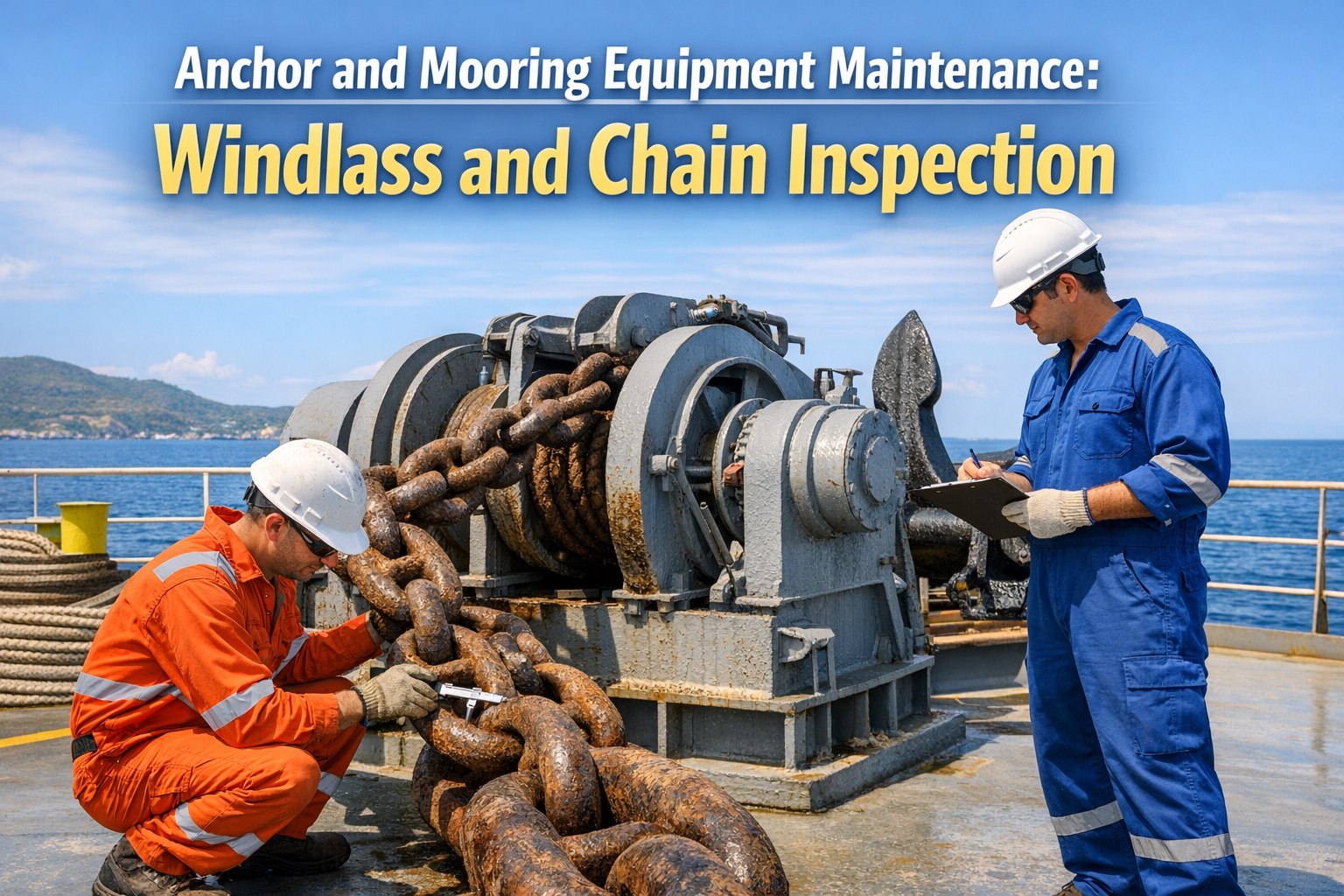
While cranes get most of the regulatory attention, deck machinery includes other critical equipment — windlasses (anchor handling), mooring winches (berthing operations), hatch cover systems (cargo access), and anchor handling winches (offshore vessel specific requirements under MSC.1/Circ.1662). Each has specific failure modes and maintenance disciplines.
Windlass (Anchor Handling)
Function: Raises and lowers anchor and chain cable. Critical for safe anchoring and emergency departure from anchorage.
Key Maintenance: Chain wheel wear, brake band condition, gearbox oil level and condition, hydraulic/electric drive inspection, cable lifter wear rate. Emergency release mechanism function test per SOLAS.
Critical Test: Emergency release must function under dead-ship conditions per SOLAS II-1/3-13 — required test.
Mooring Winches
Function: Haul in and pay out mooring lines during berthing/unberthing. Continuous duty in port; weather-exposed.
Key Maintenance: Drum condition, brake system (brake holding load minimum 80% of rope breaking strength for split-drum winches), hydraulic motor service, warping head wear, control system function.
Critical Test: Brake holding test verifies brake capacity. Mooring lines (synthetic or wire) inspected and logged per OCIMF MEG4 guidance.
Hatch Cover Systems
Function: Weathertight closure of cargo holds. Hydraulic, rolling, folding, pontoon, or lifting types on different vessel types.
Key Maintenance: Rubber seal condition (critical for weathertight integrity), steel-to-steel contact, drainage channels clear, securing mechanisms function, compression bar straightness.
Critical Test: Ultrasonic weathertightness test (preferred) or chalk test. Hose test during SOLAS survey. Now under SOLAS II-1/3-13 if lifted with cargo.
Anchor Handling Winches (OSV)
Function: Specific to offshore support vessels handling rig anchors, mooring lines, and subsea installations. Not vessel's own anchoring system.
Key Maintenance: Under separate SOLAS requirements (Guidelines MSC.1/Circ.1662). Includes wire rope tension monitoring, load indicators, emergency release systems.
How Marine Inspection Digitalises SOLAS 2026 Compliance
The SOLAS II-1/3-13 regulation generates substantial documentation across multiple compliance dimensions — Register of Ship's Lifting Appliances, Certificates of Test and Thorough Examination in Appendix 1 format, loose gear proof test records, wire rope logs aligned to ISO 4309, maintenance records aligned to manufacturer manuals, and personnel training/authorization records. Paper-based systems are structurally unequal to this volume of documentation. Here's specifically how Marine Inspection addresses SOLAS 2026 compliance:
Digital Register of Lifting Appliances
Complete inventory of every lifting appliance on vessel with type, location, SWL, serial numbers, certificates, and examination history — fully compliant with MSC.1/Circ.1663 register format requirements.
Automated Test & Exam Scheduling
Quinquennial load tests and annual thorough examinations scheduled automatically. Alerts to superintendent and master before due dates. Survey coordination with classification society.
ISO 4309 Wire Rope Logs
Wire rope inspection records aligned to ISO 4309 — install dates, inspection notes, measured degradation (broken wires, diameter reduction, corrosion), discard decisions with supporting evidence.
Certificate Management
All test certificates, thorough examination reports, loose gear proof tests stored digitally with instant retrieval. Never scramble for paperwork during surveys or port inspections.
SWL Marking Compliance
Track SWL marking status for every appliance and loose gear item. Photo evidence of permanent markings. Identification of unmarked equipment requiring marking before first renewal survey.
Crew Training & Authorization
Personnel training records, equipment-specific familiarization, master authorization for operators. Supports ISM Code alignment required by MSC.1/Circ.1663.
Preventive Maintenance Schedule
Systematic PM intervals for crane and deck machinery combine regulatory requirements with manufacturer specifications. The following schedule captures industry standard practice.
Daily (Before Use)
Visual inspection of wire rope, sheaves, hooks, safety latches. Test all limit switches and emergency stops. Verify hydraulic oil level. Check for leaks. Confirm SWL marking visible and legible. Operator pre-use checklist completion.
Weekly
Lubricate sheaves, pins, and grease points per manufacturer. Wire rope lubrication if fitted with pressurised lubricator. Inspect structural areas for cracks, deformation, corrosion. Test slewing brakes and luffing brakes.
Monthly
Detailed wire rope inspection per ISO 4309 — count broken wires, measure diameter, assess corrosion and lubrication. Hydraulic system pressure verification. Filter differential pressure check. Slewing bearing grease sampling on larger cranes.
Quarterly
Hydraulic oil sampling (TAN, moisture, contamination). Structural NDT on known hot spots. Torque check on critical bolts (slewing bearing, pedestal, king-post). Brake lining thickness measurement. Control system function verification.
Annually
Thorough examination by competent person (SOLAS requirement from 2026). Hydraulic oil change. Seal renewal in high-wear areas. Coating touch-up on corroded areas. Full electrical system insulation testing. Slewing bearing inspection and re-greasing.
Every 5 Years
Quinquennial load test per MSC.1/Circ.1663 Table 1 values. Comprehensive thorough examination. Major component overhauls — cylinders, slewing bearing, main winch drum. Wire rope replacement if due. Re-certification.
Dry Dock
Structural inspection of boom, pedestal, foundations. Coating repair. Seal renewal where not in service. Hydraulic component overhaul. Slewing bearing dismantle and measurement. Kingpost inspection. Electrical system renewal as needed.
Preparing for the First Renewal Survey After January 1, 2026
For existing vessels, the first Cargo Ship Safety Construction Renewal Survey or Passenger Ship Safety Survey after January 1, 2026 is the critical compliance milestone. Surveyors will verify specific items — knowing what they'll check lets you prepare systematically.
✓
All applicable lifting appliances certified according to an acceptable standard (LR CLAME, IACS member code, ILO 152, or flag-recognised international standard)
✓
All lifting appliances properly marked with SWL and essential safe operation information (e.g. maximum/minimum slewing radius, boom angle)
✓
All loose gear clearly and permanently marked with unique identification (serial number), SWL, and any additional marks required for safe use
✓
All lifting appliances load tested and thoroughly examined by a competent person — with certificates in Appendix 1 format of MSC.1/Circ.1663
✓
All lifting appliances provided with operation and maintenance manual — where missing, IMO guidelines provide reconstruction methods
✓
All personnel operating lifting appliances are trained, qualified and authorised by the master — records available for verification
✓
Maintenance, operation, inspection, and test regime established and integrated into the vessel's PMS and SMS
✓
Register of Ship's Lifting Appliances maintained onboard in MSC.1/Circ.1663 format with current certificates attached
Expert Review: What SOLAS 2026 Really Changes
Industry Analysis
The SOLAS II-1/3-13 regulation is the most significant update to shipboard lifting appliance safety in decades. It replaces a patchwork of voluntary class rules, flag-specific requirements, and ILO Convention 152 (limited to cargo handling gear) with unified IMO-mandated requirements covering all lifting appliances on SOLAS vessels. The practical operational impact is substantial: engine-room cranes, stores cranes, and hose handling cranes that many operators treated as "just equipment" now require the same formal certification, testing, and documentation discipline as cargo cranes.
For owners and operators, the key question is not whether to comply — non-compliance at the first renewal survey triggers detention risk — but how to comply efficiently. The operators building digital compliance infrastructure now, ahead of their first post-2026 renewal survey, will have significantly easier compliance journeys than those scrambling to reconstruct certificates, rebuild registers, and document examinations at the last moment. The equipment inventory work alone — identifying all lifting appliances, verifying SWL markings, locating existing certificates, and preparing items requiring load test — can take 6-12 months for large fleets.
Beyond compliance, the regulation drives a broader shift in how deck machinery is managed: from reactive repair to proactive maintenance, from scattered paperwork to systematic digital records, from individual vessel practice to fleet-wide standard procedures. Book a Marine Inspection demo to see how the platform supports both immediate SOLAS 2026 compliance and the broader operational benefits of systematic deck machinery management.
Conclusion
Ship crane and deck machinery management has entered a new regulatory era with SOLAS II-1/3-13 effective January 1, 2026 — expanding coverage from cargo handling gear to all lifting appliances (cargo cranes, engine-room cranes, stores cranes, hose handling cranes, hatch cover systems, launch and recovery systems, personnel handling cranes, and associated loose gear), imposing quinquennial load tests and annual thorough examinations, and requiring permanent SWL marking plus documented Registers of Ship's Lifting Appliances. Wire rope management aligned to ISO 4309, hydraulic system discipline, structural NDT on known hot spots, and systematic preventive maintenance combine to keep deck machinery reliable across decades of service. Deck machinery beyond cranes — windlass, mooring winches, hatch covers, anchor handling winches — follows similar principles with equipment-specific failure modes and regulatory requirements. The operators who meet SOLAS 2026 efficiently are those who digitalise their compliance infrastructure now rather than scrambling at the last minute. To see how Marine Inspection provides the complete digital platform for ship crane and deck machinery management — from Register of Lifting Appliances to wire rope logs, automated examination scheduling to survey-ready documentation — book a live demo today.
Frequently Asked Questions
What is SOLAS II-1/3-13 and when does it take effect?
SOLAS Regulation II-1/3-13, introduced via IMO Resolution MSC.532(107), establishes mandatory safety requirements for onboard lifting appliances and anchor handling winches on SOLAS-certified vessels. It takes effect January 1, 2026. The regulation covers design, construction, installation, operation, inspection, testing, maintenance, certification, and documentation. New lifting appliances must fully comply from January 1, 2026 — including design approval, certification, and load testing before first use. Existing lifting appliances must comply by the first renewal survey on or after January 1, 2026 — requiring load testing, thorough examination, permanent SWL marking, and documented registration. Supporting guidelines are provided in MSC.1/Circ.1663.
How often must ship cranes be load tested?
Under SOLAS II-1/3-13 and MSC.1/Circ.1663, lifting appliances require: (1) Initial load test before first use. (2) Quinquennial load test (every 5 years). (3) Load test after any major repair or modification that affects structural integrity. (4) Annual thorough examination by a competent person (not a load test, but comprehensive inspection). Test load values per Table 1 of MSC.1/Circ.1663 paragraph 3.2.1.5: typically 1.25× SWL for SWL ≤ 20 tonnes; SWL + 5 tonnes for 20-50 tonnes; 1.1× SWL for SWL > 50 tonnes. Certificates in Appendix 1 format must be maintained in the Register of Ship's Lifting Appliances and Cargo Handling Gear.
What equipment is covered by SOLAS II-1/3-13?
The regulation covers all permanently installed lifting appliances on SOLAS vessels including: cargo cranes (deck, pedestal, gantry), engine-room cranes for machinery maintenance, stores/provision cranes for supplies handling, hose handling cranes for fluid transfer, hatch cover systems (hold hatch covers and movable bulkheads), launch and recovery systems for tender boats, personnel handling cranes for crew transfer, and associated loose gear (wires, shackles, hooks, blocks). Anchor handling winches on offshore support vessels are covered under separate MSC.1/Circ.1662 guidelines. Exclusions: lifeboat davits, liferaft and rescue boat launching appliances (unless dual-purpose), and lifting appliances on MODUs. Flag administrations determine applicability for equipment with SWL below 1,000 kg.
What wire rope inspection criteria apply to ship cranes?
ISO 4309 provides the international standard for wire rope inspection, discard criteria, and documentation of remaining life. Key discard criteria: (1) Broken wires exceeding specified number per rope lay length — different thresholds for rotation-resistant vs standard ropes. (2) Diameter reduction beyond 7-10% of nominal diameter. (3) External or internal corrosion with pitting, rust streaks, loss of lubricant. (4) Deformation such as kinks, bird-cages, core protrusion, or shock damage. (5) Heat damage indicated by discoloration or altered metallurgy. (6) Excessive external wear from sheave contact. Aligning rope logs to ISO 4309 with install dates, inspection notes, measured degradation, and discard decisions turns subjective judgements into defensible decisions for audits.
Who is a "competent person" for lifting appliance examination?
Under MSC.1/Circ.1663, a competent person for thorough examination and load testing of lifting appliances must be: approved by the flag state Administration or by a Recognised Organisation (classification society) accepted by the Administration. In practice, this typically means: (1) A surveyor from a classification society (IACS member) holding appropriate competence. (2) An independent qualified competent person accredited under the flag state's system. (3) A manufacturer's authorized technician for specific equipment types. Ship's qualified personnel conduct routine inspections under the PMS but cannot perform formal thorough examinations or sign certificates. The distinction matters: routine PMS inspections complement but do not replace competent person examinations required for certification.
Prepare Your Fleet for SOLAS 2026 Compliance
Book a personalised Marine Inspection demo. In 30 minutes, see how the platform digitalises your Register of Ship's Lifting Appliances, automates load test scheduling, tracks wire rope inspections against ISO 4309, and produces the complete documentation trail your first post-2026 renewal survey demands — across your entire fleet.