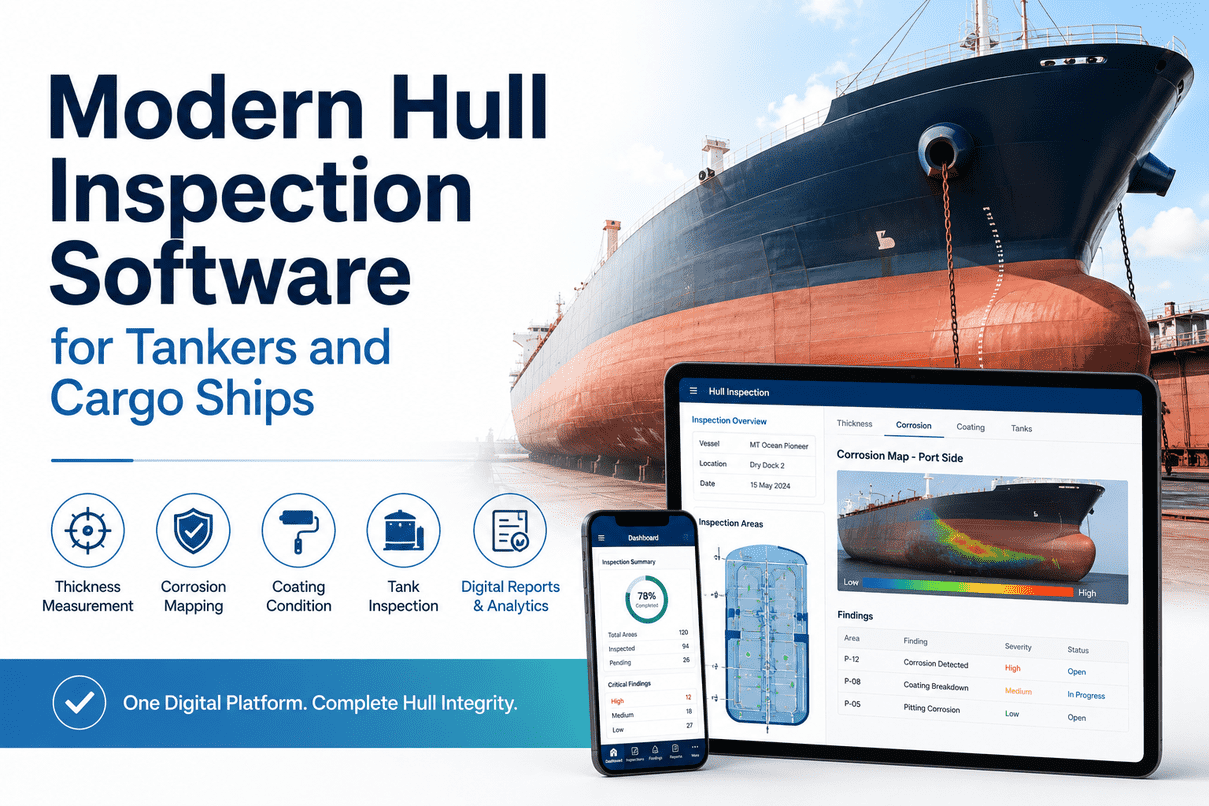
The maritime inspection landscape is undergoing its most significant technological transformation since classification societies first standardised vessel surveys in the 18th century. AI-powered corrosion detection algorithms now match human surveyor accuracy. Underwater ROVs conduct hull inspections without dry-docking. Drones equipped with SLAM technology navigate cargo tanks autonomously. IoT sensors stream real-time engine performance data to classification society offices thousands of miles from the vessel. And digital twins replicate entire vessels in virtual environments where condition monitoring happens continuously, not periodically. For fleet managers and tech officers, this is not a future scenario — DNV, Lloyd's Register, Bureau Veritas, ABS, and ClassNK are all actively deploying remote survey capabilities that are reshaping how vessels are inspected, classified, and maintained. The question is no longer whether remote inspection technology will change your operations — it is whether your digital infrastructure is ready to take advantage of it. Fleet operators building that infrastructure can start a free trial of Marine Inspection to establish the digital compliance foundation that remote survey technologies require.
AI Visual Inspection
Corrosion, crack, and coating detection comparable to human surveyors
Underwater ROVs
Hull surveys without dry-docking, up to 1,000m depth
Inspection Drones
SLAM-navigated cargo tank and structure surveys
IoT Condition Monitoring
Real-time engine, navigation, and system data to shore
Digital Twin
Virtual vessel replicas for continuous condition assessment
The Five Pillars of Remote Vessel Inspection Technology
Remote inspection technology is not a single solution — it is an ecosystem of complementary technologies that, when combined, enable vessel surveys to shift from periodic physical inspections to continuous digital monitoring. Each technology addresses a different aspect of vessel condition assessment.
What It DoesMachine learning algorithms analyse images and video from drones, ROVs, and fixed cameras to detect corrosion, cracks, coating breakdown, and structural deformation — at accuracy levels comparable to experienced human surveyors.
Who's LeadingDNV (corrosion and crack detection algorithms paired with ScoutDI drones), ABS (partnership with Google Cloud and SoftServe for coating breakdown detection), Lloyd's Register (AI assurance framework with Alan Turing Institute), China Classification Society (hull thickness measurement systems).
Operator ImpactConsistent defect detection regardless of surveyor experience level. Photographs from identical positions and lighting enable trend analysis over time. Supports predictive maintenance — identifying developing conditions before they become deficiencies.
What It DoesRemotely Operated Vehicles conduct underwater hull surveys, propeller inspections, and sea chest examinations without dry-docking. Advanced ROVs carry 4K cameras, ultrasonic thickness measurement probes, cathodic protection sensors, and cavitation cleaning systems.
Who's LeadingIACS UR Z17 governs ROV use for in-water surveys. Lloyd's Register pioneering ROV in-water surveys. DroneQ Robotics deploying Class I and Class II ROV systems rated to 350m and 1,000m depths with imaging sonar and side-scan capability.
Operator ImpactEliminates dry-dock scheduling for intermediate hull surveys. Reduces vessel downtime from days to hours. In-water surveys can be conducted at berth during cargo operations. Real-time video feed to classification society surveyors enables remote witnessing.
What It DoesUnmanned Aerial Vehicles equipped with SLAM (Simultaneous Localisation and Mapping) technology navigate enclosed spaces — cargo tanks, ballast tanks, void spaces — autonomously. They capture high-resolution imagery for AI analysis and 3D reconstruction of inspection surfaces.
Who's LeadingScoutDI (REDHUS project with DNV, achieving centimetre accuracy in cargo tank flights). DNV (network of trained drone pilots in Piraeus, Singapore, Houston, Shanghai — first class society to offer drone-based tank surveys).
Operator ImpactEliminates confined space entry risks for surveyors and crew. Reduces tank survey time significantly. Creates digital records that enable comparison between survey cycles. IACS Recommendation 42 provides guidelines for drone use in classification surveys.
What It DoesIoT sensors installed on critical systems (engines, generators, navigation equipment, steering gear) stream real-time operational data to shore-based classification society platforms. This enables condition-based surveys where inspection scope is determined by actual equipment data rather than fixed calendar intervals.
Who's LeadingDNV (remote survey of ship engines with MAN Energy Solutions — monitoring 10 critical vessel systems continuously). Lloyd's Register (proof-of-concept with Latsco for data-driven class surveys using live vessel data, December 2025). ClassNK (ShipDC data centre collecting fleet-wide Big Data).
What It DoesDigital twin technology creates a virtual replica of the physical vessel that is continuously updated with real-time sensor data, inspection imagery, and maintenance records. Bureau Veritas's 3D Classification uses digital models to support design review, construction monitoring, and in-service surveys.
Who's LeadingBureau Veritas (Digital Classification services including 3D Classification and Remote & Augmented Surveys). DNV (Veracity platform for Big Data integration). ClassNK (ShipDC data centre). Lloyd's Register (Connected Assets Big Data Platform).
Operator ImpactEnables fleet-wide condition monitoring from a single dashboard. Supports predictive maintenance by correlating sensor data with historical failure patterns. Provides classification societies with continuous access to vessel condition data — reducing survey scope and duration.
Build Your Digital Inspection Foundation Today
Remote inspection technologies require a digital compliance infrastructure — maintenance records, inspection evidence, corrective actions, and crew documentation managed digitally. Marine Inspection provides that foundation, positioning your fleet for the technologies that are already transforming maritime surveys.
The Regulatory Framework: IACS, IMO, and Remote Survey Acceptance
Remote inspection technology is not operating in a regulatory vacuum. IACS Unified Requirement Z17 governs the use of Remote Inspection Techniques for surveys, and its procedural requirements have undergone fourteen revisions. IACS Recommendation 42 provides guidelines for drone, ROV, and crawler use in classification surveys. The IMO's Sub-Committee on Ship Design and Construction (SDC) has received proposals on RIT use during Enhanced Survey Programme Surveys — though current requirements still mandate surveyor presence on board. DNV's AROS (Autonomous and Remotely Operated Ships) class notations, launched January 2025, provide the first classification framework for fully autonomous and remotely controlled vessels. Sign up for Marine Inspection to stay aligned with evolving regulatory requirements for digital survey compliance.
Expert Review: The Transition from Periodic to Continuous
The convergence of AI, IoT, robotics, and digital twin technology is not merely adding new tools to the surveyor's toolkit — it is fundamentally redefining the concept of a vessel survey. The traditional model — a surveyor boards the vessel, spends several days conducting physical inspections, and produces a snapshot-in-time report — is giving way to a model where vessel condition is monitored continuously, anomalies are detected by algorithms in real time, and physical inspections are targeted to areas where data indicates developing concerns rather than conducted on a fixed calendar schedule.
DNV's collaboration with MAN Energy Solutions for remote engine surveys, Lloyd's Register's proof-of-concept with Latsco for data-driven class surveys, and Bureau Veritas's 3D Classification services all point in the same direction: the classification society of the future monitors vessel condition through digital data streams and deploys physical surveyors only when the data warrants it. For fleet managers and tech officers, the implication is clear: the vessels that benefit first from reduced survey scope, shorter dry-dock periods, and condition-based maintenance scheduling will be those with the digital infrastructure to share verifiable operational data with their classification society.
That digital infrastructure starts with systematic digital records — maintenance completion evidence, inspection photographs, corrective action trails, and equipment condition logs — managed in a platform that produces the data quality remote surveys require. Marine Inspection provides that foundation. Schedule a walkthrough to see how Marine Inspection positions your fleet for the remote survey era.
Conclusion
Remote vessel inspection technology is not a future promise — it is a present reality that DNV, Lloyd's Register, Bureau Veritas, ABS, and ClassNK are actively deploying across the global fleet. AI-powered visual analysis detects corrosion and cracks at human-surveyor accuracy. ROVs eliminate dry-dock requirements for intermediate hull surveys. Drones navigate cargo tanks autonomously using SLAM technology. IoT sensors enable condition-based surveys determined by actual equipment data. And digital twins provide classification societies with continuous vessel condition visibility. The regulatory framework is evolving — IACS UR Z17, Recommendation 42, and DNV's AROS notations are establishing the standards — but the operational requirement is already clear: vessels with digital compliance infrastructure benefit first from reduced survey scope, shorter downtime, and predictive maintenance. Marine Inspection provides the digital foundation that remote inspection technologies require — sign up today to build your fleet's digital inspection readiness.
Frequently Asked Questions
What remote inspection technologies are classification societies currently using?
Major classification societies are deploying multiple remote inspection technologies. DNV uses AI-powered corrosion and crack detection algorithms, drone-based tank surveys (with trained pilots in Piraeus, Singapore, Houston, Shanghai), and remote engine survey capabilities developed with MAN Energy Solutions. Lloyd's Register has completed a proof-of-concept for data-driven class surveys using live vessel data and is developing AI assurance frameworks with the Alan Turing Institute. Bureau Veritas offers Digital Classification including 3D Classification and Remote & Augmented Surveys. ABS has partnered with Google Cloud for AI corrosion detection. ClassNK operates the ShipDC data centre for fleet-wide Big Data collection.
Can drones and ROVs replace physical surveyor inspections?
Currently, drones and ROVs supplement rather than fully replace physical surveyor presence. IACS UR Z17 and Recommendation 42 provide guidelines for using Remote Inspection Techniques in classification surveys, but current IMO proposals still require surveyor presence on board. However, the scope of what ROVs and drones can cover is expanding rapidly — DNV was the first class society to offer credited drone-based tank surveys, and ROV in-water hull surveys are now accepted as alternatives to dry-dock intermediate surveys by most major classification societies.
How does IoT sensor monitoring change the survey process?
IoT sensors on critical systems (engines, generators, navigation, steering) stream real-time data to classification society platforms, enabling condition-based surveys where inspection scope is determined by actual equipment performance data rather than fixed calendar intervals. DNV's collaboration with MAN Energy Solutions demonstrates this — continuous engine monitoring means inspectors focus on areas where data indicates developing concerns. This reduces vessel downtime from multi-day shipyard inspections to targeted interventions, while potentially providing safer and more transparent survey outcomes.
What digital infrastructure do fleet operators need to prepare?
Remote inspection technologies require a digital compliance foundation: systematic digital maintenance records with task completion evidence, inspection photographs linked to equipment and location, corrective action workflows with documented close-outs, crew training and competency records, and certificate expiry tracking. This data must be of sufficient quality and accessibility for classification societies to use in their remote survey platforms. The RightShip Document Management Centre, for example, requires 86 documents per inspection — 63 of which can be pre-uploaded digitally. Building this digital infrastructure now positions fleets to benefit from reduced survey scope and condition-based maintenance as remote technologies scale.
What is DNV's AROS classification notation?
AROS (Autonomous and Remotely Operated Ships) is DNV's class notation family launched in January 2025 for autonomous and remotely controlled vessels. It covers four functions: navigation, engineering, operational, and safety — with categories for remote control, decision support, supervised autonomy, and full autonomy. Control can be onboard, off-ship, or hybrid. AROS notations are aligned with the IMO's developing MASS (Maritime Autonomous Surface Ships) code. Ocean Infinity's Armada 78 fleet was the first to receive a Statement of Compliance under the framework.
Position Your Fleet for the Remote Survey Era
The vessels that benefit first from AI-powered inspections, IoT condition monitoring, and reduced survey scope are those with digital compliance infrastructure already in place. Marine Inspection provides that foundation — start building it today.