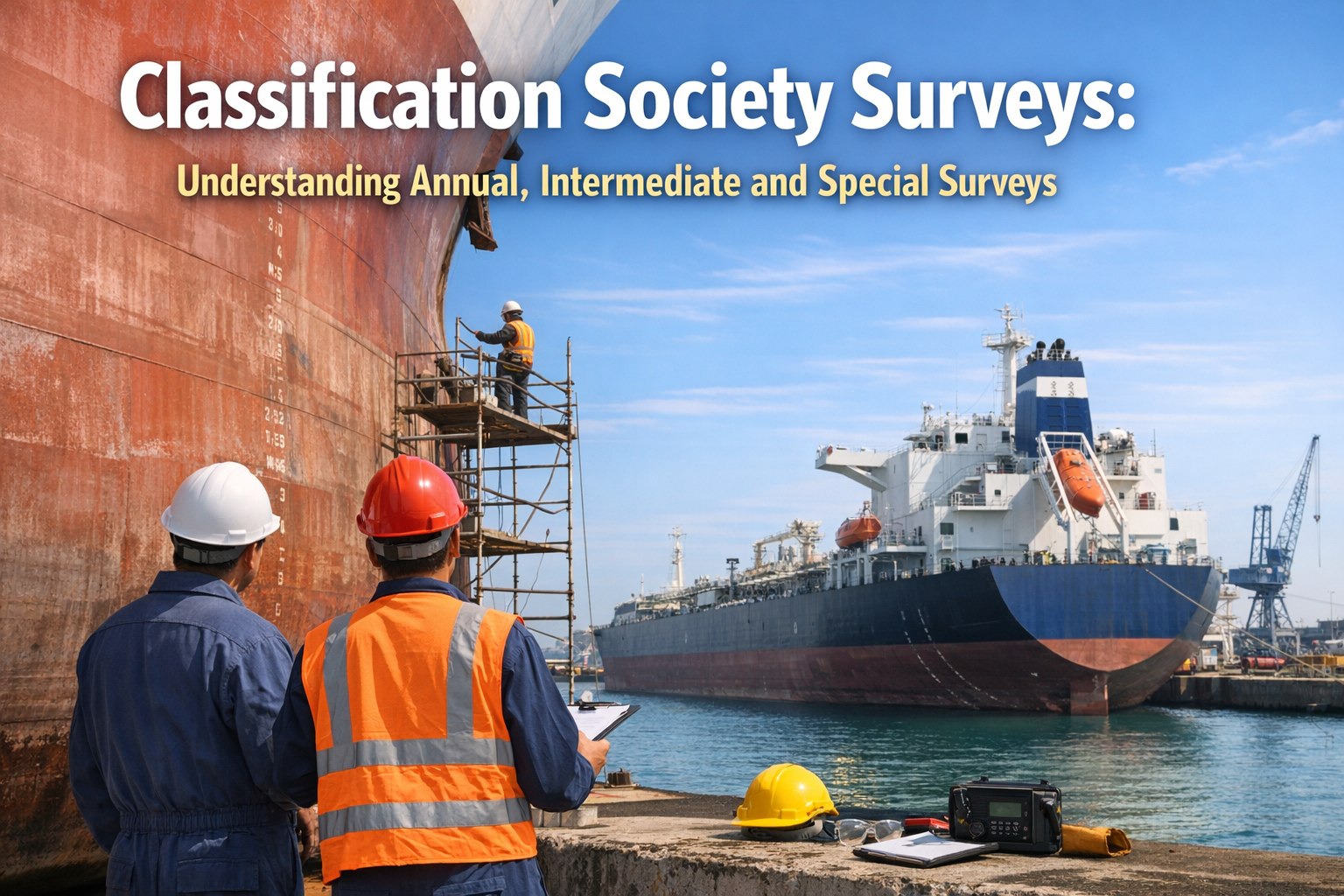
Classification society surveys are the backbone of maritime safety — the periodic verification process that confirms a vessel's hull structure, machinery, safety equipment, and systems comply with the classification rules that underpin insurance, registration, and commercial trading. More than 90% of the world's cargo-carrying tonnage is covered by the 12 member societies of the International Association of Classification Societies, and the survey outcomes they produce are not just regulatory checkboxes — they determine whether your vessel can trade, whether your insurance remains valid, and whether port state control officers have grounds for closer scrutiny. The survey cycle runs on a five-year class period, punctuated by annual surveys, an intermediate survey, a special (class renewal) survey, and docking surveys — each with different scope, timing windows, and consequences for missing deadlines. Superintendents and ship owners who understand how these surveys interact, what each one requires, and how to prepare systematically avoid the costly disruptions that come from expired class certificates, conditions of class, and unplanned dry-dockings. Fleet operators building survey readiness can start a free trial of Marine Inspection to centralise survey scheduling, condition tracking, and maintenance evidence across their entire fleet.
The Five-Year Classification Survey Cycle
Every classed vessel operates within a five-year class period that begins when classification is first assigned (for new builds) or when the special survey is completed (for existing vessels). Within this five-year cycle, multiple surveys are required at specific intervals — each verifying different aspects of the vessel's condition and compliance. Missing a survey window or allowing conditions of class to accumulate triggers consequences that range from insurance coverage gaps to class suspension. Operators who book a Marine Inspection demo can see how the platform tracks every survey date, window, and preparation requirement across the fleet.
| Survey Type | Timing | Window | Scope | Key Items Covered | Consequence of Missing |
|---|---|---|---|---|---|
| Annual Survey | Yearly (each anniversary) | ±3 months from anniversary date | General external examination | Hull condition, loadline items, safety equipment, navigation systems, fire safety, emergency systems | Class suspended; vessel cannot trade |
| Intermediate Survey | 2nd or 3rd anniversary | May coincide with annual survey window | More detailed than annual; varies by vessel age | Hull structural checks, tank condition (tankers), machinery examination, enhanced scope for 10+ year vessels | Class suspended; condition of class issued |
| Special Survey (Class Renewal) | Every 5 years | Complete before class period expires | Most comprehensive survey; equivalent to re-classification | Complete hull thickness measurement, tank examination, machinery overhaul verification, all safety systems, structural integrity | Class expires; vessel cannot trade or insure |
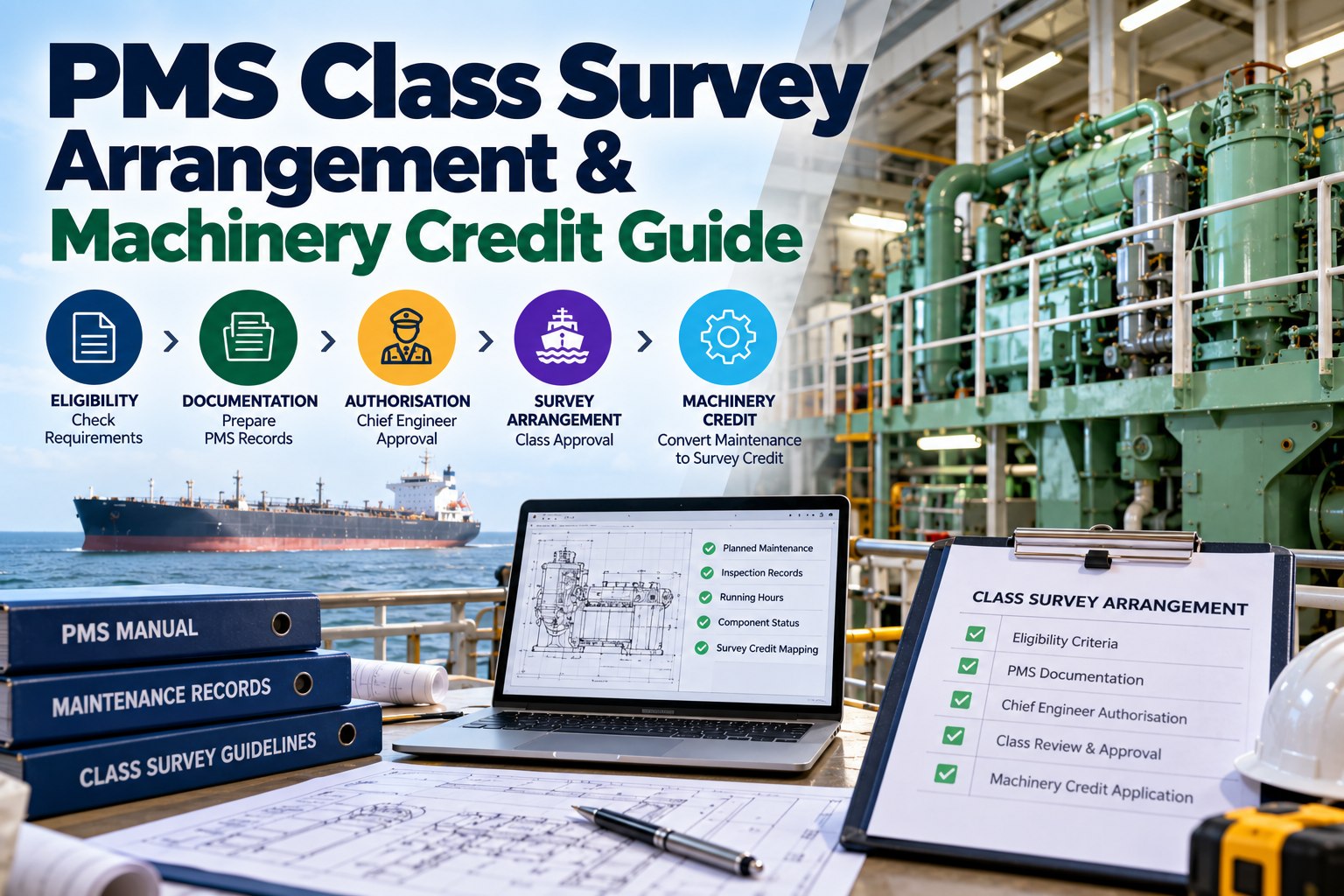
| Docking Survey | Every 2.5 years (typical) | Max 36 months between dockings for most vessels | Underwater hull and external fittings | Hull plating, rudder, propeller, sea chests, anodes, antifouling, stern tube seals, through-hull fittings | Class suspended; in-water survey may substitute if approved |
| Bottom Survey (In-Water) | Alternative to dry-docking | Must be approved by class society | ROV or diver examination of underwater hull | Hull condition, propeller, rudder, sea valves, cathodic protection — without dry-dock facility | N/A — optional alternative |
| Continuous Survey (Hull) | Spread over 5-year cycle | Portions completed at each annual survey | Alternative to single special survey | Hull compartments surveyed in rotation — 1/5 per year — avoiding single large survey | Requires class approval; missing rotation items triggers conditions |
| Continuous Survey (Machinery) | Spread over 5-year cycle | Portions completed at each annual survey | Alternative to single machinery special survey | Machinery components opened and inspected in rotation — spreading maintenance across the class period | Requires class approval; missing items triggers conditions |
| Boiler Survey | As per class rules | Typically annual or biennial | Internal and external examination of boilers | Boiler shell, tubes, mountings, safety valves, pressure testing, refractory condition | Condition of class; may restrict vessel operations |
| Tailshaft Survey | Every 5 years (or per CMS) | May be extended with condition monitoring | Withdrawal and examination of tailshaft | Shaft condition, bearings, seals, alignment — can be extended to 10-15 years with approved CMS | Class condition; shaft must be drawn if overdue |
The 12 IACS Member Societies
Not all classification societies are equal in global recognition. The 12 IACS members collectively class over 90% of commercial tonnage and are the only non-governmental organisations with IMO observer status that develop and apply technical rules. Your choice of classification society affects PSC inspection outcomes, flag state acceptance, insurance terms, and charterer confidence.
| Society | Abbreviation | Headquarters | Founded | Key Strength |
|---|---|---|---|---|
| DNV | DNV | Norway | 1864 | Largest class society by GT; digital survey pioneer |
| Lloyd's Register | LR | UK | 1760 | Oldest class society; AI assurance frameworks |
| Bureau Veritas | BV | France | 1828 | 3D Classification; Digital Classification services |
| American Bureau of Shipping | ABS | USA | 1862 | Strong in LNG and offshore; AI corrosion detection |
| Nippon Kaiji Kyokai | ClassNK | Japan | 1899 | Largest class society for bulkers; ShipDC data centre |
| RINA | RINA | Italy | 1861 | Strong Mediterranean and cruise presence |
| Korean Register | KR | South Korea | 1960 | Aligned with Korean shipbuilding industry |
| China Classification Society | CCS | China | 1956 | Largest domestic fleet; AI hull thickness systems |
| Indian Register of Shipping | IRS | India | 1975 | Growing presence in Indian subcontinent fleet |
| Croatian Register of Shipping | CRS | Croatia | 1858 | Specialist in Adriatic and Mediterranean |
| Polish Register of Shipping | PRS | Poland | 1936 | Baltic and Central European presence |
| Turkish Lloyd | TL | Turkey | 1962 | Turkish domestic and regional fleet |
Annual Survey: What Surveyors Examine
The annual survey is the most frequent classification survey — conducted at each anniversary of the class certificate, within a window of plus or minus three months. It is a general external examination designed to confirm that the vessel remains in a condition consistent with its class. While less comprehensive than the intermediate or special survey, annual survey findings that indicate deterioration trigger conditions of class that must be resolved before the next survey — and unresolved conditions lead to class suspension. Sign up for Marine Inspection to track annual survey preparation across every vessel.
Special Survey (Class Renewal): The Five-Year Milestone
The special survey is the most comprehensive examination a vessel undergoes — equivalent to re-classification. It must be completed before the five-year class period expires. For hull surveys, this means complete thickness measurement of shell plating, deck plating, and internal structural members. For machinery, it means verification of major overhauls including main engine, steering gear, and critical auxiliary systems. For older vessels, the scope expands significantly — enhanced survey programme requirements under SOLAS Chapter XI-1 apply to bulk carriers and tankers, demanding close-up surveys and thickness measurements in cargo and ballast tank spaces. Schedule a demo to see how Marine Inspection supports special survey planning with systematic preparation tracking.
Expert Review: Making Surveys Work for You, Not Against You
The classification survey cycle is often perceived as a cost burden — a series of mandatory interruptions that pull vessels out of service and generate repair bills. But the operators who manage surveys strategically treat them as planned maintenance milestones that reduce total lifecycle cost. The continuous survey programme — where hull compartments and machinery components are inspected in rotation across the five-year period rather than concentrated in a single special survey — is the clearest example of this approach. By spreading survey scope across annual surveys, operators avoid the commercial disruption and concentrated cost of a single extended dry-docking.
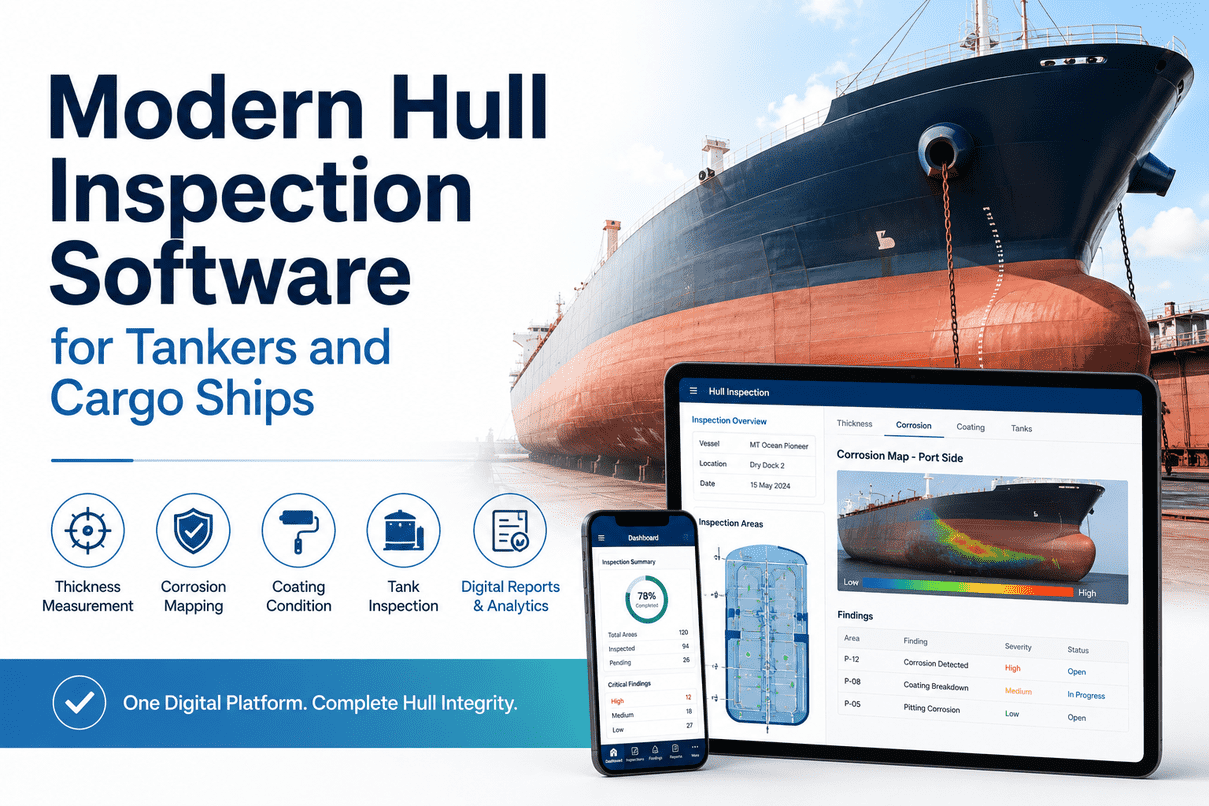
The IACS 2025 Annual Review signals the direction classification is heading: digital survey methods using 3D models for hull design review, remote survey capabilities using IoT data from critical systems, AI-powered defect detection in structural surveys, and cyber resilience requirements for new vessels. For superintendents and ship owners, this means the digital compliance infrastructure you build today — systematic maintenance records, photo evidence of equipment condition, corrective action trails, and certificate tracking — becomes the foundation for the remote and data-driven survey methods that classification societies are actively deploying.
The operators who consistently pass surveys without conditions of class are those whose daily operational systems produce survey evidence as a natural output. Maintenance completed with photographic records satisfies the surveyor's verification requirements. Corrective actions tracked and closed demonstrate that findings are managed systematically. Certificate expiry alerts prevent the compliance gaps that trigger class suspension. That is the difference between survey preparation and survey readiness. Schedule a walkthrough to see how Marine Inspection builds survey readiness into your fleet operations.
Conclusion
Classification society surveys are not optional compliance exercises — they are the foundation of your vessel's ability to trade, insure, and enter ports worldwide. The five-year class period structures a cycle of annual, intermediate, special, and docking surveys, each with specific timing windows, scope requirements, and consequences for non-compliance. With 12 IACS member societies collectively classing over 90% of global commercial tonnage and IACS publishing 78 new or revised resolutions in 2025 alone, the technical standards that surveys verify are continuously evolving. The operators who navigate this cycle efficiently are those who treat survey readiness as a continuous operational discipline — tracking dates, preparing documentation, maintaining equipment to standard, and building the digital evidence trail that surveyors verify. Marine Inspection provides the platform that connects these daily operations into one survey-ready system — sign up today to take control of your fleet's classification survey cycle.