SIRE 2.0 Inspection Guide: OCIMF Vessel Vetting for Tankers 2026
On September 2, 2024, OCIMF permanently retired VIQ7 and launched SIRE 2.0 as the tanker industry's sole commercial inspection regime. This is not an incremental update — it is a fundamental transformation of how tankers are assessed, shifting from a static questionnaire with binary Yes/No answers to a digitalized, risk-based programme where every inspection generates a bespoke Compiled Vessel Inspection Questionnaire, every response is graded on a four-tier scale, and every crew interaction is evaluated against nine Performance Influencing Factors. For tanker operators, this means the era of rehearsing answers to predictable questions is over. Every crew member aboard every tanker must now demonstrate genuine operational competence — not memorised responses — because no two CVIQs are identical and the inspector's tablet captures photographic evidence, GPS verification, and real-time observations that become part of a permanent digital record. Tanker operators preparing for SIRE 2.0 can start a free trial of Marine Inspection to build continuous inspection readiness across Hardware, Procedures, and Human Factors.
SIRE 2.0 — Live Since September 2, 2024
The Only Commercial Tanker Inspection Tool
VIQ7 permanently retired. SIRE 2.0 is now OCIMF's sole inspection programme for oil, chemical, gas, and LPG tankers worldwide.
3Dimensions per QuestionHardware, Procedures, Human Factors
9PIFs AssessedWhen crew rated "Not as Expected"
12Month Report ValidityFrom publication date on OCIMF database
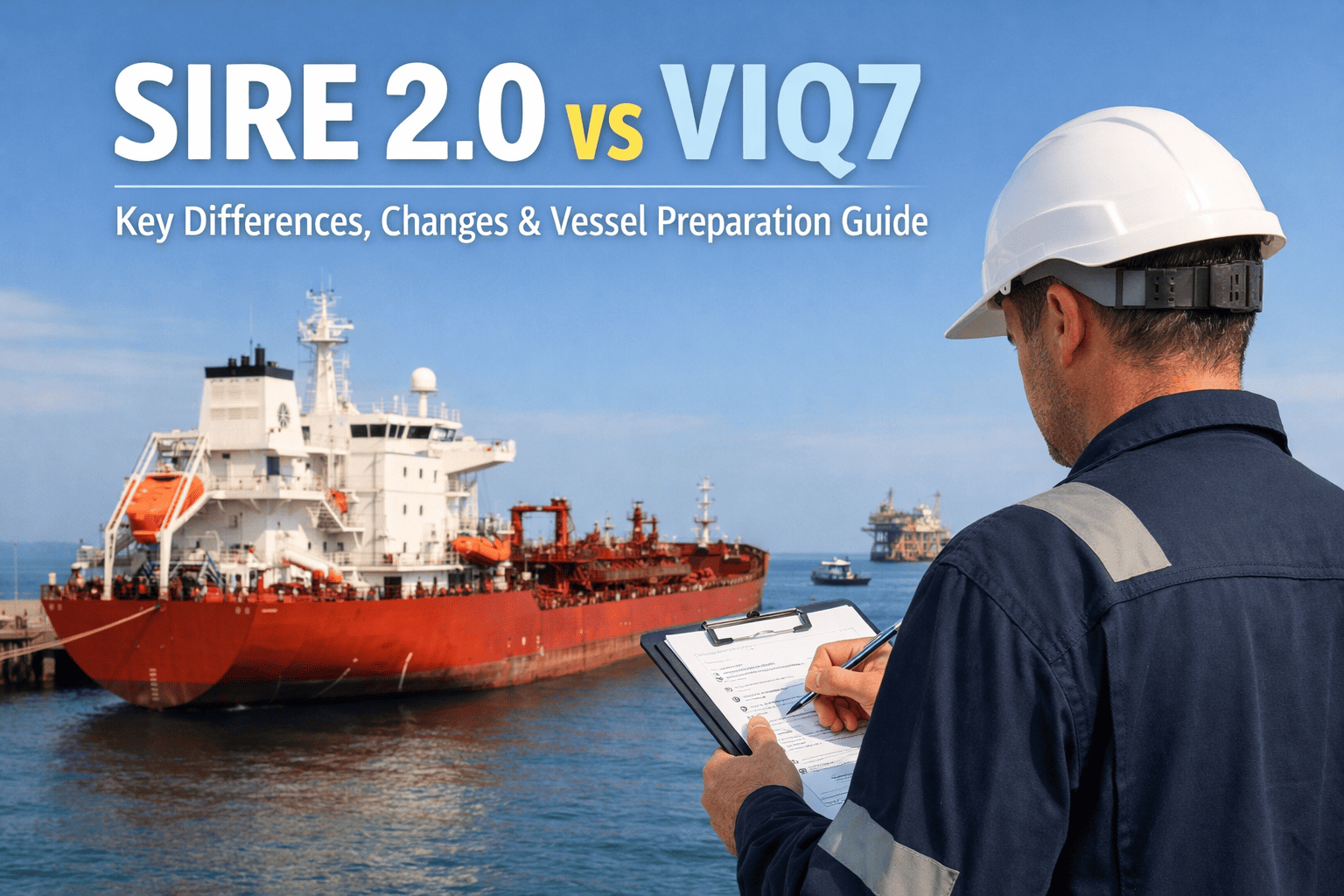
VIQ7 vs SIRE 2.0: What Changed and Why It Matters
Understanding what changed between VIQ7 and SIRE 2.0 is the starting point for every tanker operator's preparation strategy. The shift is not merely from paper to tablet — it is a fundamental change in how inspections are structured, how findings are recorded, and how crew competency is evaluated. Operators who book a Marine Inspection demo can see how the platform supports the new SIRE 2.0 operational requirements.
VIQ7 vs SIRE 2.0: Side-by-Side Comparison
Feature
VIQ7 (Retired Sep 2024)
SIRE 2.0 (Current)
Questionnaire
Fixed questionnaire — same questions every inspection
Bespoke CVIQ generated by algorithm from Question Library — no two inspections identical
Response Format
Binary Yes/No
Graded: Exceeds Expectations, As Expected, Largely as Expected, Not as Expected
Human Element
Not formally assessed
9 Performance Influencing Factors (PIFs) assessed when crew rated "Not as Expected"
Inspection Tool
Paper-based or static digital form
Web-enabled tablet with GPS verification and real-time photograph capture
Question Categories
Fixed set
Core (~50%), Rotational 1, Rotational 2, Campaign, and Conditional questions
Observation Structure
Free-text comments
Codified Subject of Concern (SOC), Nature of Concern (NOC), with mandatory photos and free text
Hardware, Procedures, and Human Factors assessed for every question
Closing Meeting Focus
KPI count of observations
Qualitative assessment — context, PIFs, and risk-based insight over simple counts
Scroll horizontally on mobile. Source: OCIMF published SIRE 2.0 guidance documents and programme introduction.
The SIRE 2.0 Inspection Lifecycle
Every SIRE 2.0 inspection follows a structured lifecycle from request to report publication. Understanding each stage allows tanker operators to build continuous readiness rather than scrambling before each inspection.
1
Inspection Request
Vessel operator initiates request through the OCIMF portal. Submitting companies cannot initiate independently. OCIMF authenticates and assigns an accredited SIRE 2.0 inspector.
2
Pre-Inspection Data Submission
Operator updates the HVPQ and PIQ. Photo Repository must be current within 6 months. Cargo type entries must be accurate — they trigger specific CVIQ questions. If STS operations are expected, select in the PIQ or STS questions will not be included.
3
CVIQ Generation
OCIMF's algorithm compiles a bespoke questionnaire from the Question Library. ~50% are Core questions (every inspection). Rotational 1 questions appear every 3rd-4th inspection. Rotational 2 appear every 6th. Campaign and Conditional questions are added based on vessel type and risk profile. The algorithm tracks question history — consecutive inspections will differ.
4
Physical Inspection (~8 Hours)
Inspector uses a web-enabled tablet to record responses with GPS verification and photographs. Each question assessed across Hardware, Procedures, and Human Factors. Crew interviews evaluate genuine operational competence. Negative observations include codified SOC, NOC, and mandatory PIF attribution.
5
Draft Report & QA Review
Submitting company's internal QA verifies the draft. Vessel operator reviews and may submit comments. Inspector corrects confirmed errors via a tracked resubmission process — impossible to alter without a documented audit trail.
6
Publication & 12-Month Active Period
Final report published to OCIMF database. Available for purchase by programme recipients (charterers, terminal operators). Negative observations should be converted to tracked corrective actions immediately — the next inspection will verify remediation.
The 9 Performance Influencing Factors (PIFs)
SIRE 2.0's nine PIFs represent the sharpest departure from VIQ7. When any crew member is rated "Not as Expected," the inspector must identify which PIFs contributed — creating a documented, codified link between individual crew performance and fleet-wide vetting outcomes. The intention is not blame but root cause identification. For operators managing multinational crews, daily competency documentation through digital platforms builds the evidence trail SIRE 2.0 demands. Sign up for Marine Inspection to track crew competency across your fleet.
1
Recognition of safety criticality of the task or associated steps
2
Custom and practice surrounding use of procedures
3
Procedures accessible, helpful, understood, and accurate for the task
4
Team dynamics, communications, and coordination with others
5
Evidence of stress, workload, fatigue, or time constraints
6
Morale, motivation, or nervousness affecting performance
"Not as Expected" triggers mandatory PIF identification, codified negative observation with SOC and NOC, and photographic evidence
Prepare Your Crew for Every SIRE 2.0 Question
Marine Inspection tracks crew competency, training records, familiarisation evidence, and task completion across all three SIRE 2.0 dimensions — so your crew demonstrates genuine operational readiness, not rehearsed answers.
The CVIQ is not random — it is algorithmically composed from four distinct question categories, each serving a different purpose. Understanding these categories helps operators prepare for the breadth of what any single inspection might cover.
~50% of CVIQ
Core Questions
Safety-critical questions present in every SIRE 2.0 inspection. These cover risks that may lead to catastrophic or severe incidents. Non-negotiable — your vessel will face these every time.
Every 3rd-4th Inspection
Rotational 1 Questions
Rotated to ensure comprehensive coverage over time. The algorithm tracks which Rotational 1 questions each vessel has previously received, ensuring consecutive inspections differ.
Every 6th Inspection
Rotational 2 Questions
Lower-frequency rotation for operational areas with longer assessment cycles. These ensure even rarely inspected equipment and procedures are eventually verified.
Time-Limited Focus
Campaign Questions
Areas of specific focus from OCIMF and its membership. A Rotational question may be temporarily elevated to Campaign status if incident data shows increased risk in that area.
Vessel-Specific
Conditional Questions
Triggered by specific vessel characteristics, operator history, or information provided through the HVPQ and PIQ. If you declare a comprehensive specialised audit per TMSA3, verification questions may be added. If STS operations are expected, STS-specific questions are included.
Preparing Your Vessel: The SIRE 2.0 Readiness Framework
Ensure HVPQ is current before updating certificates. Cargo type entries trigger specific CVIQ questions — inaccurate data means relevant questions are missed or irrelevant ones added. Complete the PIQ declaration truthfully — verification questions will test your declarations.
Photo Repository
SIRE 2.0 requires standardised vessel photographs updated every 6 months across safety-critical equipment, cargo areas, accommodation, and engine spaces. Systematic digital collection and organisation across the fleet is essential — this is not optional.
Crew Competency
Every crew member must demonstrate genuine operational competence — not rehearsed answers. Inspectors observe "Work as Done" versus "Work as Imagined." Document familiarisation with dates, participants, and task-specific evidence that crew can articulate under questioning.
Corrective Action Management
Negative observations must be converted to tracked tasks with deadlines, responsible persons, and completion evidence. The next inspection will verify remediation. Software that tracks question history identifies preparation gaps before the inspector finds them.
Expert Review: Operating in the SIRE 2.0 Era
Industry Analysis
SIRE 2.0 represents the most significant change to tanker vetting since the original SIRE programme was introduced in 1993. The evolution from standardisation to precision, from paper to digital, and from hardware-focused assessments to a holistic view of people, process, and technology fundamentally changes the operator's compliance challenge. Under VIQ7, a well-prepared vessel could anticipate every question and rehearse every answer. Under SIRE 2.0, the unpredictable CVIQ, the graded response scale, and the mandatory PIF attribution mean that only genuine operational competence — demonstrated in real time under observation — will produce consistent positive outcomes.
The operators who thrive under SIRE 2.0 are those who recognise that the programme's three-dimensional assessment framework (Hardware, Procedures, Human Factors) mirrors how well-run vessels actually operate. Equipment in good condition, procedures that are followed as written, and crew who understand why they do what they do — these are not SIRE 2.0 requirements, they are operational excellence requirements that SIRE 2.0 now makes visible and measurable. The digital evidence trail that satisfies SIRE 2.0 — maintenance records, training documentation, corrective action close-outs, photo evidence — is the same evidence trail that prevents PSC detentions, satisfies class requirements, and supports commercial vetting decisions.
SIRE 2.0 has fundamentally changed how tanker operators approach commercial vetting — from predictable checklist compliance to continuous operational readiness across Hardware, Procedures, and Human Factors. With the CVIQ algorithm ensuring no two inspections are identical, the graded response scale replacing binary Yes/No, and the nine PIFs creating a documented link between crew performance and fleet vetting outcomes, the operators who succeed are those treating inspection readiness as a daily operational discipline rather than a pre-inspection exercise. Every maintenance record maintained builds the Hardware evidence. Every procedure followed as written demonstrates the Process dimension. And every crew member who can articulate their duties under observation satisfies the Human Factor assessment. Marine Inspection provides the platform that connects these three dimensions into one auditable system — sign up today to bring your tanker fleet's SIRE 2.0 readiness into one place.
Frequently Asked Questions
What is SIRE 2.0 and when did it replace VIQ7?
SIRE 2.0 is OCIMF's digitalized Ship Inspection Report Programme that permanently replaced VIQ7 on September 2, 2024. It is now the only available commercial tanker inspection tool. Each inspection uses a bespoke Compiled Vessel Inspection Questionnaire generated by an algorithm from a comprehensive Question Library — no two CVIQs are identical. Responses are graded from "Exceeds Expectations" to "Not as Expected" instead of binary Yes/No, and every question is assessed across three dimensions: Hardware, Procedures, and Human Factors.
What vessel types are covered by SIRE 2.0?
SIRE 2.0 currently applies exclusively to tankers (SIRE category 1), covering oil tankers, chemical tankers, gas carriers, and LPG tankers. OCIMF has indicated that SIRE 2.0 will eventually encompass all of its inspection programmes, including the Barge Inspection Report Programme (BIRE) and the Offshore Vessel Inspection Database (OVID), though the timeline for extending beyond tankers has not been confirmed.
What are the 9 Performance Influencing Factors in SIRE 2.0?
The nine PIFs are: recognition of safety criticality, custom and practice surrounding use of procedures, procedure accessibility and accuracy, team dynamics and communications, stress/workload/fatigue, morale and motivation, workplace ergonomics (signage, tools, layout, noise, light, heat), human-machine interface (controls, alarms, displays), and opportunities to learn or practice. When a crew member is rated "Not as Expected," the inspector must select the contributing PIF(s) from a prescribed list, creating a documented root cause analysis.
How does the CVIQ algorithm decide which questions to include?
The CVIQ is compiled from four question types: Core questions (~50% of every CVIQ, covering catastrophic/severe risk areas), Rotational 1 (every 3rd-4th inspection), Rotational 2 (every 6th inspection), Campaign questions (time-limited focus areas), and Conditional questions (triggered by vessel type, operator history, or HVPQ/PIQ data). The algorithm tracks each vessel's question history to ensure consecutive inspections differ, and does not consider past inspection performance when generating the CVIQ.
How should tanker operators prepare for SIRE 2.0 inspections?
Preparation requires continuous operational readiness across three areas: keep the HVPQ and PIQ accurate (cargo type entries trigger specific questions), maintain the Photo Repository within the 6-month update requirement, and ensure all crew can demonstrate genuine competence under observation. Convert every negative observation into a tracked corrective action with deadlines and evidence. Use digital platforms to track which Core, Rotational, Campaign, and Conditional questions your vessel has previously covered, identifying preparation gaps before the next inspector finds them.
Master SIRE 2.0 Across Your Fleet
From HVPQ accuracy to crew competency tracking, photo repository management to corrective action workflows — Marine Inspection connects every SIRE 2.0 requirement into one platform built for tanker operators navigating the most significant change in commercial vetting history.