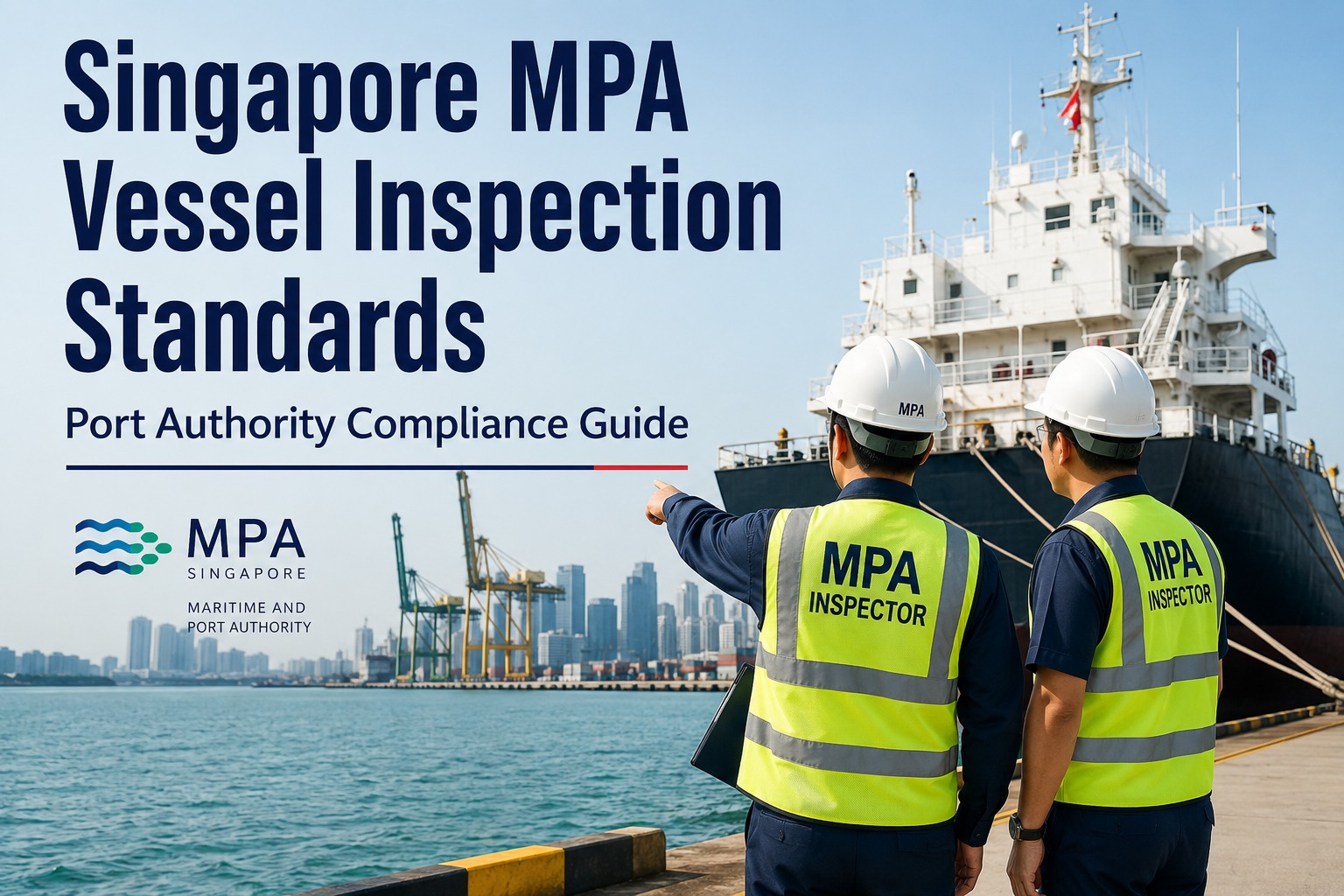
More than 130,000 vessels call at the Port of Singapore each year, making it one of the world's busiest and most intensively inspected maritime hubs. The Maritime and Port Authority of Singapore operates a dual enforcement role that few jurisdictions match: as a port state it inspects foreign-flagged vessels under the Tokyo MOU's New Inspection Regime, and as a flag state it administers the Singapore Registry of Ships — now the world's fourth-largest with over 4,400 vessels exceeding 100 million GT after a 24.9% growth surge in 2025. Singapore sits on both the Paris MOU and Tokyo MOU white lists, and its PSC team conducts over 1,000 initial inspections annually, recording around 3,000 deficiencies across high, standard, and low-risk categories. For operators calling at Singapore or flying the Singapore flag, understanding both the PSC inspection framework and MPA's accelerating digitalisation and decarbonisation requirements is essential. Fleet managers ready to centralise inspection readiness and compliance tracking can sign up for Marine Inspection's compliance platform and manage both port state and flag state obligations from a single dashboard.
130,000+
Annual Vessel Arrivals
World's busiest transhipment port
4,400+
SRS-Flagged Vessels
100M+ GT, 4th largest global registry
1,097
PSC Inspections/Year
3,059 deficiencies recorded
9
Green Shipping Corridors
Including LA/Long Beach & Rotterdam
MPA Port State Control: The Inspection Framework
Singapore's PSC inspections follow the Tokyo MOU's New Inspection Regime (NIR), which assigns vessels a risk profile (high, standard, or low) determining inspection priority and scope. MPA's PSC team — operating from the Port State Control Department within the Shipping Division — targets ships based on this risk matrix. With approximately 1,000 ships in port at any given time, inspections focus on vessels with the highest risk scores first.
MPA PSC Inspection Process
1
Ship Risk Profiling
Tokyo MOU NIR assigns risk based on flag state performance, classification society record, vessel age and type, deficiency history, and company performance.
2
Initial Inspection
PSCOs verify certificates, review crew qualifications, check safety equipment condition, and assess overall vessel compliance with SOLAS, MARPOL, STCW, and MLC.
3
Expanded Inspection (if warranted)
Clear grounds — overdue surveys, multiple deficiencies, ISM non-conformities — trigger deeper examination of operational systems and crew competence.
4
Deficiency Recording & Actions
Deficiencies coded and recorded in Tokyo MOU APCIS database. Actions range from rectification within deadline to vessel detention for serious deficiencies posing immediate threat.
5
Follow-Up & Release
Detained vessels must rectify deficiencies and apply for follow-up inspection by one of MPA's 8 authorised Recognised Organisations before departure.
Top Deficiency Categories in Singapore PSC
MPA's annual inspection data reveals consistent deficiency patterns that operators can prepare for proactively. Operators who schedule a demo of Marine Inspection's pre-arrival readiness tools can run deficiency-pattern analysis against their fleet's maintenance records and close gaps before arriving in Singapore.
Arrive PSC-Ready at Every Singapore Port Call
Marine Inspection analyses your fleet's deficiency patterns against Singapore PSC data, generates pre-arrival checklists, and tracks corrective actions through to close-out.
Expert Review: Singapore's Dual Role and the Digital Shift
Singapore's dual role as both a major port state and a top-tier flag state creates a regulatory ecosystem where compliance standards compound. As a port state, MPA enforces international conventions on over 130,000 vessel arrivals annually. As a flag state, it administers one of the world's youngest quality fleets — the SRS grew 24.9% in 2025 to become the fourth-largest global registry, largely driven by tonnage reflagging from Hong Kong amid geopolitical shifts. Singapore ranks third on the Tokyo MOU white list and fifth on the Paris MOU white list, making its flag one of the best-performing globally.
The digital transformation of Singapore's maritime sector accelerated significantly. From April 2025, all bunker suppliers must provide digital bunkering services and issue electronic bunker delivery notes as default — a move expected to save the industry 40,000 man-days annually. MPA is co-developing maritime AI products with industry and cloud providers, and the Maritime Energy Training Facility is training personnel on zero-emission fuels, with enhanced facilities being developed by 2026. The SRS expects to flag its first ammonia dual-fuel bulk carriers around 2026.
For operators, this means Singapore increasingly rewards digital readiness and environmental performance. The Maritime Singapore Green Initiative — backed by $50 million from MPA — incentivises early adoption of zero and near-zero emission technologies. Operators building toward compliance with both Singapore's evolving standards and global frameworks can sign up for Marine Inspection's free trial to connect inspection readiness, maintenance planning, and emission tracking in one integrated system.
Singapore Green Shipping & Decarbonisation Landscape
Singapore is positioning itself as the world's primary green bunkering hub, building infrastructure for methanol, ammonia, and hydrogen alongside its existing biofuel capabilities. Operators on routes through Singapore can schedule a walkthrough of Marine Inspection's emission tracking tools to model alternative fuel compliance scenarios against CII and EU ETS requirements.
Active
Digital Bunkering (Mandatory from Apr 2025)
All bunker suppliers must issue e-BDNs by default. Streamlines fuel compliance data, reduces errors, and supports early fraud detection across 130,000+ annual calls.
Active
Biofuel Bunkering (Up to B50, B100 Standard by 2025)
520,000 tonnes of biofuel blends supplied in 2023 (3.7x growth vs. 2022). MPA developing Singapore standards for B100 with industry partners.
Developing
Methanol Bunkering Infrastructure
World's first ship-to-containership methanol bunkering completed in Singapore. 50+ companies responded to MPA's EOI, with 40% proposing end-to-end solutions.
Developing
Ammonia Fuel Pathway
Fortescue Green Pioneer completed world's first ammonia fuel trial in Singapore (2024). SRS to flag first ammonia dual-fuel bulk carriers around 2026.
Strategic
9 Green & Digital Shipping Corridors
Bilateral corridors with Rotterdam, LA/Long Beach, Tianjin, Japan, Australia, and Shandong — piloting alternative fuels and digital solutions for international routes.
Strategic
Harbour Craft Net-Zero by 2050
All new harbour craft from 2030 must be fully electric, B100-capable, or net-zero fuel compatible. Tuas Port operations targeting net-zero by 2050.
Operators building environmental compliance records across Singapore operations can sign up for Marine Inspection to track emission data and environmental deficiency records fleet-wide, supporting both MPA requirements and global decarbonisation frameworks like CII and the IMO Net-Zero Framework.
Build a Singapore-Ready Compliance Operation
Marine Inspection integrates PSC readiness, flag state compliance, and green shipping tracking into one platform built for operators navigating Singapore's dual regulatory environment.
Frequently Asked Questions
How does Singapore select vessels for PSC inspection?
Singapore uses the Tokyo MOU's New Inspection Regime, which assigns each vessel a risk profile based on flag state performance, classification society record, vessel age and type, deficiency history, and company performance. High-risk ships are prioritised for inspection with the most comprehensive scope. Standard and low-risk vessels face proportionally less frequent and less intensive examinations. MPA's PSC team conducted over 1,000 initial inspections recently, split across approximately 392 high-risk, 463 standard-risk, and 242 low-risk vessels.
What happens if my vessel is detained in Singapore?
Detained vessels must rectify all serious deficiencies before departure. The master must apply for a follow-up inspection by one of MPA's 8 authorised Recognised Organisations (for vessels classed under those ROs). Vessels classed under other organisations may need to apply directly to MPA for follow-up inspection. The detention is recorded in the Tokyo MOU APCIS database, affecting the vessel's risk profile at every subsequent port in the Asia-Pacific region. Ship owners may appeal within 30 days, but the appeal does not suspend the detention.
What is the Singapore Registry of Ships and why is it growing so fast?
The SRS is administered by MPA and has grown to over 4,400 vessels exceeding 100 million GT. It became the world's fourth-largest registry in 2025 after a 24.9% growth surge, overtaking Hong Kong. This growth was driven significantly by tonnage reflagging from Hong Kong amid a now-suspended US port fee plan. Singapore ranks third on the Tokyo MOU white list and fifth on the Paris MOU white list, making it one of the best-performing flag states globally for PSC compliance.
How does Singapore's digital bunkering mandate affect vessel operations?
From April 2025, all bunker suppliers in Singapore must provide digital bunkering services and issue electronic bunker delivery notes (e-BDNs) as default. This replaces paper-based processes, streamlines data sharing between buyers and suppliers, improves regulatory compliance accountability, and supports early detection of discrepancies. MPA estimates the mandate will save the industry approximately 40,000 man-days annually. For vessel operators, this means ensuring onboard systems can receive and store electronic fuel documentation.
What green fuel options are available for bunkering in Singapore?
Singapore currently offers biofuel blends up to B50 commercially, with B100 standards being finalised. In 2023, 520,000 tonnes of biofuel blends were supplied — more than triple the 2022 volume. Methanol bunkering infrastructure is developing after the world's first ship-to-containership methanol bunkering was completed in Singapore. Ammonia fuel trials have been conducted (Fortescue Green Pioneer in 2024), with the SRS expecting to flag its first ammonia dual-fuel bulk carriers around 2026. Singapore has also established nine Green and Digital Shipping Corridors with major global ports to accelerate alternative fuel adoption.