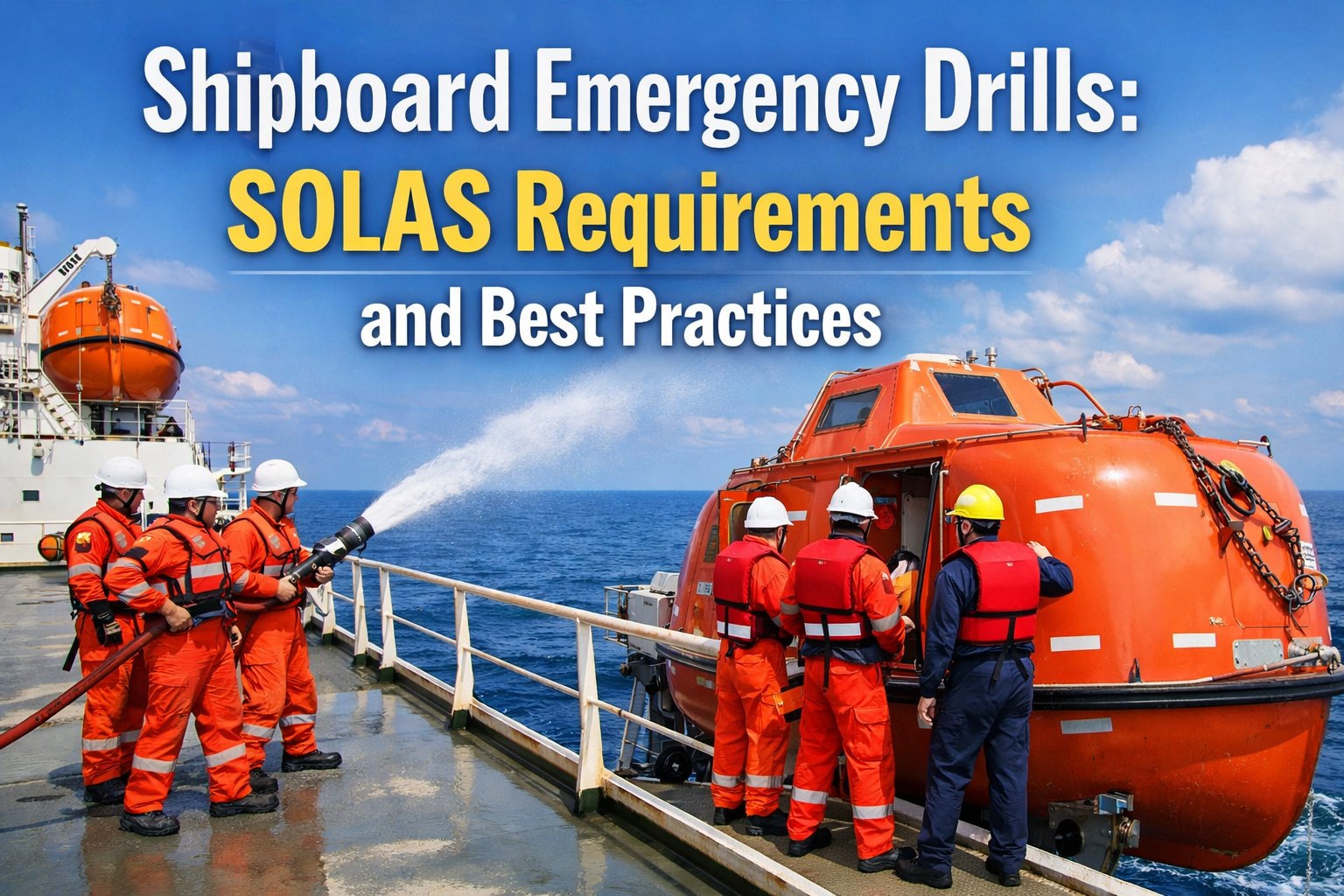
Emergency drills are the single most inspected element of any vessel's safety management system — PSC officers verify drill records at every boarding, ISM auditors review drill schedules and participation during every audit, and SOLAS regulation III/19 mandates specific drill types at specific frequencies with specific documentation requirements that leave no room for ambiguity. Every crew member must participate in at least one abandon ship drill and one fire drill every month. Enclosed space entry and rescue drills every two months. Lifeboat launch and manoeuvre in water every three months. Liferaft deployment every four months. Oil spill drills every three months. Security drills at least annually under the ISPS Code. Watertight door operation weekly. The list is extensive — and the consequences of gaps are immediate: PSC detention, ISM non-conformity, SMC suspension, and the operational consequence that matters most — crew who don't know what to do when the real emergency happens. Drills are not compliance theatre — SOLAS explicitly requires that drills be conducted as if there was an actual emergency, with lessons learned documented and fed back into the next drill planning cycle. The Britannia P&I Club emphasises that communication with shore is often overlooked during emergency exercises and should be practised. The challenge for safety officers is not understanding what drills are required — it is managing the overlapping schedules, ensuring every crew member participates (especially with frequent crew changes), documenting results with sufficient detail for audit verification, and tracking corrective actions from debrief findings. To see how Marine Inspection automates drill scheduling, tracks participation per crew member, and generates PSC-ready drill records across your fleet, book a Marine Inspection demo.

SOLAS Regulation III/19
Every Crew Member. Every Month. No Exceptions.
At least one abandon ship drill and one fire drill per month per crew member. Within 24 hours of departure if 25%+ crew are new. Before sailing on first voyage, after major modification, or with new crew.
12+
Drill types required on vessels
Weekly
to Annual frequency range
100%
Crew participation required
PSC
Verified at every boarding

Complete Drill Schedule: Every Drill, Every Frequency

Shipboard Emergency Drill Requirements — Complete Schedule
Drill Type Frequency Regulatory Basis Who Participates Key Requirements
Fire DrillMonthlySOLAS III/19.3.2All crew — every member at least once per monthDifferent fire pumps exercised at successive drills. Report to stations. Use of fire equipment. Inspect fireman's outfit. Conclude with abandon ship preparation.
Abandon Ship DrillMonthlySOLAS III/19.3.2All crew — every member at least once per monthMuster at stations. Lifejacket donning. Lifeboat lowering (different boat each drill). Equipment check. Headcount verification.
Lifeboat Launch & Manoeuvre3 MonthsSOLAS III/19.3.4.3Assigned operating crew per lifeboatEach lifeboat launched with crew and manoeuvred in water. Engine started. On-load/off-load release tested.
Free-Fall Lifeboat Launch6 MonthsSOLAS III/19.3.3.4Assigned operating crew only (not full complement)Free-fall launch with crew. Simulated launch every 6 months if admin extends to 12 months. Only manoeuvring crew aboard.
Rescue Boat LaunchMonthlySOLAS III/19.3.3.6Assigned rescue boat crewLaunch, manoeuvre in water. At minimum quarterly. Includes starting engine, VHF comms test.
Davit-Launched Liferaft4 MonthsSOLAS III/19.4.3Crew with liferaft dutiesOn-board training including inflation and lowering. May use special training raft. Not part of ship's LSA.
Enclosed Space Entry & Rescue2 MonthsSOLAS III/19.3.3Crew with enclosed space entry/rescue dutiesPlanned and conducted safely per MSC.581(110). Practice rescue procedures, BA donning, gas testing.
Man Overboard (MOB)Monthly / QuarterlySOLAS III/19, ISM CodeAll crew (bridge team + deck team + rescue boat crew)MOB alarm. Recovery turn. Rescue boat deployment. Dummy recovery. Monthly recommended; quarterly minimum per many SMS.
Oil Spill Drill (SOPEP)3 MonthsSOPEP / MARPOL Annex ICrew with SOPEP dutiesScenario-based: bunkering spill, machinery leak, hull breach. Equipment deployment. Notification procedure practice.
Watertight Door OperationWeeklySOLAS II-1/22All crew who operate WT doorsExercise operation of watertight doors (power and hand). Verify closing mechanism and indicator lights function.
Security Drill (ISPS)AnnuallySOLAS XI-2/13, ISPS Code A/13All crew with security duties (minimum). Full crew recommended.Test Ship Security Plan. Security level change procedures. Threat identification. Access control. Coordination with PFSO.
Emergency Towing6 MonthsETA Manual / Company SMSDeck crew responsible for ETA riggingRig emergency towing arrangement. Verify condition of pennant, chafing gear. Practice deployment procedure.
Steering Gear Failure3 MonthsSOLAS V/26Bridge and engine room crewChangeover to emergency/auxiliary steering. Communication between bridge and steering gear room. Tested at sea.
Damage Control / FloodingQuarterlyCompany SMS / ISM CodeDamage control teamFlooding scenario. WT door closure. Bilge pump operation. Damage assessment procedure. Stability evaluation practice.
Passenger Muster (Passenger Ships)WeeklySOLAS III/30All crew — passengers within 24hrs of departureMuster drill before or immediately after departure. Every voyage with new passengers. Crew drill weekly.
Additional company-specific drills (helicopter operations, piracy response, medical emergency) may be required by SMS. Non-statutory drills complement SOLAS minimum requirements.

The Drill That Makes the Difference: How to Run Drills That Actually Prepare Crew

SOLAS requires drills to be conducted as if there was an actual emergency — not a walk-through or a paperwork exercise. The difference between a compliance drill and a training drill is the difference between crew who can recite procedures and crew who can execute them under pressure.

Plan Realistic Scenarios
Vary the scenario each drill: engine room fire, galley fire, accommodation fire — not the same location every month. Night drills test real capability. Combine drills when appropriate (fire leading to abandon ship).
Track Individual Participation
Every crew member must participate monthly — not just be present. With crew changes, new joiners need drills within 24 hours. Track by name, not by headcount. Marine Inspection logs participation per person per drill.
Test Equipment, Not Just People
Drills are an opportunity to verify that all equipment works: fire pumps, BA sets, lifeboat engines, fire dampers, MOB alarms, VHF radios, EPIRB function. Equipment failures found in drills are lessons; failures found in emergencies are fatal.
Practise Shore Communication
Britannia P&I Club highlights that communication with shore is often overlooked during drills. Practice Mayday/PAN PAN format, company DPA notification, class/P&I notification procedures, and coastal state reporting.
Debrief Every Drill
Immediate structured debrief: what went well, what didn't, equipment issues, communication gaps. Document findings. Assign corrective actions with deadlines. Feed lessons into next drill planning. This feedback loop is the mechanism that improves performance.
Measure Response Times
Time the response: alarm to full muster, muster to lifeboat lowered, alarm to fire team at scene. Track these times across drills — they should improve. Deteriorating times indicate training gaps or crew unfamiliarity.

Documentation: What PSC and ISM Auditors Verify

Drill records are among the first documents PSC officers request. Incomplete records, missing participation lists, or gaps in the drill schedule are detainable deficiencies. Book a Marine Inspection demo to see audit-ready drill documentation.

Date and Time: Exact date and time of each drill. Must demonstrate monthly frequency without gaps.
Type of Drill: Fire, abandon ship, MOB, oil spill, enclosed space, security — clearly identified.
Scenario Description: Where the simulated emergency occurred. What conditions were simulated (night, heavy weather, specific compartment).
Equipment Used: Which fire pumps, which lifeboat lowered/launched, which BA sets donned, which rescue boat deployed.
Crew Participation: Names of all participants — not just numbers. New joiners identified. Crew who missed drill documented with reason.
Response Times: Time from alarm to full muster. Time from alarm to first fire team at scene. Time from alarm to lifeboat ready.
Debrief Findings: Strengths identified. Weaknesses identified. Equipment issues. Communication problems. Corrective actions assigned.
Master's Signature: Master oversees drill and signs the record, confirming it was conducted satisfactorily or noting areas requiring improvement.

How Marine Inspection Automates Drill Management

Automated Drill Calendar
All 12+ drill types scheduled at correct SOLAS frequencies. Automatic alerts before due dates. Overdue drill flagging to vessel, superintendent, and fleet manager. No drill falls through the cracks.
Per-Person Participation Tracking
Every crew member's drill participation tracked by name and date. New joiner alerts ensure 24-hour drill compliance. Monthly participation gaps flagged automatically. PSC-ready participation evidence.
Structured Drill Records
Mandatory fields: date, type, scenario, equipment used, participation list, response times, debrief findings, corrective actions. Photo evidence capture. Master's digital sign-off.
Corrective Action Follow-Up
Debrief findings assigned as corrective actions with owners and deadlines. Tracked to closure. Unresolved actions escalated. Demonstrates continuous improvement for ISM audits.
Fleet-Wide Drill Analytics
Drill completion rates, overdue counts, response time trends, and participation compliance across all vessels. Superintendent dashboard benchmarks vessels against each other.
Scenario Library
Pre-built drill scenarios with rotating variety. Night drill templates. Combined drill scenarios (fire → abandon ship). Ensures drills don't repeat the same scenario month after month — a common PSC observation.
Stop Managing Drills on Paper. Start Managing Drills That Save Lives.
Marine Inspection automates scheduling for 12+ drill types, tracks participation per crew member, captures structured records with debrief findings, and provides fleet-wide analytics — the complete drill management platform that makes PSC detention for drill deficiencies a thing of the past.

Conclusion

Shipboard emergency drills are the most inspected, most documented, and most consequential element of the Safety Management System — because they are the only mechanism that transforms written procedures into crew competency that saves lives in real emergencies. SOLAS mandates at least 15 distinct drill types ranging from weekly (watertight doors, passenger muster) to monthly (fire, abandon ship, rescue boat) to quarterly (lifeboat launch, MOB, oil spill, steering gear, damage control) to semi-annual (free-fall lifeboat, emergency towing) to annual (security drills). Every crew member must participate in fire and abandon ship drills monthly with no exceptions — 24-hour rule for new joiners, before-sailing rule for new crews. Documentation must include date, scenario, equipment, named participation, response times, and debrief findings with corrective actions. Best practices elevate drills from compliance exercises to genuine training: realistic scenarios, varied locations, night drills, combined scenarios, equipment verification, shore communication practice, response time measurement, and structured debriefing that feeds lessons learned into the next planning cycle. Marine Inspection provides the digital platform that automates drill scheduling, tracks per-person participation, captures structured records, and provides fleet-wide analytics — book a live demo today.
Frequently Asked Questions

FAQ 01
How often must fire and abandon ship drills be conducted?
Every crew member must participate in at least one fire drill and one abandon ship drill every month per SOLAS Regulation III/19.3.2. If more than 25% of the crew have not participated in these drills on that particular ship in the previous month, drills must take place within 24 hours of leaving port. When a ship enters service for the first time, after major modification, or when a new crew is engaged, drills must be held before sailing. On passenger ships, abandon ship and fire drills are required weekly per SOLAS III/30, though the entire crew need not participate in every weekly drill. Different fire pumps must be exercised at successive drills.
FAQ 02
What drill records must be maintained for PSC inspection?
PSC officers verify drill records including: date and time of each drill, type of drill conducted, scenario description (location and conditions simulated), equipment used (which fire pumps, which lifeboat, which BA sets), crew participation by name (not just headcount), response times where measured, debrief findings and corrective actions, and Master's signature confirming the drill was conducted. Records must demonstrate continuous monthly frequency without gaps, rotation of different lifeboats at successive drills, variety of scenarios (not the same fire location every month), and that all crew members participated — including new joiners within 24 hours of joining. Missing or incomplete records are among the most common PSC detainable deficiencies.
FAQ 03
How often must lifeboats be launched and manoeuvred in water?
Each lifeboat must be launched with its assigned operating crew aboard and manoeuvred in water at least once every three months during an abandon ship drill (SOLAS III/19.3.4.3). Lifeboats must be lowered (to embarkation position, not necessarily into water) monthly, with different boats at successive drills. Free-fall lifeboats must be free-fall launched with assigned operating crew every six months (SOLAS III/19.3.3.4) — the Administration may extend this to 12 months if simulated launching is conducted every six months. Rescue boats (other than lifeboats that double as rescue boats) must be launched monthly with assigned crew and manoeuvred in water — at minimum quarterly. Davit-launched liferaft training including inflation and lowering at intervals not exceeding four months.
FAQ 04
What is the enclosed space entry drill frequency?
Crew members with enclosed space entry or rescue responsibilities must participate in an enclosed space entry and rescue drill at least once every two months per SOLAS III/19.3.3. These drills must be planned and conducted safely, taking into account guidance from IMO Resolution MSC.581(110) — the revised recommendations for entering enclosed spaces adopted in June 2025. Drills should include: atmosphere testing practice (calibrated gas detection equipment), rescue equipment deployment (SCBA, rescue harness, lifeline), communication procedures between entry team and attendant, and simulated rescue of an incapacitated person from an enclosed space. The drill must not create the hazards it is designed to prevent — never enter an actual enclosed space for drill purposes without proper safety measures.
FAQ 05
Can different drills be combined?
Yes — combining drills is both permitted and recommended. A common and effective combination is a fire drill scenario that escalates to an abandon ship drill, testing the full emergency response chain from fire detection through evacuation. MOB drills can be combined with abandon ship drills or fire drills, provided each drill maintains clear training objectives and all required elements are covered. Oil spill drills can incorporate damage control elements. However, each drill type must retain its distinct objectives — combining should not dilute the training value of any individual drill. Records must clearly document each drill type that was conducted and the specific elements completed. PSC officers expect to see that combined drills cover all requirements for each component drill.
Book Your Live Demo
The Platform That Makes Every Drill Count
12+ drill types. Multiple frequencies. Every crew member tracked. Every scenario documented. Every corrective action followed up. Marine Inspection is the drill management platform built for safety officers who refuse to let compliance gaps put their crew at risk.
12+
Drill types automated
100%
Per-person participation tracked
PSC
Audit-ready records always
Zero
Drill gaps or missed deadlines