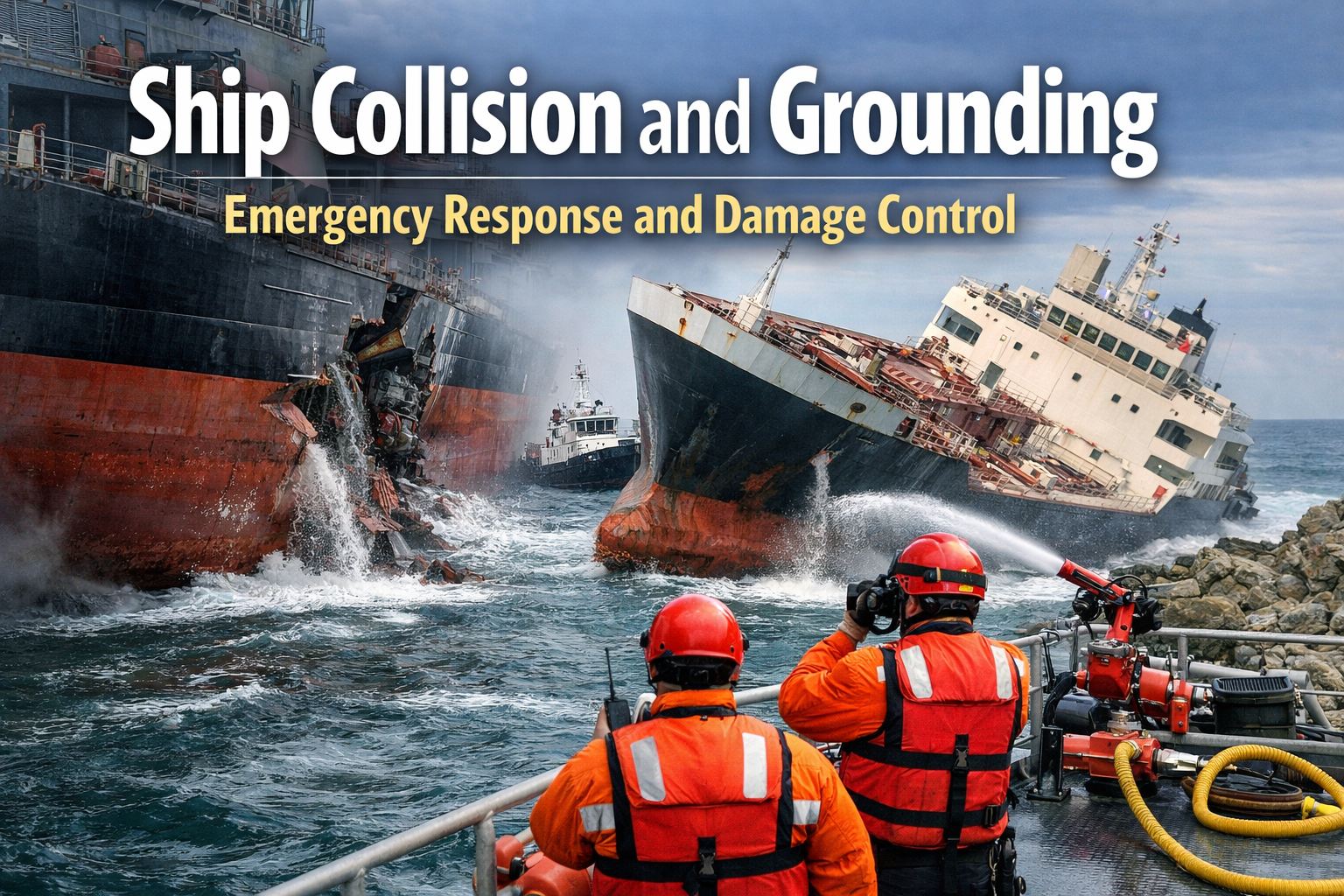
Ship Collision and Grounding: Emergency Response and Damage Control
Collision and grounding are the maritime emergencies that test a ship Master's competence most completely — requiring simultaneous management of crew safety, vessel stability, structural integrity, environmental protection, communications, and legal obligations under extreme time pressure and uncertainty. Unlike fire or man overboard where the emergency is localised, collision and grounding can compromise the vessel's entire structural envelope: hull breaches cause flooding that affects stability; grounding forces can distort the hull structure, rupture tanks, and create progressive flooding through connected spaces; and both incidents carry immediate environmental pollution risk from fuel tanks, cargo, or ballast. SOLAS Chapter II-1 defines the watertight integrity and damage stability framework that determines whether a damaged vessel survives or capsizes. SOLAS Chapter V establishes the legal obligation to render assistance to persons in distress. Classification societies operate 24/7 Emergency Response Services (ERS) that provide shore-based damage stability and longitudinal strength assessment within hours of a casualty report — using pre-loaded vessel data to calculate residual buoyancy, stability margins, and structural strength in the damaged condition. For ship Masters, the critical first minutes after collision or grounding determine the outcome: stopping engines to assess damage, closing watertight doors to contain flooding, sounding tanks to detect ingress, assessing stability, securing evidence (VDR, charts, logbooks), and communicating with flag state, class, P&I Club, and coastal authorities. Every decision must balance immediate crew safety against the risk of worsening the situation — and must be documented because collision and grounding are the maritime casualties most likely to result in formal investigation, litigation, and criminal proceedings. To see how Marine Inspection supports emergency preparedness through damage control drill records, watertight door maintenance tracking, and emergency equipment readiness across your fleet, book a Marine Inspection demo.
Collision
Impact between vessels or between vessel and fixed structure. Side shell damage. Flooding from breached compartments. Fire risk from ruptured fuel lines. Other vessel may also be damaged — duty to render assistance under SOLAS V.
Grounding
Vessel contacts seabed or waterway side. Bottom shell damage. Tank rupture and pollution risk. Vessel may remain aground (requiring refloating) or come free (requiring damage assessment while underway). Hull distortion affects structural strength.
Immediate Actions: The First 15 Minutes
The first minutes after collision or grounding are when the most consequential decisions are made — often with incomplete information. This checklist applies to both scenarios with variations noted. Book a Marine Inspection demo to see how the platform provides digital emergency checklists accessible from any device on board.
1
Sound General Alarm & Call Master
Sound general emergency alarm immediately. Call Master to the bridge if not already present. Stop engines (collision) or assess engine status (grounding — do not immediately attempt to refloat). Switch to manual steering.
2
Close Watertight Doors
Close ALL watertight doors immediately to contain potential flooding. This is the single most important damage control action. Every second of delay allows flooding to spread to additional compartments, progressively degrading stability.
3
Headcount & Casualty Assessment
Muster crew. Account for all personnel. Identify injuries and provide first aid. Search for missing persons. In collision with another vessel, assess whether the other vessel requires assistance (SOLAS V obligation).
4
Assess Flooding & Sound Tanks
Sound all tanks and void spaces adjacent to the impact area. Check bilge alarms. Visually inspect for water ingress in accessible spaces. Record tank levels and compare with pre-incident condition. Identify which compartments are flooding.
5
Check for Fire & Structural Damage
Collision can rupture fuel lines causing fire or explosion risk. Inspect engine room, pump room, and cargo spaces for fire, fuel leaks, structural distortion, and shifted cargo. Grounding: check double bottom and ballast tanks for deformation.
6
Communications & Signals
Exhibit Not Under Command (NUC) lights/shapes. Broadcast vessel position on VHF Ch.16. Maintain watch on VHF Ch.16 and DSC Ch.70. Alert shore stations and nearby vessels. Switch on deck lights at night. Issue DISTRESS or URGENCY signal as situation requires.
7
Preserve Evidence
Secure VDR/S-VDR data immediately (prevent overwrite). Do not alter charts, logbooks, or course recorder printouts. Record position, course, speed, weather, visibility, and all actions taken with timestamps. Photograph damage. This evidence is critical for investigation and legal proceedings.
8
Notify Stakeholders
Flag state administration. Classification society (activate ERS if enrolled). P&I Club (critical for pollution, salvage, and liability). Company DPA. Port state authority if in territorial waters. Coastal state if pollution risk exists (MARPOL obligation).
Damage Assessment and Stability Evaluation
Once immediate safety actions are complete, the Master must evaluate whether the vessel can safely remain afloat, whether it can proceed to port, or whether abandon ship preparations are necessary. Classification society Emergency Response Services provide critical shore-based support for this assessment.
Post-Incident Assessment Checklist
Assessment Area
What to Check
Critical Indicators
Action Required
Stability
Draft readings forward, midships, aft. List measurement. Free surface effect from flooded compartments. GM calculation if possible.
Increasing list, decreasing freeboard, sluggish roll response, loll
Contact class ERS with draft readings and damage report. Do not alter ballast without ERS guidance — incorrect ballasting can worsen stability.
Structural Integrity
Hull plating condition at impact site. Deck and bulkhead deformation. Frame/stiffener damage. Tank top distortion (grounding).
Mark and monitor cracks. Restrict access to damaged areas. Report extent to class. Consider emergency repairs if possible.
Flooding
Rate of flooding in affected compartments. Bilge pump capacity vs ingress rate. Progressive flooding through damaged boundaries.
Rising water levels despite pumping. Flooding spreading to adjacent spaces. Bilge alarm in spaces not directly damaged.
Deploy portable pumps if fixed system insufficient. Patch/plug leaks if accessible and safe. Calculate time to critical flooding level.
Pollution Risk
Fuel tank condition — particularly double bottom and side tanks at impact area. Cargo tank integrity (tankers). Ballast tank contamination.
Oil sheen on water, fuel tank level decreasing, cargo pressure/level change
Transfer fuel from damaged tanks if possible. Deploy onboard oil spill equipment. Notify coastal state authority immediately if pollution confirmed.
Propulsion & Steering
Main engine condition. Propeller and shaft inspection (grounding). Steering gear function. Rudder stock condition.
Vibration, unusual noise, loss of power, steering unresponsive
If propulsion compromised, request tug assistance. Do not run damaged propulsion without assessment — risk of further damage and shaft seal failure.
Longitudinal Strength
Hull girder bending moment and shear force in damaged condition. Classification society ERS calculates using pre-loaded vessel data.
Exceeding allowable bending moment or shear force limits in damaged condition
ERS provides guidance on cargo/ballast redistribution to reduce bending moment. Critical for avoiding structural failure (hull fracture).
Classification society ERS provides shore-based stability and strength analysis within hours using pre-loaded vessel data. Contact class immediately — do not delay waiting for complete damage information.
Grounding-Specific Procedures: To Refloat or Not
The decision to refloat after grounding is one of the most critical a Master makes — and getting it wrong can sink the vessel. A grounded vessel is often stable on the seabed; refloating may expose damage that was sealed by bottom contact, causing rapid flooding that overwhelms bilge pumps.
Before Attempting Refloating
Complete full damage assessment — know what is damaged before removing the seabed that may be plugging the hole.
Verify stability will be adequate once afloat — class ERS must confirm residual stability in damaged condition.
Confirm bilge pumping capacity exceeds expected ingress rate once free of seabed.
Check tidal conditions — rising tide may refloat vessel unexpectedly; falling tide provides more assessment time.
Consider ballast/deballast plan for controlled refloating — ERS guidance essential.
Have tug assistance standing by. Emergency towing arrangement (ETA) rigged if possible.
Do NOT Refloat If
Damage assessment is incomplete — the seabed may be the only thing preventing flooding.
Stability calculation shows inadequate GM or residual stability in damaged floating condition.
Flooding rate is expected to exceed pumping capacity.
Structural integrity assessment shows risk of hull fracture during refloating forces.
Weather is deteriorating — refloating into worsening conditions compounds every risk.
Pollution risk is greater afloat than aground — sometimes remaining aground is the lesser environmental damage.
How Marine Inspection Supports Emergency Preparedness
Watertight Door Maintenance
Testing records, gasket condition, hydraulic system service, remote closure function verification — the equipment that determines whether flooding stays contained or spreads to sink the vessel.
Damage Control Drill Records
Flooding scenario drills, damage assessment exercises, emergency pump deployment practice — documented with crew participation, response times, and debrief findings.
Emergency Equipment Tracking
Portable emergency pumps, collision mats, cement boxes, wooden plugs, emergency towing arrangements — all tracked with service dates, location, and readiness status.
Bilge & Ballast System PM
Bilge pump maintenance, bilge alarm testing, ballast valve operation, sounding pipe condition — the systems that determine whether the vessel can manage flooding or not.
Emergency Preparedness Starts Before the Emergency
Watertight doors that don't close, bilge pumps that don't start, emergency plugs that can't be found — these are the failures that turn incidents into catastrophes. Marine Inspection ensures every piece of damage control equipment is maintained, tested, and ready.
Collision and grounding trigger mandatory reporting to multiple authorities — failure to report creates additional legal liability. Sign up for Marine Inspection to maintain incident documentation that meets investigation standards.
Flag State Administration: Mandatory casualty report. Flag state may appoint investigators. Masters must cooperate fully. Criminal liability possible depending on jurisdiction and circumstances.
Classification Society: Immediate notification to class. Triggers condition of class or class suspension if damage affects classification requirements. ERS activation for stability/strength assessment. Class surveyor attendance for damage survey.
P&I Club: Immediate notification critical for coverage. P&I appoints surveyor, legal counsel, and pollution response if needed. Delay in notification can compromise coverage. Follow Club instructions on evidence preservation.
Coastal State: Required under MARPOL if pollution has occurred or is threatened. Coastal state may direct vessel movements, require port of refuge entry, or restrict operations. Comply with coastal state instructions.
Port State Authority: Required if incident occurs in port waters or vessel is proceeding to port. Port state may conduct PSC inspection before allowing departure. May impose detention if vessel is unseaworthy.
Company DPA: Designated Person Ashore must be notified per ISM Code. DPA coordinates shore-based emergency response, liaises with authorities, and manages company responsibilities.
Conclusion
Ship collision and grounding are the maritime casualties where every decision in the first minutes determines whether the incident remains manageable or escalates to total loss. The immediate action sequence — general alarm, watertight doors closed, headcount, tank sounding, fire check, NUC signals, VDR preservation, and stakeholder notification — must be drilled until reflexive. Damage assessment evaluates stability (draft readings, list, GM), structural integrity (plating, frames, bulkheads), flooding rate versus pumping capacity, pollution risk, propulsion status, and longitudinal strength — with classification society ERS providing critical shore-based calculations. Grounding-specific decisions (refloat or remain aground) require complete damage assessment before action — the seabed may be the only barrier preventing flooding. Reporting obligations extend to flag state, class, P&I Club, coastal state, port state, and company DPA — with evidence preservation (VDR, charts, logbooks, photographs) essential for the investigation and legal proceedings that follow every collision and grounding. Marine Inspection supports emergency preparedness through systematic maintenance of the equipment that determines survival: watertight doors, bilge pumps, emergency equipment, and the drill records that prove your crew is ready — book a live demo today.
Frequently Asked Questions
FAQ 01
What is the first thing to do after a collision at sea?
Sound the general emergency alarm immediately and call the Master to the bridge. Stop engines to prevent further damage. Close all watertight doors to contain flooding — this is the single most important damage control action. Switch to manual steering. Account for all crew and assess injuries. Then systematically assess damage: sound tanks, check for flooding, inspect for fire and structural damage. Exhibit Not Under Command signals. Broadcast position on VHF Channel 16. Secure VDR data and preserve all evidence — do not alter charts or logbooks. Under SOLAS Chapter V, the Master has a legal obligation to render assistance to the other vessel if it is in distress.
FAQ 02
Should you immediately try to refloat a grounded vessel?
No. Do not attempt to refloat until a full damage assessment is complete and classification society ERS has confirmed that the vessel will have adequate stability and structural strength in the damaged floating condition. The seabed may be acting as a plug for hull breaches — removing the vessel from the seabed can expose damage that causes rapid flooding exceeding pumping capacity. Before any refloating attempt: complete damage assessment, verify stability calculations, confirm bilge pump capacity exceeds expected ingress, check tidal conditions, prepare ballast/deballast plan per ERS guidance, and have tug assistance standing by. Sometimes remaining aground is the safest option — particularly if stability is marginal, weather is deteriorating, or pollution risk is greater afloat than aground.
FAQ 03
What is an Emergency Response Service (ERS)?
ERS is a 24/7 shore-based service provided by classification societies (DNV, Lloyd's, BV, ABS, ClassNK, IRClass, and others) that provides rapid damage stability and longitudinal strength assessment for damaged vessels. When a vessel enrols in ERS, all its stability data, structural information, and loading guidance is pre-loaded into shore-based computer systems. In an emergency, the Master reports damage details and the ERS team calculates residual buoyancy, stability margins, shear forces, and bending moments in the damaged condition — then provides guidance on whether the vessel is safe, what ballast adjustments to make, whether cargo redistribution is needed, and whether the vessel can proceed to port. ERS assessment is typically available within hours of casualty report.
FAQ 04
Who must be notified after a collision or grounding?
Mandatory notifications include: Flag State Administration (casualty report — may appoint investigators and criminal liability is possible). Classification Society (immediate notification, triggers class condition or suspension, ERS activation, surveyor attendance). P&I Club (immediate notification critical for coverage — Club appoints surveyor and legal counsel). Coastal State (required under MARPOL if pollution occurred or threatened). Port State (if in port waters or proceeding to port — PSC inspection likely before departure). Company DPA (Designated Person Ashore per ISM Code — coordinates shore-based response). Additionally, the Master must broadcast the vessel's position on VHF and maintain distress/urgency watch. Evidence preservation is essential: secure VDR data, do not alter charts or logbooks, photograph all damage.
FAQ 05
Why is closing watertight doors the most important action?
Watertight doors are the primary barrier between a manageable flooding incident and progressive flooding that sinks the vessel. When a hull breach allows water to enter one compartment, the vessel can typically survive with one or even two compartments flooded (SOLAS damage stability requirements). However, if watertight doors between compartments are open, water floods progressively from the breached compartment into adjacent compartments — each additional flooded compartment reduces stability and buoyancy until the vessel capsizes or sinks. The speed of progressive flooding is often faster than bilge pumps can manage. Closing all watertight doors immediately after impact contains flooding to the damaged compartment(s), preserving the vessel's overall stability and buoyancy. Every second of delay in closing watertight doors increases the volume of flooding and reduces the vessel's chance of survival.
Book Your Live Demo
The Emergency You Prepare For Is the One You Survive
Marine Inspection tracks watertight door testing, bilge pump maintenance, emergency equipment readiness, damage control drill records, and incident documentation — because when hull integrity is compromised, only systematic preparation determines the outcome.