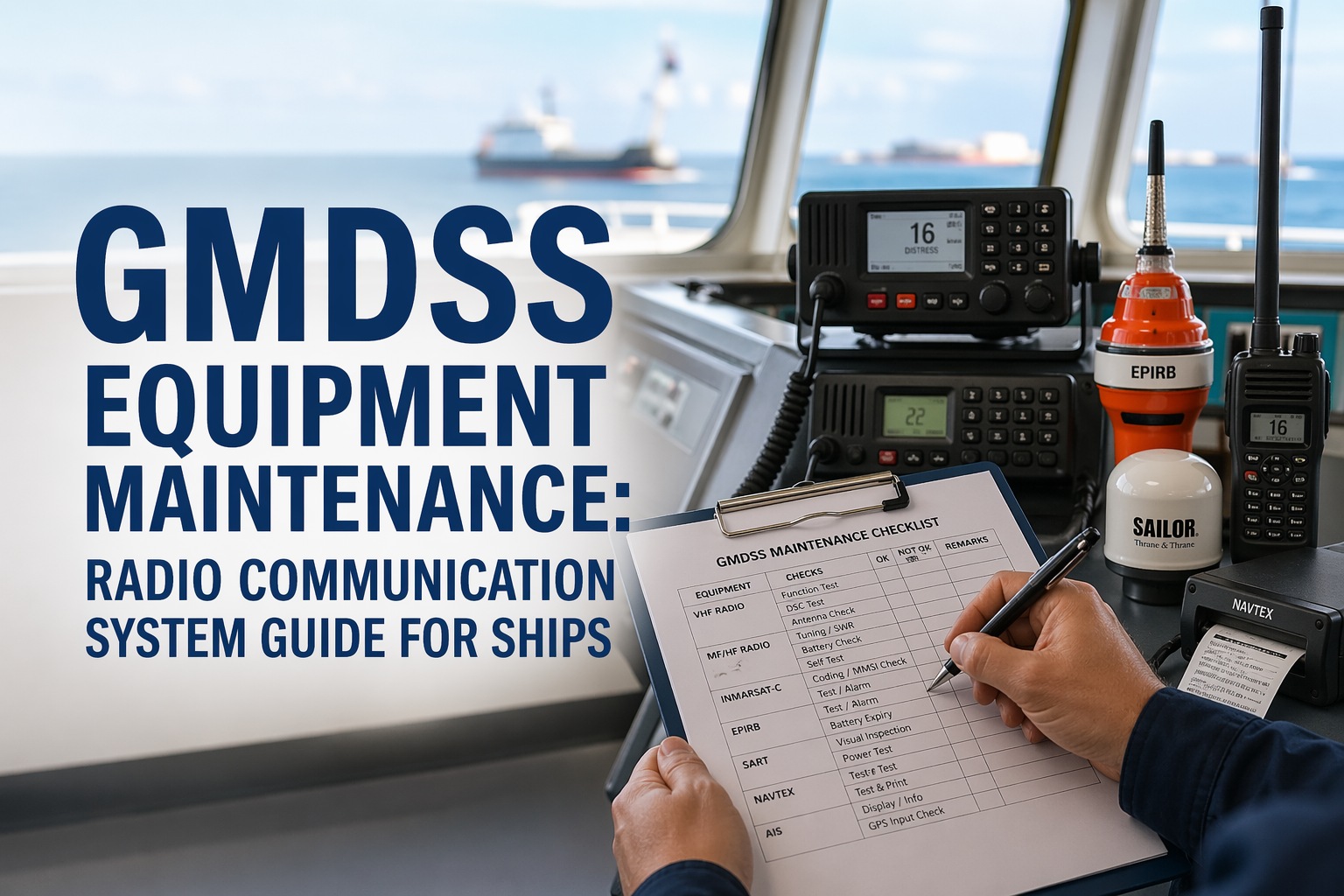
The Global Maritime Distress and Safety System is the communication backbone that connects a vessel in distress to rescue coordination centres worldwide — and it only works if every component is maintained, tested, and operational at all times. SOLAS Chapter IV mandates that GMDSS equipment must be capable of performing its intended functions at any point during the voyage, and PSC inspectors verify this by checking test records, battery expiry dates, annual survey reports, and operator competency. The 2024 GMDSS modernisation amendments (entered into force 1 January 2024 with retroactive requirement for existing ships) introduced more generic requirements independent of specific service providers — "Recognised Mobile Satellite Service" replaces Inmarsat as the defining term, and equipment requirements for sea areas A1-A4 have been updated. The Paris MoU's 2025 guidelines on GMDSS inspection (PSCC58-2025-02) give PSCOs specific checkpoints: battery expiry dates on EPIRBs, SARTs, and portable VHF; hydrostatic release unit dates; evidence of annual EPIRB testing per SOLAS IV/15.9 and MSC.1/Circ.1040/Rev.1; DSC test call logs; reserve power capacity (6-hour or 1-hour requirement); and operator licensing. The equipment suite — VHF DSC, MF/HF DSC, Inmarsat-C (or Recognised Mobile Satellite Service terminal), EPIRB, SART, NAVTEX, AIS, and survival craft VHF — requires daily, weekly, monthly, and annual testing at different intervals for different components. EPIRB batteries typically expire after 5 years from manufacture; SART batteries have manufacturer-specific intervals; HRU replacement follows the same 2-year cycle as life raft HRUs. Two crew members must hold valid GMDSS Radio Operator's Certificates (GOC or ROC). To see how Marine Inspection tracks every GMDSS equipment item, battery expiry, test record, and annual survey across your fleet, book a Marine Inspection demo.
Testing Schedule: Daily, Weekly, Monthly, Annual
| Equipment | Daily Test | Weekly Test | Monthly Test | Annual Survey | Battery Life / Replacement |
|---|---|---|---|---|---|
| VHF DSC/RT | Internal test (without radiation). Check transmit power, display, DSC function. | Station-to-station DSC test between both VHF sets. Live DSC test to coast station when in range. | Check all channels operational. Verify MMSI programmed correctly. Antenna condition. | Full functional check by qualified surveyor. Frequency measurement, power output, deviation. | Ship's mains + reserve power. Reserve battery capacity tested annually. |
| MF/HF DSC/RT | Internal test without radiation. | Live DSC test call to coast station on MF (2187.5 kHz) and one HF channel. Limited to once weekly to avoid overloading. | Check all frequencies. Verify antenna tuner. NBDP function test. Printer paper availability. | Full survey: frequency stability, power output, DSC coding. Antenna system. Earth connection. | Ship's mains + reserve power (6hr or 1hr requirement depending on config). |
| Inmarsat-C / RMSS | Verify logged in to satellite. Check message queue. EGC receiver active. | — | Inmarsat-C PV (Polling/Verification) test through LES. EGC function test. Printer paper check. | Full survey: distress alert capability, PV test log verification, antenna alignment. | Ship's mains + reserve power. |
| EPIRB (406 MHz) | — | — | Self-test function (no satellite transmission). Check physical condition, battery expiry, HRU expiry, lanyard, seawater contacts, safety clip. | Mandatory annual test by qualified surveyor per SOLAS IV/15.9 and MSC.1/Circ.1040/Rev.1. Frequency stability, signal strength, coding verified. | Battery: typically 5 years from manufacture. HRU: 2 years max. Replace before expiry. |
| SART (9 GHz Radar) | — | — | Visual inspection. Battery expiry check. Physical damage check. MMSI label legibility. Brief activation (2-3 sweeps only). | Annual test by qualified surveyor within 9.2-9.5 GHz range. Battery condition. If <12 months remaining, replace. | Battery: manufacturer-specific (typically 4-5 years). Replace if <12 months left at annual survey. |
| AIS-SART | — | — | Visual inspection. Battery expiry. MMSI label. Test sparingly to conserve battery. Check support stand. | Annual test per IMO MSC.1/Circ.1252. Position accuracy. Signal characteristics. | Battery: manufacturer-specific. Avoid frequent testing — drains battery. |
| NAVTEX | Verify receiving MSI broadcasts. Check printer/display. Paper supply. | Review received messages for completeness. | Verify all station codes correctly programmed. Check antenna connection. | Surveyor checks receiver sensitivity and station programming. | Ship's mains. |
| AIS Transponder | Verify transmitting (check on other vessel/shore). Confirm position data. | — | Verify MMSI, call sign, name, dimensions correctly entered. Check antenna separation from VHF (10m rule). | Annual test per IMO MSC.1/Circ.1252. Transmit power, frequency, timing, position accuracy. | Ship's mains + internal backup battery. |
| Portable VHF (GMDSS) | — | — | Battery condition. Physical damage. Channel 16 test. Waterproof seal check. | Power output, frequency deviation measured by surveyor. Battery capacity test. | Primary battery: 2-5 years depending on type. Spare battery required for testing (not compulsory battery). |
| Reserve Power (Batteries) | — | — | Full examination: non-sealed wet cells checked cell-by-cell (specific gravity). Sealed cells visually inspected. Results entered in GMDSS log. | Capacity test: must sustain 6-hour requirement (or 1-hour with UPS) per SOLAS IV/13. | Replace per manufacturer schedule. Typically 3-5 years for sealed lead-acid. |
Critical Expiry Dates: What PSC Checks First
Surveyors and PSCOs check expiry dates on all limited-life GMDSS items. These are the items that generate the most deficiency notices — and they are entirely preventable with systematic tracking. Book a Marine Inspection demo to see automated expiry alerts across your fleet.
2024 GMDSS Modernisation: What Changed
How Marine Inspection Manages GMDSS Compliance
Conclusion
GMDSS equipment maintenance is the discipline where a missed battery replacement or an untested DSC alert could mean the difference between a rescue and a loss — the system exists to ensure that a vessel in distress can communicate with rescue coordination centres regardless of location, and it only functions if every component is tested at the correct interval and every limited-life item is replaced before expiry. The 2024 GMDSS modernisation (Recognised Mobile Satellite Service replacing Inmarsat, equipment moved to SOLAS Chapter IV) updates the framework without changing the fundamental maintenance requirements: daily internal DSC tests, weekly live DSC calls, monthly EPIRB self-tests and battery inspections, and annual surveys by qualified radio surveyors per MSC.1/Circ.1040/Rev.1. The Paris MoU 2025 GMDSS guidelines give PSCOs specific inspection targets — battery dates, HRU dates, annual test evidence, operator licensing, reserve power capacity. EPIRB batteries (5 years), SART batteries (manufacturer-specific), HRUs (2 years), portable VHF batteries, and reserve power banks all require systematic tracking. Marine Inspection provides the digital platform that automates every test schedule, tracks every expiry date, archives every survey report, and monitors operator certifications — book a live demo today.