Man Overboard Recovery: Procedures, Equipment and Training Requirements
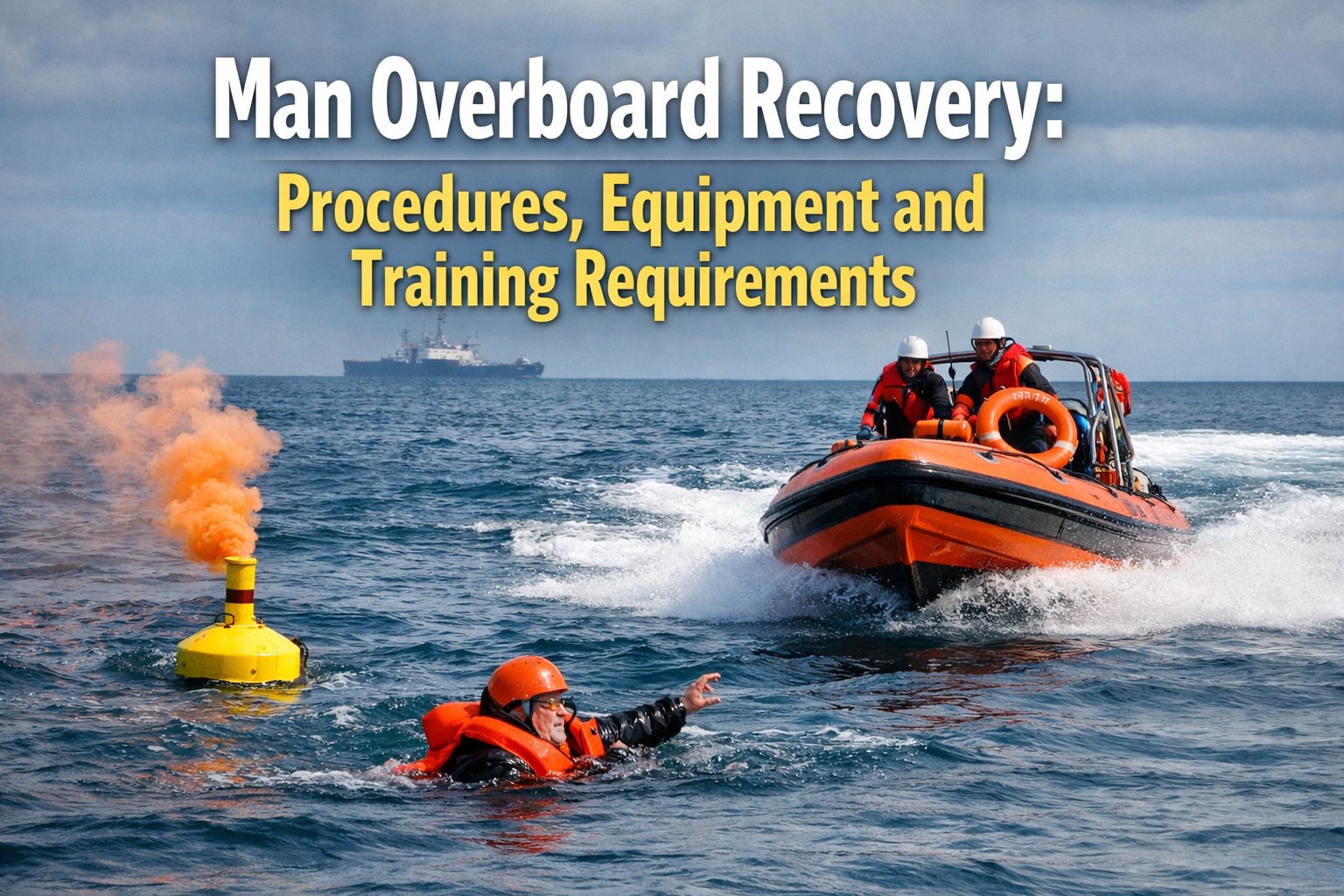
Man overboard is the maritime emergency where seconds determine survival. A person in the water at 15 knots is 450 metres behind the vessel within one minute. In water below 15°C, cold shock response triggers involuntary gasping within the first 60 seconds — and if the person is not wearing a lifejacket, drowning can follow within 3-5 minutes before hypothermia even becomes a factor. At night or in heavy weather, the chances of visually relocating someone in the water drop dramatically with every passing minute. Man overboard incidents remain a leading cause of fatalities at sea according to the Marine Accident Investigation Branch (MAIB) and IMO safety reports, and Port State Control inspections frequently cite MOB drill deficiencies as detainable findings. The response is a precisely choreographed sequence: immediate alarm and position marking, bridge manoeuvring (Williamson, Anderson, or Scharnow turn), rescue boat deployment, person-in-water recovery, and medical response — all executed under extreme time pressure by a crew that must have drilled this scenario until it becomes reflexive. SOLAS Regulation III/19 requires MOB drills at least monthly, the ISM Code mandates clear communication protocols within the Safety Management System, and STCW establishes competency standards for every crew member in emergency response. Modern technology — wearable MOB beacons, AIS SART personal devices, thermal imaging cameras, and smart lifebuoys with GPS tracking — is improving detection capability, but the core response still depends on trained crew executing proven procedures. To see how Marine Inspection tracks MOB drill records, rescue equipment maintenance, and crew training compliance across your fleet, book a Marine Inspection demo.
60 sec
Cold shock gasping begins
450m
Distance at 15 knots after 1 minute
3-5 min
Drowning risk without lifejacket in cold water
Monthly
MOB drill requirement (SOLAS III/19)
The MOB Response Sequence: Every Second Counts
The MOB response is a coordinated chain where every link must hold. If the witness doesn't shout and mark position, the bridge can't manoeuvre back. If the bridge doesn't manoeuvre, the rescue boat launches into open ocean. If the rescue boat doesn't deploy quickly, the person in the water dies from hypothermia, drowning, or both.
0 sec
WITNESS: Shout, Throw, Point
Shout "MAN OVERBOARD — STARBOARD/PORT SIDE!" immediately. Throw nearest lifebuoy with self-igniting light and smoke signal toward the person. Point continuously at the person in the water — do not stop pointing until relieved. Press MOB button on bridge GPS/ECDIS if accessible.
15 sec
BRIDGE: Alarm, Mark, Manoeuvre
Sound MOB alarm on PA system. Press MOB button on GPS/ECDIS — marking position immediately. Put rudder hard over toward the side the person fell from (swings stern and propeller away from casualty). Post extra lookouts. Engage hand steering. Hoist Flag Oscar (international signal: man overboard).
30 sec
BRIDGE: Execute Recovery Turn
Execute Williamson, Anderson, or Scharnow turn based on conditions. Approach MOB position from downwind so vessel drifts toward casualty. Issue Urgency signal (PAN PAN) on VHF Channel 16 to alert vessels in vicinity. Preserve VDR/S-VDR records.
2-5 min
DECK: Deploy Rescue Boat
Chief Officer directs rescue boat preparation. Crew don PPE and board rescue boat with portable VHF, thermal binoculars, first aid kit, and recovery equipment. Launch when safe to do so. Rescue boat approaches casualty from downwind. Stop engines well clear of person in water to prevent propeller injury.
5-15 min
RECOVERY: Retrieve and Treat
Recover person from water using rescue sling, Jason's Cradle, scramble net, or davit-mounted recovery system. Horizontal recovery preferred for hypothermic casualties — vertical lifting can cause cardiac arrest (circum-rescue collapse). Provide immediate first aid, dry clothing, thermal protection. Seek medical advice via radio.
Post
REPORT: Document and Notify
Recover lifebuoy and rescue boat. Cancel Urgency signal. Lower Flag Oscar. Complete detailed incident report: timeline, personnel actions, equipment performance, weather and sea conditions. Report to flag state, port state authority, and company safety officer as required.
Recovery Turns: Which Manoeuvre and When
Man Overboard Recovery Manoeuvres
Manoeuvre
Procedure
Best Used When
Time to Return
Key Advantage
Williamson Turn
Rudder hard over to casualty side. After 60° deviation, hard over opposite side. Midship rudder 20° short of reciprocal course.
Any visibility condition — day, night, fog. Most versatile. Standard SMS procedure.
Longest of three
Returns vessel to reciprocal of original track — ideal for delayed discovery or poor visibility
Anderson Turn (Single Turn)
Rudder hard over to casualty side. Maintain through 250° turn. Midship rudder. Stop engines when casualty 15° off bow.
Immediate action — person seen falling. Daylight. Good visibility. Ship with tight turning circle.
Fastest
Quickest return to MOB position. Simplest to execute. Best for immediate response.
Scharnow Turn
Rudder hard over to casualty side. After 240° deviation, hard over opposite. Vessel ends on reciprocal course in own wake.
Delayed discovery — time elapsed before manoeuvre is known. Vessel needs to return along own track.
Medium
Returns vessel into its own wake. Best when MOB position is significantly astern.
Always approach the casualty from downwind — vessel drifts toward person, creating lee shelter. Stop engines with person well forward of propellers.
MOB Equipment: What Must Be Ready
MOB equipment readiness is checked during every drill and verified during PSC inspections. Non-functional lifebuoy lights, disconnected MOB alarms, or unserviceable rescue boats can render even well-trained crews helpless. Sign up for Marine Inspection to track every MOB equipment item's service date and readiness status.
Lifebuoy with Light & Smoke
Self-igniting light activates on contact with water. Self-activating smoke signal visible in daylight. Must be immediately deployable — no lashings that delay throwing. Monthly function test of light and smoke.
MOB Button (GPS/ECDIS)
Instantly marks GPS position at moment of pressing. Coordinates stored for return navigation. Must be tested during every drill to confirm function and position accuracy.
Rescue Boat / Fast Rescue Craft
Davit-launched rescue boat with engine, VHF, searchlight, first aid, tow line, and recovery equipment. Monthly launch with crew and manoeuvre in water. Engine service per PMS. Fast rescue craft on offshore vessels.
Flag Oscar
International signal flag hoisted during MOB operations to alert other vessels. Must be readily accessible on bridge. Lowered once operation concluded.
Recovery Equipment
Rescue sling, Jason's Cradle, scramble net, or davit-mounted recovery system. Horizontal recovery capability essential for hypothermic casualties. Pilot ladder as embarkation access.
Wearable MOB Beacons
Personal AIS SART or immersion-activated beacons (e.g., MOBtronic, LifeTag). Appear on bridge ECDIS within seconds of water contact. Not yet IMO-mandated but increasingly adopted. Battery checks per manufacturer schedule.
How Marine Inspection Protects Your Crew
MOB Drill Scheduling & Records: Monthly drill scheduling with scenario variety tracking. Crew participation logged per person per drill. Response time metrics captured. Debrief findings and corrective actions documented. PSC and ISM audit-ready evidence.
Rescue Boat Maintenance: Running hour and calendar-based PM for rescue boat engine, davit mechanism, release hooks, fuel system, and recovery equipment. Monthly launch records with crew performance notes.
Lifebuoy & MOB Equipment: Every lifebuoy light, smoke signal, MOB marker buoy, and rescue line tracked with service date, test date, and expiry. Non-functional equipment flagged before it becomes a PSC finding.
Crew Training Records: STCW personal survival techniques, rescue boat proficiency, MOB response competency — all tracked per crew member with certification expiry alerts across crew rotations.
Every Drill Matters. Every Equipment Check Matters.
MOB incidents remain a leading cause of maritime fatalities. Marine Inspection ensures your rescue boats are maintained, your lifebuoys are tested, your drills are documented, and your crew is certified — because the next MOB alarm won't be a drill.
A person recovered alive from cold water can still die during or immediately after recovery — a phenomenon called circum-rescue collapse. Understanding cold water physiology prevents the recovery itself from becoming fatal.
Phase 1: Cold Shock (0-3 min)
Involuntary gasping reflex. Hyperventilation. Panic. Inability to hold breath. Greatest drowning risk — especially without lifejacket. Core temperature still normal.
Phase 2: Swimming Failure (3-30 min)
Peripheral cooling reduces muscle function. Swimming ability degrades. Grip strength fails. Person cannot climb rescue equipment. Must be assisted into rescue craft.
Phase 3: Hypothermia (30+ min)
Core temperature drops below 35°C. Confusion, loss of consciousness, cardiac arrhythmia. Below 30°C: unconsciousness. Below 28°C: ventricular fibrillation risk.
Phase 4: Circum-Rescue Collapse
During or immediately after recovery, blood pressure drop from position change can cause cardiac arrest. Horizontal recovery critical — do not lift vertically. Handle gently. Keep casualty horizontal and warm.
MOB Drill: What SOLAS and STCW Require
Frequency: At least once per month per SOLAS Regulation III/19. Additional drill within 24 hours of departure if impractical during short voyage. More frequent drills recommended on high-risk routes or during crew changeover.
Alarm: Sound MOB alarm via PA system. All crew respond to assigned stations. Bridge team initiates MOB response procedure including GPS marking and recovery turn.
Rescue Boat Launch: Deploy rescue boat with assigned crew if weather and sea conditions permit. If not, simulate the procedure and document the reason. Boat carries VHF, searchlight, first aid, recovery equipment.
Recovery Practice: Use training manikin or MOB dummy. Practice recovery using rescue sling, Jason's Cradle, or shipboard recovery system. Practice horizontal recovery technique for hypothermic casualties.
Communication: Test bridge-to-rescue-boat VHF communication. Practice PAN PAN urgency broadcast format. Verify MOB button marks position accurately on GPS/ECDIS.
Night Drills: Conduct occasional night drills using searchlights and thermal imaging. Night recovery is dramatically more difficult — crew must experience it in training before it happens for real.
Debrief & Records: Immediate debrief after every drill. Document date, time, scenario, equipment used, crew involved, response times, coordination gaps, and improvement points. Record in Safety Drill Record Book and Marine Inspection drill records.
Conclusion
Man overboard is the maritime emergency where the gap between training and survival is measured in seconds and metres — 450 metres per minute at 15 knots, cold shock gasping within 60 seconds, drowning risk within 3-5 minutes without a lifejacket. The response sequence (witness shout/throw/point → bridge alarm/mark/manoeuvre → rescue boat deploy → recover → treat → report) must be drilled monthly until every crew member can execute their role reflexively. Three recovery turns — Williamson (all conditions, reciprocal track), Anderson (fastest, immediate response), Scharnow (delayed discovery, own wake) — each serve specific scenarios. Recovery technique matters as much as speed: horizontal recovery prevents circum-rescue cardiac arrest in hypothermic casualties. Equipment readiness — functional lifebuoy lights, tested MOB buttons, serviceable rescue boats, calibrated AIS beacons — determines whether the trained response can actually be executed. Marine Inspection provides the digital platform that connects drill records, rescue boat maintenance, MOB equipment tracking, and crew training compliance into one system — book a live demo today.
Frequently Asked Questions
FAQ 01
What is the best recovery turn for man overboard?
It depends on the situation. The Williamson turn is the most versatile — it works in any visibility condition (day, night, fog) and returns the vessel to the reciprocal of its original track, making it ideal for delayed discovery or poor visibility situations. It is the standard turn included in most vessels' Safety Management Systems. The Anderson turn (single turn) is the fastest — best for immediate action when the person is seen falling and conditions allow visual contact. The Scharnow turn returns the vessel into its own wake and is best when the MOB position is significantly astern with known elapsed time. In all cases, approach the casualty from downwind so the vessel creates a lee and drifts toward the person. Stop engines with the person well forward of propellers.
FAQ 02
How often must MOB drills be conducted?
Per SOLAS Regulation III/19, MOB drills must be conducted at least once per month. If the vessel is on a short voyage where conducting the drill is impractical, it must be carried out within 24 hours of departure. Rescue boats must be launched monthly with assigned crew and manoeuvred in water (at minimum quarterly if conditions prevent monthly launch). STCW establishes competency standards for all crew in emergency response including MOB scenarios. Drill records must document date, time, scenario, equipment used, crew participation, response times, and debrief outcomes — these records are verified during PSC inspections and ISM audits. More frequent drills are recommended during crew changeovers and on high-risk routes.
FAQ 03
Why is horizontal recovery important?
A person who has been in cold water for an extended period can suffer circum-rescue collapse — cardiac arrest triggered during or immediately after recovery. When a hypothermic person is lifted vertically (upright), blood pools in the lower extremities due to gravity, causing a sudden drop in blood pressure and cardiac output that can trigger ventricular fibrillation or cardiac arrest. Horizontal recovery (keeping the casualty flat or near-flat during extraction) maintains more stable blood distribution and reduces this risk. Recovery equipment such as Jason's Cradle, rescue nets, and horizontal-lift slings are designed specifically for this purpose. After recovery, keep the casualty horizontal, handle gently, remove wet clothing, apply thermal protection, and seek immediate medical advice.
FAQ 04
What is the MOB button on the bridge?
The MOB button on the bridge GPS or ECDIS system instantly marks the vessel's GPS position at the exact moment it is pressed, creating a waypoint at the point where the person entered the water. This marked position becomes the navigation target for the recovery turn — the bridge team can steer directly back to the recorded coordinates. The MOB button must be tested during every drill to confirm it functions correctly and marks position accurately. Some vessels also have MOB buttons on wing consoles for immediate access by the officer of the watch. AIS MOB beacons worn by crew provide an additional position marking capability, appearing on the ECDIS display within seconds of water immersion.
FAQ 05
What equipment must the rescue boat carry during MOB response?
The rescue boat deployed for MOB recovery must carry: portable VHF radio (for communication with bridge throughout the operation), searchlight (essential for night operations and low visibility), first aid kit (including thermal blankets and hypothermia treatment supplies), tow line, boat hook, rescue sling or recovery equipment for extracting a person from the water, and personal protective equipment for the rescue crew. The officer in the rescue boat must maintain continuous VHF communication with the bridge. The rescue boat engine must be serviced per the planned maintenance system and tested during monthly launch drills. Fast rescue craft (FRC) on offshore vessels carry additional equipment including stretcher capability and enhanced medical supplies.
The Next MOB Alarm Won't Be a Drill
Make Sure Your Fleet Is Ready
Marine Inspection tracks MOB drill records, rescue boat maintenance, lifebuoy inspections, crew training certificates, and response time metrics — because when someone goes over the side, the only thing that matters is whether your crew has trained, your equipment works, and your system is documented.