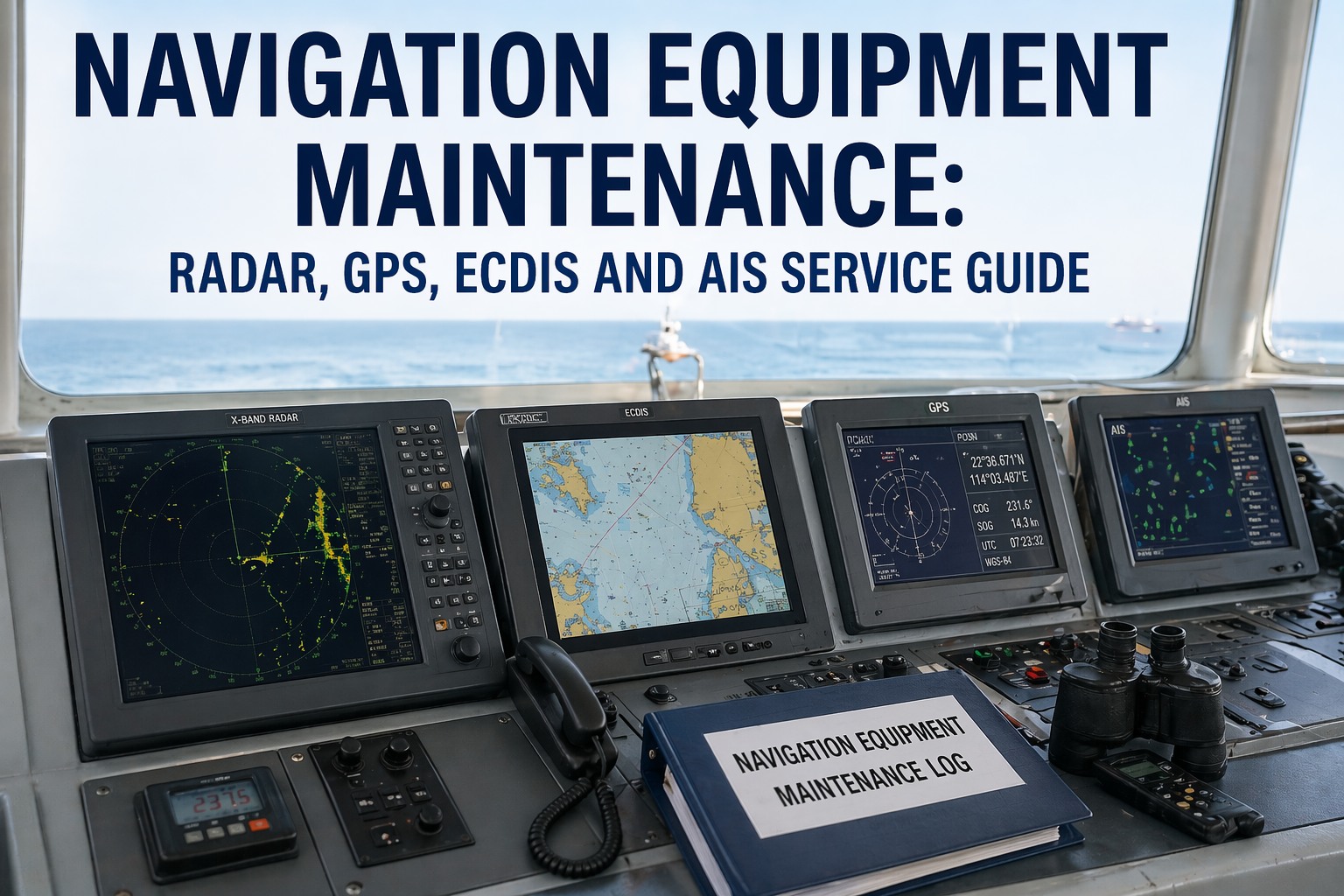
Navigation equipment failure at sea does not announce itself — it degrades quietly until the radar display shows phantom targets, the ECDIS position drifts by 0.3 nautical miles, the gyrocompass develops a 2-degree error that compounds over a 4-hour watch, or the AIS stops transmitting without triggering an alarm. EMSA's 2024 report documented over 2,800 maritime incidents in 2023, with 58.4% involving human failure — a category that includes errors stemming from poor maintenance and unchecked equipment degradation. When navigation systems deliver inaccurate data, the crew makes decisions based on a reality that doesn't exist. SOLAS Chapter V Regulation 19 mandates the carriage of specific navigation equipment based on vessel size and type: magnetic compass, gyrocompass, radar (9 GHz and 3 GHz depending on tonnage), ECDIS, GPS/GNSS, AIS, echo sounder, speed log, VDR/S-VDR, BNWAS, and rate of turn indicator. Regulation 18 requires all equipment to be type-approved and conform to IMO performance standards. But carriage is only the starting point — maintenance, calibration, testing, and software updates are what keep these systems delivering the accuracy that safe navigation depends on. ECDIS requires generic and type-specific operator training per STCW A-II/1, regular ENC updates, and annual checkups. Gyrocompasses need periodic settling error checks and professional calibration. Radar magnetrons degrade over time, reducing detection range before complete failure. Magnetic compasses require deviation adjustment after structural modifications or equipment changes near the compass. Marine Inspection tracks every bridge equipment item, calibration schedule, software update, annual survey, and VDR maintenance record across your fleet — book a demo to see how.
Complete Bridge Equipment Maintenance Schedule
| Equipment | Daily / Watch Checks | Weekly / Monthly | Annual Service | Calibration / Special | SOLAS Basis |
|---|---|---|---|---|---|
| Radar (X-band 9 GHz) | Performance check: target detection, range rings, heading marker alignment. Tuning verification. | Monthly: anti-clutter settings, range accuracy spot check, bearing accuracy check against known target. | Full service: magnetron power output, receiver sensitivity, antenna rotation speed, ARPA tracking accuracy. Display calibration. | Magnetron replacement: manufacturer schedule (typically 5,000-10,000 hrs). Bearing/range accuracy calibration. | V/19.2.3, MSC.192(79) |
| Radar (S-band 3 GHz) | Same as X-band. Verify different display from X-band. | Same as X-band. Compare performance with X-band for consistency. | Full service including ARPA/ATA functions. Second radar independence verified. | Same magnetron/calibration cycle. Antenna pedestal bearing inspection. | V/19.2.5 (ships 10,000 GT+) |
| ECDIS (Primary) | Position accuracy vs GPS/radar fix. Chart display correct for area. Alarms functioning (safety contour, XTD). | Weekly: ENC update installation. Monthly: backup arrangement test. Sensor input verification (GPS, gyro, log). | Annual checkup by authorised service engineer. Software version compliance. Display calibration. Backup test. | ENC data kept current (weekly NtM). Software updates per manufacturer. Type-specific training for operators. | V/19.2.10, A.817(19) as amended |
| ECDIS (Backup) | Verify operational. Position matches primary. Independent power source tested. | Monthly: switch to backup, verify full functionality. ENC data synced with primary. | Same annual service as primary. Independence from primary verified. | Paper chart folio maintained as alternative backup if not dual ECDIS. | V/19.2.10 backup requirement |
| GPS / GNSS | Position accuracy (compare with radar fix, visual bearings). HDOP value. Number of satellites tracked. | Monthly: antenna condition check. Differential correction reception verified (DGPS where available). | Receiver sensitivity test. Antenna cable integrity. Position accuracy comparison with surveyed position at berth. | Sub-metre accuracy with DGPS near coast. Check datum settings match chart datum. GNSS vulnerability awareness. | V/19.2.1.6, MSC.112(73) |
| Gyrocompass | Compare with magnetic compass. Settling error check. Repeater agreement across bridge wings, steering. | Monthly: gyro error calculation by azimuth/amplitude. All repeaters checked for agreement. Follow-up system test. | Professional service: bearing assembly, motor condition, power supply, damping. Settling time measurement. | Error determination after speed/latitude changes. Recalibration after any major repair. Accuracy within 0.5 degrees. | V/19.2.5, MSC.191(79) |
| Magnetic Compass | Compare with gyro. Record deviation. Check liquid level and bubble. | Monthly: deviation check on multiple headings. Lighting functional. Binnacle condition. | — | Compass adjustment by qualified adjuster after structural modifications, equipment changes near compass, or when deviation exceeds acceptable limits. Deviation card posted. | V/19.2.1, A.382(X) |
| AIS Transponder | Verify transmitting (check on other ship/shore). Position, course, speed data correct. | Monthly: MMSI, vessel name, dimensions, call sign verified correct. Antenna condition. | Annual test per MSC.1/Circ.1252. Transmit power, frequency, timing, position accuracy. | 10m antenna separation from VHF required. Update static data after any vessel modification. | V/19.2.4, MSC.74(69) |
| Echo Sounder | Reading compared with chart depth (corrected for tide, draught). Alarm set for safe depth. | Monthly: transducer condition (when accessible). Full-range test. Shallow/deep frequency selection. | Transducer inspection during dry dock. Calibration by bar check or comparison with known depth. | Frequency: 12-200 kHz depending on application. Speed of sound correction for water temperature/salinity. | V/19.2.3, MSC.74(69) |
| Speed Log | Speed reading compared with GPS SOG (accounting for current). Through-water/over-ground mode verified. | Monthly: impeller/electromagnetic sensor condition check. Log calibration verified. | Sensor inspection. Calibration on measured mile or by comparison with GPS in known current conditions. | Doppler logs: accuracy to 0.1 knots. EM logs: sensor face cleaning during dry dock. Pitot tubes: flush and inspect. | V/19.2.3, A.824(19) |
| VDR / S-VDR | Recording verified active (status indicator). No alarm conditions. | Monthly: playback test of recorded data. All sensor inputs verified recording. Capsule condition. | Annual performance test by authorised service provider. All 13 data items verified recording. Battery condition. | Float-free capsule: battery replacement per manufacturer (typically 2-3 years). Data retention: minimum 12 hours continuous. | V/20, MSC.333(90) |
| BNWAS | Verify operational during solo watchkeeping. Timer settings correct per company SMS. | Monthly: full cycle test (visual → audible → bridge alarm → remote alarm). | Annual service: timer accuracy, alarm escalation sequence, reset function. | Timer settings: typically 3-12 min first alert. Must not be capable of being disabled by watchkeeper. | V/19.2.2.3, MSC.128(75) |
ECDIS: The System That Demands the Most Attention
ECDIS has replaced paper charts on most SOLAS vessels — making it simultaneously the most critical and most maintenance-intensive navigation system on the bridge. A failure that isn't caught is worse than no system at all, because the crew trusts a display that is wrong. Sign up for Marine Inspection to track ECDIS software versions, ENC update compliance, and operator training records fleet-wide.
How Marine Inspection Manages Bridge Equipment Compliance
Conclusion
Navigation equipment maintenance is the discipline where accuracy degrades silently — a gyrocompass developing a 0.5-degree error, a radar magnetron losing 20% of its output power, an ECDIS displaying last month's ENC corrections, a speed log reading 0.5 knots fast — each individually marginal, collectively dangerous, and detectable only through systematic testing and calibration. SOLAS Chapter V mandates carriage of 12+ navigation systems depending on vessel size, and Regulation 18 requires all to be type-approved and conform to IMO performance standards. The maintenance regime spans daily OOW checks through weekly ENC updates, monthly sensor verification, annual service by authorised engineers, and periodic calibration against known references (measured miles, surveyed positions, bar checks, compass swings). ECDIS demands the most attention — ENC currency, software maintenance, backup testing, operator training, sensor integration, and annual checkups. VDR capsule batteries, radar magnetrons, and compass adjustments all follow their own replacement and service cycles. EMSA's 2024 data showing 58.4% of incidents involving human failure (including equipment degradation) confirms that missed maintenance directly causes maritime casualties. Marine Inspection provides the digital platform that tracks every calibration, every software version, every annual survey, and every operator certification — book a live demo today.