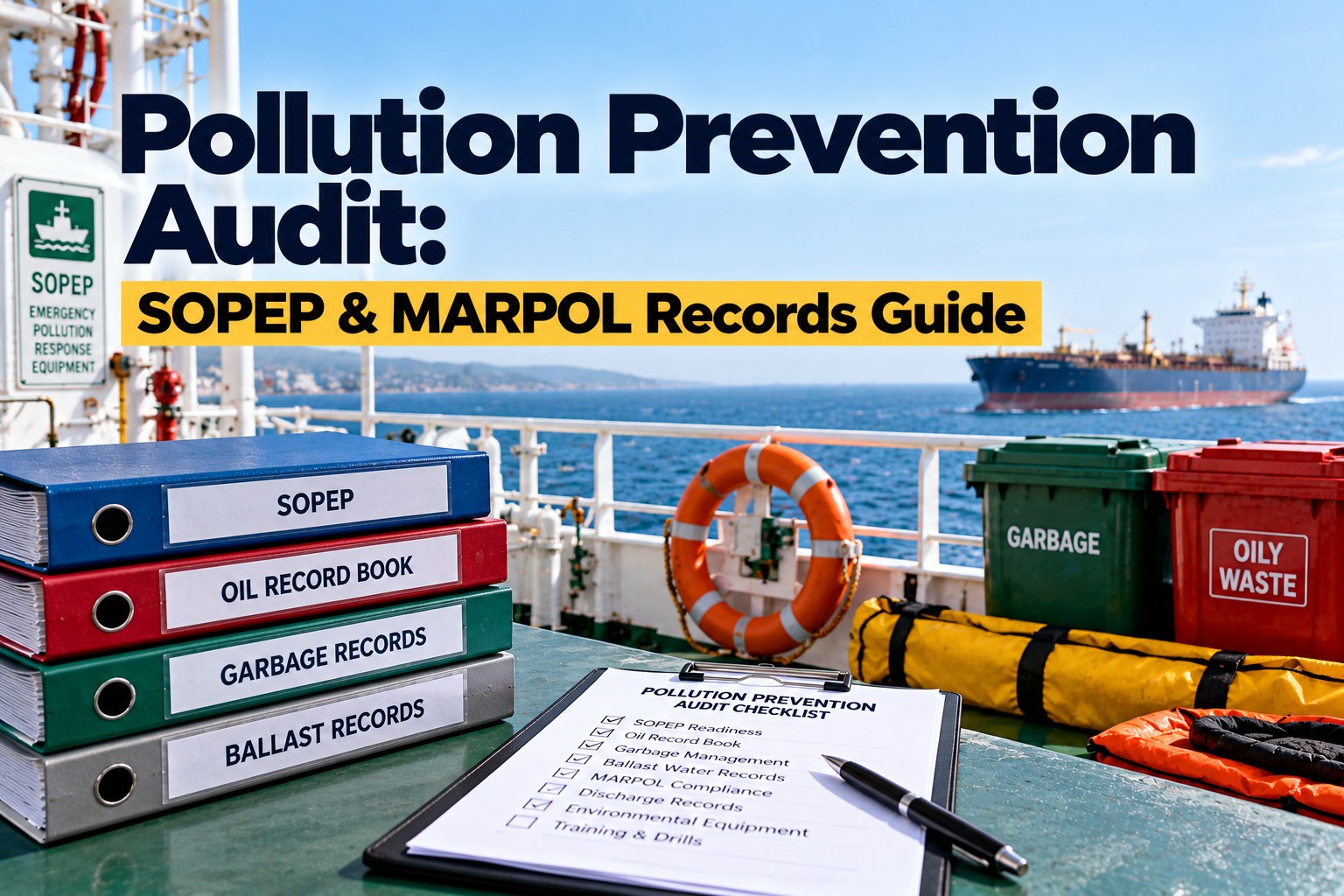
MARPOL compliance is proved almost entirely on paper: a record book, a receipt, a certificate, a plan. Port State Control knows this, which is why environmental records are checked on nearly every inspection and why gaps between them draw closer attention. This guide shows DPAs how to audit SOPEP, the oil and garbage record books, ballast water records and port waste receipts as one evidence set, and how to keep that evidence together in Marine Inspection.
Pollution prevention audit: SOPEP and MARPOL records checked annex by annex
Each MARPOL annex leaves its own trail of certificates, plans and records. Audit them one annex at a time, then check that the trails agree where they cross.
Why the pollution prevention audit needs every record, not just the oil record book
The oil record book gets the attention, but the most recent campaign shows inspectors going wider. In the 2025 Paris and Tokyo MOU campaign on ballast water management, the most frequent findings were poor record book-keeping, weak crew training and unfamiliarity with the system. For the content of each annex, see our MARPOL Annexes I to VI guide, and see environmental findings tracked per ship.
Detainable deficiencies, 2025 ballast water campaign (Paris MoU)
Campaign ran 1 September to 30 November 2025. Results as reported by IIMS, June 2026; the remaining share was not broken down.
MARPOL records audit matrix: what to check in each annex
Use this matrix as the spine of the audit. For each annex, confirm the certificate, the plan, the record book and its retention period, then do the quick live check in the last column. Turn the matrix into a free audit form.
| Annex | Certificate and plan | Record book and retention | Quick live check |
|---|---|---|---|
| I · Oil | IOPP certificate and supplement; SOPEP | Oil record book Part I (and Part II on tankers); 3 years after last entry | Sludge and bilge tank soundings against the last entries |
| II · Noxious liquids | NLS certificate; P&A manual; SMPEP | Cargo record book; 3 years after last entry | Prewash and discharge entries against port receipts |
| IV · Sewage | ISPP certificate | Discharge records as the SMS requires | Treatment plant running; holding tank level and overboard valve |
| V · Garbage | Garbage management plan; placards | Garbage record book; 2 years after last entry | Segregation bins labelled and used as the plan says |
| VI · Air | IAPP and EIAPP certificates; NOx Technical File | Bunker delivery notes 3 years; samples 12 months; fuel changeover records | Changeover times against ECA entry positions |
| BWM Convention | Ballast water certificate; approved BWM plan | Ballast water record book | Treatment system operating and its log matching the record book |
Electronic record books are allowed where approved by the flag State under IMO guidelines.
SOPEP audit: plan, contacts, drills and equipment
A SOPEP is required on oil tankers of 150 GT and above and on other ships of 400 GT and above under MARPOL Annex I regulation 37; ships carrying noxious liquids keep an SMPEP, often combined with it. The audit tests whether the plan would work tonight. Response procedures are set out in our SOPEP and oil spill response guide; see SOPEP drills and locker checks logged.
Approved and current
Approved by the flag, ship-specific, with drawings of fuel and oil lines, vents and tank positions.
Contact list in date
Coastal State and port contacts checked against IMO’s latest list; company and P&I numbers tested.
Drills that test the plan
Spill drills run at the interval the SMS sets, with scenarios that change and records of lessons learned.
Equipment complete
Sorbents, shovels, drums, plugs and protective gear match the inventory; scupper plugs fit the scuppers.
People know their role
Crew can say who reports, who closes valves and where the scupper plugs are.
Linked to transfers
Bunkering checklist includes scuppers plugged, drip trays empty and SOPEP gear on deck.
Contain the paperwork before it becomes a finding
Record books, port receipts, SOPEP drills and ballast logs filed per voyage, with gaps flagged while the ship is still at sea.
Garbage management audit: plan, placards and the record book
Garbage records are easy to check against what can be seen on deck and in the galley. The auditor compares the plan, the bins, the record book and the port receipts. Discharge rules are in our garbage management plan guide; log garbage entries with receipts free.
Garbage record book categories
Part II (J and K) applies to ships carrying solid bulk cargoes.
What to check
- Every entry has date, time, position, category and estimated quantity
- Incinerator entries agree with the incinerator log and the oil record book
- Shore deliveries backed by waste delivery receipts
- No plastics discharged at sea, ever
- Placards posted and the plan in the working language
- Book kept for two years after the last entry
Ballast water records audit: plan, system and record book
Ballast water was the 2025 campaign topic, and its results point straight at the records and the people. The record book must agree with the treatment system’s own log and with where the ship was. See ballast operations matched to positions.
Pollution records cross-checks that reveal real practice
Individual books can each look tidy. The real test is where they meet. These cross-checks take minutes and catch most of what an experienced inspector would catch. The oil record book entry codes themselves are explained in our oil record book entries guide.
Pollution prevention audit checklist
Tick these items during the audit. The last group is the cross-checks, which is where most real findings come from.
Certificates and plans
Record books
Equipment and people
Cross-checks
How Marine Inspection shows MARPOL compliance across the fleet
A DPA needs to see, at a glance, which ships are weak in which annex. Marine Inspection scores each ship’s environmental records annex by annex and turns the fleet into one heat map, so the next audit goes where the risk is. The map below is an illustrative five-ship fleet.
MV Bravo, Annex I: incinerator log shows 14 hours more running than the sludge incineration entries in the oil record book. MV Delta, BWM: two discharges recorded with the treatment system in bypass.
Pollution prevention audit FAQs
What does a pollution prevention audit cover?
Certificates, plans and record books for each MARPOL annex and the Ballast Water Management Convention, the SOPEP and its equipment, crew familiarity, and the cross-checks between records, receipts and equipment logs.
Which ships need a SOPEP?
Oil tankers of 150 GT and above and other ships of 400 GT and above, under MARPOL Annex I regulation 37. Ships carrying noxious liquid substances need an SMPEP, which can be combined with the SOPEP.
How long must MARPOL record books be kept?
The oil record book and cargo record book for three years after the last entry, and the garbage record book for two years. Bunker delivery notes are kept for three years and fuel samples for at least 12 months.
What are the garbage record book categories?
A plastics, B food waste, C domestic waste, D cooking oil, E incinerator ash, F operational waste, G animal carcasses, H fishing gear and I e-waste, plus J and K for cargo residues on ships carrying solid bulk cargoes.
What did the 2025 ballast water campaign find?
The ballast water system itself accounted for 46% of detainable deficiencies, crew training 21% and the management plan 15%, with poor record book-keeping among the most frequent findings.
Why compare record books with port receipts?
Because a receipt proves that waste recorded as delivered actually went ashore. Missing receipts or mismatched quantities are what inspectors look for first. Marine Inspection can attach receipts to each entry.
Every annex in order, every entry with its proof
Give the DPA one view of environmental compliance across the fleet, from SOPEP drills to ballast water records.