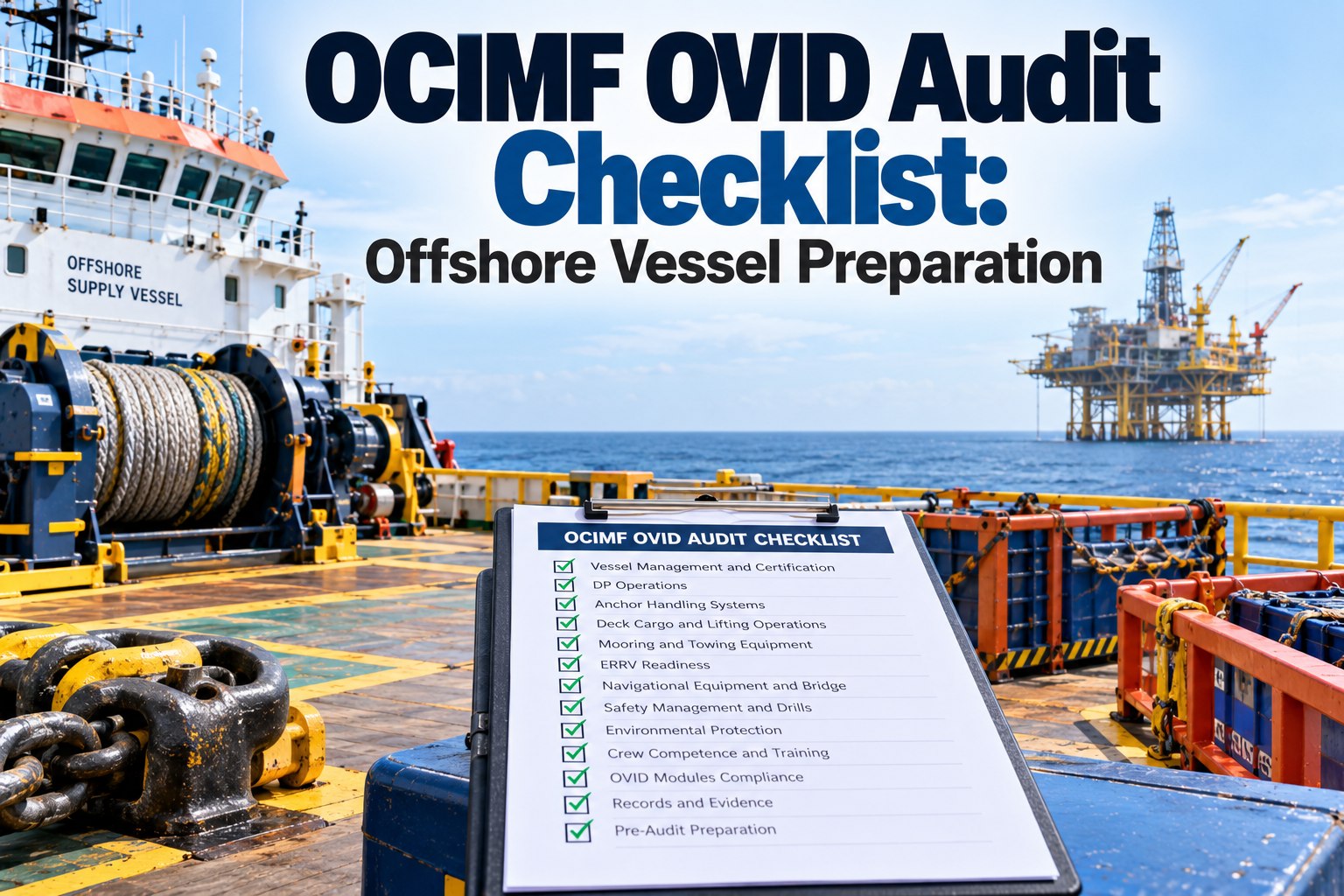
An OVID inspection does not examine a vessel type. It examines the capabilities you declared, which is a different thing and the reason two sister vessels can receive very different inspections. The questionnaire opens its operational and capability sections according to what the vessel is recorded as able to do, and that record belongs to the operator rather than to OCIMF. Declare generously and you have opened scope you then have to pass in front of an inspector. Declare narrowly and you lose work. That tension is the whole preparation problem.
OVID · Offshore vessel inspection
The inspection you get is the one you described
Fifteen chapters, with the last ones opening on capability
One chapter splitting into nineteen operation types
Every answer other than yes needing a reason
OVID preparation
Know which sections will open before the inspector does
The declared particulars are the first thing to audit
Before the inspector boards they read the vessel particulars the operator maintains: dimensions, tonnage, capacities, crane capability, dive spread, certification and crew competence. From that they work out which chapters apply, generate their working pocketbook and plan the visit. Nothing else in the process gives a QHSE manager as much leverage, and nothing else is as commonly left to drift.
Overstated capability opens scope
A capability recorded because the vessel once had it, or might have it, brings its whole section into the inspection. The questions are asked whether or not the equipment is still fitted and whether or not the current crew have ever used it.
Stale particulars make everything suspect
An inspector who finds the record disagrees with the ship in the first hour reads the rest of the day differently. The discrepancy is minor; what it does to the tone is not.
Crew competence is part of the record
Competencies recorded against the vessel set the expectation for who is on board. A declared capability with nobody aboard qualified to exercise it is the clearest finding in the set.
It is reviewed before every fixture, not every inspection
Charterers read the same record when assessing the vessel. Keeping it current is commercial work that happens to also govern the inspection.
The chapters, and what to have ready for each
The questionnaire runs to fifteen chapters, the last of which are capability-based rather than universal. Treat the right-hand column as the preparation list; most findings are availability problems rather than condition problems.
Chapter
Scope
What has to be to hand
1. General information
Vessel identity and the particulars behind it
Particulars record agreeing with the vessel in front of you
2. Certification and documentation
Statutory and class certificates, surveys, manuals
Current certificates with endorsements, and the master document list
Officer matrix, certificates, familiarisation records dated against joining
4. Navigation
Bridge procedures, passage planning, equipment
Passage plans for the current voyage, chart and publication status
5. Safety and security management
Management system in use, permits, drills, security
Recent permits, drill records naming what went wrong, risk assessments
6. Pollution prevention
Environmental management and the record books behind it
Record books consistent with the equipment and with each other
7. Structural condition
Hull, deck, tanks, coatings, closing appliances
Survey reports, coating condition records, defect list with its status
8. Operations
Splits by operation type — the largest variable in the inspection
Procedures and records for each operation the vessel is declared for
9. Mooring
Mooring arrangements, wires, winches, management
Line and wire certificates with retirement dates, winch brake records
10. Communications
Bridge and internal communications, radio equipment
Radio log, equipment test records, battery condition
11. Propulsion and machinery
Power generation, propulsion, machinery condition and upkeep
Maintenance record with its overdue list, alarm and shutdown tests
12. General appearance
The condition an inspector sees walking through
Nothing to produce — this one is decided before you speak
13. Ice
Opens only where ice capability is declared
Ice class documents, procedures, crew experience records
14. Helicopter operations
Opens where helideck or winching capability is declared
Helideck certification, equipment checks, trained team records
15. DP operations
Opens where dynamic positioning is declared
Annual trials, failure analysis, DP logs, operator competence records
Chapter numbering and content belong to the current questionnaire issue, which is revised over time, so confirm the live version against your own copy before building a preparation pack from it. The shape — universal chapters first, capability chapters last, operations splitting by type — has held.
Chapter 8 is the one that varies
Operations is not a single section. It divides by operation type, and the list is long: survey and geotechnical survey, diving, oil recovery, heavy lift, anchor handling, towing and pushing, supply, ERRV, accommodation, pipe lay, cable lay, gravel and stone discharge, ROV, icebreaking, drilling, well servicing and subsea, trenching and crew boats.
Anchor handling
Work wire and chain certification with retirement criteria, shark jaws and towing pin condition and testing, stern roller, winch brake capacity records, procedures for the moment things go wrong rather than for the routine case.
Supply and deck cargo
Deck load limits known and respected, cargo securing to a documented standard, hazardous goods segregation and documentation, bulk system integrity and the hose certification that goes with it.
ERRV and rescue
Daughter craft and fast rescue craft condition and launch testing, recovery equipment, the trained team actually on board, and survivor reception arrangements that have been exercised rather than described.
Diving and subsea
Dive spread certification, the interface procedures between the dive and marine teams, and the arrangements that stop the vessel moving while people are in the water.
The general advice for every one of these is the same: the questions follow the abnormal case. Procedures for a routine supply run are expected; what distinguishes a good result is having a documented, practised answer for the failure that the operation is known for.
Capability records that match the vessel on the day
Marine Inspection keeps declared capability, equipment certification and crew competence against the vessel, so the particulars an inspector plans from are the particulars you can stand behind.
Every question is answered in one of four ways, and three of the four require the inspector to write something. Understanding what each costs is most of the preparation nobody does.
A not-seen answer is the one worth attacking in preparation, because it is almost never about the ship. It is about whether the document, the test record or the competent person was available during the hours the inspector was aboard. The record side of that is the same discipline covered in our guide to planned maintenance systems.
How this differs from a tanker inspection
Scope comes from capability, not from a risk engine
A tanker programme builds each inspection from a question library according to vessel and crew risk factors. Here the applicable sections follow from what the vessel is declared able to do, which puts the operator much closer to the scope.
The fleet is far more varied
One questionnaire has to stretch across supply vessels, anchor handlers, construction and dive support, accommodation units, seismic vessels and crew boats. That is why so much of it is conditional.
Operations are the differentiator
On a tanker the cargo operation is the common ground. Offshore, the operation is the variable, and the operational section carries most of the weight an inspector gives the vessel.
The management system sits alongside
Operator self-assessment of the management system is a separate strand from the vessel inspection, so a strong vessel does not compensate for a weak office, and the two are read together — a point our ISM compliance and audit guide develops.
The preparation checklist
Twenty checkpoints. Mark only what you have seen produced within a few minutes, because that is the test the inspection applies.
PQDeclared particulars
Every declared capability is still fitted, working and crewed
Capabilities the vessel no longer offers have been taken off the record
Crane, deck and tank capacities agree with the vessel as she is
Crew competence entries match the people actually on board
The record was reviewed since the last change of equipment or trade
DCDocuments and certification
Certificates current, endorsed, and matching the vessel described
Officer matrix complete, with certificates for every declared capability
Wire, chain, hose and lifting gear certification with retirement dates
Familiarisation records dated against joining dates
The master document list is current and somebody can work from it
OPOperational sections
A procedure exists for every operation the vessel is declared for
Procedures cover the abnormal case, not only the routine one
Recent records show those operations being carried out as written
Equipment specific to each operation is tested and the test recorded
People who perform the operation can describe it without the manual
AVAvailability on the day
Records are reachable in minutes, by somebody who will be on board
Key personnel are not on leave or ashore during the visit
Spaces the inspector will want to enter are accessible and safe to enter
Outstanding defects have a status, an owner and a date
Findings from the previous inspection are closed with evidence aboard
Anything unmarked in the last group converts directly into not-seen answers, which is the cheapest category of damage to prevent. You can book a demo to see the checklist run against each vessel with its evidence attached.
After the inspector leaves
The visit is the short part. A report is validated and released within a fortnight, and from then on it is read by people who were never aboard and who will form a view of the vessel from it for as long as it remains the current one.
1
Read it as a charterer would
Not observation by observation, but as a picture. Three small documentary items in different chapters say something about the office; one condition item says something about the vessel. Charterers read the pattern, and so should you.
2
Answer every observation, including the ones you disagree with
An unanswered observation reads as an accepted one. Where you believe an answer was wrong, say so with the evidence rather than leaving the record to speak alone.
3
Separate the vessel fix from the fleet fix
Most observations have a version that applies to every vessel you run. Closing one on the ship it was found on, and nowhere else, guarantees meeting it again on a sister vessel in front of a different inspector.
4
Put the evidence back on board
An action closed in the office and unprovable on the vessel is not closed where the next inspection happens. The closure needs to arrive back at the ship with something that can be shown.
The useful measure over a few cycles is whether observations are changing. Repetition across inspections means the responses were corrections rather than changes to how the fleet operates, and that pattern is visible to everyone reading the database — you can see in a short demo how observations and their closures are tracked across vessels.
How Marine Inspection supports OVID preparation
Declared capability held against the vessel
Equipment, certification and competence kept with the ship they belong to, so the particulars record is maintained as part of operating rather than before an inspection.
Certification with its retirement dates
Wires, chains, hoses and lifting gear tracked to expiry, which is the documentary group that most often produces a finding on an offshore vessel.
Operation records captured as they happen
Anchor handling, cargo, rescue craft and DP activity logged at the time, so the evidence of practice exists without anybody assembling it.
Everything reachable within the visit
One place to search for the record an inspector asks for, which removes the not-seen answer that costs most and deserves it least.
Previous findings closed with evidence
Observations from the last inspection carried forward with their actions, so the first question of the next one has an answer ready.
The fleet view for the QHSE office
The same observation appearing across vessels shown as a pattern, which is where a procedure change does more than a vessel visit.
OVID preparation: frequently asked questions
What decides which parts of the questionnaire apply?
The capabilities recorded in the vessel particulars the operator maintains. Core chapters apply to everyone; the operational section divides by operation type, and the capability chapters open according to what the vessel is declared able to do. Scope is therefore largely set before anyone boards.
What happens if we declare a capability we no longer have?
The questions are asked anyway. A declared capability with equipment removed or nobody aboard qualified to use it produces findings that were entirely avoidable, so reviewing the record after any change of equipment, trade or crewing pattern matters more than most preparation work.
How are questions answered?
Yes, no, not seen, or not applicable. A no has to be specified, and both not seen and not applicable require a reason. Only a yes leaves nothing written, which is why availability during the visit matters as much as condition.
What is a not-seen answer really saying?
That the evidence could not be produced while the inspector was aboard. It is rarely about the state of the vessel and almost always about whether a document, a test record or a competent person was available, which makes it the easiest kind of damage in the report to prevent.
How does this differ from a tanker vetting inspection?
A tanker programme assembles each inspection from a question library using risk factors. Here the applicable sections follow from declared capability, the fleet covered is far more varied, and the operational section rather than the cargo operation carries most of the weight.
Which operations attract the most attention?
The ones with a known failure mode — anchor handling, towing, rescue craft launch and recovery, and lifting. For each, inspectors look past the routine procedure for a documented and practised answer to the abnormal case.
Offshore vetting
Control the scope before you prepare for it
Marine Inspection keeps declared capability, certification and operational records against the vessel and reachable in minutes — so the sections that open are ones you meant to open, and the evidence behind them is already there.