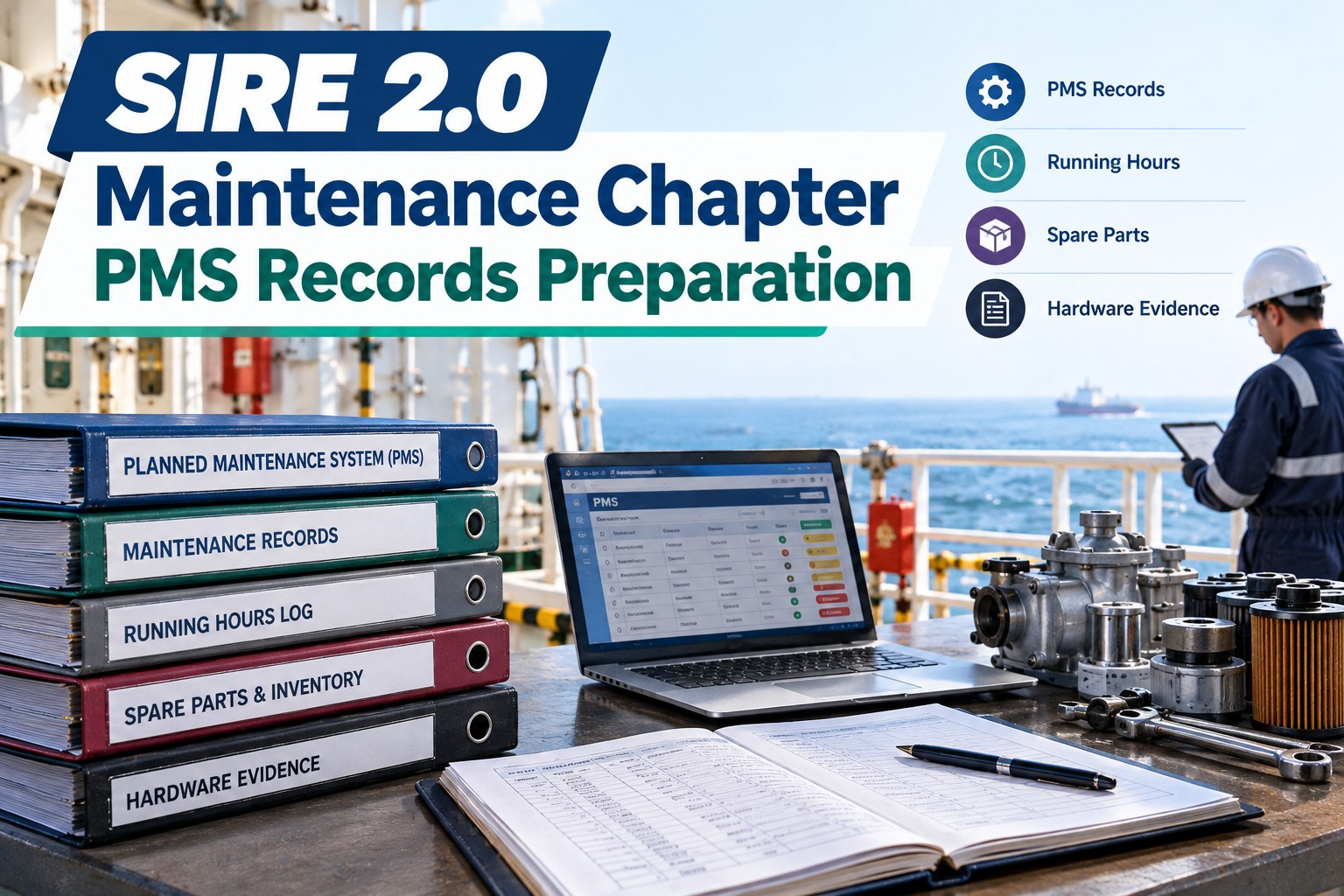
Look down the list of chapters and there is no maintenance chapter. Machinery spaces has one, cargo systems has one, mooring has one, but maintenance as a subject appears nowhere with its own number. That is not an omission. Every question in the set carries a hardware dimension alongside process and human factors, which means maintenance evidence is demanded in all twelve chapters at once — and the vessel that prepares a maintenance chapter has prepared for an examination that does not exist.
SIRE 2.0 · The hardware dimension
There is no maintenance chapter. Maintenance is the hardware answer to every question.
Each question is assessed for hardware, process and human factors. The hardware limb asks the same thing wherever it appears: is this equipment in the condition the records say it is, and can you show the work that put it there.
Anatomy of a record that answers the question
A completed maintenance record either closes the hardware limb or opens it. The difference is in fields that take seconds to fill and are routinely left thin. The record below is annotated with what each part is actually proving.
Job record — as an inspector reads it
1EquipmentNo. 2 auxiliary engine, unit 3 — identified to the component, not the system
2Routine and intervalThe job as scheduled, with the interval it runs on and the basis for it
3Due and doneBoth dates present, with the running hours at completion where the routine is hour-based
4Carried out byA named person, whose certification is reachable from here
5What was foundCondition described, measurements where the job produces them, not the word satisfactory
6Parts usedWhat was fitted, from where, with the traceability documents behind it
7EvidencePhotographs taken while the equipment was open, dated by the system rather than by hand
8Follow-onAnything the job raised, carried to a defect with an owner rather than mentioned in a remark
Rows 5, 6 and 7 are the ones most often empty, and they are the three that make the record evidence rather than an assertion.
Records that carry findings make the overdue list defensible as well, which is the subject of its own question and is covered in our guide to planned maintenance systems.
The chain an inspector follows
Nobody reads a maintenance system end to end during an inspection. They pick one piece of equipment and follow it through five steps, and any break in the chain is the observation.
01
The equipment
Seen in the space, in whatever condition it is in
02
Its routine
Does a scheduled job exist for it, on a defensible interval
03
The last completion
When it was done, by whom, and what was found
04
The evidence
Photographs, measurements, parts and their documents
05
The person
Asked to describe the job they are recorded as having done
Step five is where a strong system occasionally fails. A perfect record signed by an officer who cannot describe the work is worse for the vessel than a thin record from someone who clearly did it, because it raises a question no amount of paperwork answers.
Where the hardware limb bites, chapter by chapter
| Chapter |
The equipment behind the questions |
What the record has to carry |
| Certification and documentation | Anything whose certificate depends on a survey or test being done | The test behind the certificate, not just the certificate |
|---|
| Navigation and communications | Bridge equipment, radio installation, emergency power to both | Functional tests with results, and the battery condition behind them |
|---|
| Safety management | Fire-fighting and life-saving appliances, emergency systems | Servicing dates, and tests of the arrangements that have to act |
|---|
| Pollution prevention | Separating equipment, alarms, monitors, sludge and incineration plant | Calibration status and alarm tests recorded with their results |
|---|
| Maritime security | Hardening materials, access arrangements, alert systems | Inspection routines against items that are rarely used |
|---|
| Cargo and ballast systems | Inert gas plant, pumps, valves, venting arrangements, instruments | Overhaul history, alarm proving and instrument calibration |
|---|
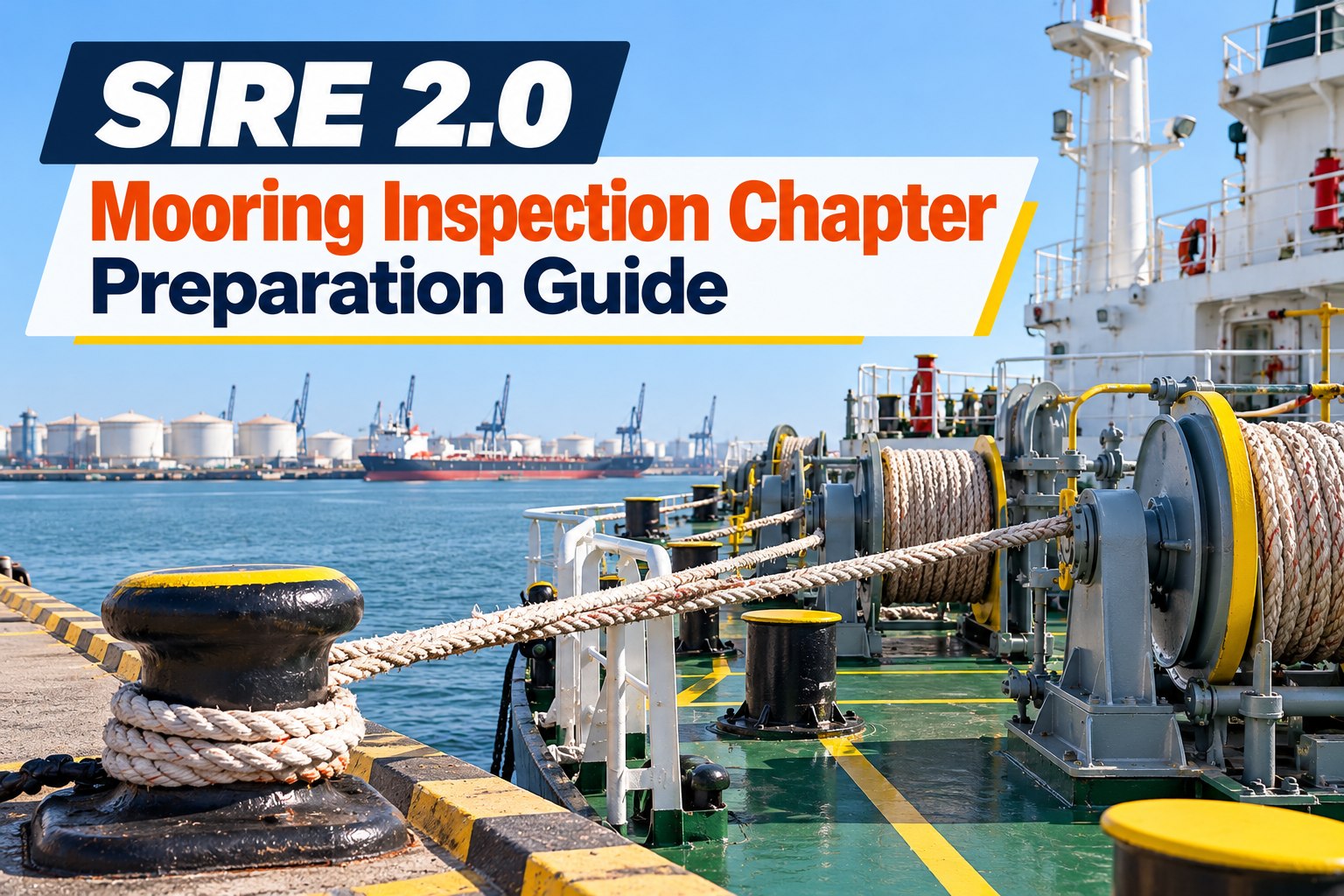
| Mooring and anchoring | Winches, brakes, lines and tails, windlass and cable | Brake tests with the figure marked, and line history by item |
|---|
| Machinery spaces | Main and auxiliary plant, steering, electrical distribution, bilge arrangements | The full chain — routine, completion, findings, parts and evidence |
|---|
Machinery spaces is where the chain is followed most often and most deeply, but the limb exists everywhere. The interval logic behind the heaviest of those routines is covered in our guide to main engine overhaul scheduling.
Evidence captured while the equipment is still open
Marine Inspection records findings, measurements, parts and photographs at the job rather than afterwards, with the person named and their certification attached — so the chain holds wherever an inspector picks it up.
Running hours, and the figure that has to be true
Hour-based routines rest on a counter, and the counter is checkable against things that do not lie. This is a small and recurring source of observations on otherwise well-run vessels.
The counter against the log
Hours recorded for a machine should be consistent with the engine room log and with the voyage. A generator showing hours it could not have run, or missing hours it certainly did, undermines every routine hung off that number.
Counter changes recorded
When a counter is replaced or reset, the event and the offset have to be written down. Without it the maintenance history before the change becomes impossible to read, which is a worse loss than it sounds.
The interval basis stated
Whether the figure comes from the maker, from class, from fleet experience or from condition monitoring. An interval nobody can source is an interval nobody can defend when it is exceeded.
Whichever comes first, applied
Where a routine runs on hours or calendar, the record should show which triggered it. Equipment serviced only ever on one of the two suggests the other is not being watched.
Defending a longer interval
Fleets increasingly run some routines on condition rather than on a fixed period, which is sound engineering and a harder answer to give. The question an inspector asks is not why you extended the interval but what you are watching instead.
The trend, not the last reading
A condition-based interval rests on a series. One analysis report proves nothing; a run of them showing a parameter holding steady or moving slowly is the argument. Keep the series together and in order, because that is the form the argument takes.
The limit set in advance
What reading brings the job forward, decided before the readings started. A threshold chosen after seeing the data is not a threshold, and an officer who cannot state one has described monitoring without a decision attached to it.
Who agreed to it
Where an extension touches something class has an interest in, the correspondence that permits it should be with the routine rather than in a separate folder ashore. Where it is purely a company decision, the person who took it should be named.
What happened the last time it moved
The strongest evidence that a condition-based regime works is a case where the data brought a job forward. A regime that has only ever extended intervals looks like a cost decision wearing engineering clothes.
Presented that way, a longer interval reads as a managed decision rather than a deferral with better vocabulary, and the conversation ends quickly. You can book a demo to see condition data, limits and routine changes kept against the equipment they govern.
The same logic applies to anything running on maker guidance that the vessel has departed from. The departure is defensible; the departure with no basis recorded against it is the finding.
Spares as part of the hardware answer
The spares question is not really about inventory levels. It is about whether the maintenance the records describe was physically possible.
1Parts fitted appear in the record
A job that renewed something should show what was renewed and where it came from. A completion with no parts against it describes an inspection rather than an overhaul.
2Stock moved when the job was done
If the record says parts were fitted and the inventory never changed, one of the two is wrong, and an inspector will not assume it is the inventory.
3Traceability documents are with the part
Certificates for parts that require them, reachable from the job rather than from a separate file nobody can navigate quickly.
4Critical spares are identified as such
The equipment whose failure matters most should be visibly treated differently in both the routines and the holdings, rather than sitting in the same undifferentiated list as everything else.
Deferral that survives the question
Overdue work is not disqualifying and never has been. What is examined is whether the deferral was a decision somebody took or a date that passed.
Defensible
Approved by a named person ashore
A reason recorded at the time
A compensating measure in place
A revised date that has not also passed
Not defensible
Overdue with nothing behind it
A reason added later, in a different hand
A date moved repeatedly without comment
Signed as complete when it was not
The last line in the right-hand column is the one that changes category. A job recorded as done that was not is a false record in the management system, and it is provable the moment the component is opened.
RCThe records
Jobs are identified to the component, not the system
Completions carry findings and measurements, not the word satisfactory
Parts fitted are recorded, with traceability reachable from the job
Photographs exist for work that was opened up
Every overdue item has an approval, a reason and a revised date
HWThe hardware and the people
Running hour counters agree with the engine room log
Counter replacements and offsets are recorded
Interval sources can be stated for the main routines
Stock movements match the parts shown as fitted
The person named on a record can describe the job they did
The last checkpoint is worth testing before an inspection does it for you. You can book a demo to see jobs, findings, parts and photographs held together against each piece of equipment.
Marine Inspection modules for the hardware evidence trail
MaintenancePlanned Routines · Running Hours · Defect Register
Carries routines against the component with their interval basis recorded, tracks running hours with counter changes and offsets, and raises anything a job finds as a defect with an owner rather than leaving it in a remark.
InspectionJob Records · Findings · Photo Evidence
Captures the condition found, the measurements taken and photographs while the equipment is still open, dated by the system, which is what turns a completion into something an inspector can be shown.
Spares & InventoryStock · Issues · Traceability Documents
Records parts issued at the job so the stock position and the maintenance record move together, and keeps traceability certification with the part rather than in a separate file.
Crew & CompetenceCertificates · Qualification Matrix
Links the person named on a job to their qualification, so the competence question behind a maintenance record is answered from the record itself.
Document ControlMaker Manuals · Procedures · Class Correspondence
Holds the maker guidance and class correspondence that interval decisions rest on, so an officer asked to justify a routine can produce the basis rather than describe it.
Reporting & AnalyticsOverdue View · Fleet Dashboard
Shows overdue work with its approvals across the fleet and flags items ageing without movement, which is where the deferral conversation happens while it is still cheap.
Maintenance evidence: frequently asked questions
Which chapter covers maintenance?
None of them, and all of them. There is no maintenance chapter in the question set. Every question is assessed across hardware, process and human factors, so maintenance evidence is demanded wherever equipment appears — concentrated in machinery spaces, but present in cargo systems, mooring, safety, pollution prevention and security too.
What does an inspector actually follow?
One piece of equipment through five steps: the equipment as seen, whether a scheduled routine exists for it on a defensible interval, the last completion with who did it and what they found, the evidence behind that completion, and then the person themselves, asked to describe the job. A break at any step is the observation.
What makes a completion record weak?
Recording the system rather than the component, closing with the word satisfactory instead of what was found, no parts against a job that clearly renewed something, no photographs of work that was opened up, and findings mentioned in a remark rather than carried to a defect with an owner.
Is overdue maintenance a finding?
Not in itself. What is examined is whether the deferral was decided or simply happened. An approval by a named person, a reason recorded at the time, a compensating measure and a revised date that has not also passed is defensible. Overdue with nothing behind it is not, and a job signed as complete when it was not is a different and far more serious category.
Why do running hours matter so much?
Because hour-based routines rest entirely on that figure. The counter should be consistent with the engine room log and the voyage, counter replacements and offsets should be recorded, and where a routine runs on hours or calendar the record should show which one triggered it.
What is really being asked about spares?
Whether the maintenance the records describe was physically possible. Parts fitted should appear in the job, stock should have moved when the work was done, traceability documents should be reachable from the record, and critical items should be visibly treated differently from ordinary stock.
The hardware limb
Prepare the chain, not the chapter
Marine Inspection keeps routines, completions, findings, parts and photographs on one record against each component, with the person named and their qualification attached — so wherever an inspector picks up the chain, it holds all the way through.