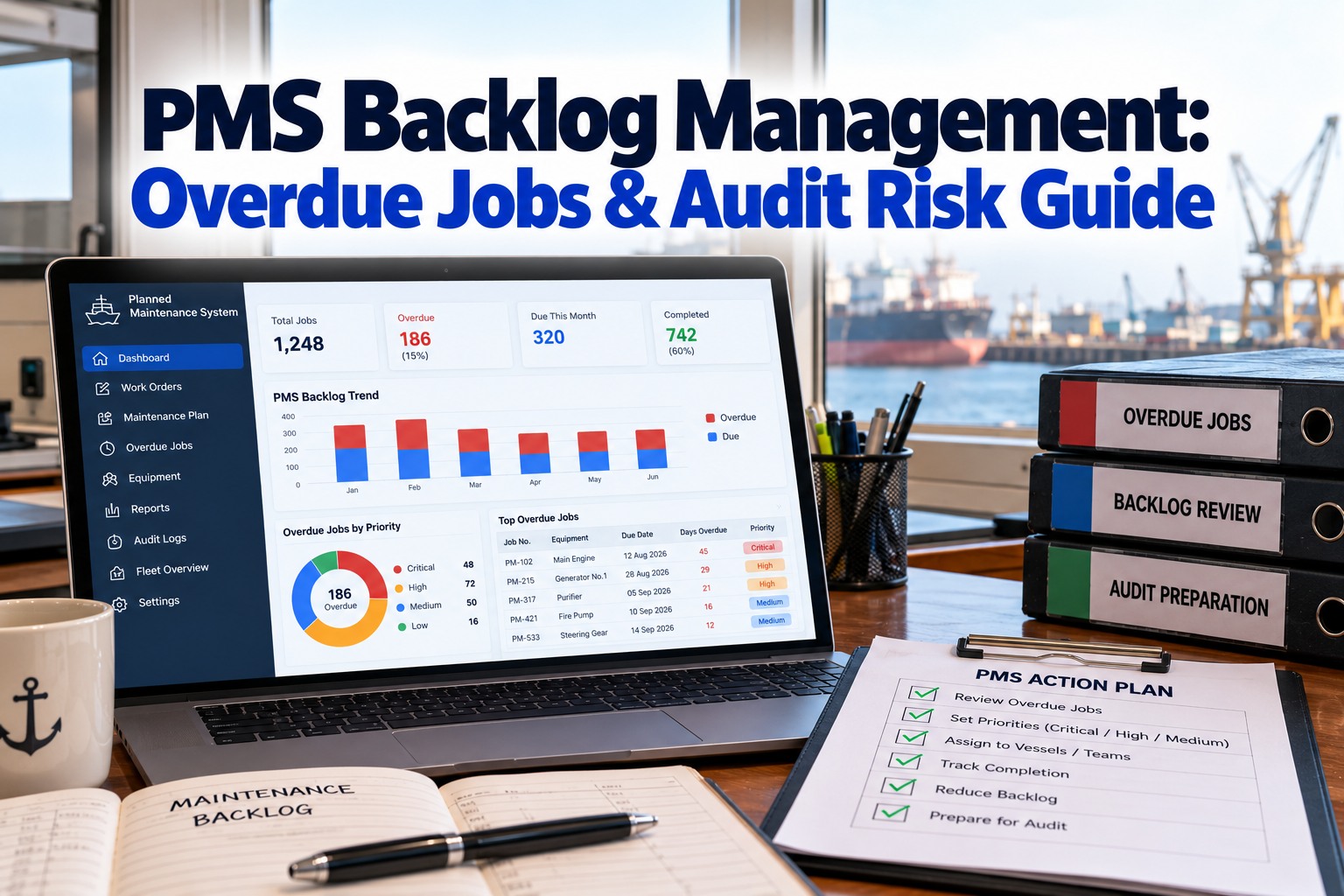
Every fleet has PMS backlog. The question is whether anyone is managing it. Overdue jobs pile up quietly through short port stays, missing spares and a busy crew, until a PSC officer finds a defect on deck and asks to see the maintenance records. Then a list of overdue red lines becomes an ISM finding, or a detention. This guide is for fleet managers. It shows how to measure backlog properly, rank overdue jobs by risk, clear it with a 90-day plan and fix the causes so it does not come back. Book a demo to see fleet-wide backlog tracking in Marine Inspection.
PMS backlog management: find the overdue jobs before an auditor does
PMS backlog: why overdue jobs are an audit red flag
A PSC officer rarely starts with the PMS. They start with a defect, then follow it back into the maintenance system. If the job was overdue, the problem stops being one broken item and becomes an ISM Code question.
An Isle of Man PSC notice lists, as a detention reason, a ship whose ISM system for effective maintenance and defect reporting was not effectively carried out on board. For how detentions build from single deficiencies, see our guide to PSC detention deficiencies and prevention.
Measuring PMS backlog: count, age and crew-weeks
A single “number of overdue jobs” hides more than it shows. Ten overdue cleaning jobs and one overdue steering gear test are not the same backlog. Use three measures together.
How many jobs are overdue
Easy to report, but treats every job as equal. Split it into critical and class items versus routine.
How long they have been overdue
Group into 0–30, 31–90 and 90+ days. Old critical jobs are where audit findings live.
How long to clear it
Estimated hours of open work divided by the crew’s weekly maintenance hours. The best single measure of whether a ship can catch up.
Worked example
Fabrico’s example: 4 people at 40 maintenance hours a week. On board, use the hours the engine crew can really give to planned work.
Bands are Fabrico’s guidance for industrial plants. Ships with small crews and short port stays may need their own targets.
Overdue jobs by risk: prioritising the PMS backlog
Do not clear the backlog oldest first or easiest first. Clear it by risk. Two questions place every overdue job: how critical is it, and how long has it been overdue?
See every overdue job across the fleet, ranked by risk
PMS backlog reduction: a 90-day clearing plan
A clearing campaign works when it has a start, an end and an owner. This sequence suits a ship, or a fleet, that has drifted into the 4+ crew-week zone.
Clean and triage
- Find jobs done but never closed in the PMS
- Retire jobs for equipment no longer fitted
- Split ready work from work waiting on spares or port time
- Place every job on the risk matrix
Targeted catch-up
- Clear the critical quadrant first
- Order missing spares in one push
- Plan port calls for jobs needing shutdown
- Consider a riding crew for heavy catch-up
Fix the cause
- Review intervals that keep slipping
- Match planned hours to real crew capacity
- Set a backlog target for each ship
- Review it weekly on board, monthly ashore
Root causes of PMS backlog and overdue maintenance
Backlog is a symptom. Clear it without fixing the cause and it is back within a few months. Many causes trace back to how the PMS was set up in the first place; our planned maintenance system guide covers the foundations.
Spares not on board
Jobs wait on parts. Link the spares to the job when it is planned, not when it falls due.
Crew capacity
More planned hours than people. Check the plan against the real crew size.
Trading pattern
Short port stays leave no time for shutdown work. Plan these jobs around known longer calls.
Wrong intervals
Intervals copied from a sister ship or set too tight. Review against maker guidance.
Done but not recorded
The work happened but the PMS never heard. Make recording part of finishing the job.
Waiting for the yard
Jobs pushed to a dry dock that keeps moving. Give each one a date and a risk review.
PMS backlog audit-risk checklist
Maritime Mutual recommends logging known defects as non-conformities, reporting them ashore and disclosing outstanding items at the PSC opening meeting. For full inspection preparation, see our port state control inspection preparation guide.
How Marine Inspection helps fleet managers control PMS backlog
Marine Inspection shows backlog across the fleet in crew-weeks, age and risk, not just a count. It ranks the overdue jobs that matter, and tracks a clearing campaign from the first day to the last. The burn-down below is illustrative.
PMS backlog: frequently asked questions
What is a healthy PMS backlog?
How do you measure maintenance backlog?
Can PMS backlog lead to a detention?
What should we clear first?
Can PMS jobs be postponed?
Backlog you can see is backlog you can clear
Crew-weeks, age and risk for every ship, and an audit trail that shows you are in control.