AMOS is the reference point in ship maintenance software for a reason: the first purpose-built PMS for vessels, AMOS-D, shipped in 1984 running on DOS, and four decades of maritime deployment have left the platform with maintenance, procurement, inventory and compliance depth that few products match. SpecTec reports the suite running across more than 3,000 vessels and 300-plus customers worldwide, available in tiered configurations and deployable on-premise, in a vendor-managed cloud, in a customer-managed cloud, or hybrid. So when a technical director starts researching AMOS alternatives, it is almost never because the software cannot do the job. It is because the fit has drifted — the licence and professional-services line has outgrown a 12-vessel fleet, the crew works on phones while the system expects a desktop in the ship's office, the upgrade path needs an IT project every cycle, or the renewal quote landed at a number that no longer maps to how the fleet actually operates. This guide sets out the four categories of alternative available in 2026, the capability lines that genuinely differentiate them, the total-cost-of-ownership items that never appear in a proposal, and a migration sequence that survives contact with a live fleet. Start a free trial of Marine Inspection to run your own equipment hierarchy against a modern cloud PMS before you commit to another renewal cycle.
Why Fleets Start Evaluating AMOS Alternatives
The trigger is rarely a missing feature. It is a mismatch between what the platform was architected for and how the fleet runs today. These are the six signals that most often start a replacement evaluation, drawn from the questions technical directors and IT managers actually bring to vendor calls. Book a Marine Inspection demo to see how the same workflows look on a mobile-first platform before you decide whether a switch is warranted.
The Four Categories of AMOS Alternative
Every credible alternative sits in one of four architectural tiers. The tiers differ far more from each other than the products inside each tier differ among themselves, so identifying the right tier eliminates most of the shortlist before a single demo is booked.
Integrated suites covering technical management, procurement, crewing, voyage, chartering and finance on one data model. Deep, configurable and genuinely enterprise-grade, with custom quotations, multi-year terms and implementation measured in quarters.
The tier AMOS itself occupies, alongside other long-standing maritime specialists. Class-recognised planned maintenance depth, mature spares and procurement modules, tiered editions and a choice of on-premise, managed-cloud or hybrid deployment.
Mobile-first platforms built after the smartphone, with offline create-edit-submit on the vessel, ship-to-shore sync when the link returns, per-vessel published pricing and deployment in weeks rather than quarters. Narrower than ERP by design.
Strong land-based asset and work-order tooling adapted for marine use. Capable on shore facilities and shipyard plant, but typically without Continuous Machinery Survey logic, certificate windows or ship-to-shore offline sync.
Capability Comparison: What Actually Separates the Tiers
Feature grids from vendors tend to converge, because every platform claims every capability. The lines below are the ones where architecture forces a real difference, together with the verification question that exposes it during a demo. Sign up for Marine Inspection and test these against your own equipment register rather than a vendor sandbox.
| Capability Line | Legacy or Enterprise Suite Pattern | Modern Cloud PMS Pattern | Verify in the Demo |
|---|---|---|---|
| Class and ISM evidence | Mature survey-credit handling, long track record with class societies, PMS survey arrangement well understood | Certificate windows and survey due dates tracked natively; confirm class acceptance for your society and flag | Ask which societies have accepted the system for PMS survey arrangement, and request a reference vessel |
| Offline crew working | Onboard client with periodic replication; core workflows often assume a shore-office desktop | Full create, edit and submit offline on phone or tablet, syncing when satellite or port connectivity returns | Put the device in airplane mode, close a job with photos, then reconnect and watch the sync resolve |
| Deployment model | On-premise, vendor-managed cloud, customer-managed cloud or hybrid, chosen at contract stage | Multi-tenant cloud only, with no server, no client install and no version pinned to a vessel | Ask who patches what, and what a version upgrade costs the fleet in downtime |
| Time to first value | Commonly 6 to 15 months across configuration, migration, integration and training | Roughly 6 to 10 weeks for a fleet of five to eight vessels where records are reasonably complete | Request the phased plan with named milestones, not an average timeline |
| Pricing structure | Custom quotation by fleet, module and user; three-year terms typical; services quoted separately | Published per-vessel or per-user subscription with the module set defined up front | Ask for year-one and year-three totals in writing, including services and support |
| Spares and procurement | Deep procure-to-pay, supplier performance analytics, budget control and contract management | Stock levels, minimum thresholds, requisition and reorder; heavy procurement often via integration | Map your actual requisition-to-PO chain and identify where it leaves the system |
| Reporting access | Powerful once configured; complex queries may need a specialist or a service request | Self-serve dashboards for overdue counts, backlog by vessel and completion rate | Ask a superintendent-level question live and time how long the answer takes |
| Integrations | Established connectors into ERP, finance and supply chain, usually a scoped project | Documented API and standard connectors; depth varies sharply between products | Name your finance and telematics systems and ask for a working reference, not a roadmap |
| Scope breadth | Chartering, voyage, crewing and finance available on the same data model | Maintenance, inspection and compliance only; commercial functions stay in separate systems | List the modules you would genuinely operate in year one and price only those |
Total Cost of Ownership: The Lines That Are Not in the Proposal
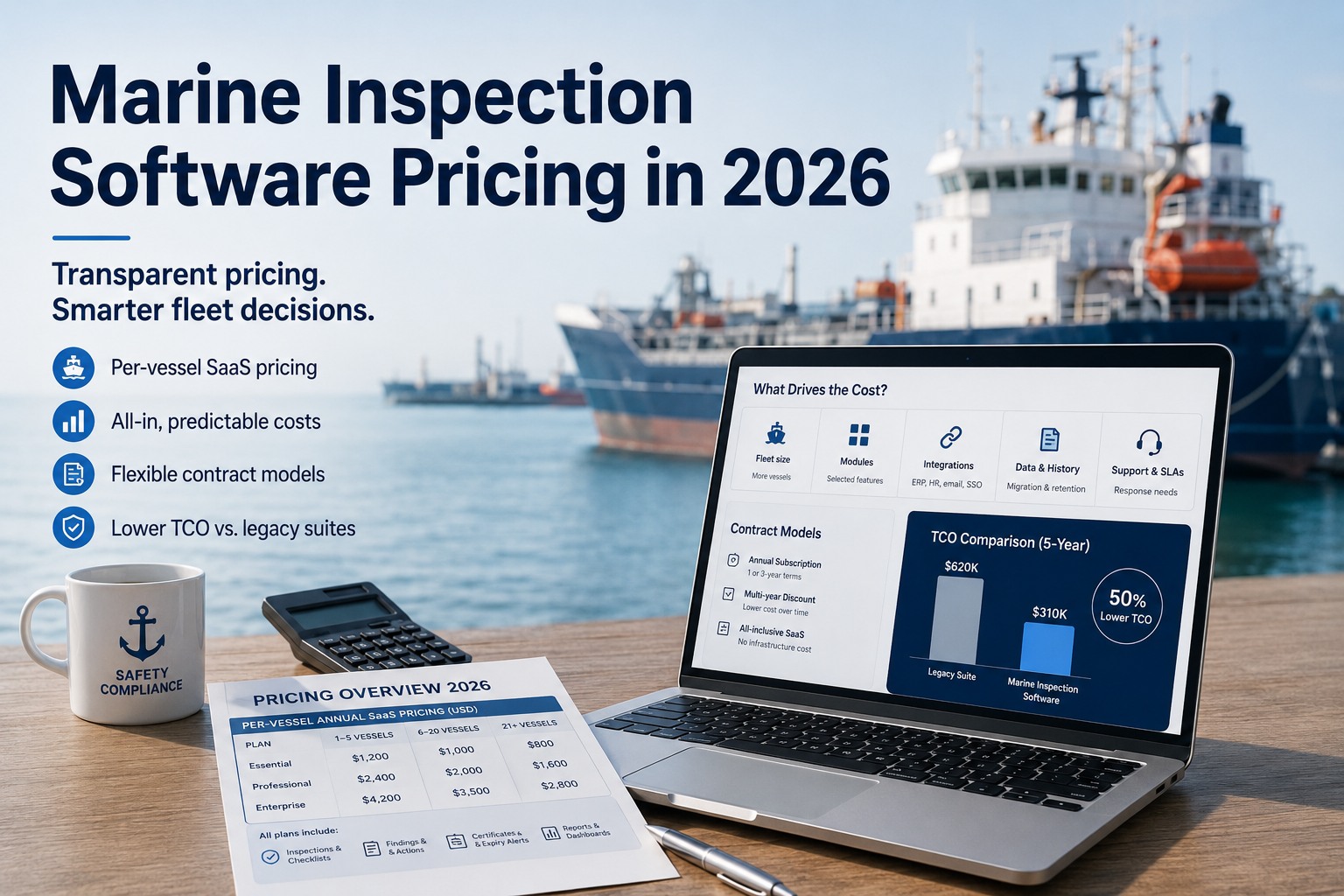
Licence price is the most quoted and least decisive number in a maintenance software decision. Analysts tracking the 2026 market report that unlisted cost items routinely inflate first-year total cost of ownership by 20 to 40 percent when they are not surfaced before signature. Schedule a demo to see transparent per-vessel pricing applied to your fleet without a custom-quote cycle.
| Cost Line | Enterprise or On-Premise Pattern | Cloud Subscription Pattern | Question to Put in Writing |
|---|---|---|---|
| Implementation services | Frequently adds 20 to 30 percent to first-year spend | Often bundled or a fixed onboarding fee | What is the fixed-fee ceiling for go-live across the whole fleet? |
| Data migration | Scoped per vessel; historical job data and spares catalogues priced separately | Standard extract, cleanse, map and validate cycle, usually included | How many years of history are included, and who owns the cleansing? |
| Infrastructure | Shore server, backup, disaster recovery and eventual hardware refresh | None — hosting, backup and patching sit with the vendor | What happens at the next server end-of-life date? |
| Version upgrades | Planned project with testing, downtime and sometimes consultant time | Continuous release with no fleet action required | What did the last major upgrade cost an existing customer? |
| Training and turnover | Per-user training, repeated as crews rotate every few months | Role-based onboarding and in-product guidance for new joiners | What is the retraining cost for a full crew change? |
| Integration builds | Each connector scoped and quoted as its own project | Documented API access, typically within the subscription | Is API access included at our tier, or gated behind an upgrade? |
| Contract exposure | Three-year terms typical, with renewal uplift at renegotiation | Annual or monthly terms with published rates | What is the maximum permitted annual increase, in the contract? |
Migration Sequence That Survives a Live Fleet
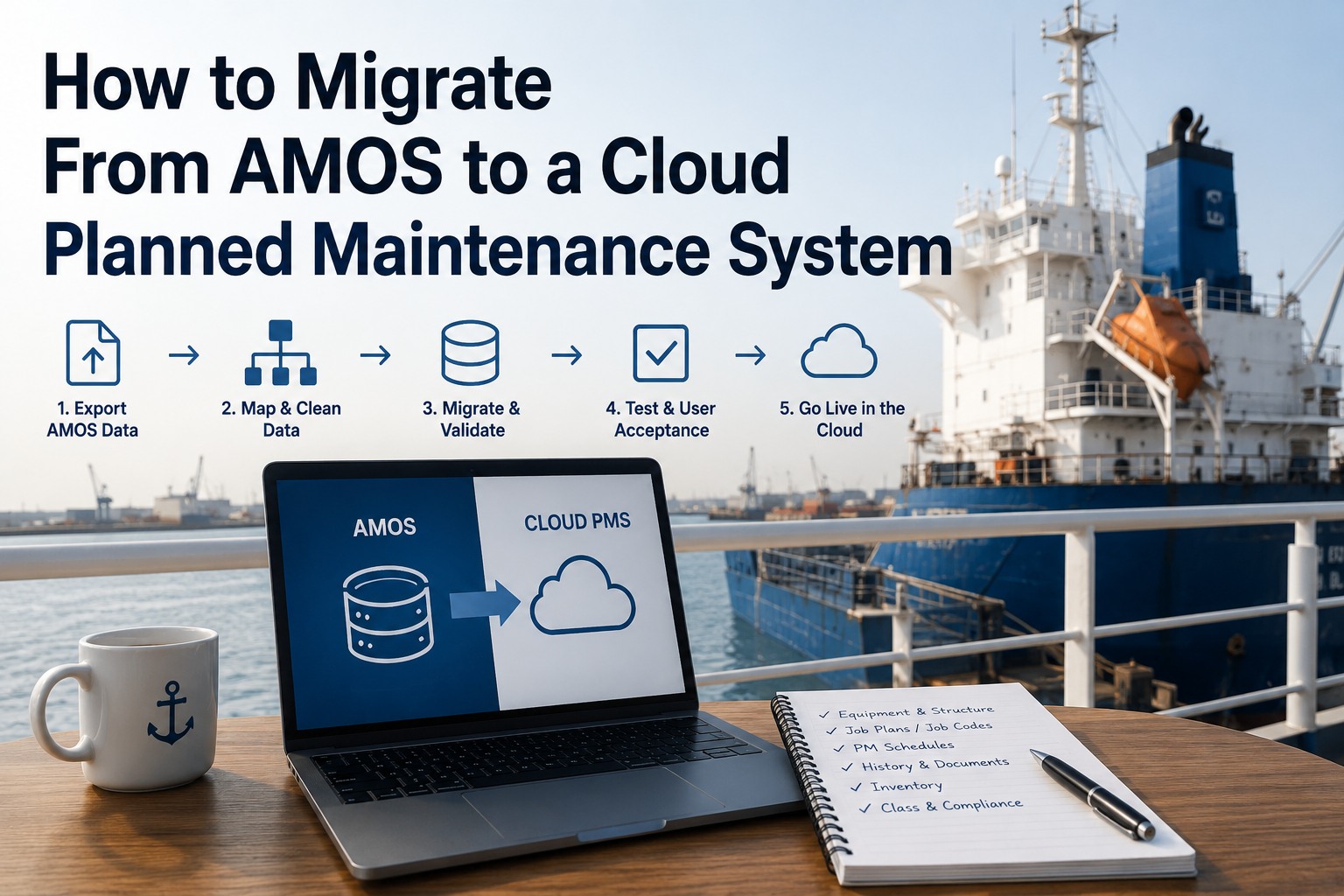
The risk in replacing a maintenance system is not the software. It is the data and the handover. Migration research consistently puts 80 to 83 percent of projects over budget or over schedule, and maritime migrations are harder than most because every vessel carries its own operational history. This five-phase sequence is the pattern that holds up. Start a free trial and run phase three on a single vessel before committing the fleet.
Demo Checklist: What to Test Before You Sign
Run this against every shortlisted platform, including your incumbent at renewal. It is built around the items that separate a system crews use from one they work around. Book a walkthrough with Marine Inspection and work through these points against your own vessel data.