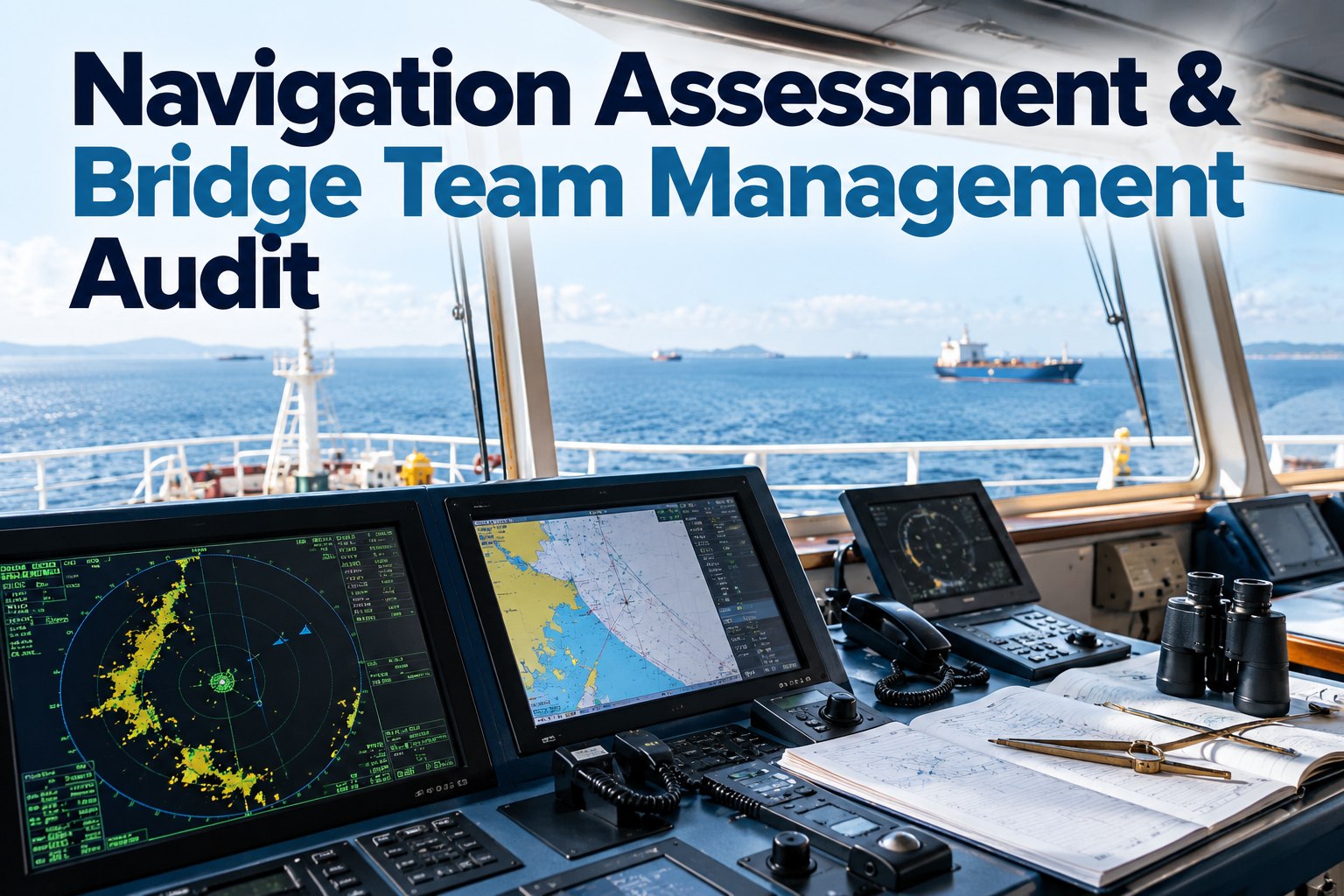
A bridge team audit asks one question the paperwork cannot answer: when the passage plan meets real traffic, weather and fatigue, does the team on watch still behave the way the Safety Management System says it will? For the Designated Person Ashore (DPA) this is the audit with the longest reach. ISM Code element 4 gives the DPA direct access to the highest level of management, so what you observe on the bridge is what top management hears. EMSA's Annual Overview of Marine Casualties and Incidents 2025 links 64.5% of accident events to human action, which is why grounding and collision prevention is judged on team behaviour as much as on equipment. This guide covers the four stages of voyage planning (IMO A.893(21)), the Bridge Resource Management (BRM) behaviours to watch, a situational-awareness check, a 1-4 observation scale and a DPA close-out loop. Start a free trial of Marine Inspection to record bridge observations on a tablet, with photo evidence and automatic corrective-action tracking.
Bridge Team Audit: The Numbers That Frame the Observation
64.5%
Accident Events
Linked to human action (EMSA 2025)
78.8%
Human Element
Of investigated incidents involved it
4
Planning Stages
Appraisal, planning, execution, monitoring
2,659
Casualties in 2024
Marine casualties and incidents, EU scope
Where the Human Element Shows Up in Casualty Data
Incidents with human element
78.8%
Accident events: human action
64.5%
Contributing factors: human behaviour
50.5%
Source: EMSA Annual Overview of Marine Casualties and Incidents 2025, covering 2015-2024. Figures describe EU-reported casualties and are an indicator, not a prediction for any single vessel.
DPA ROLEISM Code element 4 requires the company to designate a person ashore with direct access to the highest level of management. Element 12 calls for review and evaluation of the SMS, including internal audits. A bridge team audit is the point where both elements meet: an observation on the bridge becomes a finding, and the finding reaches the people who can fund or change the fix.
1
Appraisal
All relevant information gathered: charts, sailing directions, weather, draught, port data. Audit question: was anything missing before the track was drawn?
2
Planning
Berth-to-berth plan on charts, with safe speed, alteration points, position-fixing method and contingencies. Master approves before departure.
3
Execution
The voyage follows the plan or changes made to it. Audit question: are deviations recorded and briefed to the whole team?
4
Monitoring
Progress tracked against plan, with primary and secondary position fixing and plan details available on the bridge.
Passage-Plan Execution: What the Auditor Observes and Verifies
Six BRM Behaviours to Score on Every Bridge Visit
C
Challenge and Response
Does the OOW voice a doubt, and does the master acknowledge it without defensiveness?
L
Closed-Loop Communication
Orders are repeated back and confirmed, including helm and engine orders.
X
Cross-Checking
Radar, ECDIS, visual bearings and depth are compared, not trusted individually.
W
Workload Management
Tasks are shared. Is a lookout posted, or is the OOW doing everything alone?
H
Watch Handover
Relieving officer is briefed on traffic, plan status, standing orders and alarms.
M
Master-Pilot Exchange
Plan shared, pilot's intentions queried, and the team keeps monitoring the pilot.
BRM behaviours are easier to defend in a management review when each score has evidence behind it. See how Marine Inspection captures observation notes and photos against each behaviour during a live watch.
Situational Awareness: Three Levels to Probe
LEVEL 1
Perception
Ask: what is around us right now? Can the OOW name the closest targets, depth and set without checking the screen first?
LEVEL 2
Comprehension
Ask: what does it mean? Does the OOW know which targets are give-way and which are stand-on, and why a particular alarm matters?
LEVEL 3
Projection
Ask: what happens in the next 20 minutes? Where is the next alteration point, the nearest abort option and the next CPA concern?
The three-level model is a widely used situational-awareness framework. The probing questions are suggested prompts, not a regulatory text.
Turn Bridge Observations Into Management Evidence
Record scores, photos and corrective actions in one place, then show top management the trend across every vessel in your fleet.
Good Practice You Should See
Departure briefing involves every watchkeeper, and anyone may ask questions
Junior officer queries a course alteration and receives a reasoned answer
Lookout posted and relieved on schedule in restricted visibility
ECDIS alarms set for the voyage and checked at handover
Deviations from the plan are announced and written up
Warning Signs to Escalate
Master gives orders and no one questions them, even when a doubt is visible
Alarms muted or limits widened to stop nuisance alerts
OOW leaves the bridge conning position for routine tasks while traffic is close
Handover completed in under a minute with no plan status given
Pilot left unmonitored, with the team assuming the pilot is right
Suggested 1-4 Observation Scale for the Audit Report
This scale is our suggested model for structuring observations. It is not part of the ISM Code or any class or flag requirement. Adapt the labels to your SMS.
The DPA Close-Out Loop
1
Observe
Score behaviours in real traffic, not only in port
→
2
Debrief
Share findings with master and officers the same day
→
3
Escalate
Take patterns to top management with evidence
→
4
Verify
Re-observe at the next visit to confirm the fix held
DPA Bridge Team Audit Checklist
Before the Visit
Review the last bridge observations, near-miss reports and navigation-related non-conformities for the vessel
Confirm the voyage includes confined water, pilotage or heavy traffic so behaviour is observable
Agree the observation scale and BRM behaviours with the master in advance
Passage Plan
Appraisal evidence on file and plan approved by the master before departure
ECDIS plan matches the paper chart, with safety values and alarms set for the voyage
Position-fixing method, frequency and contingency or abort options stated in the plan
Team Behaviour
Departure briefing held with all watchkeepers and the pilot, with questions invited
Challenge and response, and closed-loop orders, observed at least once
Lookout and workload arrangements match traffic and visibility
Watch handover includes plan status, traffic, standing orders and alarm state
Follow-Up
Findings debriefed with the master and officers before leaving the vessel
Corrective actions assigned with owners and dates, and re-observation scheduled
Fleet-level patterns reported to top management
What is a bridge team management audit?
It is a structured observation of how the bridge team plans, communicates and monitors during a real watch. It combines a review of the passage plan and records with scored observation of BRM behaviours such as challenge and response, cross-checking and handover.
Why is the DPA involved in navigation audits?
ISM Code element 4 gives the DPA direct access to the highest level of management. Navigation findings often point to shore-side causes such as manning, schedules or training, and the DPA is the person placed to take them upward.
What are the four stages of voyage planning?
IMO Resolution A.893(21), supporting SOLAS Chapter V regulation 34, sets out appraisal, planning, execution and monitoring. The master must approve the plan before the voyage starts.
How often should bridge team audits be done?
The ISM Code does not set a bridge-specific frequency. Many companies include a bridge observation in each internal audit and add extra visits after navigation near-misses or when a new master or senior officers join. Set the interval in your SMS and keep to it.
Can bridge observations be recorded digitally?
Yes. Marine Inspection lets auditors score observations, attach photos and assign corrective actions from a tablet, even offline.
Start a free trial to try it on your next bridge visit.
Make Every Bridge Visit Count
Give your DPA team one system for passage-plan checks, BRM scoring, corrective actions and fleet-level trends.