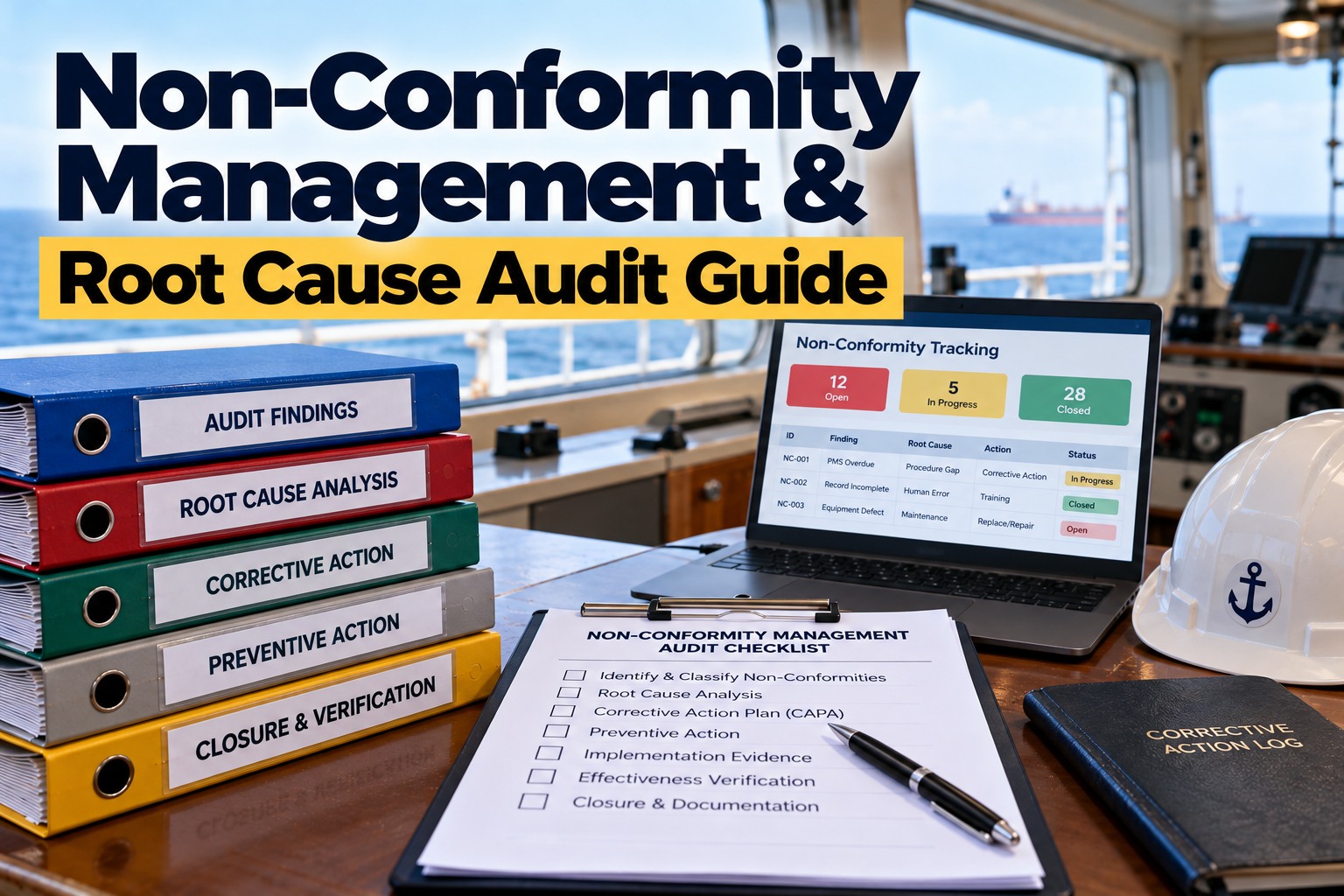
Most audit findings are closed; far fewer are fixed. The difference shows up when the same finding returns on the next audit or on a sister ship. This guide shows DPAs how to classify non-conformities, find the real root cause, write corrective and preventive actions that remove it, and verify closure in a way auditors accept. Track every step with evidence in Marine Inspection.
Non-conformity management and root cause analysis: three different actions, one finding
A finding needs up to three responses, and confusing them is why findings come back. The example below is an emergency fire pump that failed to start during an audit.
Fix the problem in front of you.
Repair the pump and retest it.Remove the cause so it does not happen again.
The weekly test was ticked without starting the pump: change the test record so it captures the start time and pressure.Stop it happening where it has not happened yet.
Check the same test record on every ship and brief all chief engineers.Definitions follow ISO 9000: correction eliminates a detected non-conformity; corrective action eliminates its cause and prevents recurrence; preventive action eliminates the cause of a potential non-conformity.
What the ISM Code requires for non-conformity management
Section 9 of the ISM Code is short, but it sets two duties: report and investigate, then act to prevent recurrence. External audits under IACS PR 9 add the clock. For what happens when a finding is graded major, see our major non-conformity recovery guide. See findings tracked against these clocks.
Classifying audit findings by severity and recurrence
The ISM grades (observation, non-conformity, major non-conformity) set the formal response. For internal priority, add a second question: has this happened before? A minor finding seen on three ships is a system problem, and deserves more effort than its grade suggests. Score findings this way automatically, free.
Internal prioritisation guide; formal grading always follows the ISM Code definitions.
Non-conformity containment: the first 24 hours after a finding
Before analysis comes containment. If the finding is a hazard, make it safe now and record what was done; root cause can wait a day, a missing fire pump cannot. Containment is the correction, not the corrective action, so the finding stays open.
Make it safe. Isolate, repair or provide a back-up, and tell the bridge or engine room.
Record the facts. What was found, where, when and by whom, with photos.
Check for the same problem nearby. Other pumps, other spaces, other records of the same type.
Report to the company. As ISM 9.1 requires, so the DPA can decide whether other ships are affected.
Root cause analysis methods for shipboard findings
The root cause is the reason the system allowed the problem, not the person who was standing nearest. Two simple methods cover most findings: five whys for single-thread problems and a cause diagram for problems with several contributors. See root cause templates in use.
Five whys · illustrative
Cause categories to check
If the only cause found is “crew did not follow the procedure”, keep asking why the procedure was not followed.
Writing a corrective action that fixes the root cause
A good corrective action is specific, owned, dated and aimed at the cause. Most weak actions fail one simple test: if they were done perfectly, could the finding still happen again? Our ISM audit checklist shows the areas where findings most often arise. Write actions with owners and dates free.
| Finding | Weak action | Strong action |
|---|---|---|
| Emergency fire pump failed to start | Crew reminded to test the pump | Test record revised to capture start time and pressure; chief engineer verifies weekly; checked at next internal audit |
| Rest hour records inconsistent with log | Officers told to record accurately | Rest hours entered from the watch schedule with automatic limit checks; master reviews weekly |
| Chart corrections overdue | Second officer to catch up | Correction workload planned into the watch routine; DPA dashboard flags any week missed |
| Permit closed with isolation still in place | Toolbox talk on permits | Permit form cannot close until linked isolations are removed and signed |
Find the cause once, fix it everywhere
Root cause, corrective action, fleet-wide checks and effectiveness evidence linked to every finding, from every audit and inspection.
Corrective vs preventive action: extending the fix across the fleet
A corrective action fixes the ship where the finding was raised. The preventive step asks where else the same cause exists. For a fleet operator, that is usually the more valuable half, because sister ships share procedures, equipment and habits. See fleet-wide checks issued from one finding.
Corrective action implemented and verified.
Same check run on vessels with the same equipment or trade.
Procedure, form or training revised so new ships inherit the fix.
Verifying effectiveness: non-conformity closure that satisfies auditors
“Action taken” is not closure. A finding is closed when the evidence shows the cause has gone, which often means waiting long enough to see the new process work. External auditors sample closed findings and check this at the next audit. The wider role of internal audits is covered in our ISM internal audit guide.
Not enough to close
- “Crew briefed” with no record of who or when
- A revised procedure nobody has used yet
- A photo of the repair, but no proof the cause changed
- Closed by the person who raised the action, with no review
Evidence that closes it
- Records showing the new process working over several cycles
- Follow-up check or internal audit confirming it
- Fleet-wide check results where a preventive action was set
- Reviewed and closed by someone other than the action owner
Repeat findings: the root cause signal auditors look for
One finding is an event; the same finding three times is a pattern. Auditors look for repeats because they show whether the corrective action process works. Trend findings by category every quarter and take the top repeats to management review. Findings from PSC count too; our PSC deficiency codes guide explains how they are coded.
Non-conformity management audit checklist
Use this checklist to audit the finding process itself, by sampling a few closed findings and following each from report to closure.
How Marine Inspection keeps non-conformities moving to closure
Findings fail quietly: they sit at “action in progress” until the next audit. Marine Inspection shows every open finding against its target date and flags repeats, so the DPA sees what is ageing and what keeps coming back. The board below is an illustrative fleet view.
MV Bravo: chart correction finding raised for the third time in 18 months; preventive action across the fleet proposed for management review.
Non-conformity and root cause analysis FAQs
What is the difference between correction and corrective action?
A correction fixes the problem that was found, such as repairing a pump. A corrective action removes the cause so it does not happen again, such as changing the test record that let a failed pump go unnoticed.
What does the ISM Code require for non-conformities?
Section 9 requires non-conformities, accidents and hazardous situations to be reported to the company, investigated and analysed, and procedures for corrective action, including measures to prevent recurrence.
How long is allowed to close an external audit non-conformity?
Under IACS PR 9, the company submits a corrective action plan and a schedule of up to three months from the audit is normally agreed, with effectiveness verified no later than the next scheduled audit.
Is “human error” a root cause?
Rarely. It is usually where the analysis stopped. Ask why the error was possible: training, workload, procedure design, equipment or supervision.
When can a non-conformity be closed?
When the evidence shows the cause has been removed and the new process is working, ideally confirmed by someone other than the action owner.
Why do repeat findings matter?
Repeats show that corrective actions are not working, and auditors treat them as a sign of a weak system. Marine Inspection can flag repeats across the fleet.
Close the loop on every finding
From the first report to verified closure, keep every non-conformity moving and every fix proven, across the whole fleet.