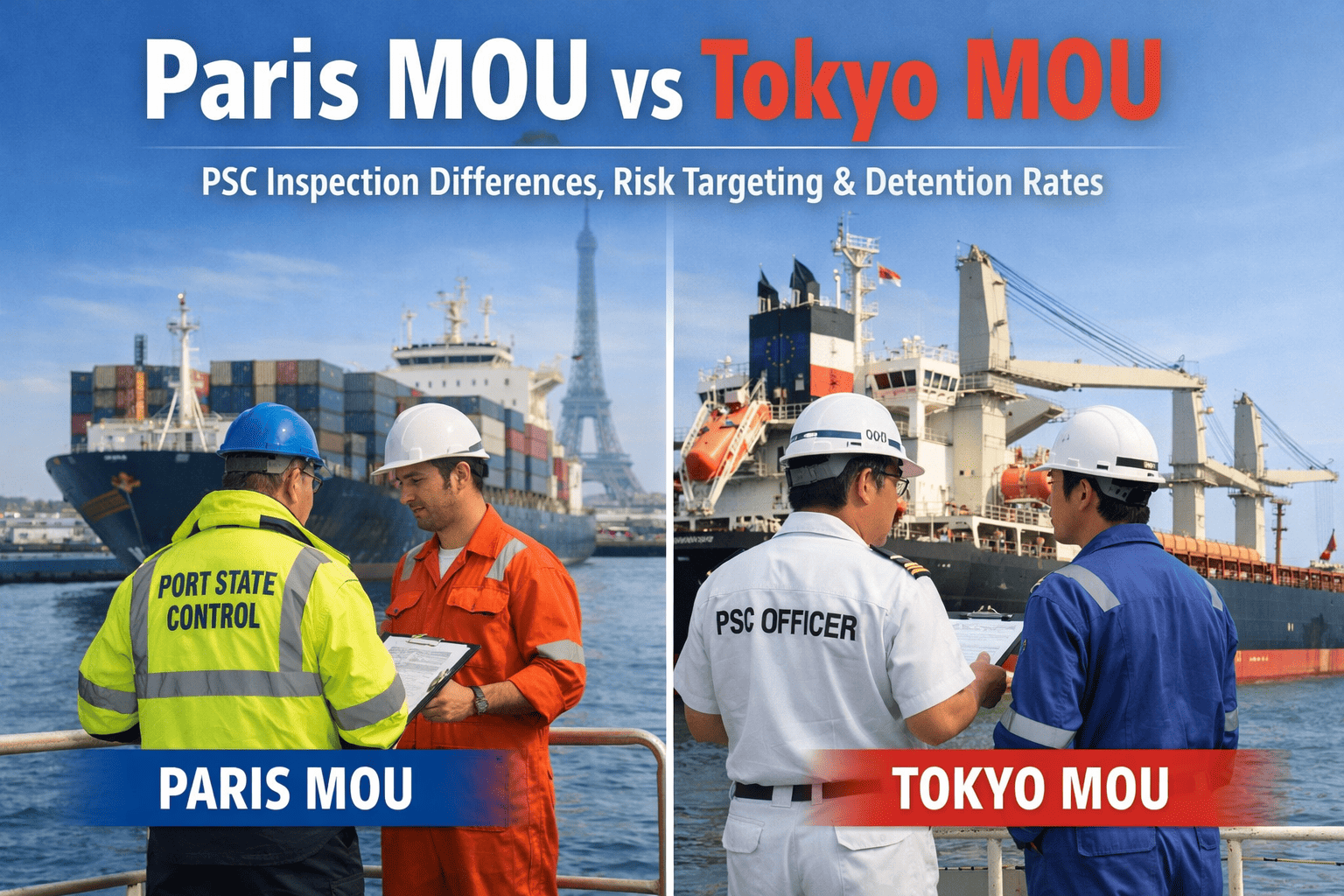
Port State Control inspections are the last line of defence against substandard ships — and two regional regimes dominate global maritime enforcement: the Paris MOU (covering European coastal states and the North Atlantic) and the Tokyo MOU (covering the Asia-Pacific). Together, they account for over 80% of all PSC detentions worldwide. Both operate a New Inspection Regime (NIR) with risk-based vessel targeting, but the way they calculate risk profiles, prioritize inspections, and enforce detentions differs in ways that directly affect your operational planning. This guide compares both regimes side by side — covering membership, targeting systems, inspection scope, detention triggers, and how to keep your fleet compliant across both regions. Operators managing fleets across multiple MOU regions can sign up for Marine Inspection's compliance platform to track PSC readiness, deficiencies, and corrective actions in one system.
Paris MOU vs Tokyo MOU: Key Numbers (2024 Data)
27
Paris MOU Members
European + North Atlantic maritime authorities
21
Tokyo MOU Members
Asia-Pacific maritime authorities
~15,000
Paris MOU Inspections/yr
Covering European and North Atlantic ports
~32,000
Tokyo MOU Inspections/yr
Covering Asia-Pacific ports (2024 data)
The Full Comparison
Both MOUs share the same goal — ensuring foreign vessels in their ports comply with international conventions — but they differ in membership, geographic scope, inspection volumes, and operational details.
Paris MOU vs Tokyo MOU: Side-by-Side Comparison
Feature
Paris MOU
Tokyo MOU
Established
1982 — the first regional PSC regime
1993 — modelled after Paris MOU
Members
27 maritime authorities (EU/EEA + Canada)
21 maritime authorities (Asia-Pacific)
Region
European coastal waters + North Atlantic
Asia-Pacific (Australia to Russia, Japan to SE Asia)
Targeting System
NIR (New Inspection Regime) — since 2011
NIR (adopted 2014) — aligned with Paris MOU model
Risk Profiles
High Risk · Standard Risk · Low Risk (HRS/SRS/LRS)
High Risk · Standard Risk · Low Risk (same model)
Inspection Window
Low Risk: 24–36 months · Standard: 10–12 months · High: 5–6 months
Low Risk: 24–36 months · Standard: 10–12 months · High: 5–6 months
Annual Inspections
~15,000–17,000 per year
~30,000–32,000 per year (largest volume globally)
Flag State Lists
White / Grey / Black list (3-year rolling performance)
White / Grey / Black list (same methodology)
Company Performance
Included in risk profile calculation
Included in risk profile calculation
CIC Campaigns
Joint campaigns with Tokyo MOU (e.g., BWM 2025)
Joint campaigns with Paris MOU (coordinated globally)
ISM Enforcement
Strong ISM focus — deficiencies = clear grounds for detailed inspection
ISM assessed but enforcement consistency varies by port state
Banning Powers
Vessels detained 3+ times in 36 months can be banned from the region
No equivalent banning mechanism — repeated detentions increase risk profile
How the Ship Risk Profile Works
Both MOUs use the same NIR framework to calculate a Ship Risk Profile (SRP) that determines inspection priority, frequency, and scope. Understanding the factors that drive your risk rating is the key to managing PSC exposure across both regions.
Ship Risk Profile: What Drives Your Rating
1
Ship Type — High-risk types (passenger, ro-ro, bulk carriers, tankers) attract more scrutiny than low-risk types.
2
Ship Age — Ships older than 12 years receive higher risk weighting. Research shows ships over 6 years are significantly more likely to be detained.
3
Flag State Performance — Flags on the Black or Grey list increase risk score. White list flags reduce it. Based on 3-year rolling detention data.
4
Recognized Organization (Class) — Performance of your classification society affects your profile. High-performing ROs reduce risk; poor performers increase it.
5
Company Performance — The operator/ISM company's historical deficiency and detention rate across their entire fleet is factored into every vessel's profile.
6
Deficiency History — Number and severity of deficiencies from previous inspections. Research confirms 5+ deficiencies significantly increase detention probability.
7
Detention History — Previous detentions in any MOU region elevate your risk profile. Multiple detentions within 36 months can trigger banning in Paris MOU.
8
Audit History — ISM and ISPS compliance record, including any outstanding ISM-related observations from prior inspections.
9
Certificate Status — Valid, current certificates from your flag state, class, and statutory authorities. Expired or missing certificates trigger immediate detailed inspection.
What PSC Inspectors Actually Check
Both MOUs inspect against the same international conventions — SOLAS, MARPOL, STCW, MLC, Load Lines, and the ISM/ISPS Codes. The conventions are the same, but the emphasis and common findings differ by region.
Top Detention Categories (Both MOUs)
Fire Safety
Fire detection systems, fire-fighting equipment, fire doors, fire dampers, and emergency escape routes. Fire safety deficiencies are consistently the #1 or #2 detention category in both Paris and Tokyo MOU regions. Malfunctioning fire detection panels, expired extinguishers, and blocked fire doors are the most common findings.
Top Detention Categories (Both MOUs)
Life-Saving Appliances
Lifeboats, liferafts, immersion suits, EPIRBs, and associated launching equipment. Deficiencies include expired servicing, inoperative davits, missing or damaged safety equipment, and crew unfamiliarity with LSA operation during drills.
Frequently Cited
Safety of Navigation
Charts (paper and ECDIS), passage planning, bridge equipment, pilot ladders, and AIS. Incorrectly rigged pilot ladders are a particular enforcement focus — PSCOs may conduct follow-up inspections specifically for this deficiency regardless of normal inspection windows.
Frequently Cited
ISM Code Compliance
ISM-related deficiencies are a primary driver of detentions in both regions. Paris MOU explicitly treats ISM failures as "clear grounds" for a more detailed inspection. A pattern of non-detainable deficiencies can collectively indicate ISM system failure — triggering a detainable ISM finding.
Regional Emphasis
MLC / Crew Welfare (Paris MOU Focus)
Paris MOU places significant emphasis on Maritime Labour Convention compliance — crew living conditions, working hours, wages, and contracts. European PSCOs frequently inspect accommodation standards, food quality, and crew welfare provisions more thoroughly than some other regions.
Regional Emphasis
Ballast Water Mgmt (2025 CIC Focus)
Both MOUs are conducting a joint Concentrated Inspection Campaign (CIC) on Ballast Water Management from September–November 2025. In 2024, Tokyo MOU recorded 1,004 BWM deficiencies. Non-operational BWMS or evidence of bypassing treatment can trigger immediate detention.
Key Differences That Affect Your Operations
While both MOUs share the NIR framework, several operational differences create distinct compliance challenges depending on where your fleet trades.
Paris MOU — Distinct Features
Banning mechanism — Vessels detained 3+ times within 36 months can be banned from the entire Paris MOU region. No other MOU has an equivalent measure. This makes repeated detentions in Europe existentially dangerous for commercial operations.
Stronger ISM enforcement — Paris MOU explicitly defines ISM deficiencies and provides detailed guidelines for PSCOs on how to identify ISM system failures. Multiple non-detainable deficiencies can collectively demonstrate ISM failure — elevating them to a detainable finding.
EU regulatory overlay — Vessels in European waters face additional EU-specific requirements (EU-ETS, FuelEU Maritime, MRV regulation, Mediterranean ECA) that are layered on top of standard PSC inspections and may trigger additional compliance checks.
Tokyo MOU — Distinct Features
Higher inspection volume — Tokyo MOU conducts roughly double the annual inspections of Paris MOU (~32,000 vs ~15,000). More port calls = more inspection exposure. The probability of inspection on any given port call is higher in several Asia-Pacific ports.
Enforcement consistency varies — Research identifies discrepancies in PSC enforcement practices between Tokyo MOU port states. Inspection rigor and detention thresholds can differ significantly between, for example, Australia, China, Japan, and Southeast Asian nations.
No banning mechanism — Unlike Paris MOU, Tokyo MOU does not ban vessels after repeated detentions. However, each detention elevates the ship's risk profile, increasing future inspection frequency and scrutiny — creating an escalating cycle that is difficult to break.
Manage PSC Readiness Across Both MOUs
Marine Inspection tracks deficiencies, corrective actions, certificate expiry, and inspection readiness in one platform — so your fleet is prepared whether the next port call is Rotterdam or Singapore.
How to Reduce Your Risk Profile in Both Regimes
Since both MOUs use the same NIR risk factors, the strategy for maintaining a Low Risk profile is consistent — but execution requires systematic tracking across your entire fleet.
Ensure your flag state performs well in both MOU regions. Flag state performance is a 3-year rolling average — poor performance by other vessels under the same flag drags your risk profile up regardless of your own record.
Factor you influence indirectly
Research across 125,000+ Tokyo MOU inspections confirms that vessels with 5 or more deficiencies face significantly higher detention probability. Address every deficiency immediately and document the corrective action with evidence.
Strongest controllable factor
ISM deficiencies are a primary detention driver. Don't just have an SMS — ensure it's implemented in practice. Crew must understand procedures, drills must be documented, non-conformities must be tracked and closed. Paris MOU explicitly links ISM failures to detention.
Systemic — affects every inspection category
When Paris and Tokyo MOUs announce a joint CIC (like the 2025 BWM campaign), every vessel in the fleet must be prepared for the specific campaign questionnaire. Non-compliance on CIC focus areas during the campaign period carries elevated detention risk.
Predictable — published in advance
You can calculate your vessel's Ship Risk Profile in advance using both MOUs' online tools. Do this before entering a new region — not after receiving an inspection notification. If your profile is High Risk, address the controllable factors (deficiency count, ISM effectiveness, certificate currency) before the port call. A proactive approach to PSC is always cheaper than a reactive one.
Track PSC Readiness Across Every Port, Every Region
Marine Inspection connects deficiency tracking, corrective action management, certificate monitoring, and crew competency records — giving you fleet-wide PSC readiness visibility across Paris MOU, Tokyo MOU, and every other regime your vessels enter.
Frequently Asked Questions
What is the main difference between Paris MOU and Tokyo MOU?
The most operationally significant difference is the Paris MOU's banning mechanism — vessels detained 3+ times within 36 months can be banned from the entire European/North Atlantic region. Tokyo MOU has no equivalent power. Paris MOU also has stronger ISM enforcement guidelines and faces additional EU regulatory overlay. Tokyo MOU conducts roughly double the annual inspection volume, meaning higher inspection frequency exposure for vessels trading in Asia-Pacific.
How is a vessel's risk profile calculated?
Both MOUs use the New Inspection Regime (NIR) to calculate a Ship Risk Profile based on: ship type, age, flag state performance (White/Grey/Black list), recognized organization performance, company (ISM DOC holder) performance, deficiency history, and detention history. The profile determines inspection priority (High/Standard/Low Risk) and the window between mandatory inspections — from 5–6 months for High Risk to 24–36 months for Low Risk.
What are the top deficiency categories in PSC inspections?
Fire safety and life-saving appliances consistently rank as the top detention categories in both MOUs. Safety of navigation (including pilot ladders), ISM compliance, emergency systems, and MARPOL-related deficiencies are also frequently cited. In 2025, ballast water management emerged as a major deficiency area, with Tokyo MOU recording over 1,000 BWM deficiencies in 2024 alone.
How often will my vessel be inspected?
Under the NIR used by both MOUs: Low Risk vessels have an inspection window of 24–36 months, Standard Risk vessels 10–12 months, and High Risk vessels 5–6 months. However, PSCOs can inspect outside these windows if "clear grounds" exist — such as a report from another port, visible deficiencies from the dock, or information about an incident. CIC campaigns also trigger inspections regardless of the normal schedule.
Does a detention in Tokyo MOU affect my Paris MOU profile?
Yes. Both MOUs share inspection data through the global GISIS and Equasis systems. A detention in Tokyo MOU is visible to Paris MOU inspectors and affects your ship's risk profile when it enters European waters — and vice versa. Your deficiency and detention history follows you globally, not just within the MOU region where it occurred.